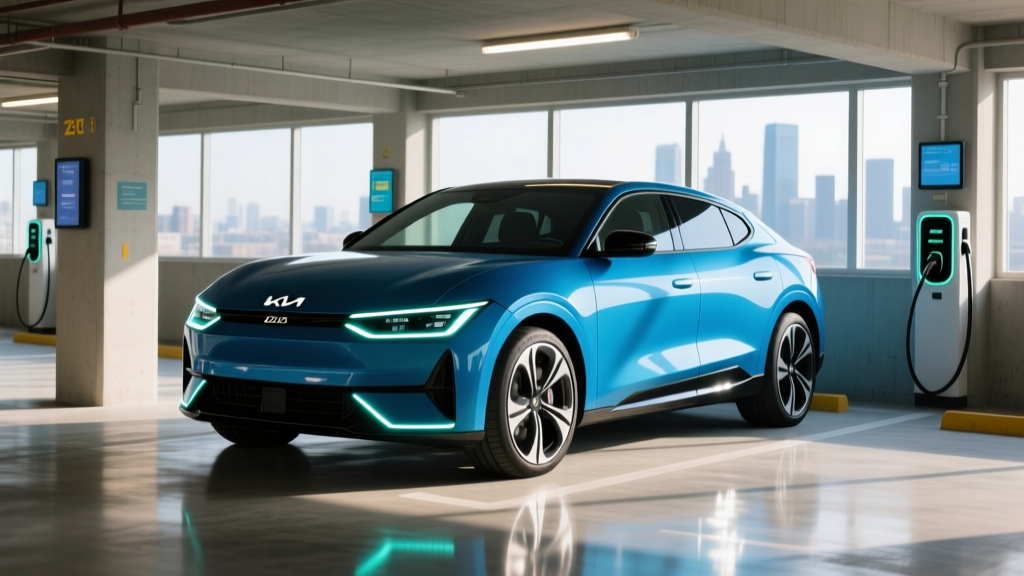
If you are searching for a 2025 Kia EV6 lease deal, you have likely seen the aggressive monthly payment offers from Kia and third-party leasing companies. The EV6 remains one of the most compelling electric crossovers on the market, combining an 800-volt architecture, fast charging, and a practical cabin. But a low monthly lease payment only tells part of the financial story.
To make a truly informed decision, you need to understand the total cost of ownership (TCO) over a typical five-year period. This means looking beyond the sticker price and the lease rate to include fuel (electricity) costs, insurance premiums, maintenance, depreciation, and the impact of federal and state incentives. This guide breaks down every dollar you can expect to spend—and save—when driving a 2025 Kia EV6.
2025 Kia EV6: The Baseline Numbers
Before we can calculate costs, we need to establish the vehicle's core specifications. The 2025 Kia EV6 is available in several trims, but the volume sellers are the Wind (RWD and AWD) and the GT-Line. For this analysis, we will focus on the EV6 Wind AWD, as it represents the most common configuration for lease deals.
| Specification | Value |
|---|---|
| Base MSRP | ~$50,200 (before destination) |
| EPA Estimated Range | 282 miles |
| Real-World Highway/Cold Range | ~230 - 250 miles |
| Battery Capacity | 77.4 kWh (NMC chemistry) |
| Max DC Fast Charge Rate | ~240 kW (peak) |
| 10-80% DC Charge Time | ~18 minutes (under ideal conditions) |
| Level 2 (AC) Charge Rate | 10.9 kW |
| Efficiency (Combined) | 117 MPGe (29 kWh/100 miles) |
| Horsepower | 320 hp |
| 0-60 mph Time | 4.5 seconds |
| Battery/Powertrain Warranty | 10 years / 100,000 miles |
Source: fueleconomy.gov and Kia Motors America.
The Federal Tax Credit: Do You Qualify?
The single biggest factor in the economics of any 2025 Kia EV6 lease deal or purchase is the federal tax credit under Internal Revenue Code Section 30D. For 2025 and 2026, the maximum credit remains $7,500, but qualifying for it is not guaranteed. The rules are complex and hinge on three main pillars: your income, the vehicle's MSRP, and where the battery components and critical minerals were sourced.
- Income Caps: Your modified adjusted gross income (MAGI) cannot exceed $300,000 for joint filers, $225,000 for heads of household, or $150,000 for single filers.
- MSRP Caps: The vehicle's MSRP must not exceed $80,000 for SUVs, pickups, and vans, or $55,000 for sedans and other vehicles. (The EV6 is classified as an SUV, so the $80k cap applies).
- Battery Sourcing: To get the full $7,500, the battery must meet specific percentage thresholds for North American assembly and critical minerals sourced from the US or free-trade partners. These thresholds increase annually. (As of early 2025, the EV6 built in West Point, Georgia, generally qualifies for the full $7,500, but always verify the VIN on the IRS portal before purchasing).
- Point-of-Sale Transfer: You can now transfer the credit to the dealer at the point of sale, effectively using it as a down payment reduction. This is a massive benefit for lease deals, as the leasing company (the legal owner) claims the credit and can pass the savings directly to you in the form of a lower capitalized cost.
Always verify current rules and your specific eligibility at IRS.gov. Tax laws are subject to change.
5-Year Total Cost of Ownership (TCO) Breakdown
Let's model a realistic five-year ownership scenario. We'll assume you drive 12,000 miles per year (60,000 miles total) and charge primarily at home using a Level 2 charger.
| Cost Category | Estimated 5-Year Cost | Notes |
|---|---|---|
| Purchase Price (Net of Incentives) | ~$42,700 | $50,200 MSRP - $7,500 Fed Credit. (Excludes state taxes/fees). |
| Home Charging Equipment & Install | $600 - $1,500 | Quality Level 2 charger + electrician (assuming panel is sufficient). |
| Electricity (Fuel) Cost | ~$2,610 | 60k miles / 100 * 29 kWh * $0.15/kWh (national avg residential). |
| Maintenance | ~$1,200 | Cabin air filters, tire rotations, wiper fluid. No oil changes. |
| Insurance | ~$11,000 | Avg $2,200/yr. EVs typically cost 15-25% more to insure than gas equivalents. |
| Depreciation (Estimated) | ~$18,000 | Assuming 45% retention after 5 years (EV depreciation is currently higher than average). |
| Total Estimated 5-Year Cost | ~$76,110 | This is the total cash outlay + value lost. |
Leasing vs. Buying: The Depreciation Hedge
The depreciation line item above is the wildcard. EV resale values have been volatile. By leasing, you transfer the risk of steeper-than-expected depreciation to the leasing company (Kia Finance or a bank). If the lease deal is structured well—meaning the "residual value" they predict is higher than the actual market value in three years—you can walk away with a win. If the market crashes, you're protected. If the market is strong, you have the option to buy the car at the pre-set residual price.
Charging vs. Gas: The Per-Mile Math
The primary operational savings of the EV6 come from fuel. Let's compare it to a direct internal combustion competitor, like the 2025 Hyundai Tucson Hybrid (AWD), which gets a combined 38 MPG.
| Vehicle | Energy Source | Efficiency | Cost per Unit | Cost Per Mile | Total Fuel Cost (60k mi) |
|---|---|---|---|---|---|
| Kia EV6 AWD | Electricity (Home) | 29 kWh/100mi | $0.15 / kWh | $0.044 | $2,640 |
| Kia EV6 AWD | Electricity (DCFC) | 29 kWh/100mi | $0.40 / kWh | $0.116 | $6,960 |
| Hyundai Tucson Hybrid | Gasoline | 38 MPG | $3.50 / gallon | $0.092 | $5,520 |
Maintenance Savings: Where the EV6 Shines
Electric vehicles have far fewer moving parts than internal combustion engine (ICE) vehicles. There is no engine oil, no transmission fluid to flush, no spark plugs, no timing belts, and no exhaust system. The EV6's maintenance schedule is remarkably simple.
| Service Item | Kia EV6 (EV) | Typical Gas SUV (e.g., Sportage) |
|---|---|---|
| Oil & Filter Changes | $0 (None required) | ~$600 (6 changes @ $100) |
| Tire Rotations | ~$250 (5 rotations @ $50) | ~$250 |
| Cabin Air Filter | ~$150 (3 replacements) | ~$150 |
| Brake Pads/Rotors | $0 - $200 (Regen braking saves pads) | ~$800 (1-2 axle services) |
| Transmission/Engine Fluids | $0 | ~$400 (Flushes and replacements) |
| Total Estimated | ~$400 - $600 | ~$2,200+ |
The EV6's regenerative braking system does most of the work to slow the car, meaning the physical friction brakes are used far less frequently. It is common for EV owners to go 80,000 miles or more on their original brake pads. However, note that EVs are heavier and produce more instant torque, which can lead to faster tire wear if you drive aggressively. Budget for a set of premium tires around year 4.
Insurance and Depreciation: The Hidden Costs
Insurance Premiums
EVs are generally more expensive to insure than their gas counterparts. According to industry data, EV insurance premiums can be 15% to 25% higher. There are two main reasons:
- Repair Costs: EVs often require specialized labor and expensive parts (especially the battery pack and high-voltage components) after a collision.
- Total Loss Thresholds: Because the battery is so costly, minor damage to the battery casing can lead an insurer to declare the vehicle a total loss.
For the 2025 EV6, expect to pay roughly $1,800 to $2,500 per year for full coverage, depending on your driving record, location, and age. Always get insurance quotes before signing a lease or purchase agreement.
Depreciation Trends
Historically, EVs have suffered from steeper depreciation than reliable gas cars like the Toyota RAV4. This is driven by rapid technology improvements (newer EVs charge faster and go further), price wars initiated by Tesla, and consumer anxiety about long-term battery health. However, the EV6's 10-year/100,000-mile battery warranty provides a strong safety net for second owners, which should help stabilize its resale value compared to EVs with shorter warranties. Expect the EV6 to retain roughly 40% to 50% of its value after five years, which is competitive for the EV segment but lower than top-tier gas SUVs.
Frequently Asked Questions (FAQ)
How much does a 2025 Kia EV6 lease deal actually cost per month?
Lease payments vary wildly based on your down payment (capital cost reduction), the term (usually 24 or 36 months), and the money factor (interest rate). A realistic 36-month lease with $4,000 down (including the $7,500 tax credit applied as a cap cost reduction) could range from $350 to $550 per month depending on the trim and your credit tier. Always negotiate the "capitalized cost" (the sale price of the car) before discussing monthly payments.
Does the Kia EV6 qualify for the full $7,500 federal tax credit in 2025?
Generally, yes, provided you meet the income requirements and the vehicle's battery sourcing complies with the latest IRS rules. The EV6 is assembled in West Point, Georgia, which helps it clear the North American assembly hurdle. However, the critical minerals requirement is complex. Always use the VIN checker on the IRS website or the DOE's fueleconomy.gov portal to confirm eligibility for the specific car you are buying or leasing.
Is the Kia EV6 reliable? What about the battery?
Kia's 10-year/100,000-mile powertrain and battery warranty is one of the best in the industry. It guarantees that the battery will retain a certain percentage of its original capacity (typically 70%) over that period. The EV6's E-GMP platform has proven robust since its 2022 launch, and NMC battery chemistry from suppliers like SK On is well-understood. For most owners, battery degradation will be minimal over the first 5-7 years.
Can I charge the EV6 at Tesla Superchargers?
Yes. Starting with the 2025 model year, Kia has begun transitioning to the NACS (North American Charging Standard) port. If your 2025 EV6 has the NACS port, you can plug directly into Tesla Superchargers. If it has a CCS port, Kia provides a NACS adapter (or you can purchase one) to access the Tesla network, which is currently the most reliable DC fast-charging network in the US.
What happens if I exceed the mileage limit on my EV6 lease?
Most standard leases have a 10,000 or 12,000-mile annual limit. If you exceed this, you will be charged an excess mileage fee at lease-end, typically ranging from $0.20 to $0.30 per mile. If you have a long commute, it is almost always cheaper to pre-purchase extra miles at the start of the lease than to pay the penalty at the end.
Final Verdict: Is the 2025 EV6 Lease Deal Worth It?
A 2025 Kia EV6 lease deal can be an outstanding financial move, but only if you have the right infrastructure and driving habits. It is a buy (or lease) if:
- You can install a Level 2 charger at home to unlock the lowest fuel costs.
- You qualify for the $7,500 federal tax credit and can apply it to the lease's capitalized cost.
- You drive less than 15,000 miles a year and want to avoid long-term depreciation risk.
You should reconsider if:
- You rely entirely on expensive public DC fast charging.
- Your insurance quotes come back significantly higher than your current gas car.
- You regularly take road trips into areas with sparse charging infrastructure (though the EV6's 240 kW peak charging speed and NACS access make this less of a concern than with other EVs).