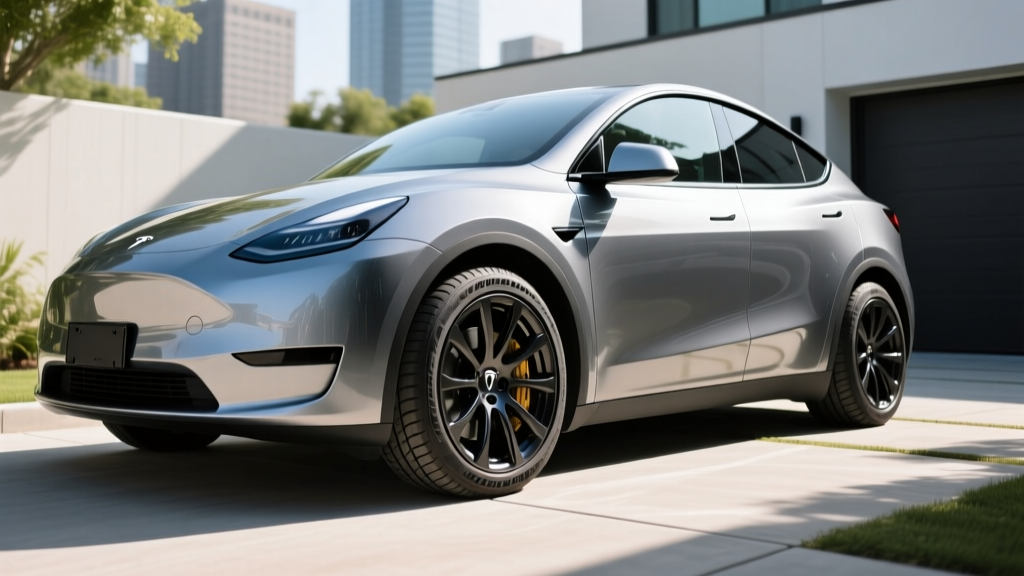
The Tesla Model Y remains one of the best-selling electric vehicles in the United States, and for good reason: strong range, fast charging, and access to the Supercharger network. But one topic that trips up both new owners and prospective buyers is the Tesla Model Y tire setup — sizing differences across trims, how tire choice affects real-world range, correct pressure for efficiency, and which replacement tires actually make sense for an EV.
This guide covers everything you need to know about Model Y tires in the context of the vehicle's full performance, range, charging, and ownership profile. We'll also break down the 2025–2026 lineup specs so you know exactly what you're buying.
2025–2026 Tesla Model Y Trim Lineup and Tire Sizing
Tesla simplified the Model Y lineup significantly for the 2025 refresh (internally called "Juniper"). Tire sizing depends on your chosen trim and wheel option. Here's how it breaks down:
| Trim | Wheel Size | OEM Tire Size | OEM Tire Model | EPA Range |
|---|---|---|---|---|
| Long Range RWD | 19" Gemini | 255/45R19 | Continental CrossContact LX2 | 320 mi |
| Long Range AWD | 19" Gemini | 255/45R19 | Continental CrossContact LX2 | 311 mi |
| Long Range AWD | 20" Induction | 255/40R20 | Pirelli P Zero (EV) | 290 mi |
| Performance AWD | 21" Überturbine | 265/35R21 (rear) / 255/35R21 (front) | Pirelli P Zero (EV) | 277 mi |
The critical takeaway: wheel size directly costs you range. The jump from 19" to 20" wheels on the Long Range AWD shaves roughly 21 miles off the EPA estimate. The Performance model's staggered 21" setup drops it further. If maximizing range matters to you, stick with the 19" Gemini wheels.
Real-World Range: What the EPA Number Doesn't Tell You
EPA Estimate: 311 miles
Real-world highway (70 mph, mild weather): ~265–280 miles
Real-world mixed city/highway: ~280–295 miles
Cold weather (below 30°F, highway): ~210–240 miles
Source: EPA estimates via fueleconomy.gov. Real-world figures based on owner-reported data and independent testing.
Your Tesla Model Y tire choice is one of the most impactful variables on real-world range. Rolling resistance accounts for a significant portion of energy consumption at highway speeds. Switching from the OEM Continental CrossContact LX2 (an all-season touring tire with low rolling resistance) to an aggressive all-terrain or high-performance summer tire can reduce range by 5–10%. That's 15–30 miles lost on a full charge.
Tire pressure matters just as much. Tesla recommends 42 PSI cold for most Model Y configurations. Running 2–3 PSI below spec increases rolling resistance noticeably. Check pressures monthly and always when tires are cold — heat from driving can add 3–5 PSI, giving a false reading.
How Tires Affect Efficiency: kWh per 100 Miles
The Model Y Long Range AWD achieves an EPA-rated 28 kWh/100 mi (roughly 120 MPGe combined). That efficiency figure assumes OEM tires at correct pressure. Here's how different tire categories shift that number:
- OEM all-season touring (low rolling resistance): 27–29 kWh/100 mi — baseline
- EV-specific touring (e.g., Michelin Pilot Sport EV, Hankook iON evo): 27–28 kWh/100 mi — comparable or slightly better
- Grand touring all-season (e.g., Michelin CrossClimate2): 29–31 kWh/100 mi — slight penalty for snow capability
- Ultra-high-performance summer: 31–34 kWh/100 mi — stickier compound, higher resistance
- All-terrain / aggressive tread: 33–37 kWh/100 mi — significant range loss
If you drive 12,000 miles per year, the difference between 28 and 34 kWh/100 mi translates to roughly 720 extra kWh annually — about $100–$180 in additional electricity cost depending on your local rates and home vs. public charging mix.
Charging Specs: DC Fast Charge and Home Level 2
| Charging Method | Max Rate | Speed / Time |
|---|---|---|
| DC Fast Charge (V3/V4 Supercharger) | 250 kW peak | 10–80% in ~25 min; ~175 mi added in 15 min |
| Level 2 Home (Tesla Wall Connector, 48A) | 11.5 kW | ~44 miles per hour of charging |
| Level 2 Home (32A mobile connector) | 7.7 kW | ~30 miles per hour of charging |
| Level 1 (120V standard outlet) | ~1.4 kW | ~3–4 miles per hour |
The Model Y uses a ~78 kWh usable battery (NMC chemistry in Long Range and Performance trims). Note that kW (kilowatts) measures charging power — the rate of energy delivery — while kWh (kilowatt-hours) measures total battery energy capacity. They are not interchangeable.
Charging curve reality: The 250 kW peak is only sustained at low states of charge (roughly 10–30% SoC) with battery preconditioning active. By 50% SoC, the rate tapers to ~150 kW. By 80%, it drops to ~60 kW. This is why Tesla quotes 10–80% time rather than 0–100%. Charging from 80–100% at a Supercharger adds another 20+ minutes for relatively few miles — plan your road trips around the 10–80% window.
For home charging, a 48-amp Tesla Wall Connector on a 60-amp circuit delivers a full overnight charge in roughly 7–8 hours. Budget $500–$1,500 for professional installation depending on panel proximity and whether your home needs a service upgrade.
Performance and Battery Specs at a Glance
| Specification | Long Range RWD | Long Range AWD | Performance AWD |
|---|---|---|---|
| 0–60 mph | 5.8 sec | 4.8 sec | 3.5 sec |
| Horsepower | ~346 hp | ~384 hp | ~456 hp |
| Drivetrain | Rear-Wheel Drive | Dual-Motor AWD | Dual-Motor AWD |
| Battery (usable) | ~78 kWh (NMC) | ~78 kWh (NMC) | ~78 kWh (NMC) |
| EPA Range | 320 mi | 311 mi (19") / 290 mi (20") | 277 mi |
| Efficiency | 27 kWh/100 mi | 28 kWh/100 mi | 30 kWh/100 mi |
| Cargo (rear seats up) | 30.2 cu ft | ||
| Cargo (rear seats folded) | 72.1 cu ft | ||
| Rear Legroom | 40.5 in | ||
| Battery Warranty | 8 years / 120,000 miles (70% retention) | ||
| Basic Vehicle Warranty | 4 years / 50,000 miles | ||
NMC (nickel manganese cobalt) chemistry provides high energy density, which is why the Model Y achieves over 300 miles in Long Range trims. However, NMC batteries benefit from daily charging limits of 80–90% for longevity. Set your daily charge limit to 80% and only charge to 100% before long road trips. This is different from LFP (lithium iron phosphate) chemistry, which Tesla uses in the base rear-wheel-drive Model 3 — LFP can be charged to 100% daily without accelerated degradation.
Best Replacement Tires for the Tesla Model Y
When your OEM tires wear out — typically between 25,000 and 40,000 miles depending on driving style and rotation habits — you'll face a decision. EVs tend to wear tires faster than gas cars due to higher vehicle weight (the Model Y weighs ~4,200–4,400 lbs) and instant torque delivery. Here are the top replacement categories:
Best for Range and Efficiency
Hankook iON evo SUV — Purpose-built for EVs with ultra-low rolling resistance and foam noise-reduction technology. Expect range comparable to or slightly better than OEM. Available in 19" and 20".
Best All-Season All-Rounder
Michelin CrossClimate2 — Excellent rain and light-snow performance with the 3PMSF (Three-Peak Mountain Snowflake) rating. Slight efficiency penalty (~1–2 kWh/100 mi) but outstanding versatility for four-season climates. Available in 19" and 20".
Best for Performance Driving
Michelin Pilot Sport 4 SUV — Superior dry and wet grip, sharper handling. Trade-off is faster wear and ~3–5 kWh/100 mi efficiency loss. Best for Performance trim owners who prioritize handling over max range.
Best Budget Option
Continental CrossContact LX25 — Successor to the OEM tire with similar touring characteristics. Competitive pricing, good comfort, and reasonable efficiency. A safe, predictable choice.
Critical note for staggered setups: The Performance trim with 21" Überturbine wheels uses a staggered configuration (wider rear tires). You cannot rotate front-to-rear on these — only side-to-side if the tires are non-directional. Budget accordingly, as rear tires will wear faster under acceleration loads.
Pricing, Tax Credits, and Total Cost
| Trim | Base MSRP | Federal Credit (§30D) | Effective Price |
|---|---|---|---|
| Long Range RWD | $44,990 | Up to $7,500* | ~$37,490* |
| Long Range AWD | $47,990 | Up to $7,500* | ~$40,490* |
| Performance AWD | $52,490 | Up to $7,500* | ~$44,990* |
*Federal tax credit eligibility under IRS §30D is not guaranteed. Eligibility depends on:
- Buyer income caps: Modified AGI ≤ $150,000 (single), $225,000 (head of household), $300,000 (joint)
- MSRP cap: SUVs/vans/pickups capped at $80,000 — all Model Y trims qualify
- Battery sourcing: Critical minerals and battery components must meet phased-in domestic/content requirements that tighten annually through 2032
- Point-of-sale transfer: As of 2024+, the credit can be transferred to the dealer at purchase, reducing your out-of-pocket cost immediately rather than waiting for tax filing
Always verify current-year eligibility on the IRS website or with a tax professional before purchase. Battery sourcing requirements have disqualified some EVs in prior years, and the rules continue to tighten.
Tech, Driver Assistance, and Drawbacks
The refreshed Model Y includes a 15.4" center touchscreen, a rear-seat entertainment display, ventilated front seats, ambient lighting, and power-folding second-row seats. Tesla's infotainment remains one of the most responsive in the industry, though it routes nearly all vehicle controls through the screen — including climate, mirror adjustment, and glovebox release.
Autopilot and FSD (Supervised): Every Model Y ships with basic Autopilot (traffic-aware cruise control and lane centering). Full Self-Driving (Supervised) is an $8,000 option or $99/month subscription. FSD adds automated lane changes, traffic light and stop sign recognition, and navigation-guided driving.
Both Autopilot and FSD (Supervised) are SAE Level 2 driver-assistance systems. The driver must remain fully engaged, monitor the road at all times, and be prepared to take over instantly. These are not self-driving systems. Only Level 4 services like Waymo operate without a driver in the loop. Tesla's "Full Self-Driving" naming has drawn scrutiny from NHTSA and consumer advocates.
Notable drawbacks:
- No physical instrument cluster — all driving info is on the center screen
- Turn signal stalks removed in the refresh — signals are now on the steering wheel (controversial)
- Build quality has improved but still inconsistent panel gaps reported by some owners
- No Apple CarPlay or Android Auto — Tesla's native system only
- Insurance costs tend to run 15–30% higher than comparable gas SUVs
Pros
- Class-leading Supercharger network access
- 311–320 mi EPA range (Long Range trims)
- Fast DC charging (250 kW peak, ~25 min 10–80%)
- Spacious cargo area (72.1 cu ft folded)
- Over-the-air updates continuously add features
- Strong resale value relative to most EVs
Cons
- 21" Performance tires wear fast and cost $350+ each
- No instrument cluster or physical controls
- Steering-wheel turn signals require adaptation
- FSD (Supervised) is expensive and still Level 2
- Higher insurance premiums than gas equivalents
- 20" and 21" wheels significantly reduce range
Who Should Buy the Tesla Model Y?
Best for: Daily commuters with home charging access, small-to-medium families needing cargo flexibility, road-trippers who value Supercharger network reliability, and tech-forward buyers who want OTA updates and minimal maintenance.
Consider alternatives if: You need a third row (look at the Model X or Kia EV9), you want physical buttons and CarPlay (BMW iX, Hyundai Ioniq 5), you tow frequently (Rivian R1S or Ford F-150 Lightning), or you live in an apartment without charging access and your area has limited public infrastructure.
For tire-specific buyers: if you plan to keep the 19" wheels and prioritize range, the Model Y Long Range is hard to beat. If you want the Performance model's 3.5-second 0–60 time, budget for faster tire wear and replacement costs of $1,200–$1,600 for a set of 21" rubber.
Frequently Asked Questions
What tire pressure does the Tesla Model Y require?
Tesla recommends 42 PSI (cold) for most Model Y configurations. Check the sticker on the driver's door jamb for your specific trim. Always measure when tires are cold (before driving or at least 3 hours after). Proper pressure is critical for range, wear, and safety.
How often should I rotate my Model Y tires?
Tesla recommends rotation every 6,250 miles or when tread depth difference between front and rear reaches 2/32 inch. For the Performance model's staggered 21" setup, front-to-rear rotation is not possible — only side-to-side if tires are non-directional. Expect to replace staggered setups sooner due to uneven wear patterns.
Does the Tesla Model Y qualify for the full $7,500 federal tax credit?
As of the current tax year, the Model Y qualifies for up to $7,500 under IRS §30D, provided you meet income caps ($150K single / $300K joint), the vehicle MSRP is under $80,000 (all trims qualify), and battery sourcing requirements are met. The credit can be applied at point of sale. Verify current rules at irs.gov before purchasing.
What is the real-world range of the Tesla Model Y?
The Long Range AWD with 19" wheels has a 311-mile EPA estimate. In real-world highway driving at 70 mph, expect 265–280 miles. In mixed driving, 280–295 miles is typical. In cold weather below 30°F, plan for 210–240 miles. Tire choice, pressure, and driving style can shift these numbers by ±15 miles.
How fast does the Model Y charge at home and on the road?
At a V3/V4 Supercharger, the Model Y peaks at 250 kW and charges from 10–80% in approximately 25 minutes. At home with a 48A Tesla Wall Connector (11.5 kW), you add about 44 miles per hour — a full charge overnight in 7–8 hours. On a standard 120V outlet (Level 1), expect only 3–4 miles per hour.
Is the Tesla Model Y worth buying vs. competitors?
Against the Hyundai Ioniq 5, Ford Mustang Mach-E, and BMW iX, the Model Y wins on Supercharger network access, cargo space, and software. It loses on interior material quality (vs. BMW), charging speed on non-Tesla networks (Ioniq 5 charges faster at 350 kW stations), and physical controls. If Supercharger reliability and cargo volume are priorities, the Model Y remains the default choice.
Do EV-specific tires really make a difference?
Yes. EV-optimized tires like the Hankook iON evo or Michelin Pilot Sport EV use low-rolling-resistance compounds, reinforced sidewalls for heavier vehicle weight, and foam inserts to reduce road noise (which is more noticeable without engine sound). They typically cost 10–20% more than standard tires but deliver measurably better range and cabin quietness.