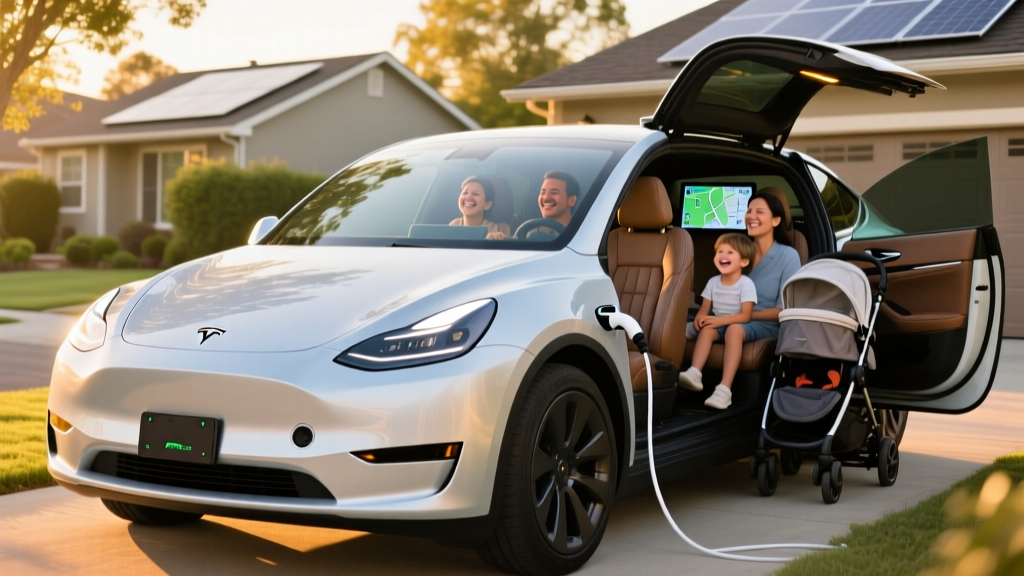
The Tesla Model Y remains one of the best-selling electric vehicles in the United States, and for good reason: strong range, access to the Supercharger network, and a starting price that undercuts most luxury EV SUVs. But for growing families, the standard five-seat layout leaves a gap. Enter the optional third-row seat — a compact, rear-facing bench that pushes passenger capacity to seven. The question every buyer asks is whether Model Y three rows actually works for real family duty, or whether it's a compromise too far.
We've spent time with the 2026 Model Y Long Range AWD equipped with the seven-seat option to answer that question with hard data on range, charging, cargo space, and ownership cost.
Quick Verdict: Who Should Consider Model Y Three Rows?
The seven-seat Model Y is best understood as a 5+2 configuration — five adults plus two children in the way-back. The third row suits kids roughly 4'10" and under, making it ideal for carpooling elementary-schoolers or hauling the occasional extra cousin on a short trip. If you regularly carry more than five people on long drives, a three-row SUV like the Kia EV9 or Rivian R1S will serve you better. If you need the extra seats only a few times a month and want to keep your footprint, price, and energy consumption low, the Model Y's third row is a genuinely useful option.
Range, Battery, and Efficiency
The 2026 Model Y Long Range AWD with the seven-seat option carries the same structural battery pack as the five-seat variant. Tesla does not reduce battery capacity for the three-row layout, but the added weight of the seat hardware (roughly 60–75 lbs) trims the EPA range estimate by a small margin compared to the five-seat Long Range AWD.
| Spec | Value |
|---|---|
| EPA Range | 308 miles |
| Battery (Usable) | ~75 kWh, NMC chemistry |
| Efficiency | 122 MPGe combined / 28 kWh/100 mi |
| Drivetrain | Dual-motor AWD |
| Horsepower | 384 hp (combined) |
| 0–60 mph | 4.8 seconds |
| Max DC Fast Charge | 250 kW (peak) |
| 10–80% DCFC Time | ~25 minutes |
| Level 2 Home Charge | 11.5 kW / ~44 mi/hr |
| Cargo (Behind 3rd Row) | 12.1 cu ft |
| Cargo (3rd Row Folded) | 34.3 cu ft |
| Cargo (Max, All Rows Folded) | 72.1 cu ft |
| Base MSRP (7-seat) | $49,990 (+$2,000 seat option) |
| Battery Warranty | 8 years / 120,000 miles |
The NMC (nickel manganese cobalt) chemistry in the Long Range pack delivers higher energy density than the LFP (lithium iron phosphate) cells found in the base RWD Model Y. That density matters here: the seven-seat layout adds mass, and NMC's efficiency advantage helps preserve range. The trade-off is that NMC batteries benefit from daily charging limits around 80–90% to maximize longevity, whereas LFP packs tolerate regular 100% charges. Tesla's battery management system handles this automatically via the charge-limit slider in the app.
Charging Speed: DC Fast, Level 2, and the Charge Curve Reality
The Model Y Long Range AWD supports a peak DC fast-charge rate of 250 kW on V3 Superchargers and compatible third-party CCS/NACS stations. But peak rate is not sustained rate — a distinction every EV buyer must understand.
| Charging Level | Power (kW) | Miles Added per Hour | Notes |
|---|---|---|---|
| Level 1 (120V) | ~1.4 kW | ~4 mi/hr | Emergency/trickle only |
| Level 2 (240V, 48A) | 11.5 kW | ~44 mi/hr | Full overnight charge in ~7 hrs |
| DC Fast (V3 Supercharger) | 250 kW peak | ~1,000 mi/hr (peak) | 10–80% in ~25 min; tapers sharply above 80% |
| DC Fast (V4 Supercharger) | Up to 250 kW | Similar to V3 | Newer stalls; cable is lighter |
The charge curve matters. The Model Y will pull close to 250 kW between roughly 10–30% state of charge, then taper progressively. By 60%, you're seeing ~150 kW; by 80%, roughly 70–90 kW. Charging from 80–100% on DC fast charging is painfully slow — plan to unplug at 80% on road trips and move on. This is why Tesla's navigation system routes you through multiple shorter charging stops rather than one long one.
For home charging, a Level 2 wall connector on a 60-amp circuit (48 amps continuous) delivers the full 11.5 kW the Model Y's onboard charger can accept. That's roughly 44 miles of range per hour of charging — enough to replenish a full day's driving overnight. Installation costs vary widely; budget $800–$2,000 for a professional install if your electrical panel is near the garage, or $2,000–$4,500 if a panel upgrade or long conduit run is needed. Always get a quote from a licensed electrician before purchasing equipment.
Third-Row Practicality: Space, Comfort, and Cargo Trade-Offs
This is the section that determines whether the Model Y three rows configuration works for your household. Let's be direct: the third row is small.
Legroom: The third row offers approximately 26.5 inches of legroom. For context, that's roughly what you'd find in the way-back of a compact crossover from a decade ago. Children under about 5'0" will fit reasonably well. Teenagers and adults will not be comfortable for more than 15–20 minutes.
Headroom: The sloping roofline cuts into third-row headroom. Taller children may find their heads brushing the rear glass. The seat cushion is flat and low, meaning knees sit high — acceptable for short trips, not for cross-country drives.
Access: The second-row seats tilt and slide forward to allow third-row entry. It works, but it's a squeeze compared to the walk-through access you'd get in a larger SUV. Car seats in the second row complicate access further.
Cargo with all three rows up: Just 12.1 cubic feet behind the third row. That's enough for a couple of backpacks or a small grocery run — not a family road trip's worth of luggage. Fold the third row (a 50/50 split), and you recover 34.3 cu ft, which is practical daily cargo space. Fold everything flat and you get 72.1 cu ft, competitive with midsize SUVs.
Front trunk (frunk): The Model Y retains its front trunk regardless of seating configuration, adding roughly 4.1 cu ft of enclosed storage — useful for charging cables, a small cooler, or groceries you want separated from the cabin.
Pricing, Trims, and Federal Tax Credit Eligibility
| Trim / Config | MSRP | Est. After §30D Credit |
|---|---|---|
| Long Range AWD (5-seat) | $47,990 | ~$40,490* |
| Long Range AWD (7-seat) | $49,990 | ~$42,490* |
| Performance AWD (5-seat) | $52,490 | ~$44,990* |
*Estimated after $7,500 federal tax credit. Eligibility is NOT automatic — see rules below.
The seven-seat option costs $2,000 on the Long Range AWD trim. It is not available on the base RWD or the Performance trim as of the 2026 model year.
Does the Model Y Qualify for the Federal EV Tax Credit?
The Model Y Long Range AWD is eligible for up to $7,500 under IRS §30D, but only if you meet all of the following requirements. As of 2026, the credit can be transferred to the dealer at point of sale, reducing your purchase price directly — but you must still meet income and sourcing criteria, or you'll owe the credit back at tax time.
- MSRP cap: The vehicle's base MSRP must be at or below $80,000 for SUVs. The Model Y clears this easily at ~$49,990.
- Buyer income cap: Modified adjusted gross income must not exceed $150,000 (single), $225,000 (head of household), or $300,000 (married filing jointly).
- Battery sourcing: A percentage of critical minerals and battery components must be sourced from the U.S. or free-trade-agreement countries. Tesla has progressively shifted Model Y battery supply chains to meet these thresholds, but the exact qualifying percentage changes throughout the model year. Verify current eligibility at fueleconomy.gov before purchasing.
- Final assembly: Must occur in North America. The Model Y is assembled at the Fremont, CA and Austin, TX factories — both qualify.
Always consult IRS.gov or a tax professional to confirm your personal eligibility. Rules have changed multiple times since the Inflation Reduction Act passed, and they may shift again.
Performance, Driving Dynamics, and Tech
The dual-motor AWD powertrain produces 384 horsepower and launches the Model Y to 60 mph in 4.8 seconds — brisk for a family crossover, and more than adequate for highway merging and passing. The instantaneous torque delivery that defines EVs makes the Model Y feel quicker than its numbers suggest in around-town driving.
Ride quality: The 2026 Model Y benefits from the "Juniper" refresh that improved suspension tuning and cabin noise isolation. Ride quality over rough pavement is noticeably better than pre-2025 models, though it still firms up over sharp impacts compared to a Hyundai Ioniq 5 or Ford Mustang Mach-E.
Driver assistance: Tesla's Autopilot (standard) provides adaptive cruise control and lane-centering on highways. Full Self-Driving (Supervised), a $8,000 option or $99/month subscription, adds automatic lane changes, traffic-light recognition, and city-street navigation. However, FSD remains a SAE Level 2 system — you must keep your hands on the wheel and eyes on the road at all times. It is not self-driving. The system can and does make errors, particularly in construction zones, during heavy rain, and at complex intersections.
Infotainment: The 15.4-inch center touchscreen controls virtually every vehicle function, including climate, mirrors, and glove-box release. There is no instrument cluster — speed and navigation appear in the upper-left corner of the main screen. The rear-seat entertainment screen (8 inches) is standard on 2026 models. Streaming, gaming, and a dash-cam viewer are all integrated. No Apple CarPlay or Android Auto is offered — Tesla's proprietary system is the only option.
Model Y Three Rows vs. Three-Row EV Competitors
If you're cross-shopping a seven-seat EV, here's how the Model Y stacks up against the most relevant alternatives:
| Vehicle | EPA Range | 3rd-Row Legroom | Max DCFC | Starting MSRP |
|---|---|---|---|---|
| Tesla Model Y LR AWD (7-seat) | 308 mi | ~26.5 in | 250 kW | $49,990 |
| Kia EV9 GT-Line AWD | 270 mi | ~32.0 in | 236 kW | $63,900 |
| Rivian R1S Dual-Motor | 330 mi | ~33.5 in | 200 kW | $79,900 |
The Model Y wins on price and charging infrastructure. The EV9 wins on genuine third-row comfort and cargo space. The R1S offers the most capable off-road and towing platform but at a steep premium. Your decision hinges on how often you'll actually use the third row and how much you're willing to spend.
Pros and Cons
- Lowest starting price among three-row EVs
- Access to Tesla Supercharger network (30,000+ stalls)
- Strong efficiency at 122 MPGe combined
- Fast DC charging (10–80% in ~25 min)
- OTA software updates continuously add features
- Excellent safety ratings (IIHS Top Safety Pick+)
- Third row fits only small children; minimal legroom
- Cargo space behind 3rd row is just 12.1 cu ft
- No Apple CarPlay or Android Auto
- No physical buttons — all controls via touchscreen
- FSD subscription cost adds up ($99/month)
- Insurance premiums run 15–25% higher than comparable ICE SUVs
Ownership Costs: What to Budget Beyond the Purchase Price
Buying the Model Y is only the beginning. Here's a realistic five-year ownership picture for a buyer driving 12,000 miles per year with home Level 2 charging:
- Electricity: At a national average of $0.16/kWh and 28 kWh/100 mi, expect ~$537/year in home charging costs. Public DC fast charging costs roughly 2–3× more per kWh.
- Maintenance: No oil changes, no spark plugs. Budget for cabin air filter replacement (~$50–80/year), tire rotation, and wiper fluid. Tesla recommends tire rotation every 6,250 miles. Total annual maintenance: ~$150–250.
- Insurance: National average for a Model Y is $1,800–$2,600/year depending on state, driving record, and coverage level. Get quotes before purchasing.
- Tires: EVs are heavier and deliver instant torque, wearing tires faster than ICE vehicles. Expect replacement every 30,000–40,000 miles at $800–$1,400 for a set of four.
- Depreciation: The Model Y has historically held value better than most EVs, but increased competition from the EV9, Ioniq 9, and refreshed Chinese-market rivals is putting downward pressure on resale values.
Frequently Asked Questions
What is the real-world range of the Model Y three-row?
The EPA rates the 2026 Model Y Long Range AWD (7-seat) at 308 miles. In real-world highway driving at 70–75 mph in mild weather, plan for 265–280 miles. In freezing temperatures, that drops to 220–240 miles. Preconditioning the battery (automatic when navigating to a Supercharger) helps recover some cold-weather range.
How fast does the Model Y charge at home and on the road?
On a home Level 2 charger (11.5 kW), the Model Y adds roughly 44 miles of range per hour — a full charge takes about 7 hours. On a V3 Supercharger, it peaks at 250 kW and charges from 10–80% in approximately 25 minutes, though the rate tapers significantly above 80% state of charge.
How much does the seven-seat Model Y cost after tax credits?
The MSRP is $49,990 for the Long Range AWD with the seven-seat option. If you qualify for the full $7,500 §30D federal credit (income under the cap, vehicle meets battery-sourcing requirements), the effective price drops to approximately $42,490. State incentives may reduce it further — check afdc.energy.gov for your state's programs.
Is the Model Y three-row worth buying vs. the Kia EV9 or Rivian R1S?
If your third-row passengers are small children and you prioritize price, efficiency, and charging infrastructure, the Model Y is the best value. If you need genuine adult-sized third-row seating, more cargo space with all rows up, or a more traditional SUV driving experience, the EV9 or R1S are better choices — at a significantly higher price.
Can adults fit in the Model Y's third row?
Technically yes, but not comfortably. With ~26.5 inches of legroom and limited headroom due to the sloping roof, adults will find the third row cramped beyond a 10–15 minute ride. This seat is designed for children or very short trips.
Does the Model Y three-row affect the battery warranty?
No. Tesla's battery and drive unit warranty covers 8 years or 120,000 miles (whichever comes first) with a minimum 70% capacity retention, regardless of seating configuration. The third-row seat hardware is covered under the standard 4-year/50,000-mile new vehicle limited warranty.
Is Tesla's FSD worth the extra cost for families?
FSD (Supervised) at $99/month or $8,000 outright can reduce highway driving fatigue on long road trips. However, it is a Level 2 driver-assist system — you must remain fully attentive. Many families find standard Autopilot (included) sufficient for highway cruising and skip the FSD upgrade. Try the monthly subscription for a few months before committing to the full purchase.