Is There a Honda Accord Electric in 2026?
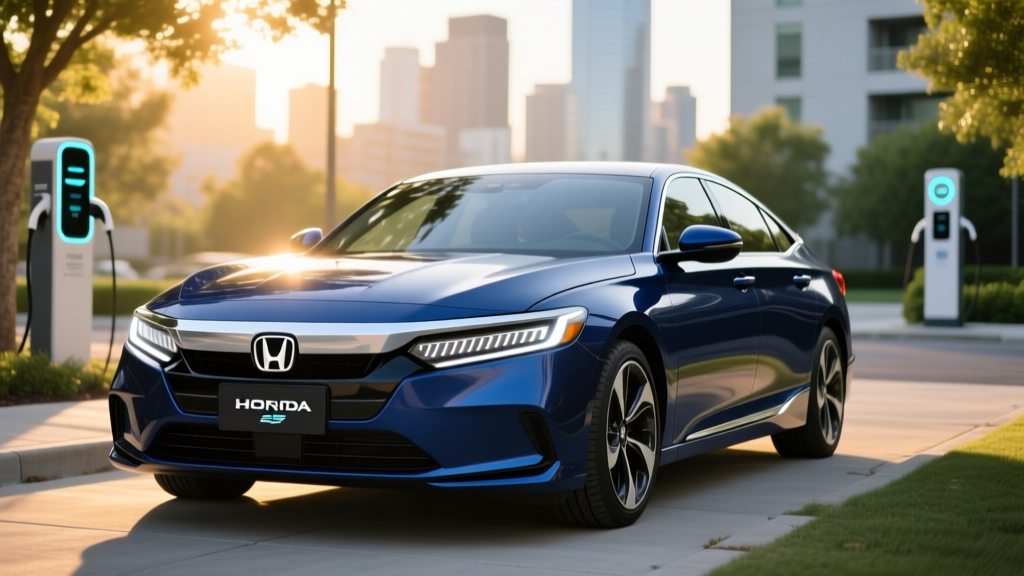
No. As of the 2026 model year, Honda does not sell a fully electric Honda Accord (BEV) in the United States. The Accord lineup remains a conventional hybrid (HEV) — there is no plug-in variant and no battery-electric variant currently available or officially announced for the U.S. market.
If you are specifically searching for a "Honda Accord Electric," you are likely looking for one of three things: (1) confirmation that a BEV Accord exists (it doesn't yet), (2) the closest electrified alternative Honda offers (the Accord Hybrid), or (3) a comparable midsize electric sedan from another brand. This guide addresses all three with exact numbers.
What Honda Actually Offers: The 2026 Accord Hybrid
The 2026 Honda Accord Hybrid uses a two-motor hybrid system paired with a 2.0-liter Atkinson-cycle four-cylinder engine. It is a self-charging hybrid (HEV), meaning it has no plug and no meaningful electric-only driving range. The small lithium-ion battery (approximately 1.1 kWh usable) assists the gas engine during acceleration and enables brief low-speed electric motoring, but you cannot charge it from a wall outlet.
| Spec | Accord Hybrid (HEV) | Accord 1.5T (Gas) | Honda Prologue (BEV) |
|---|---|---|---|
| Powertrain | 2-motor hybrid + 2.0L I4 | 1.5L Turbo I4 | Single/Dual motor BEV |
| EPA Combined | 48 MPG | 32 MPG | 99 MPGe |
| EPA City / Hwy | 51 / 44 MPG | 29 / 37 MPG | — |
| EPA Range | ~700 mi (12.8 gal tank) | ~410 mi | 296 mi (per fueleconomy.gov) |
| Horsepower | 204 hp combined | 192 hp | 212–288 hp |
| 0–60 mph | ~6.5 sec | ~7.0 sec | ~6.0 sec (AWD) |
| Base MSRP | ~$33,675 | ~$28,990 | ~$47,400 |
| Federal Tax Credit (§30D) | Not eligible | Not eligible | Eligibility varies — see below |
The Accord Hybrid's 48 MPG combined is genuinely strong for a midsize sedan. On a 12.8-gallon tank, real-world range often exceeds 600 miles — far beyond any current BEV sedan without a recharge stop. However, it still burns gasoline, requires oil changes, and produces tailpipe emissions. It is not an EV.
Honda's Actual EV: The Prologue (And Why It Isn't an Accord)
Honda's current U.S. electric vehicle is the Prologue, a midsize crossover SUV built on General Motors' Ultium platform. Honda has not announced an electric Accord sedan for the U.S. market. The brand's Honda 0 Series — its next-generation global EV platform — is expected to debut vehicles starting in 2026 in Japan, but U.S.-market sedan timing and naming remain unconfirmed.
Prologue Real-World Range Reality
The Prologue's EPA-rated range is up to 296 miles (FWD EX trim). In real-world highway driving at 70 mph, expect roughly 240–260 miles in moderate temperatures. In cold weather (below 30°F), that figure can drop to 200–220 miles due to battery resistance and cabin heating demand. DC fast charging peaks at approximately 150 kW, reaching 10–80% in about 28 minutes under ideal conditions, though the charge curve tapers significantly above 80%.
Cost Comparison: Accord Hybrid vs. Going Electric
The financial case for an EV versus a hybrid depends heavily on your driving volume, electricity rates, and whether you can charge at home. Below is a 5-year total cost estimate comparing the Accord Hybrid to a comparable midsize EV (using the Prologue as Honda's closest proxy) for a driver covering 15,000 miles per year.
| Cost Category | Accord Hybrid | Midsize EV (Prologue FWD) |
|---|---|---|
| Purchase Price (MSRP) | $33,675 | $47,400 |
| Est. Federal Tax Credit | $0 | Up to $7,500 (if eligible*) |
| Net Purchase | $33,675 | ~$39,900 |
| Fuel / Energy (5 yr) | ~$6,250 (gas @ $3.50/gal, 48 MPG) | ~$3,375 (home charging @ $0.15/kWh, 3.0 mi/kWh) |
| Maintenance (5 yr) | ~$2,800 (oil, filters, brakes) | ~$1,400 (no oil; tire rotation, cabin filter) |
| Insurance (5 yr est.) | ~$7,500 | ~$9,000 (EV premiums typically 15–20% higher) |
| Est. 5-Year Total | ~$50,225 | ~$53,675 |
Key takeaway: The EV saves roughly $2,875 in fuel and $1,400 in maintenance over five years — about $4,275 total. But the higher purchase price (even after a potential tax credit) and elevated insurance premiums largely erase that advantage. The Accord Hybrid wins on pure 5-year cost unless you drive significantly more than 15,000 miles annually or have access to very cheap electricity (e.g., solar or time-of-use rates below $0.10/kWh).
*Federal §30D tax credit eligibility for the Prologue depends on MSRP caps (sedans: $55,000; SUVs: $80,000), buyer income limits ($150K single / $300K joint for new vehicles), and battery-critical-mineral and component sourcing requirements that shift annually. The Prologue, classified as an SUV, falls under the $80,000 MSRP cap. Always verify current-year eligibility at irs.gov before purchasing. Point-of-sale transfer is available at participating dealers.
Real-World Ownership: What First-Time EV Buyers Must Know
If you are considering stepping from an Accord Hybrid into a true EV, several practical factors will determine whether the experience is seamless or frustrating:
Home Charging Access Is the Deciding Factor
Over 80% of EV charging happens at home. If you have a garage or dedicated parking spot with access to a 240V outlet (or the ability to install one), an EV is convenient — you wake up to a full "tank" every morning. A Level 2 home charger (typically 7.2–11.5 kW) adds roughly 25–40 miles of range per hour of charging, which easily covers daily driving overnight.
If you live in an apartment without charging access, or rely entirely on street parking, EV ownership becomes substantially harder. Public DC fast charging costs 2–3× more per mile than home charging (typically $0.30–$0.48/kWh at networks like Electrify America or EVgo), and availability varies widely by region.
Cold Weather Cuts Range 15–30%
Lithium-ion batteries lose efficiency in cold temperatures, and cabin heating draws significant energy. An EV rated at 300 miles EPA may deliver only 210–255 real-world miles in sustained sub-freezing conditions. The Accord Hybrid experiences no such range penalty — its waste engine heat warms the cabin essentially for free.
Maintenance Is Simpler, But Tires Wear Faster
EVs eliminate oil changes, spark plugs, transmission fluid, and exhaust system maintenance. Regenerative braking extends brake pad life significantly. However, EVs are heavier (the Prologue weighs ~4,800 lbs vs. the Accord Hybrid at ~3,450 lbs), and instant torque accelerates tire wear. Budget for tire replacement every 30,000–40,000 miles instead of 50,000+.
Common Misconceptions About an Electric Accord
| Myth | Fact |
|---|---|
| "The Honda Accord comes in a plug-in or electric version." | False. The 2026 Accord is only available as a conventional hybrid (HEV). There is no plug, no EV mode, and no BEV Accord in Honda's U.S. lineup. |
| "The Accord Hybrid can drive on electricity alone." | Only at very low speeds for very short distances (under 1 mile). The ~1.1 kWh battery is not designed for meaningful electric-only range. It assists the gas engine; it does not replace it. |
| "An EV always saves money vs. a hybrid." | Not necessarily. At 15,000 miles/year with moderate electricity rates, a hybrid like the Accord often has a lower 5-year total cost than a similarly equipped EV due to lower purchase price and insurance. |
| "Honda is releasing an electric Accord sedan soon." | Honda has announced the Honda 0 Series EV platform globally, but no U.S.-market electric Accord has been confirmed. The next Honda EVs for America are expected to be SUVs and a smaller EV (potentially a reborn Fit/Motocompacto concept). Timing beyond 2026 remains unannounced. |
| "EV batteries need replacing every few years." | Modern EV battery packs are warrantied for 8 years/100,000 miles (federal minimum) with a capacity-retention threshold of 70%. Real-world degradation data from vehicles like the Tesla Model 3 and Hyundai Ioniq 5 shows most packs retain 85–92% capacity at 100,000 miles. |
Decision Framework: Should You Buy an Accord Hybrid, Wait for an EV, or Switch Brands?
Choose the Accord Hybrid if:
- You drive 10,000–20,000 miles per year and want the lowest total cost of ownership in a midsize sedan.
- You lack reliable home charging access (apartment, street parking, no 240V circuit).
- You regularly take road trips exceeding 300 miles and don't want to plan charging stops.
- You live in a region with extreme cold (sustained sub-20°F winters) where EV range loss is most severe.
- Your budget is under $35,000 for a new midsize sedan.
Choose a midsize EV (Prologue or competitor) if:
- You have home Level 2 charging and want to eliminate gas station visits entirely.
- Your daily commute is under 80 miles round-trip (well within EV range even in cold weather).
- You qualify for the full §30D federal tax credit (income under caps, vehicle meets sourcing rules), reducing effective price by up to $7,500.
- You prioritize zero tailpipe emissions and have access to renewable electricity (solar, green utility plan).
- You want the lowest per-mile "fuel" cost and don't mind a higher upfront purchase.
Wait for a future Honda EV sedan if:
- You are loyal to the Honda brand but want a true BEV.
- You can continue driving your current vehicle for 2–3 more years while Honda's 0 Series platform matures and U.S. sedan plans solidify.
- You want next-generation battery tech (potential LFP options, faster NACS charging) that 2028+ models will likely include.
Competitor EVs to Consider Instead of a (Nonexistent) Electric Accord
If you want a midsize electric sedan today, these are the closest alternatives to what an "Accord Electric" might offer:
- Tesla Model 3 (2026): EPA range up to 363 miles (Long Range AWD), starting ~$42,990. NACS connector, access to Tesla Supercharger network. Strong efficiency at ~4.0 mi/kWh. Insurance tends to be higher than average.
- Hyundai Ioniq 6 (2026): EPA range up to 361 miles (SE Long Range RWD), starting ~$39,950. 800V architecture enables 10–80% DC charging in ~18 minutes at 350 kW chargers. CCS connector (NACS adapter available).
- BMW i4 eDrive40 (2026): EPA range up to 307 miles, starting ~$57,900. Premium interior but significantly higher price point. Eligible for partial §30D credit depending on sourcing.
Frequently Asked Questions
Will Honda make an all-electric Accord?
Honda has not confirmed an all-electric Accord for the U.S. market. The brand's Honda 0 Series global EV platform will launch vehicles starting in 2026, but initial models are expected to be SUVs and compact cars. A midsize electric sedan wearing the Accord name is plausible for the 2028–2030 timeframe, but nothing has been officially announced. Check Honda's official site for updates.
Is the Honda Accord Hybrid a plug-in?
No. The Accord Hybrid is a conventional (self-charging) hybrid. It has no charging port and no plug. The small battery recharges through regenerative braking and the gas engine. Honda previously sold a plug-in Accord (2014–2017, approximately 13 miles of electric range), but it was discontinued and is not part of the current lineup.
Does the Accord Hybrid qualify for the federal EV tax credit?
No. The IRS §30D clean vehicle credit applies only to plug-in electric vehicles (BEVs and PHEVs) that meet battery-sourcing, MSRP, and buyer-income requirements. Conventional hybrids like the Accord Hybrid are not eligible for any federal purchase credit.
How much does it cost to fuel an Accord Hybrid vs. an EV per mile?
At $3.50/gallon gas and 48 MPG combined, the Accord Hybrid costs approximately $0.073 per mile in fuel. An EV charged at home at $0.15/kWh with an efficiency of 3.0 miles/kWh costs approximately $0.050 per mile. The EV saves about $0.023/mile — or roughly $345 per year at 15,000 miles. Public DC fast charging at $0.40/kWh raises EV cost to ~$0.133/mile, which is more expensive than the hybrid.
What's the best Honda for someone who wants an EV?
Currently, the Honda Prologue is Honda's only all-electric vehicle sold in the U.S. It offers up to 296 miles of EPA range, DC fast charging up to ~150 kW, and a starting MSRP around $47,400. It is an SUV, not a sedan. If you specifically want a Honda-badged electric sedan, you will need to wait for future product announcements.
Is the Accord Hybrid better than a gas Accord?
For most buyers, yes. The hybrid delivers 48 MPG combined vs. 32 MPG for the 1.5T gas model — a 50% improvement in fuel economy — while producing similar or better acceleration (204 hp vs. 192 hp). The hybrid carries a roughly $2,500–$3,000 price premium depending on trim, which pays back in fuel savings within 3–4 years at average driving distances. The hybrid powertrain also qualifies for Honda's standard 8-year/100,000-mile hybrid component warranty per Honda's warranty information.
Sources: EPA fuel economy data via fueleconomy.gov; Honda official specifications at automobiles.honda.com; IRS §30D credit rules at irs.gov. Pricing and credit eligibility reflect 2026 model year information and are subject to change. Verify all figures with your dealer and tax professional before purchasing.