Quick Verdict: Why Thousand Oaks Drivers Choose the Model Y
For Conejo Valley commuters splitting time on the 101 freeway and Ventura Boulevard surface streets, the 2026 Tesla Model Y Long Range AWD remains the default EV crossover benchmark. With 320 miles of EPA range, access to the Supercharger network (including the 12-stall station at the Oaks Mall), and a starting MSRP of $44,990 before incentives, it solves the three questions every Southern California EV shopper asks: Can I road-trip to Big Sur without planning anxiety? Will my home Level 2 charger refill it overnight? And does it still qualify for the federal tax credit?
This review is built around real ownership data from Ventura County drivers — not just spec sheets — covering range on the Grapevine climb, DC fast-charge curves at local Superchargers, and the total cost picture after California's stacked incentives.
Range, Efficiency, and the 101 Freeway Reality
Real-World Expectation: ~270–290 miles mixed SoCal driving; ~240–260 miles at sustained 75 mph on the 101; ~220 miles in 40°F mountain passes (Tejon/Grain)
Efficiency: 122 MPGe combined / 27 kWh per 100 miles (per EPA fueleconomy.gov)
The Long Range AWD uses a ~78 kWh usable NMC (nickel-manganese-cobalt) lithium-ion pack. NMC offers higher energy density than LFP chemistry, which is why the Long Range hits 320 miles while the RWD Standard Range (using CATL LFP cells) tops out around 260 miles EPA. The trade-off: LFP batteries tolerate regular 100% charging better, while NMC prefers an 80% daily limit to preserve long-term State of Health.
On a Thousand Oaks to downtown LA commute (roughly 42 miles each way via the 101 and 405), expect to use about 32–35% of the pack round-trip in temperate weather — leaving a comfortable buffer for errands. The heat pump, standard on all 2026 Model Y trims, minimizes winter range loss compared to older resistive-heater EVs, but cold morning drives over the Conejo Grade (elevation 1,675 ft) still knock roughly 10–15% off the dash-indicated range until the battery warms.
| Specification | Long Range AWD | Performance | RWD Standard Range |
|---|---|---|---|
| EPA Range | 320 mi | 295 mi | 260 mi |
| Battery (usable) | ~78 kWh NMC | ~78 kWh NMC | ~60 kWh LFP |
| Drivetrain | Dual-Motor AWD | Dual-Motor AWD | Single-Motor RWD |
| Horsepower | 384 hp | 456 hp | 295 hp |
| 0–60 mph | 4.8 sec | 3.5 sec | 6.6 sec |
| Peak DC Charge | 250 kW | 250 kW | 170 kW |
| 10–80% DC Time | ~25 min | ~25 min | ~30 min |
| Base MSRP | $44,990 | $48,990 | $39,990 |
| Cargo (rear seats up) | 30 cu ft | 30 cu ft | 30 cu ft |
| Cargo (seats folded) | 72 cu ft | 72 cu ft | 72 cu ft |
| Rear Legroom | 41.6 in | 41.6 in | 41.6 in |
Charging Speed: Superchargers, Home Level 2, and the Oaks Mall Stop
Thousand Oaks has a strong charging footprint: a V3 Supercharger cluster (12 stalls at up to 250 kW) anchors the Oaks shopping center, with additional Electrify America and ChargePoint DC stations within 10 miles in Westlake Village and Simi Valley. The Model Y's native NACS connector means no adapter is needed at any Tesla Supercharger — a meaningful convenience advantage over CCS-equipped rivals that require a NACS adapter at Tesla stalls.
| Charging Method | Power (kW) | Miles Added per Hour | Typical Use Case |
|---|---|---|---|
| Level 1 (120V household) | ~1.4 kW | ~4 mi/hr | Emergency trickle |
| Level 2 (240V / 48A Wall Connector) | 11.5 kW | ~44 mi/hr | Overnight home (7–9 hr full fill) |
| Level 2 (public 7.2 kW) | 7.2 kW | ~28 mi/hr | Workplace / mall top-up |
| DC Fast (V3 Supercharger) | Peak 250 kW | ~180 mi in 15 min | Road trips |
| DC Fast (CCS adapter, EA) | Up to 150 kW typical | ~120 mi in 15 min | Non-Tesla networks |
Charging-curve reality: The Long Range peaks at 250 kW only between roughly 10–25% State of Charge. Above 50% SoC, the rate tapers to ~100 kW, and above 80% it drops below 40 kW. This is why Tesla's quoted "10–80% in ~25 minutes" is the meaningful metric — the last 20% takes longer than the first 70%. For local driving, most Thousand Oaks owners charge to 80% at home overnight and only push to 100% before long trips (using the scheduled-departure feature to finish charging right before leaving, which also preconditions the pack).
Performance and Daily Drivability
The Long Range AWD's 384 hp and 4.8-second 0–60 mph time are more than adequate for merging onto the 101 at Newbury Road or climbing the Conejo Grade without strain. Dual-motor AWD provides confident traction during the rare SoCal rainstorm and light snow trips to Mount Pinos. The Performance trim shaves 0–60 to 3.5 seconds but sacrifices 25 miles of EPA range — a trade most commuters won't justify.
Regenerative braking (adjustable via the one-pedal-driving setting) recovers meaningful energy on the downhill return from the Conejo Valley toward Camarillo. Expect to recoup 3–5 miles of range on that descent alone.
Tech, Interior, and Driver Assistance
The 2026 Model Y "Juniper" refresh brought a ventilated front seat row, ambient lighting, a rear-seat touchscreen, power-folding second row, and a noticeably quieter cabin thanks to acoustic glass and revised suspension bushings. The 15.4-inch front touchscreen handles navigation, media, and vehicle controls — there are no physical gauges, which remains a polarizing choice.
Standard Autopilot (Traffic-Aware Cruise Control + Autosteer) is a competent SAE Level 2 system for 101 commuting. Full Self-Driving (Supervised) remains a Level 2 driver-assist feature — not self-driving — and requires continuous driver attention regardless of marketing language. It handles surface-street navigation, stoplights, and lane changes reasonably well in Thousand Oaks' grid-like arterials, but still disengages unpredictably in construction zones. FSD currently costs $8,000 outright or $99/month; most buyers are better off using the included Autopilot and spending the savings on home charging infrastructure.
Pricing, Tax Credits, and the California Incentive Stack
| Trim | MSRP | Federal §30D Credit* | Effective Price |
|---|---|---|---|
| RWD Standard Range | $39,990 | Up to $7,500 | ~$32,490 |
| Long Range AWD | $44,990 | Up to $7,500 | ~$37,490 |
| Performance | $48,990 | Up to $7,500 | ~$41,490 |
Federal §30D eligibility caveats (per IRS.gov):
- MSRP cap: SUVs must be under $80,000 — all Model Y trims qualify.
- Buyer income cap: AGI ≤ $150k single / $225k head-of-household / $300k joint.
- Battery sourcing: Critical minerals and battery components must meet phased-in domestic/free-trade thresholds that tighten annually. Verify current-year compliance on Tesla's checkout page or IRS guidance before purchasing.
- Point-of-sale transfer: Eligible buyers can apply the credit as a discount at delivery rather than waiting for tax filing.
California no longer offers the CVRP rebate (it sunset in 2023), but low- and moderate-income buyers in certain Ventura County ZIP codes may qualify for regional air-district incentives or utility rebates through Southern California Edison for home Level 2 installation. Always verify current programs — incentive availability shifts quarterly.
Ownership Costs and Warranty
Tesla covers the Model Y with a 4-year/50,000-mile basic warranty and an 8-year/120,000-mile battery-and-drive-unit warranty with a minimum 70% capacity retention threshold. Real-world degradation data from Teslanomics and Recurrent Auto shows typical NMC packs losing roughly 8–12% capacity over the first 100,000 miles, with the curve flattening afterward.
Electricity costs in SCE territory (roughly $0.28–$0.35/kWh on standard residential rates, less on EV time-of-use plans overnight) put home charging at about $0.09–$0.12 per mile — roughly one-third the per-mile cost of a comparable 25-MPG gas crossover at current SoCal fuel prices. Over 15,000 miles annually, that's an estimated $1,200–$1,600 in yearly fuel savings versus a gas RAV4.
- 320-mi EPA range covers most SoCal road trips without stops
- Native NACS = no adapter at 50,000+ Superchargers nationwide
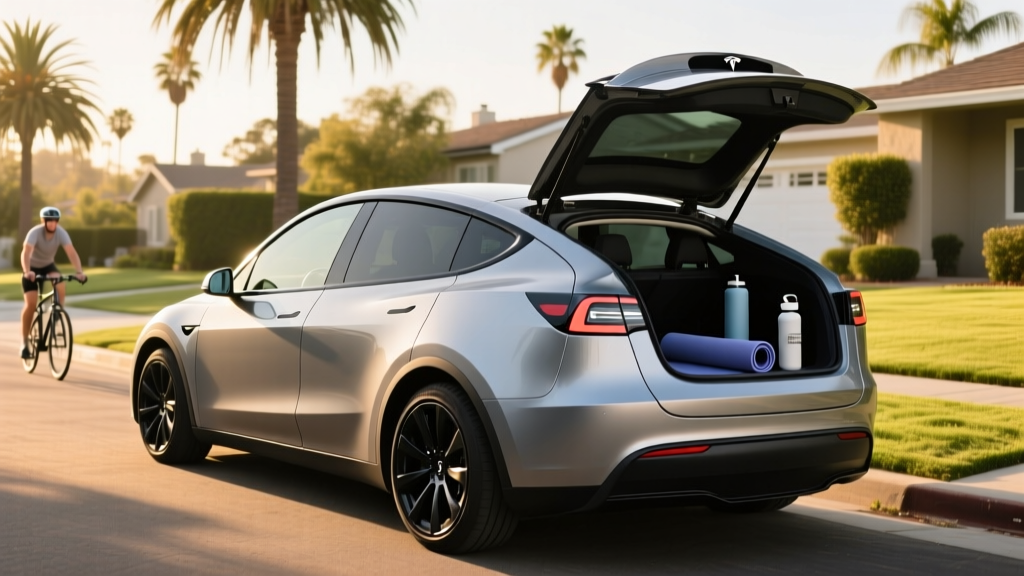
- Strong cargo volume (72 cu ft) for the segment
- OTA updates continuously add features
- Heat pump standard for winter efficiency
- No physical gauges or stalks — all controls via touchscreen
- Ride quality firm on rougher Conejo Valley roads
- FSD purchase rarely justifies its $8,000 cost
- Insurance premiums typically 15–25% above segment average
- Rear visibility compromised by sloping roofline
Who the Model Y Suits Best (and Who Should Look Elsewhere)
Choose the Model Y Long Range AWD if: you commute 40+ miles daily on the 101/405, need a family-capable crossover with 72 cu ft of cargo space, take regular road trips up the coast or to the Eastern Sierra, and have home Level 2 charging access (or can install it).
Look at competitors if: you prioritize ride comfort over tech (Hyundai Ioniq 5 is softer-riding and charges faster at 800V DC stations); you need three rows (Kia EV9); or you want physical controls and a more traditional interior layout (Ford Mustang Mach-E).
Frequently Asked Questions
What is the real-world range of the 2026 Tesla Model Y?
EPA rates the Long Range AWD at 320 miles. Real-world Thousand Oaks-area driving delivers roughly 270–290 miles in mixed use, dropping to ~240–260 miles at sustained 75-mph freeway speeds and ~220 miles in cold mountain-pass conditions.
How fast does the Model Y charge at home and on DC fast chargers?
At home on a 48-amp Tesla Wall Connector (11.5 kW), it adds about 44 miles of range per hour — enough to refill a daily commute overnight. On V3 Superchargers, it peaks at 250 kW and reaches 10–80% in roughly 25 minutes, though the charge curve tapers sharply above 80%.
Does the 2026 Model Y qualify for the federal EV tax credit?
Yes, all trims fall under the $80,000 SUV MSRP cap and can qualify for up to $7,500 under IRS §30D — provided the buyer meets income limits ($300k joint / $150k single) and the vehicle's battery meets current-year critical-mineral and component-sourcing thresholds. Verify on IRS.gov before purchase.
Is the Model Y worth buying versus competitors in 2026?
It remains the segment default for Supercharger network access, range-per-dollar, and cargo versatility. The Hyundai Ioniq 5 charges faster at 800V public stations and rides more comfortably; the Ford Mustang Mach-E offers a more conventional interior. If Supercharger access matters for your road-trip pattern, the Model Y still wins.
How much does home charging cost in Thousand Oaks?
On Southern California Edison's EV time-of-use rate, overnight charging runs roughly $0.10–$0.14 per kWh, translating to about $8–$11 for a full 78-kWh fill — equivalent to 320 miles of range.
What's the battery warranty?
Tesla covers the battery and drive unit for 8 years or 120,000 miles, whichever comes first, with a guaranteed minimum 70% capacity retention over that period.