The Quick Answer: Does the Tesla Model Y Have a Third Row?
Yes — but with major caveats. Tesla offers an optional third-row seat on the Model Y Long Range AWD only, expanding seating from five to seven passengers. However, this $2,000 add-on (bringing the effective price to roughly $50,130 in 2026) transforms the third row into a space best suited for children under 5'4" or very short trips. Adult passengers will find it cramped, with limited headroom and essentially zero cargo space behind the raised seats.
If you're researching whether the Model Y fits your growing family, this review covers every dimension, range figure, and ownership cost you need to make a data-driven decision.
Model Y at a Glance: 2026 Specs
| Spec | Long Range AWD | Long Range RWD | Performance |
|---|---|---|---|
| EPA Range | 310 mi (295 mi w/ 3rd row) | 320 mi | 285 mi |
| Battery (usable) | ~75 kWh, NMC | ~75 kWh, NMC | ~75 kWh, NMC |
| Peak DC Charge Rate | 250 kW | 250 kW | 250 kW |
| 10–80% DC Fast Charge | ~22 min | ~22 min | ~22 min |
| Level 2 Home Charge | 11.5 kW (~44 mi/hr) | 11.5 kW (~44 mi/hr) | 11.5 kW (~44 mi/hr) |
| 0–60 mph | 4.8 sec | 5.8 sec | 3.5 sec |
| Horsepower | 384 hp (dual motor) | 295 hp (single motor) | 456 hp (dual motor) |
| Drivetrain | AWD | RWD | AWD |
| Efficiency | 122 MPGe / 28 kWh/100mi | 127 MPGe / 27 kWh/100mi | 111 MPGe / 30 kWh/100mi |
| Base MSRP | $48,130 | $46,130 | $53,130 |
| 3rd-Row Option | +$2,000 | Not available | Not available |
| Battery/Drive Unit Warranty | 8 years / 120,000 miles | ||
Sources: fueleconomy.gov, Tesla Model Y design page.
Third-Row Reality: Dimensions, Comfort, and Daily Use
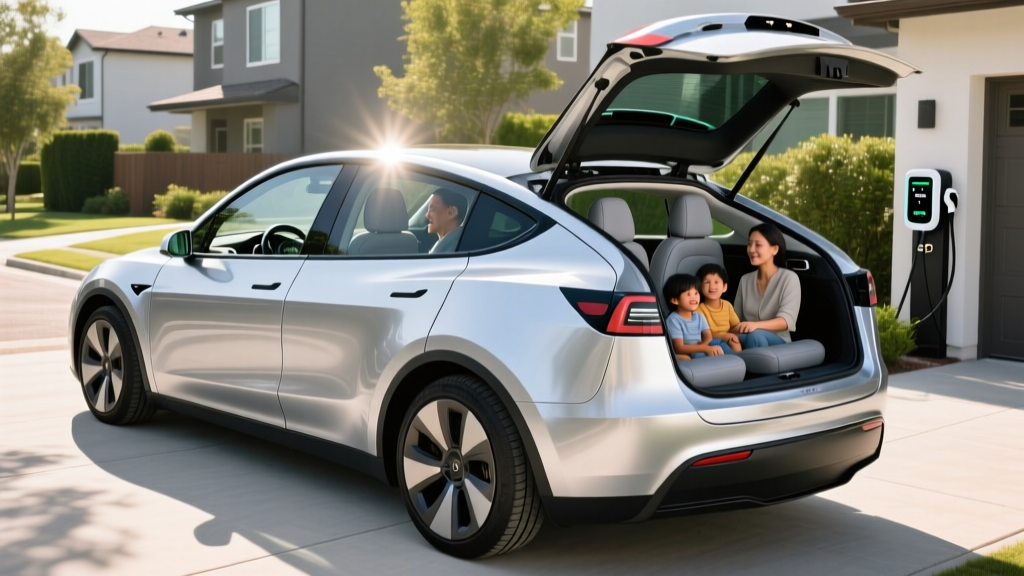
The optional third row adds two small, rear-facing seats. Here's what you need to know about the physical space:
- Third-row legroom: ~26.5 inches — tight even for children on longer drives
- Third-row headroom: ~35.5 inches — the sloping roofline cuts into space significantly
- Cargo behind raised 3rd row: ~12 cu ft — enough for a couple of backpacks or a single small stroller, nothing more
- Cargo with 3rd row folded: ~30 cu ft behind the second row
- Max cargo (all rear seats folded): ~72 cu ft — competitive with midsize SUVs
- Second-row legroom: ~40.5 inches — generous and unaffected by the third-row option
In practice, the third row works for school-dropoff carpools with younger kids. For any trip over 20 minutes, or for passengers taller than about 5'2", the seating position becomes uncomfortable. The cushion sits low to the floor, creating a "knees-up" posture, and ingress/egress requires folding and sliding the second row — a multi-step process that takes practice.
Adding the third row increases curb weight by approximately 80–100 lbs and alters the aerodynamic profile slightly. Tesla's own configurator shows the Long Range AWD dropping from 310 mi to approximately 295 mi of EPA-estimated range with the option. In real-world highway driving at 70 mph, expect ~240–260 miles in mild weather and ~200–220 miles in sub-freezing temperatures, where the NMC battery and cabin heating draw additional energy.
Real-World Range: What the EPA Sticker Doesn't Tell You
The 2026 Model Y Long Range AWD carries an EPA-estimated 310 miles (295 mi with the third-row option). But as any experienced EV owner knows, the EPA number represents a blended cycle. Here's how it translates to real driving:
- City / stop-and-go driving: 300–320 mi — regenerative braking recaptures significant energy in urban conditions, often exceeding the EPA estimate
- Highway at 65 mph: ~280 mi — aerodynamic drag dominates but remains manageable
- Highway at 75–80 mph: ~240–260 mi — efficiency drops sharply above 70 mph; this is the range figure to plan road trips around
- Cold weather (below 32°F): ~200–230 mi — the NMC chemistry loses efficiency in the cold, and resistive cabin heating draws 2–4 kW continuously. The Model Y uses a heat pump (standard), which mitigates this somewhat compared to resistive-only systems, but expect a 20–30% range reduction in deep winter
- Towing (up to 3,500 lbs rated): ~150–180 mi — if you're pulling a small trailer, plan charging stops accordingly
For most commuters doing 30–50 miles per day, the Model Y delivers a comfortable week between charges. For road trips over 250 miles, you'll want to plan at least one Supercharger stop.
Charging Speed: Supercharger Network and Home Setup
The Model Y charges at a peak rate of 250 kW on V3/V4 Tesla Superchargers, using the native NACS connector — no adapter needed. Here's the full charging picture:
| Charging Level | Power | Speed (Approx.) | Use Case |
|---|---|---|---|
| Level 1 (120V outlet) | ~1.4 kW | ~5 mi/hr | Emergency / overnight trickle |
| Level 2 (240V, 48A) | 11.5 kW | ~44 mi/hr | Daily home charging (Wall Connector) |
| Level 2 (240V, 32A) | 7.7 kW | ~30 mi/hr | Mobile Connector / lower-amp circuits |
| DC Fast (V3 Supercharger) | 250 kW peak | 10–80% in ~22 min | Road trips |
| DC Fast (non-Tesla CCS w/ adapter) | Up to 150–250 kW | Varies by station | Expanding access in 2026 |
Charging curve reality: The Model Y peaks at 250 kW only between roughly 10–30% state of charge. From 30–60%, the rate tapers to ~150–180 kW, and above 80% it drops below 50 kW to protect the battery. This is why Tesla (and every EV manufacturer) quotes 10–80% times rather than 0–100%. Charging from 80–100% at a Supercharger can add 15–20 minutes and provides minimal range gain — it's better to charge to 80% and drive.
For home charging, Tesla's Gen 3 Wall Connector ($475) on a 60-amp circuit delivers 11.5 kW, adding roughly 44 miles of range per hour. Most owners plug in overnight and wake up to a full battery. Installation typically runs $500–$2,000 depending on your electrical panel's capacity and distance from the panel to the garage — factor this into your budget.
Pricing, Trims, and Federal Tax Credit Eligibility
The 2026 Model Y lineup starts at $46,130 for the Long Range RWD and climbs to $53,130 for the Performance trim. Adding the third-row seat to the Long Range AWD brings the effective price to approximately $50,130 before destination fees.
| Trim | MSRP | With 3rd Row | Est. Price After §30D Credit* |
|---|---|---|---|
| Long Range RWD | $46,130 | N/A | ~$38,630 |
| Long Range AWD | $48,130 | $50,130 | ~$40,630 / ~$42,630 |
| Performance AWD | $53,130 | N/A | ~$45,630 |
*Federal tax credit estimates assume full eligibility. Actual credit varies.
- MSRP cap: SUVs must have an MSRP at or below $80,000 (all Model Y trims qualify)
- Buyer income cap: Modified AGI must not exceed $150,000 (single), $225,000 (head of household), or $300,000 (married filing jointly)
- Battery sourcing: A percentage of critical minerals and battery components must be sourced from the U.S. or FTA-partner countries — Tesla's supply chain has been evolving, and partial credit ($3,750) vs. full credit ($7,500) depends on the specific build week and battery cell origin
- Point-of-sale transfer: As of 2024, you can transfer the credit to the dealer at purchase, reducing your out-of-pocket cost immediately rather than waiting for tax filing
- Verify before buying: Check the latest eligibility on IRS.gov or ask your Tesla advisor for the specific vehicle's battery sourcing documentation
The battery sourcing requirement is the biggest variable. Tesla sources cells from multiple suppliers (CATL, Panasonic, LG), and the specific chemistry and origin can change by production batch. Always confirm the credit amount for your exact VIN before finalizing the purchase.
Technology, Driver Assistance, and Ownership Experience
The Model Y's tech stack remains one of its strongest selling points — and, depending on your preferences, one of its most polarizing:
- Infotainment: 15-inch center touchscreen running Tesla's proprietary OS. No Apple CarPlay or Android Auto — you use Tesla's native apps for navigation, Spotify, podcasts, and phone mirroring via Bluetooth
- Autopilot (standard): SAE Level 2 driver assistance including adaptive cruise control, lane centering, and automatic emergency braking. The driver must remain engaged and keep hands on the wheel at all times
- Full Self-Driving (Supervised): Optional $8,000 upgrade (or $99/month subscription) adding automatic lane changes, traffic light/stop sign recognition, and Navigate on Autopilot. Despite the name, this remains SAE Level 2 — you are responsible for driving at all times
- Over-the-air updates: Tesla pushes regular software updates that can add features, improve efficiency, or adjust regenerative braking behavior
- Sentry Mode / Dashcam: Built-in camera recording when parked or driving, stored on a USB drive
- Heat pump: Standard on all trims, significantly improving cold-weather efficiency compared to resistive heating
All current Tesla driver-assistance features are SAE Level 2. You must keep your eyes on the road and hands on the wheel. The system can and will make errors — especially in construction zones, faded lane markings, and adverse weather. True self-driving (Level 4) is only available in limited robotaxi services like Waymo, not in any consumer vehicle.
How the Model Y Stacks Up Against Key Competitors
If the third-row question is central to your decision, here's how the Model Y compares to other electrified family SUVs:
| Vehicle | 3rd Row? | EPA Range | Starting MSRP | Max Cargo |
|---|---|---|---|---|
| Tesla Model Y LR AWD | Optional (2 seats, tight) | 310 mi | $48,130 | 72 cu ft |
| Kia EV9 (2026) | Standard (3-across, usable) | 270–304 mi | ~$54,900 | 81.7 cu ft |
| Hyundai Ioniq 9 (2026) | Standard (3-across, usable) | ~300 mi (est.) | ~$52,000 | ~80 cu ft |
| VW ID.4 | No (5-seat only) | 275 mi | $40,790 | 64.2 cu ft |
| Toyota Grand Highlander Hybrid | Standard (spacious) | 36 MPG combined (HEV) | $40,170 | 97.5 cu ft |
The takeaway: if you need a genuinely usable third row for older children or adults on a regular basis, the Kia EV9 or Hyundai Ioniq 9 are substantially better choices. The Model Y's third row is a niche option — functional for occasional, short-distance child transport but not a true seven-seat solution.
- Class-leading Supercharger network access (17,000+ stations in North America)
- Excellent efficiency: 28 kWh/100mi is among the best in the segment
- Strong 0–60 performance (4.8 sec LR AWD) for a family SUV
- Best-in-class software and OTA update cadence
- Heat pump standard for cold-weather efficiency
- Competitive cargo volume with 3rd row folded (72 cu ft)
- Third row is cramped — only suitable for small children, short trips
- Minimal cargo space (12 cu ft) with 3rd row raised
- No Apple CarPlay or Android Auto
- No physical buttons — all controls via touchscreen
- FSD subscription/purchase cost adds significantly to total price
- Insurance premiums tend to run 15–30% higher than comparable ICE SUVs
Who Should Buy the Model Y (and Who Shouldn't)?
Buy the Model Y with the third row if: You have one or two small children (under 8–9 years old) who need occasional rides in the back, you primarily commute solo or with one passenger, you value access to the Supercharger network for road trips, and you want the lowest per-mile energy cost in a premium electric SUV.
Skip the third row (or skip the Model Y entirely) if: You regularly carry more than five people, your "third-row passengers" are teenagers or adults, you need substantial cargo room while carrying more than five, or you prefer physical controls and Apple CarPlay integration. In those cases, the Kia EV9 or a plug-in hybrid like the Toyota Grand Highlander are more practical family haulers.
Frequently Asked Questions
Does the Tesla Model Y have a third row in 2026?
Yes, the Model Y Long Range AWD offers an optional third-row seat package for an additional $2,000, expanding seating to seven. It is not available on the RWD or Performance trims.
Is the Model Y third row practical for adults?
No. With approximately 26.5 inches of legroom and 35.5 inches of headroom, the third row is only practical for children under about 5'4". Adults will find it uncomfortable even on short trips.
What is the real-world range of the Model Y?
The EPA rates the Long Range AWD at 310 miles (295 mi with the third-row option). Real-world highway driving at 75 mph yields approximately 240–260 miles in mild weather and 200–220 miles in freezing temperatures.
How fast does the Model Y charge at home and on the road?
On a home Level 2 Wall Connector (11.5 kW), the Model Y adds about 44 miles of range per hour — a full overnight charge. On a V3 Supercharger, it peaks at 250 kW and charges from 10–80% in approximately 22 minutes.
Does the Model Y qualify for the $7,500 federal EV tax credit?
It depends. All trims fall under the $80,000 MSRP cap for SUVs, but buyer income limits ($150K single / $300K joint) and battery-sourcing requirements apply. The full $7,500 credit depends on the specific vehicle's battery cell origin — confirm with your Tesla advisor and check IRS.gov for current rules.
How much cargo space does the Model Y have with the third row up?
Approximately 12 cubic feet behind the raised third row — enough for a couple of small bags or a compact stroller. With the third row folded, you get about 30 cu ft behind the second row, and 72 cu ft with all rear seats folded.
Is the Model Y better than the Kia EV9 for families?
It depends on your third-row needs. The EV9 offers a genuinely spacious, three-across third row suitable for adults, plus more total cargo volume. The Model Y wins on charging network access, efficiency, and software — but its third row is a compromise. If seven seats are a daily requirement, the EV9 is the stronger pick.
What is the Model Y battery warranty?
Tesla covers the battery and drive unit for 8 years or 120,000 miles (whichever comes first), with a minimum 70% capacity retention guarantee over that period.