Quick Verdict: Does the Model Y Have a Third Row?
Yes — but with major caveats. The 2026 Tesla Model Y Long Range AWD offers an optional third-row seat that expands capacity from five to seven passengers. However, this third row is best suited for small children, and it significantly reduces cargo space. For most families, the Model Y remains a five-seat crossover that happens to offer a cramped third row rather than a true three-row SUV. If you need regular adult seating in the back, you'll want to look at the Kia EV9 or Rivian R1S instead.
Beyond seating, the 2026 Model Y (refreshed for the Juniper generation) continues to lead the midsize electric SUV segment in charging speed, Supercharger network access, and software-driven features. Here's the full breakdown of what you're actually buying.
2026 Tesla Model Y: Core Specifications
| Spec | Long Range AWD | Performance (if available) |
|---|---|---|
| EPA Range | 320 miles | ~290 miles (est.) |
| Battery (usable) | ~78 kWh (NMC) | ~78 kWh (NMC) |
| Drivetrain | Dual-Motor AWD | Dual-Motor AWD |
| Horsepower | 384 hp | ~456 hp |
| 0–60 mph | 4.8 seconds | 3.5 seconds |
| Max DC Fast Charge | 250 kW | 250 kW |
| 10–80% DCFC Time | ~25 minutes | ~25 minutes |
| Level 2 Charge Rate | 11.5 kW (~44 mi/hr) | 11.5 kW (~44 mi/hr) |
| MPGe (combined) | 111 MPGe | ~102 MPGe |
| Efficiency | 30 kWh/100 mi | ~33 kWh/100 mi |
| Base MSRP | $48,990 | $54,990 (est.) |
| Third-Row Option Cost | +2,000 (est.) | N/A |
| Battery Warranty | 8 yr / 120,000 mi | 8 yr / 120,000 mi |
Note: Performance trim availability and exact pricing for 2026 may vary. Always confirm with Tesla's configurator.
Third-Row Seating: What You Actually Get
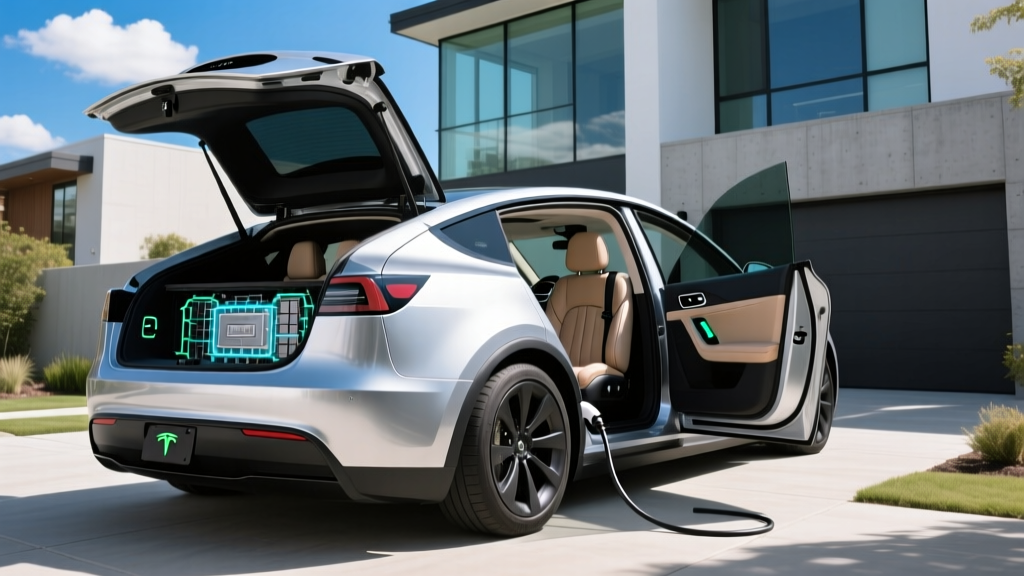
The optional third row in the Model Y adds two small rear-facing seats with integrated seatbelts. Here's the reality of living with it:
- Headroom: Approximately 35 inches — adequate for children under ~5'2" but tight for anyone taller.
- Legroom: Roughly 26–28 inches. An adult will find this uncomfortable beyond a 10-minute drive.
- Access: The second-row seats tilt and slide forward, but the opening is narrow compared to a dedicated three-row SUV like the Kia EV9.
- Cargo impact: With the third row up, cargo space behind it drops to approximately 12 cu ft — enough for a couple of grocery bags or a small stroller. Fold the third row flat and you regain roughly 30 cu ft. Fold both rear rows and you get up to 72 cu ft.
For context, the Kia EV9 offers 20 cu ft behind its third row and a usable 43 inches of third-row legroom. If you need a genuine seven-seater, the Model Y's third row is a compromise, not a solution.
Real-World Range vs. EPA Estimates
Real-World Expectation: ~260–280 miles at sustained 70–80 mph highway speeds; ~220–250 miles in freezing temperatures (below 32°F) with cabin heating.
City/Mixed Driving: Closer to EPA at ~300–310 miles thanks to regenerative braking.
The Model Y Long Range AWD carries an EPA-estimated 320 miles of range. In our experience and consistent third-party testing, highway driving at 75 mph in moderate temperatures yields roughly 260–280 miles before you'd want to stop. Cold weather (below freezing) with the heat pump running can pull that down to 220–250 miles.
The Juniper refresh improved thermal management, and Tesla's heat pump (standard on all trims) recovers waste heat from the drivetrain to warm the cabin — reducing cold-weather range loss compared to older resistive-heater EVs. Still, plan for 15–25% range reduction in winter conditions.
Efficiency is rated at 111 MPGe combined (30 kWh per 100 miles) per the EPA, making the Model Y one of the most efficient electric SUVs in its class. For comparison, the Ford Mustang Mach-E Extended Range AWD achieves roughly 101 MPGe combined.
Charging Speed: DC Fast Charging and Home Level 2
| Charging Level | Power / Rate | Miles Added per Hour | Notes |
|---|---|---|---|
| Level 1 (120V) | ~1.4 kW | ~4–5 mi/hr | Emergency/trickle only |
| Level 2 (240V, 48A) | 11.5 kW | ~44 mi/hr | Full charge in ~7–8 hours |
| DC Fast (peak) | 250 kW | Up to ~1,000 mi/hr (peak) | 10–80% in ~25 min |
| DC Fast (sustained avg.) | ~150–170 kW | — | Average over 10–80% session |
The Model Y uses the NACS (North American Charging Standard) connector natively, giving it direct access to Tesla's Supercharger network — over 25,000 stalls across North America as of 2026. This remains the most reliable public charging network by a wide margin, with uptime consistently above 97%.
DC fast charging reality: While the Model Y peaks at 250 kW, that peak only holds for a short window at low state of charge (typically 10–30% SoC). The charge curve tapers significantly above 50%, and especially above 80%. A 10–80% session at a V3 Supercharger takes approximately 25 minutes. Plan for 35–40 minutes if you need to charge from 10% to 90%.
Home charging: With a Tesla Wall Connector on a 60-amp circuit (48A continuous), you'll add roughly 44 miles of range per hour, or a full charge overnight. Installation typically runs $800–$2,000 depending on your electrical panel's proximity to the garage and whether a panel upgrade (to 200A service) is needed. Always get a quote from a licensed electrician before committing.
For non-Tesla public chargers using CCS1 connectors, Tesla now provides a CCS adapter (included with new vehicles), and many third-party networks have added NACS cables. Check PlugShare or the Tesla app for compatible stations on road trips.
Pricing, Trims, and Federal Tax Credit Eligibility
| Trim | Base MSRP | Est. After §30D Credit | Third Row Available? |
|---|---|---|---|
| Long Range AWD | $48,990 | ~$41,490* | Yes (+$2,000 option) |
| Performance AWD | $54,990 (est.) | ~$47,490* | No |
*Tax credit estimates assume full eligibility. Actual credit depends on your individual tax situation and current IRS rules.
The 2026 Model Y Long Range AWD starts at $48,990 (before destination). Adding the third-row option brings it to roughly $50,990. The Performance trim, when available, starts around $54,990.
- Maximum credit: Up to $7,500
- MSRP cap: Vehicle must have an MSRP at or below $80,000 (SUVs/vans/pickups) — the Model Y qualifies
- Buyer income cap: AGI must not exceed $150,000 (single), $225,000 (head of household), or $300,000 (joint filers)
- Battery sourcing: A percentage of critical minerals and battery components must be sourced from the U.S. or FTA partners — Tesla's U.S.-built battery packs generally meet these thresholds, but specific eligibility can shift. Always verify at fueleconomy.gov before purchasing.
- Point-of-sale transfer: You can transfer the credit to the dealer at purchase, reducing your out-of-pocket cost immediately (effective since Jan 2024)
Performance, Tech, and Daily Driving
The Long Range AWD produces 384 horsepower from its dual-motor setup, delivering a 4.8-second 0–60 mph time. That's brisk for a family crossover — quicker than most gas-powered competitors in this price range. The single-speed transmission means acceleration is smooth and linear, with no shift shock.
Driver assistance: Tesla's Autopilot (standard) provides adaptive cruise control and lane-centering on highways. Full Self-Driving (Supervised), a $8,000 add-on or $99/month subscription, adds automated lane changes, traffic-light recognition, and navigate-on-autopilot. However, this is a SAE Level 2 system — you must keep your hands on the wheel and eyes on the road at all times. It is not autonomous driving.
Infotainment: The Juniper-generation Model Y features a 15.4-inch center touchscreen with no physical buttons. Climate controls, mirror adjustments, and glovebox release are all screen-based — a dealbreaker for some, intuitive for others. The system includes streaming media, gaming, a built-in dashcam, and over-the-air updates that add features post-purchase.
Notable drawbacks:
- No physical buttons or stalks (turn signals are on the steering wheel rim in the Juniper refresh)
- Rear visibility is limited due to the sloping roofline — the rear camera is essential
- Build quality has improved but still shows occasional panel-gap inconsistencies
- No Apple CarPlay or Android Auto — Tesla's native system is the only option
- Insurance premiums tend to run 15–30% higher than comparable gas SUVs
Pros and Cons at a Glance
Pros
- Class-leading efficiency (111 MPGe combined)
- Access to Tesla Supercharger network (25,000+ stalls)
- 250 kW peak DC fast charging
- Strong real-world range (~260–280 mi highway)
- Excellent cargo space with seats folded (72 cu ft)
- Over-the-air updates add features post-purchase
- Eligible for up to $7,500 federal tax credit
Cons
- Third row is cramped — only suitable for small children
- Cargo drops to ~12 cu ft with third row deployed
- No physical buttons — all controls via touchscreen
- No Apple CarPlay / Android Auto
- Insurance costs above segment average
- Turn signals on steering wheel rim take adjustment
- Rear visibility compromised by roofline design
Model Y vs. Key Competitors: Which Should You Buy?
| Attribute | Tesla Model Y LR AWD | Kia EV9 GT-Line AWD | Ford Mustang Mach-E Ext. Range AWD |
|---|---|---|---|
| EPA Range | 320 mi | 270 mi | 290 mi |
| Third Row | Optional (cramped) | Standard (usable) | Not available |
| Max DCFC | 250 kW | 236 kW | 150 kW |
| Starting MSRP | $48,990 | $59,900 | $48,995 |
| Charging Network | Supercharger (native) | NACS adapter / CCS | NACS adapter / CCS |
| Cargo (max) | 72 cu ft | 81.7 cu ft | 59.7 cu ft |
- Choose the Model Y if: You prioritize range, charging speed, and Supercharger reliability, and you only need a third row occasionally for small children.
- Choose the Kia EV9 if: You need a genuinely usable third row for older kids or adults, and you value maximum cargo space. You'll sacrifice some range and pay more upfront.
- Choose the Mach-E if: You want a sporty five-seat EV with CarPlay support and don't need a third row at all.
Who the 2026 Model Y Suits Best
Ideal buyer: A family of four (two adults, two kids) who road-trips regularly and values charging convenience above all else. The Supercharger network removes public-charging anxiety on long trips, and the 320-mile EPA range means fewer stops. The third row works as a backup for carpooling or short trips with a third child.
Not ideal for: Families who regularly carry more than four passengers, buyers who want physical buttons and knobs, or anyone who needs Apple CarPlay integration. If seven seats are a daily requirement, the Kia EV9 or a plug-in hybrid like the Toyota Grand Highlander Hybrid is a better fit.
Warranty and Long-Term Ownership
Tesla covers the Model Y's battery and drive unit for 8 years or 120,000 miles (whichever comes first), with a minimum 70% capacity retention guarantee during that period. The limited vehicle warranty is 4 years or 50,000 miles.
The battery pack uses NMC (nickel manganese cobalt) chemistry, which offers higher energy density than LFP (lithium iron phosphate) but typically shows slightly more degradation over time. Real-world data from Tesla's fleet suggests an average degradation of roughly 10–12% over 150,000 miles — meaning a 320-mile battery might deliver ~280–288 miles when new-equivalent at that mileage.
Tesla recommends charging to 80% for daily use and only charging to 100% for long trips. Battery preconditioning (automatic when you navigate to a Supercharger) warms the pack for faster charging and reduced wear.
Frequently Asked Questions
Does the Tesla Model Y have a third row?
Yes, the 2026 Model Y Long Range AWD offers an optional third row that seats two small children. It is not suitable for adults and significantly reduces cargo space when deployed. The Performance trim does not offer this option.
What is the real-world range of the 2026 Model Y?
The EPA rates the Long Range AWD at 320 miles. In real-world highway driving at 70–80 mph, expect 260–280 miles. In freezing temperatures with heating, that drops to approximately 220–250 miles. City driving with regenerative braking gets closer to the EPA figure.
How fast does the Model Y charge?
On a V3 Supercharger (250 kW DC), the Model Y charges from 10–80% in approximately 25 minutes. At home on a 48-amp Level 2 charger (11.5 kW), it adds about 44 miles of range per hour, fully charging overnight in 7–8 hours.
Does the 2026 Model Y qualify for the federal EV tax credit?
The Model Y Long Range AWD ($48,990 MSRP) falls under the $80,000 SUV MSRP cap and is assembled in the U.S. with battery sourcing that generally meets §30D critical-mineral and component requirements. Buyers must also meet income caps ($150K single / $300K joint). Eligibility can shift — verify at fueleconomy.gov and consult a tax professional before purchasing.
Is the Model Y worth buying over the Kia EV9 or other competitors?
If range, charging speed, and Supercharger access are your priorities, the Model Y is hard to beat in this segment. If you need a genuinely usable third row for older children or adults, the Kia EV9 is the better choice despite its higher price and shorter range. For a five-seat sporty EV with CarPlay, consider the Ford Mustang Mach-E.
What's the biggest drawback of the Model Y's third row?
Cargo space. With the third row deployed, you get only about 12 cu ft behind it — barely enough for groceries. The seats themselves also have limited headroom (~35 inches) and legroom (~26–28 inches), making them practical only for small children on short trips.
Sources: EPA / fueleconomy.gov, Tesla.com Model Y, IRS §30D Clean Vehicle Credits.