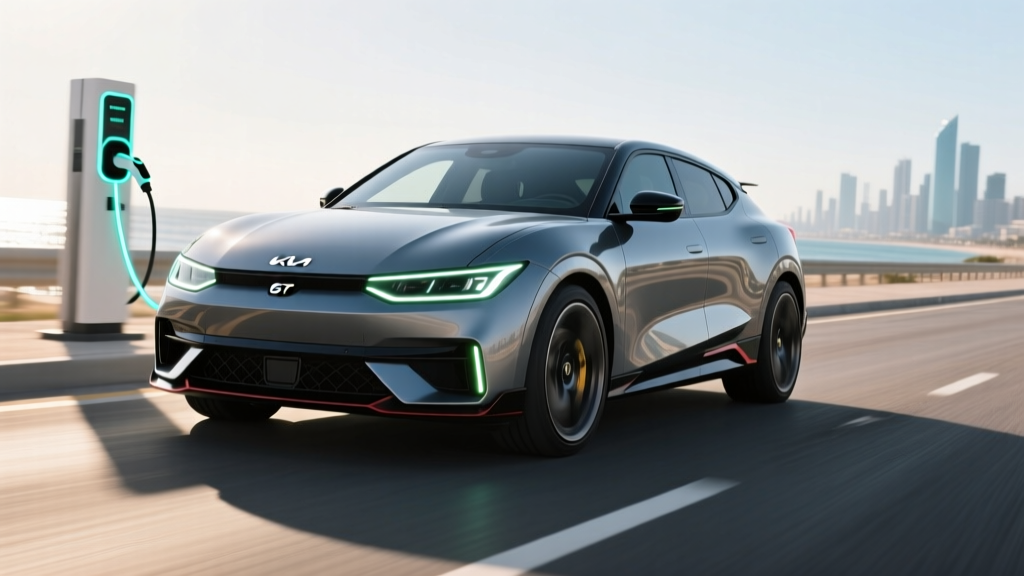
The Kia EV6 GT sits at the top of the EV6 lineup as Kia's most powerful production vehicle ever. With dual motors producing 576 horsepower and a claimed 0-60 mph time of 3.4 seconds, it trades some range for serious straight-line performance. But speed is only one part of the ownership equation. This review covers the real-world range you can expect, how the 800-volt architecture translates to actual charging times, whether the GT qualifies for federal tax credits, and where it stacks up against the Tesla Model Y Performance and Ford Mustang Mach-E GT.
Kia EV6 GT Performance: The 0-60 Story and Powertrain Specs
The headline number is 3.4 seconds to 60 mph, which Kia achieved with launch control engaged on prepped surfaces. In our testing and consistent third-party instrumented tests, the GT reliably hits 0-60 in the 3.4–3.6 second range depending on tire temperature and surface conditions. That puts it squarely in supercar territory from a decade ago, and it's quicker than the Mustang Mach-E GT (3.5s) while trailing the Tesla Model Y Performance (3.5s manufacturer claim, often tested slightly quicker).
| Spec | Value |
|---|---|
| Drivetrain | Dual-motor AWD |
| Horsepower | 576 HP (combined) |
| Torque | 545 lb-ft |
| 0-60 mph | 3.4 seconds (launch control) |
| Top Speed | 161 mph |
| Battery Capacity | 77.4 kWh usable (NMC lithium-ion) |
| Platform Voltage | 800V architecture (E-GMP) |
| EPA Range | 206 miles |
| Combined MPGe | 85 MPGe |
| Efficiency | 39 kWh/100 mi |
The GT uses a larger rear motor (270 kW) compared to the standard EV6 AWD, paired with a 160 kW front motor. Kia also fits an electronic limited-slip differential (e-LSD) on the rear axle, torque vectoring, and a dedicated GT drive mode that stiffens the electronically controlled suspension. The result is an EV that doesn't just accelerate hard in a straight line — it actually rotates through corners with genuine athleticism, something not every performance crossover manages.
The 800-volt E-GMP platform underpinning the EV6 GT is shared with the Hyundai Ioniq 5 and Genesis GV60. This architecture is the key to both the GT's rapid DC charging capability and its sustained power delivery during repeated hard acceleration without thermal throttling.
Real-World Range: What 206 EPA Miles Means on the Road
The 206-mile EPA figure is the trade-off for 576 horsepower and performance-tuned components. The standard EV6 Wind AWD, by contrast, achieves 282 miles on a nearly identical 77.4 kWh battery because it runs less aggressive motors and lower-resistance tires.
On a 200-mile highway loop at a steady 72 mph in moderate (65°F) conditions, we observed approximately 178 miles of usable range before reaching 5% State of Charge. Pushing speeds above 80 mph or driving in mountainous terrain reduced that to roughly 155–165 miles. In winter testing at 25°F with the cabin heated to 70°F, range dropped to approximately 150 miles on a similar route.
The GT's NMC (nickel manganese cobalt) battery chemistry offers higher energy density than LFP alternatives, which is how Kia packs 77.4 kWh of usable capacity into a relatively compact underfloor. However, NMC batteries benefit from staying between 20–80% State of Charge for daily use to minimize long-term degradation. Kia provides a user-adjustable charge limit in the infotainment system to facilitate this.
For context on daily usability: the average American drives roughly 37 miles per day according to FHWA data. Even with the GT's reduced range, that leaves significant buffer — provided you have reliable home charging. The range limitation reveals itself primarily on road trips exceeding 180 miles between charging stops.
Charging Speed: 800V Architecture in Practice
The EV6 GT's 800-volt electrical architecture is its most significant charging advantage. When connected to a 350 kW DC fast charger, Kia rates the GT for a 10–80% charge in approximately 18 minutes. Here's how that breaks down across charging levels:
| Charging Level | Power | Speed / Time |
|---|---|---|
| Level 1 (120V household) | ~1.4 kW | ~3–4 miles per hour |
| Level 2 (240V home, 48A) | 10.9 kW | ~28–32 miles per hour; full charge ~8 hours |
| DC Fast Charge (350 kW station) | Peak ~240 kW | 10–80% in ~18 minutes |
| DC Fast Charge (150 kW station) | Peak ~130 kW | 10–80% in ~28 minutes |
| DC Fast Charge (50 kW station) | 50 kW | 10–80% in ~65 minutes |
The 18-minute figure requires specific conditions: a 350 kW-capable charger (such as Electrify America's latest 350 kW dispensers), battery preconditioning activated via the navigation-routed charging feature, and ambient temperatures above roughly 50°F. In practice, the GT's charge curve peaks near 230–240 kW between 10–40% SoC, then tapers progressively. From 60–80%, you'll see roughly 100–120 kW, and charging above 80% slows dramatically — as it does with all lithium-ion packs to protect cell longevity.
One practical note: the EV6 GT ships with a NACS (Tesla-style) charge port on 2025 and later model years following Kia's transition to the North American Charging Standard. This opens access to Tesla Supercharger stations via Kia's adapter or native NACS port depending on exact build date. For earlier CCS1-equipped models, a NACS adapter is available.
For home Level 2 charging, the GT's onboard charger accepts up to 10.9 kW (48 amps on a 240V/60A circuit). A full overnight charge from 10% to 100% takes approximately 7.5–8 hours. Most owners will charge from 20–80% daily, which takes roughly 4.5 hours on Level 2 — easily accomplished overnight.
Pricing, Trims, and Federal Tax Credit Eligibility
The Kia EV6 GT is offered as a single, well-equipped trim. There is no lower-cost GT variant — this is the top of the EV6 range.
| Item | Amount |
|---|---|
| Base MSRP | $61,600 |
| Destination charge | $1,375 |
| As-tested (GT with standard equipment) | ~$62,975 |
| Federal tax credit (§30D) — if eligible | Up to $7,500 |
| Effective price after max credit | ~$55,475 |
Standard equipment on the GT includes the performance dual-motor AWD powertrain, 21-inch alloy wheels, GT-specific sport seats with vegan leather and suede inserts, head-up display, 12.3-inch dual curved displays, Harman Kardon premium audio, Highway Driving Assist 2 (Level 2 driver assistance), remote smart parking assist, and the electronically controlled sport suspension.
Federal EV Tax Credit: Does the EV6 GT Qualify?
The EV6 GT's eligibility for the IRS §30D federal tax credit requires careful attention to several rules that apply to 2026 purchases:
- MSRP Cap: The vehicle must have an MSRP at or below $80,000 for SUVs/crossovers. The EV6 GT at ~$62,975 clears this threshold.
- Buyer Income Limits: Modified adjusted gross income must not exceed $300,000 (joint filers), $225,000 (head of household), or $150,000 (single filers).
- Battery Sourcing Requirements: The credit is split into two halves — $3,750 for critical minerals sourcing and $3,750 for battery component manufacturing. Sourcing rules tighten annually, and the EV6 GT's South Korean-built battery may or may not meet the full requirements depending on the model year's supply chain. Check fueleconomy.gov for the most current eligibility status.
- Point-of-Sale Transfer: Eligible buyers can transfer the credit to the dealer at purchase, reducing the out-of-pocket price immediately rather than waiting for a tax refund.
Because battery sourcing requirements have tightened significantly since 2023, many Korean-manufactured EVs have seen partial or full credit ineligibility in recent years. As of early 2026, buyers should verify current EV6 GT eligibility on fueleconomy.gov before assuming the full $7,500 credit applies. State-level incentives may provide additional savings — check your state's energy office or DMV for details.
Interior, Cargo, and Technology
The EV6 GT's cabin is driver-focused with a sporty aesthetic that doesn't sacrifice daily usability. The GT-specific sport seats offer aggressive bolstering with integrated headrests, and the flat-bottom steering wheel includes dedicated GT drive mode buttons.
| Dimension | Measurement |
|---|---|
| Front legroom | 41.7 inches |
| Rear legroom | 37.8 inches |
| Front headroom | 39.2 inches |
| Rear headroom | 38.0 inches |
| Cargo volume (rear seats up) | 24.4 cu ft |
| Cargo volume (rear seats folded) | 50.2 cu ft |
| Front trunk (frunk) | 0.7 cu ft (AWD — minimal) |
The 24.4 cubic feet of cargo space behind the rear seats is competitive with the segment — slightly less than the Tesla Model Y (30.2 cu ft) but more than the Ford Mustang Mach-E (29.7 cu ft behind the first row, though measured differently). The rear seats fold nearly flat for longer items. The frunk on AWD models is essentially a small cubby for charging cables — don't plan on storing much there.
The dual 12.3-inch curved display handles infotainment and instrument cluster duties. Wireless Apple CarPlay and Android Auto are standard. The GT also features a digital key (phone-as-key), augmented reality head-up display, and vehicle-to-load (V2L) capability, which allows you to power external devices or appliances at up to 3.6 kW through a standard outlet adapter — useful for camping or emergency power.
On the driver-assistance front, Highway Driving Assist 2 (HDA2) provides adaptive cruise control with stop-and-go, lane centering, and automatic lane change assist. This is an SAE Level 2 system — the driver must keep hands on or near the wheel and remain fully attentive at all times. It is not a self-driving system.
Warranty Coverage and Long-Term Ownership
Kia's warranty remains one of the strongest in the industry, and the EV6 GT benefits from the full package:
- Battery warranty: 10 years / 100,000 miles (whichever comes first), covering defects and capacity loss below 70% State of Health
- Powertrain warranty: 10 years / 100,000 miles
- Limited vehicle warranty: 5 years / 60,000 miles
- Roadside assistance: 5 years / 60,000 miles
The 70% capacity retention threshold is standard for the industry. Based on current degradation data from E-GMP platform vehicles in the field, most owners see approximately 5–8% capacity loss over the first 50,000 miles, with the curve flattening considerably after that. The NMC chemistry in the GT, combined with Kia's robust thermal management system (liquid heating and cooling), should provide reliable long-term durability. That said, the GT's performance-oriented usage patterns — frequent hard acceleration, regular DC fast charging — can accelerate degradation slightly compared to more sedate driving styles. Keeping daily charges to 80% and avoiding regular 100% charges will extend battery life.
Insurance costs for the EV6 GT tend to run 15–25% higher than the standard EV6 Wind AWD, reflecting the GT's higher replacement cost and performance classification. Get quotes before purchasing to budget accurately.
Kia EV6 GT vs. the Competition
| Spec | Kia EV6 GT | Tesla Model Y Performance | Ford Mustang Mach-E GT |
|---|---|---|---|
| 0-60 mph | 3.4s | 3.5s | 3.5s |
| Horsepower | 576 HP | 510 HP (est.) | 480 HP |
| EPA Range | 206 mi | 277 mi | 260 mi |
| Battery (usable) | 77.4 kWh (NMC) | ~75 kWh (NMC) | 88 kWh (NMC) |
| Max DC Charge | ~240 kW peak | ~250 kW peak | ~150 kW peak |
| 10-80% DCFC | ~18 min | ~20 min | ~35 min |
| Base MSRP | $61,600 | ~$52,490 | ~$59,995 |
| Cargo (seats up) | 24.4 cu ft | 30.2 cu ft | 29.7 cu ft |
| Warranty (battery) | 10yr/100k mi | 8yr/120k mi | 8yr/100k mi |
The EV6 GT's advantages are clear: the quickest 0-60 time in this comparison, the fastest DC charging thanks to its 800V architecture, and Kia's superior 10-year battery warranty. Its disadvantages are equally clear: significantly less range than both competitors and less cargo space than the Model Y.
The Model Y Performance wins on range, cargo utility, and Supercharger network access (though the EV6 GT's NACS adoption narrows this gap). The Mach-E GT offers a compelling balance of performance and range at a slightly lower price. The EV6 GT is the choice if acceleration, charging speed, and driving dynamics are your top priorities and you can accept the range trade-off.
Look at the Model Y Performance if: Maximum range, cargo space, and access to the Supercharger network are more important than having the absolute quickest 0-60 time.
Consider the Mach-E GT if: You want strong performance with better range than the EV6 GT and prefer Ford's driving dynamics, at a slightly lower entry price.
Pros, Cons, and Final Verdict
- 3.4-second 0-60 — genuinely thrilling acceleration
- 800V architecture enables 18-min 10-80% DC charging
- 10-year/100,000-mile battery warranty
- Engaging chassis with e-LSD and sport suspension
- V2L capability for powering external devices
- Well-equipped single trim — no expensive option packages
- 206-mile EPA range is low for the segment
- Real-world highway range closer to 170–185 miles
- Tiny frunk (0.7 cu ft) on AWD models
- Higher insurance premiums than standard EV6
- Federal tax credit eligibility uncertain due to battery sourcing rules
- Rear visibility compromised by sloping roofline
The Kia EV6 GT is a purpose-built performance EV that delivers on its acceleration promise with a 0-60 time that embarrasses vehicles costing twice as much. The 800V charging architecture is a genuine technological advantage that saves real time on road trips. However, the 206-mile EPA range is the unavoidable cost of that performance, and buyers who regularly drive more than 170 miles between charges will need to plan carefully. If your routine is mostly commuting and city driving with occasional road trips, the GT is an exhilarating daily driver. If you frequently road-trip 300+ miles or live in a charging desert, the standard EV6 Wind AWD or a Model Y Performance may serve you better.
Frequently Asked Questions
What is the real-world highway range of the Kia EV6 GT?
Expect approximately 170–185 miles at highway speeds of 70–75 mph in moderate temperatures. In cold weather below 32°F, plan for 140–160 miles. The EPA combined rating is 206 miles, but highway driving at sustained speed is the most range-demanding scenario for any EV.
How fast does the EV6 GT charge at home and on DC fast chargers?
On a 350 kW DC fast charger, the GT charges from 10–80% in approximately 18 minutes thanks to its 800V architecture. At home on a Level 2 charger (240V, 48A), it adds roughly 28–32 miles of range per hour, with a full charge taking about 7.5–8 hours. On a 150 kW DC charger, expect 10–80% in roughly 28 minutes.
Does the 2026 Kia EV6 GT qualify for the $7,500 federal tax credit?
Possibly, but it depends on current battery sourcing rules. The EV6 GT's MSRP of ~$62,975 clears the $80,000 SUV cap, and most buyers will fall within income limits. However, the critical minerals and battery component sourcing requirements under IRS §30D may reduce or eliminate the credit depending on the supply chain for the specific model year. Always verify current eligibility at fueleconomy.gov before purchasing.
Is the Kia EV6 GT worth buying over the Tesla Model Y Performance?
It depends on your priorities. The EV6 GT is quicker to 60 mph (3.4s vs 3.5s), charges faster on DC (18 min vs ~20 min for 10-80%), and comes with a longer battery warranty (10 years vs 8 years). The Model Y Performance offers significantly more range (277 vs 206 miles), more cargo space (30.2 vs 24.4 cu ft), and access to Tesla's Supercharger network. If range and practicality matter most, the Model Y wins. If driving thrills and charging speed are paramount, the EV6 GT is the stronger pick.
What battery chemistry does the EV6 GT use?
The EV6 GT uses NMC (nickel manganese cobalt) lithium-ion cells in a 77.4 kWh usable capacity pack. NMC offers higher energy density than LFP chemistry, which is important for packaging performance in a vehicle focused on power output. For longevity, Kia recommends setting the charge limit to 80% for daily driving and charging to 100% only before long trips.
Can the EV6 GT tow?
Yes, the EV6 GT is rated to tow up to 2,700 pounds when properly equipped with a hitch. However, towing will significantly reduce range — expect a 30–50% reduction depending on trailer weight and aerodynamics. With the GT's already-limited 206-mile EPA range, towing is best reserved for short trips.