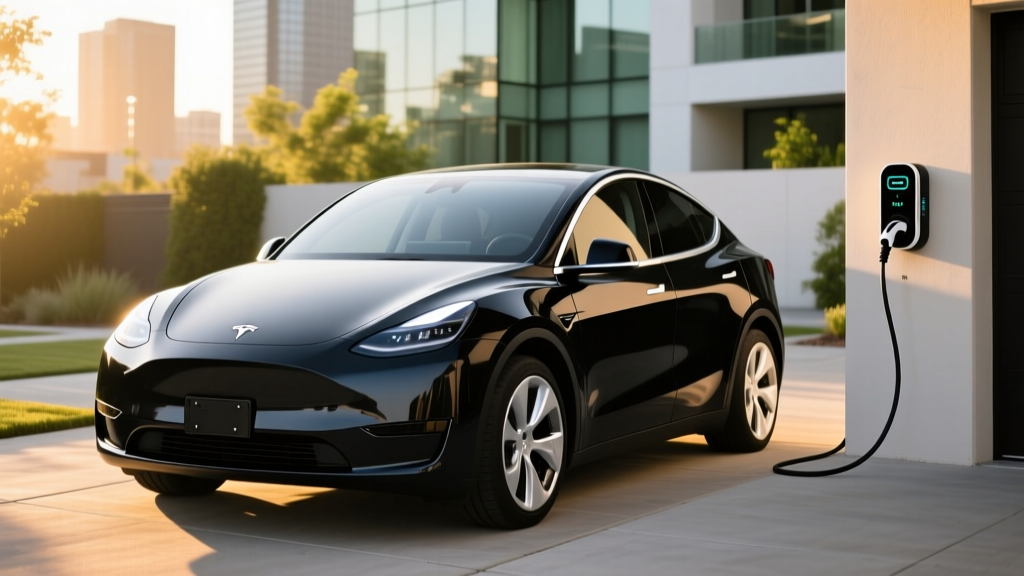
The question "is Tesla a tech company" surfaces constantly in automotive and investment circles. After spending extensive time with the 2026 Tesla Model Y Long Range AWD — Tesla's highest-volume vehicle and the best-selling EV in America — the answer becomes clear: Tesla operates as a software-defined technology company that happens to manufacture vehicles. But does that tech-first identity actually serve EV buyers, or does it create friction where traditional automakers excel? This review examines the Model Y through both lenses.
Range, Battery, and Real-World Efficiency
The 2026 Model Y Long Range AWD carries an 82 kWh usable battery pack (NMC chemistry) and achieves an EPA-estimated 320 miles of range. The base Rear-Wheel Drive model uses a 60 kWh LFP (lithium iron phosphate) pack with a 303-mile EPA rating. LFP batteries trade energy density for longevity and can be charged to 100% daily without degradation concerns — a meaningful advantage for commuters who need full capacity every morning.
EPA 320 miles (Long Range AWD) translates to approximately 270–290 miles in mixed highway driving at 70 mph. In cold weather (below 32°F), expect a 20–30% reduction, bringing usable range to roughly 210–250 miles. The Model Y's heat pump mitigates cabin-heating losses better than resistive systems, but battery chemistry physics still apply. City driving with regenerative braking recovers more energy, often exceeding the EPA combined estimate.
Efficiency lands at 122 MPGe combined (Long Range AWD), or roughly 27 kWh per 100 miles — among the most efficient in the midsize electric SUV segment. Tesla's thermal management system and integrated drivetrain contribute to this advantage over heavier competitors.
| Specification | Long Range AWD | Rear-Wheel Drive |
|---|---|---|
| EPA Range | 320 miles | 303 miles |
| Battery (usable) | 82 kWh NMC | 60 kWh LFP |
| Efficiency | 122 MPGe (27 kWh/100mi) | 128 MPGe (26 kWh/100mi) |
| 0–60 mph | 4.8 seconds | 6.2 seconds |
| Horsepower | 384 hp (dual motor) | 295 hp (single motor) |
| Drivetrain | AWD (dual motor) | RWD |
| Max DC Fast Charge | 250 kW | 170 kW |
| 10–80% DC Time | ~25 minutes | ~30 minutes |
| Base MSRP | $48,990 | $44,990 |
Charging Speed: DC Fast and Home Level 2
The Model Y Long Range AWD peaks at 250 kW on DC fast chargers (Tesla Superchargers V3/V4 or CCS-compatible stations with adapter). However, peak rate is not sustained rate. The charge curve tapers significantly above 60% state of charge. In practice, a 10–80% session takes approximately 25 minutes under optimal battery preconditioning. Without preconditioning — which the navigation system triggers automatically when a Supercharger is selected — cold-soak can add 5–10 minutes to that session.
Home Level 2 charging on a 48-amp (11.5 kW) circuit adds roughly 37 miles per hour of charging. A full 10–100% session takes about 8.5 hours for the Long Range model. Tesla's Mobile Connector and Wall Connector are both compatible with the NACS (North American Charging Standard) port, which is now the industry standard adopted by Ford, GM, Rivian, and others.
| Charging Level | Power | Miles Added per Hour | 10–80% Time |
|---|---|---|---|
| Level 1 (120V outlet) | 1.4 kW | ~4 mi/hr | N/A (overnight partial) |
| Level 2 (240V, 48A) | 11.5 kW | ~37 mi/hr | ~6 hours |
| DC Fast (Supercharger V3) | 250 kW peak | ~180 mi in 15 min | ~25 minutes |
Tesla's Supercharger network remains the most reliable public charging infrastructure in the U.S., with over 6,500 stations and 60,000+ connectors nationwide. The network's uptime and plug-and-charge simplicity set the standard that Electrify America, EVgo, and others are still working to match.
Performance and Drivetrain Dynamics
The Long Range AWD's dual-motor setup delivers 384 horsepower and a 4.8-second 0–60 mph time — quick for a family SUV that seats five and hauls cargo. The Performance variant drops that to 3.5 seconds with 455 hp, though it commands a $52,990 MSRP. Acceleration is linear and immediate, as expected from electric drivetrains, with no turbo lag or transmission hesitation.
Handling benefits from the low center of gravity inherent to skateboard battery platforms. The Model Y's ride quality improved with the 2025 refresh — firmer damping and revised suspension tuning reduce the floatiness that plagued earlier models. However, the steering remains artificially weighted at higher speeds, a common complaint among driving enthusiasts who prefer the feedback of a Porsche Macan Electric or BMW iX.
Tech Stack: Where "Is Tesla a Tech Company" Gets Answered
This is where Tesla's identity as a technology company becomes undeniable. The 15.4-inch center touchscreen runs a proprietary Linux-based OS that handles navigation, media, climate, vehicle settings, and over-the-air (OTA) updates. Tesla pushes software updates monthly, adding features, refining efficiency algorithms, and occasionally introducing entirely new capabilities — something legacy automakers are only beginning to replicate.
Autopilot comes standard and provides SAE Level 2 driver assistance: adaptive cruise control, lane-keeping, and automatic lane changes on highways. Full Self-Driving (Supervised) is an $8,000 add-on that adds city-street navigation, traffic-light recognition, and parking lot maneuvering. Despite the name, FSD remains a Level 2 system — the driver must remain fully engaged and responsible at all times. Tesla's vision-only approach (no LiDAR) generates debate about safety margins compared to Waymo's Level 4 robotaxi architecture, which uses redundant sensor suites.
Full Self-Driving (Supervised) is not autonomous driving. It requires continuous driver supervision, hands-on-wheel monitoring, and readiness to intervene. It does not operate in all weather conditions, construction zones, or unmapped areas. Treat it as an advanced driver-assist system, not a replacement for an attentive driver.
The Tesla app ecosystem — remote climate control, Sentry Mode security cameras, vehicle location tracking, and scheduled charging — is the most mature in the industry. Competitors like Hyundai's Bluelink and FordPass offer similar features, but Tesla's integration depth and reliability remain ahead.
Interior Space, Cargo, and Practicality
The 2025-refreshed Model Y (carried into 2026) improved rear-seat comfort with a longer cushion and recline adjustment. Rear legroom measures 41.6 inches — adequate for adults on longer trips, though the Hyundai Ioniq 5 offers 41.7 inches with a flatter floor. Front legroom is generous at 41.8 inches.
Cargo capacity behind the second row is 30.2 cubic feet, expanding to 72.1 cubic feet with seats folded. The front trunk (frunk) adds 4.1 cubic feet for charging cables or a small bag. Total usable space trails the Ford Mustang Mach-E (59.7 cu ft max) slightly but exceeds the Ioniq 5 (59.3 cu ft max). The Model Y's liftgate opening is wide and practical for loading strollers, luggage, or hardware-store runs.
Pricing, Trims, and Federal Tax Credit Eligibility
The 2026 Model Y lineup starts at $44,990 for the Rear-Wheel Drive (LFP battery, 303-mile range). The Long Range AWD reviewed here is $48,990. The Performance variant is $52,990. Destination charges add $1,390 across all trims.
| Trim | MSRP | Est. Federal Credit (§30D) | Effective Price |
|---|---|---|---|
| Rear-Wheel Drive | $44,990 | Up to $7,500* | ~$37,490 |
| Long Range AWD | $48,990 | Up to $7,500* | ~$41,490 |
| Performance AWD | $52,990 | Up to $7,500* | ~$45,490 |
*Federal tax credit eligibility under IRS §30D rules depends on buyer income caps ($150K single / $300K joint MAGI), vehicle MSRP caps ($80K for SUVs — all Model Y trims qualify), and battery critical-mineral and component sourcing requirements. The Model Y's U.S.-assembled battery currently meets sourcing thresholds for the full $7,500 credit, but these rules shift annually. The credit can be transferred to the dealer at point of sale as a purchase-price reduction. Consult a tax professional to confirm your eligibility.
Warranty and Long-Term Ownership
Tesla covers the Model Y's battery and drive unit for 8 years or 120,000 miles (Long Range/Performance) with a minimum 70% capacity retention threshold. The RWD model with the LFP battery carries an 8-year/100,000-mile battery warranty. The basic vehicle warranty is 4 years/50,000 miles — standard for the segment but shorter than Hyundai's 5-year/60,000-mile basic coverage.
Real-world degradation data from Tesla's fleet suggests the NMC packs lose approximately 10–12% capacity over 150,000 miles. LFP packs show slower degradation curves, often retaining 90%+ capacity at 100,000 miles. Battery replacement out of warranty runs $12,000–$16,000 depending on pack size — a cost buyers should factor into long-term ownership projections.
Pros, Cons, and Who Should Buy
- Class-leading Supercharger network access and reliability
- OTA software updates continuously add features and refinements
- Strong efficiency (122–128 MPGe) reduces charging costs
- Mature app ecosystem and remote vehicle management
- LFP battery option allows daily 100% charging without degradation worry
- Full $7,500 federal tax credit eligibility (as of 2026 sourcing rules)
- Minimalist interior lacks physical buttons — climate and mirror adjustments require touchscreen
- Ride quality improved but still firm compared to Ioniq 5 or Mach-E
- FSD ($8,000) remains Level 2 despite the autonomous-sounding name
- Vision-only driver assist raises concerns in heavy rain, fog, or snow
- No Apple CarPlay or Android Auto — Tesla's native infotainment only
- Panel gaps and build-quality inconsistencies still surface in delivery forums
Best for: Tech-forward commuters and small families who value software integration, OTA updates, and Supercharger reliability. The Model Y suits buyers who prioritize efficiency and charging infrastructure over plush interiors or traditional luxury cues. Road trippers benefit from the Supercharger network's coverage. Budget-conscious buyers should consider the RWD trim with LFP battery for maximum longevity.
Consider alternatives if: You want physical climate controls, Apple CarPlay, or a softer ride. The Hyundai Ioniq 5, Ford Mustang Mach-E, and Kia EV6 all offer compelling packages with more conventional interfaces and competitive range.
Is It Worth Buying vs. Key Competitors?
The Model Y's tech-company DNA is its greatest asset and its greatest vulnerability. The software stack, Supercharger network, and OTA update cadence are unmatched. But competitors have closed the gap on range, charging speed, and interior quality. The Ioniq 5 charges faster (800V architecture, 10–80% in 18 minutes), the Mach-E offers a more traditional SUV feel, and the Rivian R2 (arriving late 2026) promises adventure-oriented capability.
If you value continuous software evolution, the most reliable public charging network, and a proven efficiency record, the Model Y remains the benchmark. If you prioritize interior refinement, physical controls, or faster DC charging, the competition has caught up — and in some areas, surpassed Tesla.
Frequently Asked Questions
What is the real-world range of the 2026 Tesla Model Y?
The EPA estimates 320 miles for the Long Range AWD and 303 miles for the RWD. Real-world highway driving at 70 mph yields approximately 270–290 miles. Cold weather (below 32°F) reduces range by 20–30%, so winter commuters should plan for 210–250 miles.
How fast does the Model Y charge at home and on DC fast chargers?
DC fast charging peaks at 250 kW (Long Range), with a 10–80% session taking about 25 minutes. Home Level 2 charging at 11.5 kW adds roughly 37 miles per hour, fully replenishing the battery overnight.
Does the Model Y qualify for the $7,500 federal EV tax credit?
Yes, as of 2026, all Model Y trims qualify for the full §30D credit, provided the buyer meets income caps ($150K single / $300K joint). The credit can be applied at point of sale. Eligibility depends on battery-sourcing rules that can change — verify with the IRS or a tax professional.
Is Tesla's Full Self-Driving actually self-driving?
No. FSD (Supervised) is an SAE Level 2 driver-assist system. The driver must remain fully engaged, hands on the wheel, and ready to take over at any moment. It is not autonomous driving.
How does the Model Y compare to the Hyundai Ioniq 5 or Ford Mach-E?
The Ioniq 5 charges faster (18-min 10–80%) and offers a more spacious rear seat. The Mach-E provides a more traditional SUV driving feel and physical controls. The Model Y leads in software integration, Supercharger access, and efficiency. The best choice depends on your priorities.