Quick Verdict: The Model Y's Tax Credit Rating and 2026 Value Proposition
The 2026 Tesla Model Y remains the best-selling electric vehicle in the United States for good reason: it delivers a compelling blend of range, charging infrastructure access, and software polish that competitors still struggle to match. But for buyers researching the Tesla credit rating — meaning the Model Y's eligibility for the federal §30D EV tax credit — the picture requires careful attention to IRS sourcing rules, income caps, and MSRP limits that determine whether you'll actually see $7,500 come off your purchase price.
This review covers the 2026 Model Y Long Range AWD and Performance trims with exact EPA figures, real-world range data, charging speeds, and a detailed breakdown of how Tesla's battery sourcing affects your tax credit eligibility in 2026.
| Spec | Long Range AWD | Performance |
|---|---|---|
| EPA Range | 320 miles | 293 miles |
| Battery (usable) | ~75 kWh, NMC | ~75 kWh, NMC |
| Peak DC Fast Charge | 250 kW | 250 kW |
| 10–80% DC Time | ~25 minutes | ~25 minutes |
| Level 2 Home Charge | 11.5 kW (~44 mi/hr) | 11.5 kW (~44 mi/hr) |
| 0–60 mph | 4.8 seconds | 3.5 seconds |
| Horsepower | 384 hp | 456 hp |
| Drivetrain | Dual-Motor AWD | Dual-Motor AWD |
| MPGe (combined) | 111 MPGe | 103 MPGe |
| Efficiency | 30 kWh/100 mi | 33 kWh/100 mi |
| Base MSRP | $44,990 | $51,490 |
| Battery Warranty | 8 yr / 120,000 mi | 8 yr / 120,000 mi |
Range and Efficiency: EPA Sticker vs. Real-World Miles
The 2026 Model Y Long Range AWD carries an EPA-estimated 320 miles of range. The Performance trim drops to 293 miles due to stickier tires, larger 21-inch wheels, and a sportier powertrain calibration. Efficiency for the Long Range sits at a competitive 30 kWh per 100 miles (111 MPGe combined), according to EPA data.
Tesla's NMC (nickel manganese cobalt) battery chemistry provides strong energy density, which is why the Model Y achieves over 300 miles in a relatively compact crossover footprint. However, NMC cells are more sensitive to sustained 100% state-of-charge storage than LFP (lithium iron phosphate) batteries. Tesla recommends daily charging to 80% for NMC packs and reserving 100% charges for road trips — a practice that extends long-term battery health.
Charging Speed: DC Fast Charging and Home Level 2
Charging is where the Tesla ecosystem continues to dominate. The 2026 Model Y supports up to 250 kW on DC fast chargers via the native NACS (North American Charging Standard) connector. On a V3 Tesla Supercharger or any compatible 250+ kW station, the Model Y Long Range can add approximately 200 miles of range in 15 minutes under optimal conditions.
| Charging Level | Power (kW) | Miles Added per Hour | Notes |
|---|---|---|---|
| Level 1 (120V) | ~1.4 kW | ~3–5 mi/hr | Emergency/trickle only |
| Level 2 (240V, 48A) | 11.5 kW | ~44 mi/hr | Home Wall Connector ideal |
| Level 2 (240V, 32A) | 7.7 kW | ~30 mi/hr | Mobile Connector on 240V outlet |
| DC Fast (Supercharger V3) | Up to 250 kW | ~1,000 mi/hr peak | 10–80% in ~25 min |
| DC Fast (Supercharger V4) | Up to 250 kW | ~1,000 mi/hr peak | CCS vehicles via magic dock |
A critical detail many spec sheets omit: peak charge rate is not sustained charge rate. The Model Y hits 250 kW only at a low state of charge (roughly 10–20% SoC) and then tapers progressively. From 10–80%, the average charge rate is closer to 120–140 kW. This is why the 10–80% time is approximately 25 minutes rather than the 18 minutes you'd calculate from peak rate alone. Above 80%, charging slows dramatically to protect battery longevity — plan to unplug and move on at 80% during road trips rather than waiting for a full charge.
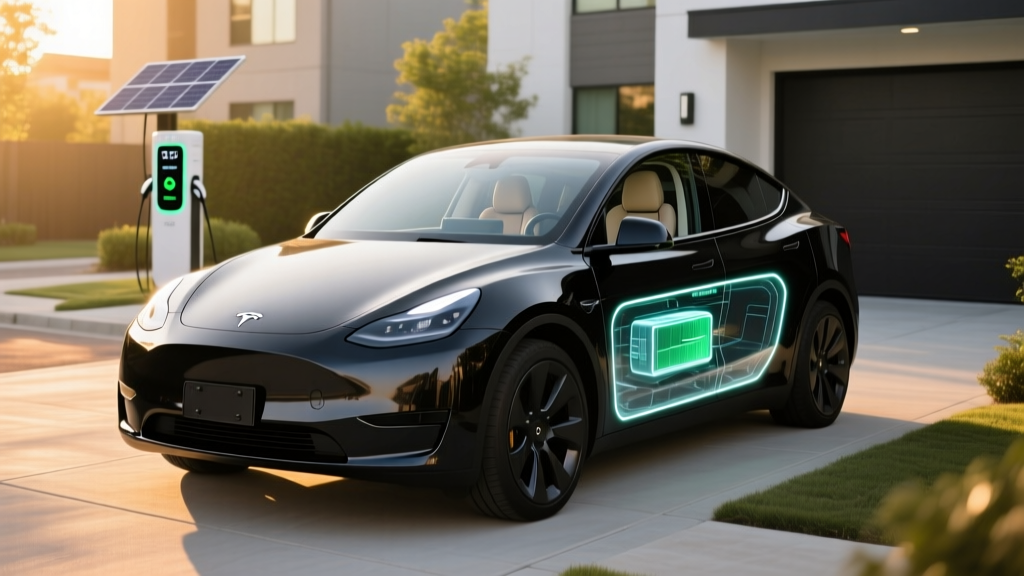
For home charging, Tesla's Wall Connector at 48 amps on a 60-amp circuit delivers 11.5 kW, adding roughly 44 miles of range per hour. A full overnight charge from 20% to 80% takes about 4–5 hours. Installation of a 240V/60A circuit typically costs $800–$2,000 depending on your electrical panel's capacity and the distance from panel to charger location. If your panel is maxed out, a service upgrade to 200A can add $1,500–$3,000.
Performance, Handling, and Drivetrain
The Long Range AWD uses a dual-motor setup producing 384 combined horsepower, achieving a 0–60 mph time of 4.8 seconds. The Performance trim bumps output to 456 hp and drops the sprint to 3.5 seconds — sports-car territory in a five-passenger crossover.
Both trims feature Tesla's adaptive all-wheel-drive system with independent torque control front and rear. The ride quality on the Long Range is firm but compliant; the Performance trim's lowered suspension and 21-inch Überturbine wheels trade some comfort for sharper cornering. Neither trim offers adjustable air suspension — that remains reserved for the Model S and Model X.
Regenerative braking is strong and configurable. In "Hold" mode, the Model Y delivers near one-pedal driving in most city conditions, though it will not come to a complete stop without brake application at very low speeds.
Interior, Cargo, and Technology
The 2026 Model Y's minimalist interior centers on a 15.4-inch touchscreen that controls virtually every vehicle function — climate, mirrors, glovebox, and driving settings. There is no traditional instrument cluster; speed and navigation appear on the main screen. This design polarizes buyers: some find it clean and intuitive, others miss physical buttons for climate and volume.
Cargo volume is a standout: 30.2 cubic feet behind the second row and 72.1 cubic feet with the rear seats folded. The rear trunk includes a deep under-floor storage well, and the front trunk (frunk) adds approximately 4.1 cubic feet for charging cables or a small bag. Total usable storage exceeds most compact SUV competitors, including the Ford Mustang Mach-E and Hyundai Ioniq 5.
Passenger space is adequate for adults in both rows. Rear legroom measures 37.7 inches, and headroom is generous thanks to the glass roof panel (which lacks a shade — a common complaint in summer heat). The second row seats three, though the center position is narrow and best suited for children.
Tech highlights include:
- Autopilot (standard): SAE Level 2 adaptive cruise + lane centering. Requires active driver supervision at all times.
- Full Self-Driving (Supervised) ($8,000 option or $99/month): Enhanced navigation-based lane changes, traffic light/stop sign recognition, and autosteer on city streets. Still Level 2 — the driver must remain fully engaged.
- Over-the-air software updates that add features post-purchase
- Sentry Mode dashcam recording with USB storage
- Dog Mode and Camp Mode for climate management while parked
Pricing, Trim Levels, and the Tesla Tax Credit Rating
The 2026 Model Y is offered in two main trims:
| Trim | Base MSRP | Federal §30D Credit | Effective Price (if eligible) |
|---|---|---|---|
| Long Range AWD | $44,990 | Up to $7,500* | ~$37,490* |
| Performance | $51,490 | Up to $7,500* | ~$43,990* |
*Tax credit eligibility depends on multiple IRS requirements. See checklist below.
Understanding the Tesla credit rating for 2026 requires navigating the evolving IRS §30D clean vehicle credit rules. The Model Y qualifies as an SUV for the $80,000 MSRP cap (higher than the $55,000 sedan cap), and both trims fall well under that threshold. However, eligibility hinges on three additional filters:
- Buyer income caps: Modified adjusted gross income (MAGI) must not exceed $300,000 (married filing jointly), $225,000 (head of household), or $150,000 (single filers).
- Battery component sourcing: For the full $7,500, battery components must be manufactured or assembled in North America (phased thresholds increase annually). If only critical minerals requirements are met, the credit is $3,750.
- Critical minerals sourcing: A percentage of critical minerals must be extracted or processed in the US or a free-trade-agreement country (threshold rises each year through 2027).
- Point-of-sale transfer: As of 2024, buyers can transfer the credit to the dealer at purchase, reducing the upfront price rather than waiting for a tax refund. Tesla supports this at delivery.
- Foreign entity of concern (FEOC) restriction: Vehicles with battery components from a FEOC (primarily targeting certain Chinese manufacturers) are disqualified entirely.
Tesla manufactures the Model Y at its Austin, Texas Gigafactory and sources an increasing share of battery cells from domestic production. For 2026, the Model Y Long Range and Performance have generally qualified for the full $7,500 credit for eligible buyers, but you should verify your specific VIN's eligibility using the IRS's official tool at fueleconomy.gov before placing an order. Battery supply chains shift, and a mid-year sourcing change could alter eligibility.
Warranty Coverage and Long-Term Battery Outlook
Tesla covers the Model Y's battery and drive unit for 8 years or 120,000 miles, whichever comes first, with a guaranteed minimum 70% capacity retention over that period. The basic vehicle limited warranty covers 4 years or 50,000 miles.
Real-world degradation data from Tesla's fleet suggests NMC batteries in the Model Y lose approximately 10–12% of capacity over the first 100,000 miles, after which the degradation curve flattens significantly. Many high-mileage Model Y owners report 85–88% state-of-health at 120,000 miles, comfortably above the warranty threshold.
If a battery replacement is needed out of warranty, current estimates run $12,000–$16,000 for a Model Y pack — a significant sum, though catastrophic battery failure remains statistically rare. Most degradation-related claims involve gradual capacity loss rather than sudden failure.
How the Model Y Compares to Key Competitors
The Model Y's closest rivals in 2026 include the Hyundai Ioniq 5, Ford Mustang Mach-E, and Kia EV6. Each has distinct trade-offs:
- Hyundai Ioniq 5: Offers 800V architecture for faster peak charging (up to 350 kW, 10–80% in ~18 min), but real-world range is slightly lower (305 miles EPA). Less mature charging network access.
- Ford Mustang Mach-E: Competitive range (320 miles Extended Range AWD), but Ford's dealer network and service experience for EVs remains inconsistent. DC fast charging peaks at 150 kW — noticeably slower.
- Kia EV6: Shares the Ioniq 5's 800V platform and fast charging. Slightly smaller cargo area. Build quality and interior materials edge ahead of the Model Y's spartan cabin.
Where Tesla still wins decisively: the Supercharger network. With over 20,000 stalls in North America and industry-leading uptime, Tesla owners face far fewer charging-desert scenarios on road trips. Non-Tesla EVs can now access some Supercharger stalls via the Magic Dock adapter, but the experience is less seamless than native NACS charging.
Choose a competitor if: You want faster DC charging (Ioniq 5/EV6), a more traditional interior with physical controls, or prefer a dealership service model over Tesla's mobile-ranger-and-service-center approach.
- 320-mile EPA range with strong real-world efficiency (30 kWh/100 mi)
- Supercharger network access — the most reliable DC fast-charging ecosystem
- Class-leading cargo volume (72.1 cu ft max)
- Continuous OTA software improvements
- Qualifies for up to $7,500 federal tax credit (eligibility dependent)
- Strong resale value relative to most EVs
- Minimalist interior lacks physical buttons and a dedicated instrument cluster
- No adjustable air suspension; ride can be firm on rough roads
- Glass roof without a shade creates heat in summer
- Service center availability varies by region; mobile ranger wait times can be long
- 250 kW peak DC charging is slower than 800V competitors (Ioniq 5 at 350 kW)
- FSD (Supervised) is expensive and still requires full driver attention
Frequently Asked Questions
What is the real-world range of the 2026 Tesla Model Y?
The EPA rates the Long Range AWD at 320 miles. In real-world highway driving at 70 mph, expect 270–290 miles. In freezing weather, range drops to approximately 220–255 miles due to battery chemistry limitations and cabin heating demands, even with the heat pump.
How fast does the Model Y charge at home and on the road?
At home on a 240V/48A Tesla Wall Connector, the Model Y charges at 11.5 kW, adding about 44 miles per hour — a full overnight charge covers daily needs easily. On a 250 kW Supercharger, the 10–80% charge takes approximately 25 minutes, though peak rate tapers significantly above 50% state of charge.
How much does the 2026 Model Y cost after tax credits?
The Long Range AWD starts at $44,990. If you qualify for the full $7,500 §30D federal credit (meeting income caps, battery sourcing, and MSRP requirements), the effective price drops to approximately $37,490. The Performance trim starts at $51,490, or about $43,990 after the credit. State incentives may reduce the price further — check your state's energy office for details.
Does the 2026 Tesla Model Y qualify for the federal EV tax credit?
Yes, the Model Y generally qualifies for up to $7,500 under IRS §30D, but only if you meet all requirements: income below the MAGI thresholds, battery components and critical minerals meeting 2026 sourcing percentages, and the vehicle's MSRP under the $80,000 SUV cap. Always verify your specific VIN on fueleconomy.gov before purchasing. Consult a tax professional for personal eligibility advice.
Is the Model Y worth buying over the Hyundai Ioniq 5 or Ford Mach-E?
If Supercharger network access, software features, and cargo space are your top priorities, the Model Y is hard to beat. If you value faster peak DC charging (350 kW on the Ioniq 5), a more conventional interior, or prefer dealer-based service, the Ioniq 5 or EV6 may be a better fit. The Mach-E offers comparable range but slower charging. Test-drive all three before deciding.
What is the biggest drawback of the Tesla Model Y?
The most commonly cited complaints are the lack of physical controls (everything runs through the touchscreen), the glass roof without a shade, and inconsistent service center availability in rural areas. The 250 kW DC charging peak, while adequate, is falling behind 800V competitors that charge noticeably faster at compatible stations.