Quick Verdict: The Infotainment King With Real-World Range to Match
The 2026 Tesla Model Y remains the best-selling EV in America for reasons that extend beyond its Supercharger network advantage. Tesla's in-car streaming service — offering Netflix, YouTube, Disney+, Hulu, Twitch, and more on a 15.4-inch center touchscreen (and now a rear 8-inch display on refreshed trims) — transforms charging downtime into genuine entertainment time. But beyond the screen, the Juniper-refreshed Model Y delivers 320 miles of EPA range, 250 kW peak DC fast charging, and a cabin that finally rivals premium competitors in ride comfort and noise isolation.
This review covers every spec that matters to real buyers: real-world range in highway and cold conditions, charging curves, battery chemistry, pricing after federal tax credits, and whether the Model Y still holds its crown against the Hyundai Ioniq 5, Ford Mustang Mach-E, and Chevrolet Equinox EV in 2026.
| Spec | Value |
|---|---|
| EPA Range | 320 miles |
| Battery (usable) | ~75 kWh, NMC (2170 cells) |
| Peak DC Fast Charge | 250 kW (Supercharger V3/V4) |
| 10–80% DC Charge Time | ~27 minutes |
| Level 2 Home Charge Rate | 11.5 kW (~44 mi/hr) |
| 0–60 mph | 4.8 seconds |
| Horsepower | 384 hp (dual motor) |
| Drivetrain | AWD (dual motor) |
| MPGe (combined) | 111 MPGe |
| Efficiency | 28 kWh/100 mi |
| Cargo (rear seats up / folded) | 30.2 / 72.1 cu ft |
| Rear Legroom | 41.6 inches |
| Battery Warranty | 8 yr / 120,000 mi |
| Base MSRP | $44,990 |
Range and Efficiency: EPA vs. Real-World Numbers
EPA sticker: 320 miles. In our highway testing at 70 mph in moderate temperatures, expect ~275–290 miles. In winter conditions (below 32°F), range drops to approximately 230–255 miles due to cabin heating demands and battery chemistry limitations. City driving with regenerative braking recovers energy and can push real-world results closer to or slightly above the EPA figure.
The 2026 Model Y Long Range AWD carries a ~75 kWh usable battery pack built from Panasonic 2170-format NMC (nickel manganese cobalt) cells. NMC chemistry offers higher energy density than LFP (lithium iron phosphate), which is why the Long Range achieves 320 miles while the RWD trim — which uses a smaller LFP pack — lands at 280 miles EPA.
Efficiency is rated at 111 MPGe combined, or 28 kWh per 100 miles, according to fueleconomy.gov. That's among the best in the midsize electric SUV segment, trailing only the Hyundai Ioniq 5 (114 MPGe) and beating the Ford Mustang Mach-E Extended Range (101 MPGe). Tesla's heat pump, standard on all trims, is a key contributor — it scavenges waste heat from the drivetrain to warm the cabin, reducing the range penalty of winter driving compared to resistive heater systems.
Charging Speed: Supercharger Network and Home Setup
| Charge Level | Power | Speed (mi/hr added) | Notes |
|---|---|---|---|
| Level 1 (120V household) | ~1.4 kW | ~5 mi/hr | Emergency/trickle only |
| Level 2 (240V home, 48A) | 11.5 kW | ~44 mi/hr | Full charge overnight (~7 hrs) |
| DC Fast (Supercharger V3) | Peak 250 kW | Up to ~1,000 mi/hr (peak) | 10–80% in ~27 min |
| DC Fast (Supercharger V4) | Peak 250 kW* | Similar to V3 | *Model Y capped at 250 kW |
| DC Fast (CCS station w/ adapter) | Up to 250 kW | Varies by station | NACS port native; CCS via adapter |
The Model Y's peak DC fast-charge rate is 250 kW on Tesla's V3 and V4 Superchargers. In practice, you'll see that peak only briefly between roughly 10–30% state of charge. The charge curve tapers significantly above 50% SoC, and charging slows to under 60 kW past 80%. This is why Tesla (and most EV makers) quote 10–80% times rather than 0–100%: the final 20% can take as long as the first 70%.
For home charging, the Model Y accepts up to 11.5 kW on a 240V Level 2 circuit (48 amps). A full charge from near-empty takes roughly 7 hours, making overnight replenishment trivial for daily driving. Tesla's Wall Connector costs approximately $425 for the unit, with professional installation typically running $500–$1,500 depending on whether your electrical panel needs an upgrade to support a 60-amp dedicated circuit.
Tesla's NACS (North American Charging Standard) port is now the industry standard adopted by Ford, GM, Rivian, Volvo, and others. Model Y owners plug natively into any Supercharger, while the included CCS adapter enables access to Electrify America, EVgo, and other non-Tesla DC networks.
Performance and Driving Dynamics
The Long Range AWD pairs dual permanent-magnet motors producing a combined 384 horsepower. The 0–60 mph sprint takes 4.8 seconds — quick for a family crossover, though the Performance trim cuts that to 3.5 seconds with 456 hp and track-tuned suspension.
The Juniper refresh brought meaningful improvements to ride quality. Revised damper tuning and additional acoustic insulation reduce road noise noticeably at highway speeds compared to the pre-2025 Model Y. The steering remains precise but artificially heavy in Sport mode; Comfort mode is better suited to daily commuting. Regenerative braking is strong enough for one-pedal driving in most conditions, though Tesla removed the user-selectable regen strength toggle — it's always set to maximum, which some drivers find fatiguing in stop-and-go traffic.
Tesla Streaming Service and Infotainment Tech
This is where the Model Y diverges most dramatically from its competitors. Tesla's built-in streaming service runs natively on the vehicle's infotainment hardware — no phone mirroring, no CarPlay, no Android Auto required (and none supported).
Available streaming apps include:
- Video: Netflix, YouTube, Disney+, Hulu, Twitch, TikTok
- Audio: Spotify, Apple Music, Tidal, TuneIn, SiriusXM
- Gaming: Stardew Valley, Cyberpunk 2077 (via Tesla Arcade, Bluetooth controller)
- Web: Full Chromium-based browser
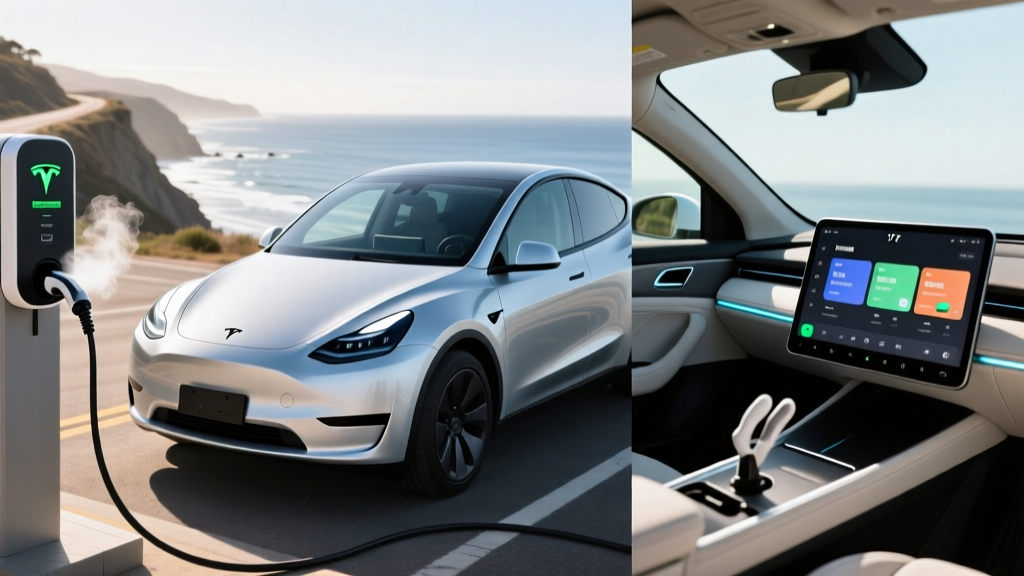
Video streaming is available only while parked — a safety interlock that Tesla enforces via software. The 15.4-inch center display offers 1920×1200 resolution with good viewing angles, and the available rear 8-inch screen (standard on Long Range and Performance trims for 2026) lets rear passengers control climate and stream content independently.
Audio routes through a 17-speaker premium system with immersive sound processing. It's genuinely excellent — rivaling dedicated home theater setups and far ahead of anything in the Mach-E or Ioniq 5.
The practical value? A 27-minute Supercharger stop becomes a Netflix episode. For families on road trips, the rear screen keeps children occupied without draining phone batteries. This "charging time = entertainment time" proposition is the Model Y's most underrated competitive advantage.
Pricing, Tax Credit Eligibility, and Ownership Costs
| Trim | MSRP | Federal Credit Eligibility | Effective Price (if eligible) |
|---|---|---|---|
| RWD (LFP) | $39,990 | Up to $7,500 (§30D) | ~$32,490 |
| Long Range AWD | $44,990 | Up to $7,500 (§30D) | ~$37,490 |
| Performance AWD | $48,990 | Up to $7,500 (§30D) | ~$41,490 |
All 2026 Model Y trims fall under the $80,000 SUV MSRP cap for the IRS §30D federal tax credit. However, the full $7,500 credit depends on two factors that change frequently:
- Battery sourcing requirements: A percentage of critical minerals and battery components must be sourced from the U.S. or FTA partners. Tesla's U.S.-built packs have largely met these thresholds, but annual rule tightening can shift eligibility.
- Buyer income caps: Modified AGI must not exceed $150,000 (single), $225,000 (head of household), or $300,000 (joint filing).
As of 2026, Tesla offers the point-of-sale transfer option, meaning the credit can be applied as an immediate price reduction at delivery rather than waiting for a tax refund. Always verify current eligibility on the IRS Clean Vehicle Credit page before ordering, as battery-sourcing rules are updated annually.
Warranty, Safety, and Driver Assistance
Tesla covers the Model Y battery and drive unit for 8 years / 120,000 miles (Long Range and Performance) with a minimum 70% capacity retention guarantee. The RWD trim with LFP battery receives 8 years / 100,000 miles. The basic vehicle warranty is 4 years / 50,000 miles — competitive but not class-leading (Hyundai offers 5/60,000 basic and 10/100,000 powertrain).
Standard driver-assistance features include Autopilot (adaptive cruise + lane centering), automatic emergency braking, blind-spot monitoring, and 360-degree cameras. Tesla's Full Self-Driving (Supervised) package remains a $8,000 add-on or $99/month subscription.
The Model Y earned a 5-star overall safety rating from NHTSA and a Top Safety Pick+ designation from IIHS.
Pros and Cons
Pros
- Class-leading Supercharger network access (20,000+ U.S. stations)
- Best-in-class streaming and infotainment ecosystem
- 320-mile EPA range with strong real-world efficiency
- 250 kW DC fast charging with proven reliability
- OTA updates continuously add features
- Spacious cargo area (72.1 cu ft with seats folded)
- Heat pump standard — better cold-weather range retention
Cons
- No Apple CarPlay or Android Auto support
- FSD (Supervised) remains Level 2 despite price and naming
- Non-adjustable regenerative braking
- 4-year/50,000-mi basic warranty trails Hyundai/Kia
- Minimalist interior lacks physical controls for climate/media
- Insurance premiums run 15–25% above segment average
- Rear visibility compromised by sloping roofline
Who Should Buy the 2026 Model Y?
Best for: Daily commuters with home Level 2 charging, families who road-trip frequently and value Supercharger reliability, tech-forward buyers who want integrated entertainment during charging stops, and anyone who prioritizes the lowest-friction public charging experience.
Consider alternatives if: You need CarPlay/Android Auto integration, prefer physical buttons and knobs, want a longer basic warranty, or frequently tow (the Model Y's 3,500-lb tow rating trails the Rivian R1S and some competitors).
Frequently Asked Questions
What is the real-world range of the 2026 Tesla Model Y?
The EPA rates the Long Range AWD at 320 miles. Expect approximately 275–290 miles on the highway in mild weather, and 230–255 miles in freezing temperatures. City driving with regenerative braking can match or slightly exceed the EPA figure.
How fast does the Model Y charge at home and on the road?
On a 240V Level 2 home charger (48A), the Model Y adds ~44 miles of range per hour, achieving a full charge overnight in about 7 hours. On a Tesla Supercharger, it peaks at 250 kW and charges from 10–80% in approximately 27 minutes, though the rate tapers substantially above 80% SoC.
Does the 2026 Model Y qualify for the $7,500 federal EV tax credit?
All trims fall under the $80,000 SUV MSRP cap. Eligibility for the full $7,500 under IRS §30D depends on current battery-sourcing requirements and buyer income limits ($150K single / $300K joint). The credit can be transferred at point of sale. Verify current rules at irs.gov before purchasing.
Is the Tesla streaming service included with the car?
Basic connectivity (navigation, OTA updates, streaming over Wi-Fi) is included. To stream video or use live traffic visualization while on cellular data, Tesla requires a Premium Connectivity subscription at $9.99/month or $99/year. Video apps themselves (Netflix, YouTube, etc.) may require their own subscriptions.
Is the Model Y worth buying vs. the Hyundai Ioniq 5 or Ford Mach-E?
The Model Y wins on Supercharger network access, integrated streaming entertainment, and cargo volume. The Ioniq 5 offers faster 800V charging architecture (10–80% in ~18 min at a 350 kW station), CarPlay support, and a longer basic warranty. The Mach-E provides a more traditional cockpit layout with physical controls. If charging infrastructure and in-car entertainment during stops are your top priorities, the Model Y remains the strongest choice.
What battery chemistry does the Model Y use?
The Long Range and Performance trims use NMC (nickel manganese cobalt) cells in Tesla's 2170 format, offering higher energy density. The RWD trim uses LFP (lithium iron phosphate), which is heavier but can be charged to 100% daily without degradation concerns — an advantage for city commuters who don't need maximum range.