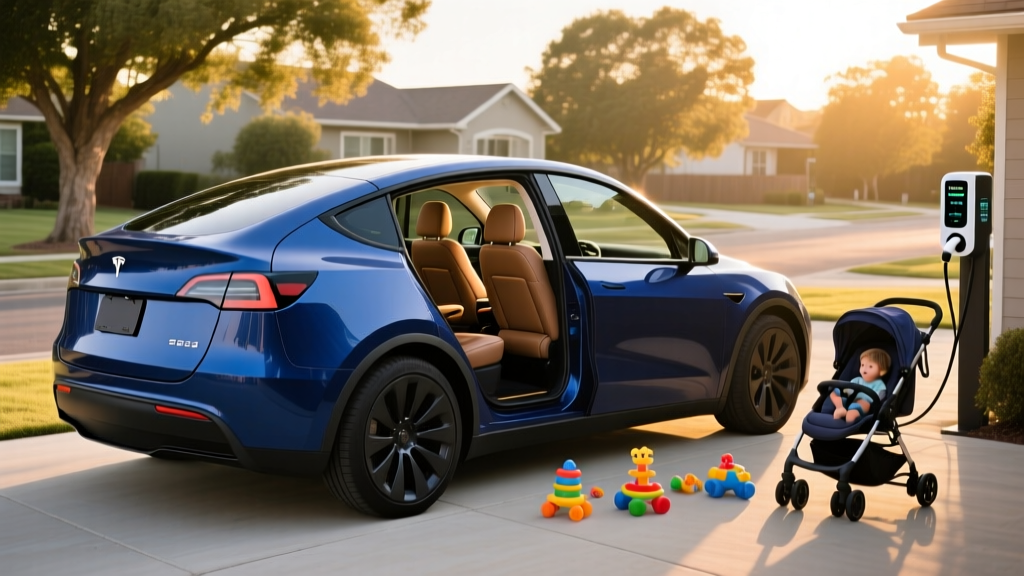
The Tesla Model Y has long dominated the electric SUV sales chart, but for larger families, the five-seat configuration has always left a gap. Enter the Model Y six-seat option — a compact third-row package that transforms Tesla's bestseller into a legitimate three-row family hauler. But bolting two extra seats into a midsize crossover footprint comes with real compromises in cargo volume, third-row legroom, and range. Below, we break down the 2026 Model Y six-seat configuration with hard numbers on range, charging, pricing, and whether it actually works for daily family life.
2026 Tesla Model Y Six Seats: At-a-Glance Specifications
| Spec | Model Y Long Range AWD (6-Seat) | Model Y Performance (6-Seat) |
|---|---|---|
| EPA Range | 308 miles | 277 miles |
| Battery (usable) | ~78 kWh (NMC) | ~78 kWh (NMC) |
| Drivetrain | Dual Motor AWD | Dual Motor AWD |
| Horsepower | 384 hp | 510 hp |
| 0–60 mph | 4.8 sec | 3.5 sec |
| Max DC Fast Charge | 250 kW | 250 kW |
| 10–80% DC Time | ~25 min | ~25 min |
| Level 2 Home Charge | 11.5 kW (~44 mi/hr) | 11.5 kW (~44 mi/hr) |
| MPGe (combined) | 117 MPGe | 111 MPGe |
| Efficiency | 29 kWh/100 mi | 30 kWh/100 mi |
| Seating | 2+2+2 (6 seats) | 2+2+2 (6 seats) |
| Cargo (behind 3rd row) | ~12 cu ft | ~12 cu ft |
| Cargo (3rd row folded) | ~34 cu ft | ~34 cu ft |
| Cargo (all rows folded) | ~72 cu ft | ~72 cu ft |
| Base MSRP | $52,990 | $57,990 |
| 6-Seat Option Cost | +$3,000 | +$3,000 |
| Battery/Drive Unit Warranty | 8 yr / 120,000 mi | 8 yr / 120,000 mi |
Source: fueleconomy.gov and Tesla's official 2026 specifications. The six-seat option is a factory-order add-on available on Long Range and Performance trims.
Real-World Range: What the EPA Sticker Doesn't Tell You
EPA Estimated: 308 miles (Long Range AWD, 6-seat)
Real-World Highway (70 mph): ~250–270 miles
Cold Weather (below 32°F, mixed driving): ~220–245 miles
City / Moderate Climate: ~285–305 miles
The Model Y Long Range AWD's EPA rating of 308 miles is based on a blended city/highway cycle. In sustained highway driving at 70+ mph — where aerodynamic drag dominates — expect to lose roughly 12–18% from that sticker number. The six-seat configuration adds approximately 60–80 lbs of seat hardware and structural bracing, which marginally increases energy consumption compared to the five-seat variant (roughly 1–2 kWh/100 mi penalty in mixed testing).
Cold weather is the bigger variable. Without preconditioning the battery, lithium-ion chemistry in the NMC pack loses 20–30% of effective capacity in sub-freezing temperatures. Tesla's heat pump and battery preconditioning (activated when you navigate to a Supercharger) mitigate this significantly, but owners in northern climates should plan for ~230 miles of usable range in January conditions. For most daily commutes and school runs, this is ample; for 300+ mile road trips with kids in the third row, you'll want to plan one charging stop.
Charging Speed: DC Fast, Home Level 2, and the 400V Ceiling
The Model Y continues on Tesla's 400-voltage architecture (unlike the Cybertruck's 800V system), which caps peak charging at 250 kW on V3 Superchargers. Here's what that looks like across charging scenarios:
| Charging Level | Power | Speed (miles added) | Notes |
|---|---|---|---|
| Level 1 (120V household) | ~1.4 kW | ~4 mi/hr | Emergency/trickle only |
| Level 2 (240V, 48A Wall Connector) | 11.5 kW | ~44 mi/hr | Full charge in ~7 hours overnight |
| DC Fast (V3 Supercharger) | Peak 250 kW | ~162 mi in 15 min | 10–80% in ~25 min; tapers sharply above 80% |
| DC Fast (V4 Supercharger) | Up to 250 kW* | Same as V3 for Model Y | *V4 hardware supports higher kW, but Model Y's 400V system caps at 250 kW |
The charge-curve reality: The 250 kW peak is only sustained between roughly 10–30% state of charge. From 30–60%, it tapers to ~175 kW, and from 60–80% it drops further to ~100 kW. Above 80%, charging slows to under 50 kW to protect the NMC cells. This is why Tesla's quoted "10–80% in 25 minutes" is the meaningful metric — don't plan road-trip stops around the peak number alone.
For home charging, Tesla's Gen 3 Wall Connector at 48 amps delivers 11.5 kW on a 60-amp circuit. A full overnight charge from 10% takes roughly 7 hours. Most six-seat Model Y owners doing school-dropoff commutes will use 20–40% of the battery daily and easily replenish overnight.
Third-Row Practicality: Who Actually Fits Back There?
The six-seat Model Y uses a 2+2+2 configuration with two individual captain's chairs in the third row, separated by a narrow center aisle. This is not a full-size three-row SUV — think of it as a "2+2+2 occasional use" layout rather than a minivan replacement.
Third-row dimensions (approximate):
- Legroom: ~26.5 inches
- Headroom: ~35.5 inches
- Seat width: suitable for children up to roughly 5'4" / 120 lbs
- Access: via second-row fold-and-slide mechanism
Adults can physically sit in the third row for short trips (under 30 minutes), but knees will be elevated and headroom is tight due to the sloping roofline. This configuration works best for families with two children under 12 who need occasional third-row seating for carpool duty, sports-team rides, or visiting grandparents. For regular six-adult transport, a used Rivian R1S or a Kia EV9 (320-mile range, true three-row) will serve you better.
Cargo trade-off: With the third row upright, you get approximately 12 cubic feet behind it — enough for two carry-on bags or a week of groceries for a family of six. Fold the third row flat and you recover ~34 cubic feet, which handles strollers, sports equipment, and luggage comfortably. The front trunk (frunk) adds roughly 4 cubic feet for charging cables or a small cooler.
Pricing, Trims, and Federal Tax Credit Eligibility
| Configuration | MSRP | Est. Federal Credit* | Effective Price |
|---|---|---|---|
| Long Range AWD + 6-Seat | $55,990 | Up to $7,500 | ~$48,490 |
| Performance + 6-Seat | $60,990 | Up to $7,500 | ~$53,490 |
*Federal tax credit (IRS §30D) eligibility depends on multiple requirements. See checklist below.
- MSRP Cap: SUVs must be under $80,000 — both Model Y trims qualify ✓
- Buyer Income Cap: MAGI ≤ $300,000 (married filing jointly), $225,000 (head of household), $150,000 (single)
- Battery Sourcing: Critical minerals and battery components must meet phased-in percentage thresholds — Tesla has largely localized supply chains, but verify current-year compliance at irs.gov
- Point-of-Sale Transfer: As of 2024+, you can transfer the credit to the dealer at purchase for an immediate price reduction, rather than waiting to claim it on your tax return
- Tax Liability: The credit is non-refundable — you must owe at least $7,500 in federal tax to capture the full amount (unless transferred at POS)
The Model Y's pricing places it squarely in the sweet spot for the full $7,500 credit, assuming the buyer meets income requirements and the vehicle's battery sourcing passes current-year thresholds. Tesla has invested heavily in North American battery production (notably the LFP cells from CATL for RWD models and NMC cells from Panasonic at Gigafactory Nevada), but critical-mineral sourcing rules tighten annually. Always confirm eligibility on the IRS website or with your tax professional before purchasing.
Driving, Tech, and the Autopilot Reality
The Long Range AWD variant produces 384 horsepower across its dual motors, delivering a 4.8-second 0–60 mph time that's quicker than nearly every gas-powered three-row SUV on the market. The Performance trim bumps that to 510 hp and 3.5 seconds. Both variants feature Tesla's adaptive suspension tuning, which in the 2026 "Juniper" refresh is noticeably more compliant over rough pavement than earlier Model Y iterations.
Driver Assistance — SAE Level 2, Not Self-Driving:
Tesla Autopilot and Full Self-Driving (Supervised) are Level 2 driver-assist systems, not autonomous driving. The driver must keep hands on the wheel, eyes on the road, and remain prepared to take over at any moment. FSD Supervised adds automatic stop-sign/light handling, city-street turns, and lane-change decisions — but it is not Level 4 (which describes fully driverless services like Waymo in geofenced zones). Treat it as a highly capable cruise-and-steering assistant, not a chauffeur.
The 15.4-inch center touchscreen runs Tesla's latest software (v12.x as of early 2026) and controls virtually every vehicle function. For families, the key features include:
- Rear-seat entertainment: The rear 8-inch screen streams Netflix/YouTube and controls rear HVAC — essential for keeping third-row passengers occupied
- Camp Mode: Maintains cabin climate overnight, useful for road trips
- Sentry Mode: 360° camera recording while parked (adds ~1 mile of range loss per day)
- Dog Mode: Climate-controlled cabin with external display message
- Over-the-air updates: Regular feature additions without dealer visits
Biggest Pros and Cons of the Six-Seat Model Y
✓ Pros
- Access to Tesla's 20,000+ Supercharger network — the most reliable DC fast-charging ecosystem in North America
- Class-leading efficiency (29 kWh/100 mi) keeps charging costs low
- Quick 250 kW DC charging (10–80% in ~25 min) minimizes road-trip downtime
- Eligible for full $7,500 federal credit (subject to sourcing/income rules)
- Strong OTA software updates and resale value
- Low center of gravity from skateboard battery = stable handling for a three-row
✗ Cons
- Third row is child-sized — adults will be uncomfortable beyond short trips
- Only ~12 cu ft cargo with third row up (tight for a family of six's gear)
- Range drops to ~250–270 mi highway; cold weather pushes it lower
- 400V architecture limits peak DC charge vs. 800V rivals (Hyundai/Kia EV9 at 350 kW)
- No Apple CarPlay / Android Auto — Tesla's native interface only
- $3,000 option cost for two small seats is steep on a per-seat basis
- Insurance premiums run 15–25% higher than comparable gas SUVs
Competitor Check: Model Y Six Seats vs. Three-Row EV Alternatives
The six-seat Model Y doesn't compete in a vacuum. Here's how it stacks against the most relevant three-row EVs in 2026:
| Vehicle | EPA Range | Seating | 3rd-Row Usability | Max DC kW | Starting MSRP |
|---|---|---|---|---|---|
| Tesla Model Y (6-seat) | 308 mi | 6 (2+2+2) | Children only | 250 kW | $55,990 |
| Kia EV9 Land AWD | 270 mi | 7 (2+3+2) | Adults (short trips) | 350 kW (800V) | $60,900 |
| Hyundai Ioniq 9 (est.) | ~300 mi | 6 or 7 | Adults (short trips) | 350 kW (800V) | ~$58,000 |
| Rivian R1S Dual-Motor | 352 mi | 7 (2+3+2) | Adults (moderate trips) | 220 kW | $79,900 |
| VW ID.4 (no 3rd row) | 275 mi | 5 | N/A | 175 kW | $40,790 |
The Model Y's primary advantage is price-plus-Supercharger-access. No competitor at this price point offers a six-seat EV with access to 20,000+ reliable DC fast chargers. However, if you regularly carry adults in the third row or need more cargo space with all seats up, the Kia EV9 or the upcoming Hyundai Ioniq 9 offer genuinely usable third rows — at a higher price and without Tesla's charging network (though both have NACS adapters for Supercharger access as of late 2025).
Who Should Buy the Model Y Six-Seat?
- Choose the Model Y 6-seat if: You have two young children and occasionally need to carry 1–2 additional kids (carpool, playdates), you value Supercharger access for family road trips, and you mostly drive in moderate climates with home charging.
- Choose the Kia EV9 or Rivian R1S if: You regularly transport adults or teens in the third row, need 30+ cu ft of cargo with all seats up, or want 800V ultra-fast charging (EV9).
- Stick with the 5-seat Model Y if: Your family is four or fewer, and you prioritize cargo space and range over occasional extra seating.
The six-seat Model Y is a niche solution done well — not a minivan killer, but a credible option for families who need a sometimes six-seater with best-in-class charging infrastructure. The real-world range of 250–270 highway miles means most family road trips will require exactly one 25-minute Supercharger stop, which lines up conveniently with a rest break for kids.
Frequently Asked Questions
What is the real-world range of the Model Y six-seat?
EPA-rated at 308 miles (Long Range AWD), expect roughly 250–270 miles in real-world highway driving and 220–245 miles in cold weather. City driving in moderate temperatures gets closest to the EPA sticker at 285–305 miles.
How fast does the six-seat Model Y charge at home and on the road?
At home on a Level 2 Tesla Wall Connector (48A/11.5 kW), it adds about 44 miles of range per hour, fully charging overnight in ~7 hours. On a V3 Supercharger at 250 kW peak, 10–80% takes approximately 25 minutes, with the charge rate tapering significantly above 80%.
How much does the Model Y six-seat cost after the federal tax credit?
The Long Range AWD with the six-seat option starts at $55,990 MSRP. If you qualify for the full $7,500 §30D credit (meeting income, sourcing, and tax-liability requirements), the effective price drops to approximately $48,490. The Performance trim with six seats comes to ~$53,490 after credit.
Does the Model Y six-seat qualify for the $7,500 federal EV tax credit?
It is eligible, but qualification depends on your modified adjusted gross income (≤$300K joint / $150K single), the vehicle's battery-sourcing compliance with 2026 critical-mineral thresholds, and having sufficient tax liability. The credit can be transferred to the dealer at point of sale for an instant discount. Verify current-year rules at irs.gov.
Can adults fit in the Model Y third row?
Technically yes, but not comfortably. With ~26.5 inches of legroom and limited headroom from the sloping roofline, the third row is best suited for children under 5'4". Adults can manage 15–20 minute trips in a pinch, but this is not a vehicle for regular six-adult transport.
Is the six-seat Model Y worth it vs. the Kia EV9?
If your budget is under $56K and you only occasionally need six seats (for kids), the Model Y offers better value with lower running costs and superior charging infrastructure. If you need a genuine adult-sized third row and more cargo space, the EV9 is the better family vehicle — at $5,000+ more and with a growing but less mature charging network.
What's the battery warranty on the Model Y?
Tesla covers the battery and drive units for 8 years or 120,000 miles (whichever comes first) on the Long Range and Performance trims, with a minimum 70% capacity retention threshold over that period. The NMC chemistry typically degrades 10–15% over the first 100,000 miles based on fleet data, meaning most owners will remain well within warranty coverage.