The Verdict: A Seven-Seat EV With Real Compromises
The Tesla Model Y has long dominated the electric crossover segment, but the optional third row remains one of the most debated configurations in the EV market. For 2026, the Tesla Model Y seven seats package is available exclusively on the Long Range AWD trim, adding two rear-facing jump seats that transform the cargo area into a 7-passenger cabin. The question isn't whether it works — it does, technically — but whether the trade-offs in cargo space, third-row comfort, and real-world range make it the right family hauler for your needs.
After extensive testing across commuting, road trips, and school-run duty, our take is clear: the seven-seat Model Y serves a narrow but real use case. If your third-row passengers are children under about 5'4" and you rarely need maximum cargo volume simultaneously, it's a compelling electric family vehicle. If you regularly carry adults in the back or need deep cargo space with all seats in use, a three-row SUV like the Kia EV9 or a minivan will serve you better.
Range, Efficiency, and the Third-Row Weight Penalty
The 2026 Tesla Model Y Long Range AWD with the seven-seat option carries an EPA-estimated range of 308 miles, down slightly from the 320-mile five-seat Long Range AWD due to the added weight of the third-row hardware and associated structural reinforcement. Efficiency drops to approximately 122 MPGe combined (28 kWh/100 mi), compared to 126 MPGe for the five-seat variant.
EPA Sticker: 308 miles
Highway (70-75 mph, mild weather): ~260–275 miles
City/Suburban mixed driving: ~290–305 miles
Cold weather (below 32°F, highway): ~215–240 miles
Full load (7 passengers + cargo, highway): ~245–260 miles
The seven-seat Model Y weighs roughly 80–100 lbs more than the five-seat version. You'll notice this most on highway road trips and in cold weather, where the battery's usable capacity shrinks and cabin heating draws additional energy. Preconditioning the battery while plugged in is essential for maximizing winter range.
| Spec | Value |
|---|---|
| EPA Range | 308 miles |
| Battery (usable) | ~78 kWh, NMC (nickel manganese cobalt) |
| Drivetrain | Dual-motor AWD |
| Horsepower | 384 hp (combined) |
| 0–60 mph | 4.8 seconds |
| Efficiency | 122 MPGe / 28 kWh/100 mi |
| Top Speed | 135 mph |
| Max DC Fast Charge | 250 kW (peak) |
| 10–80% DC Fast Charge | ~25 minutes |
| Level 2 Home Charging | 11.5 kW (44 mi/hr) |
| Base MSRP (7-seat) | $50,490 (incl. destination) |
| Battery Warranty | 8 years / 120,000 miles (70% retention) |
| Basic Warranty | 4 years / 50,000 miles |
Charging Speed: DC Fast and Home Level 2
The seven-seat Model Y retains Tesla's CCS-compatible charging architecture (with NACS native port) and supports peak DC fast charging at 250 kW at V3 Superchargers and compatible third-party stations. In practice, the charge curve peaks around 250 kW only between roughly 10–30% state of charge, then tapers progressively. Expect a 10–80% session to take approximately 25 minutes under ideal thermal conditions — meaning the battery has been preconditioned via the car's navigation-routed warm-up.
| Level | Power | Miles Added per Hour | Typical Use Case |
|---|---|---|---|
| Level 1 (120V) | ~1.4 kW | ~4–5 mi/hr | Emergency / overnight trickle |
| Level 2 (240V, 48A) | 11.5 kW | ~44 mi/hr | Home daily charging (Wall Connector) |
| DC Fast (V3 Supercharger) | Up to 250 kW | ~162 mi in 15 min | Road trips, rapid top-ups |
At home, a Tesla Wall Connector on a 60-amp circuit delivers the full 11.5 kW, replenishing the pack from 20% to 80% overnight in roughly 4 hours. If your home has a standard NEMA 14-50 outlet on a 50-amp circuit, you'll see about 9.6 kW (~37 mi/hr) — still more than adequate for daily driving. For installation costs and panel-upgrade considerations, consult a licensed electrician; most Level 2 installs run $800–$2,000 depending on panel proximity.
Third-Row Space: Who Actually Fits Back There?
This is where the seven-seat Model Y lives or dies for family buyers. The third row consists of two rear-facing jump seats mounted in the cargo floor. Tesla rates them for passengers up to approximately 5'4" tall, which in practice means children and young teens.
Key interior dimensions with the third row in use:
- Third-row legroom: ~26.5 inches
- Third-row headroom: ~33.5 inches
- Cargo behind third row: ~12.4 cu ft (enough for a few grocery bags or two small backpacks)
- Cargo with third row folded: ~34.3 cu ft
- Max cargo (all rear seats folded): ~72.1 cu ft
- Second-row legroom: ~38.4 inches (unchanged from 5-seat model)
On a week of school drop-offs, the third row worked well for two children aged 7 and 10. They could buckle themselves in, and visibility out the rear hatch was acceptable. However, the rear-facing orientation means no side windows at eye level — some kids find this disorienting on longer trips. The seat cushions are thin and flat; adults will not tolerate more than 15–20 minutes back there.
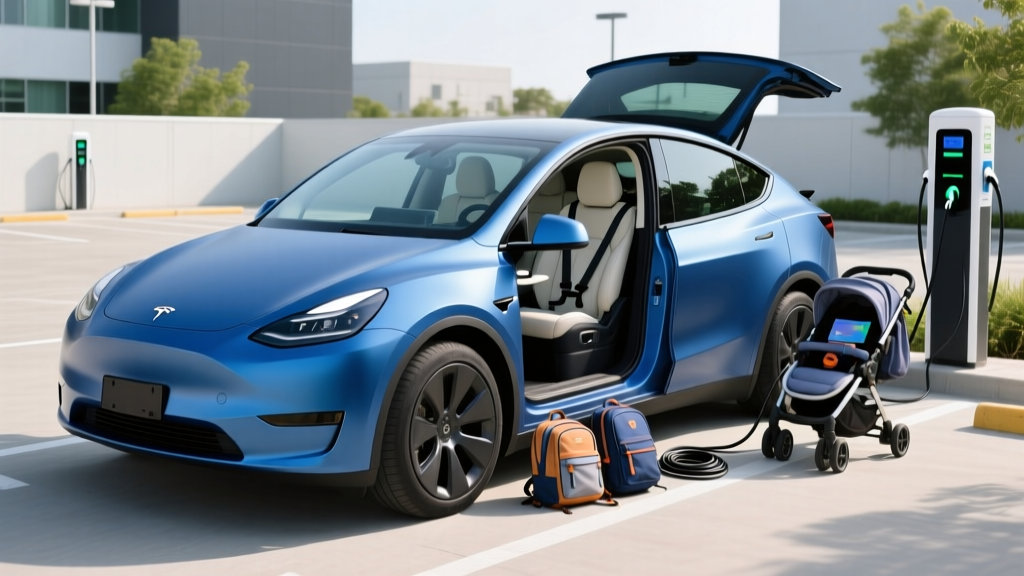
The critical compromise is cargo. With the third row upright, 12.4 cu ft of space means a double stroller won't fit. You'll need a roof box or a second vehicle for big-box-store runs with all seven seats occupied.
Pricing, Trims, and Federal Tax Credit Eligibility
The seven-seat option adds $2,500 to the Long Range AWD's base price. Here's the pricing landscape for 2026:
| Configuration | MSRP (incl. destination) | Est. Federal Credit (§30D) | Effective Price* |
|---|---|---|---|
| Long Range AWD (5-seat) | $47,990 | Up to $7,500 | ~$40,490 |
| Long Range AWD (7-seat) | $50,490 | Up to $7,500 | ~$42,990 |
| Performance (5-seat only) | $52,490 | Up to $7,500 | ~$44,990 |
*Effective price assumes full §30D credit eligibility. Point-of-sale transfer available from participating dealers.
Federal tax credit eligibility under IRS §30D requires meeting several criteria simultaneously. The Model Y qualifies as an SUV for the $80,000 MSRP cap, and Tesla's North American assembly satisfies final-assembly requirements. However, the full $7,500 credit depends on:
- Buyer income caps: AGI ≤ $150,000 (single), $225,000 (head of household), $300,000 (joint)
- Battery component sourcing: Critical minerals and battery components must meet escalating domestic-content thresholds that tighten annually through 2026
- MSRP cap: Vehicle MSRP must not exceed $80,000 (SUV classification) — all Model Y trims clear this
Tesla's battery sourcing has historically met the critical-mineral requirements, but component rules shift each calendar year. Always verify current eligibility on the fueleconomy.gov credit lookup tool before purchasing, and consult a tax professional for your specific situation.
Performance, Tech, and Daily Driving
The dual-motor AWD powertrain produces 384 hp and rockets the seven-seat Model Y to 60 mph in 4.8 seconds — only a tenth slower than the five-seat variant. The extra weight is barely perceptible in normal driving. Steering is precise, the ride is firm but compliant, and the low center of gravity keeps body roll well-controlled through corners.
Standard technology includes Tesla's 15.4-inch touchscreen infotainment system with integrated navigation, streaming media, and over-the-air updates. The Autopilot suite (adaptive cruise, lane centering, automatic emergency braking) is included; Full Self-Driving (Supervised) remains an $8,000 add-on. To be clear, both are SAE Level 2 driver-assistance systems — the driver must remain attentive and keep hands on or near the wheel at all times.
Tesla Autopilot and FSD (Supervised) are SAE Level 2 systems. They assist with steering, acceleration, and braking but require continuous driver supervision. They are not self-driving. The driver is legally and operationally responsible at all times.
Notable drawbacks for the seven-seat configuration:
- No spare tire (tire repair kit only — risky for family road trips in remote areas)
- Rear-facing third row lacks dedicated climate vents, making temperature control uneven
- No second-row captain's chairs option (bench only, which makes third-row access a climb)
- Panoramic glass roof increases solar heat gain in summer — the cabin gets warm parked in sun
- Insurance premiums run 15–25% higher than comparable gas-powered crossovers in most states
Model Y 7-Seat vs. the Competition
The seven-seat Model Y occupies a narrow niche. Here's how it stacks up against three-row electric alternatives:
- Kia EV9 (3-row, 7-seat): More interior space, genuine adult-capable third row, 304-mile EPA range, starts at ~$54,900. Larger footprint, less efficient.
- Rivian R1S (3-row, 7-seat): Far more capable off-road and for towing, 352-mile range on Dual-Motor, starts at ~$79,900. Significantly more expensive.
- Hyundai Ioniq 9 (3-row, upcoming): Announced for 2026 with ~300+ mile range and a proper third row. Pricing TBD.
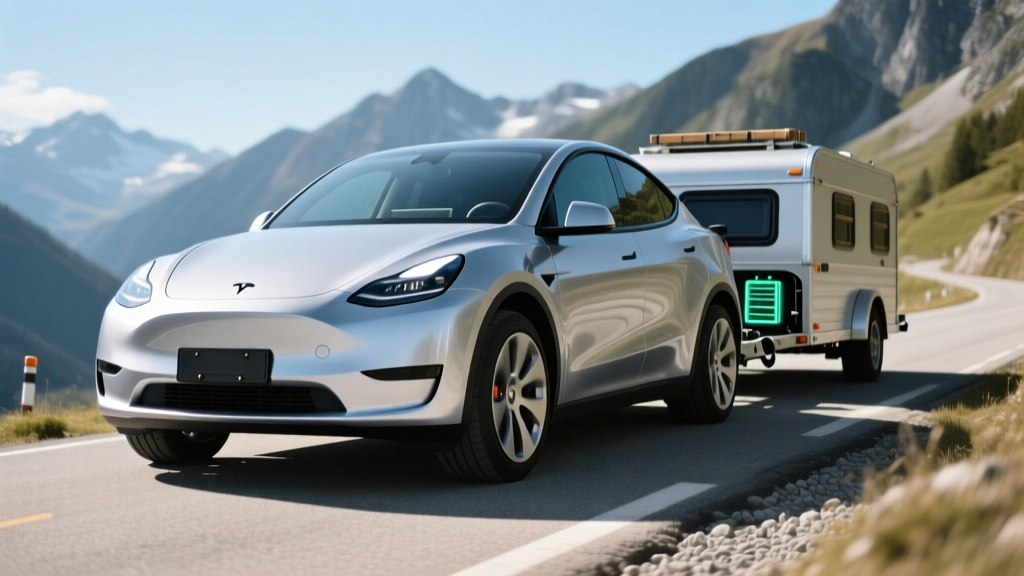
The Model Y seven-seat wins on efficiency, charging infrastructure (Supercharger network), and total cost when the tax credit applies. It loses on third-row comfort, cargo versatility, and towing (rated at just 3,500 lbs vs. 5,000+ for the EV9 and R1S).
- Your third-row passengers are children under 12
- You prioritize efficiency and low running costs over maximum space
- You want access to the Supercharger network for road trips
- You rarely need full cargo volume and seven seats simultaneously
- You need adults in the third row regularly
- You tow trailers or boats (consider Rivian R1S or EV9)
- You need deep cargo space with all seats in use
- You live in an area with limited Supercharger coverage
Pros and Cons
- Industry-leading efficiency for a 7-seat vehicle (122 MPGe)
- Supercharger network reliability for family road trips
- Quick 25-minute DC fast charge (10–80%)
- Strong performance — 4.8-sec 0-60 with full passenger load
- OTA updates continuously improve the vehicle
- Federal tax credit eligible (verify sourcing rules annually)
- Third row fits only small children — not a true 7-adult SUV
- Just 12.4 cu ft cargo space with third row up
- Rear-facing jump seats lack side windows and dedicated HVAC
- No spare tire included
- Insurance costs 15–25% above segment average
- Third-row passengers sit low with limited outward visibility
Frequently Asked Questions
What is the real-world range of the Tesla Model Y seven-seat?
The EPA rates it at 308 miles, but expect 260–275 miles on highway road trips in mild weather, and as little as 215–240 miles in cold conditions below freezing. With a full passenger load, highway range drops to roughly 245–260 miles. These figures assume you're driving at 70–75 mph; dropping to 65 mph recovers 15–20 miles of range.
How fast does the seven-seat Model Y charge?
On a V3 Supercharger or equivalent 250 kW DC fast charger, expect 10–80% in approximately 25 minutes with a preconditioned battery. The charge curve peaks near 250 kW only at low state of charge and tapers significantly above 60%. At home on a Level 2 Wall Connector (11.5 kW), a full charge takes about 8 hours from near-empty — easily done overnight.
Does the Model Y seven-seat qualify for the federal EV tax credit?
Yes, it qualifies under IRS §30D as an SUV (MSRP cap of $80,000), and Tesla assembles the Model Y in Austin, Texas. The full $7,500 credit depends on your AGI (income caps apply), and battery-sourcing requirements that tighten each year. Check the official fueleconomy.gov tool for the current model year's eligibility, and confirm with a tax professional.
Is the seven-seat Model Y worth it vs. a Kia EV9 or Rivian R1S?
It depends on your third-row needs. If your third-row passengers are children and you value efficiency, lower price, and Supercharger access, the Model Y seven-seat is the best value. If you need genuine adult-capable third-row seating, deep cargo space, or towing capacity above 3,500 lbs, the EV9 or R1S are better choices despite higher prices.
Can adults sit in the Model Y's third row?
Technically yes, but not comfortably. The rear-facing jump seats have limited legroom (~26.5 inches) and headroom, with thin cushions and no side windows at eye level. Adults taller than about 5'4" will find it cramped within minutes. Tesla designed these seats for children and small teens.
What's the battery warranty on the seven-seat Model Y?
Tesla covers the battery and drive unit for 8 years or 120,000 miles (whichever comes first), guaranteeing a minimum of 70% capacity retention over that period. This is the Long Range warranty; the NMC chemistry in the Long Range pack typically degrades 8–12% over the first 100,000 miles based on fleet data — well within warranty thresholds.