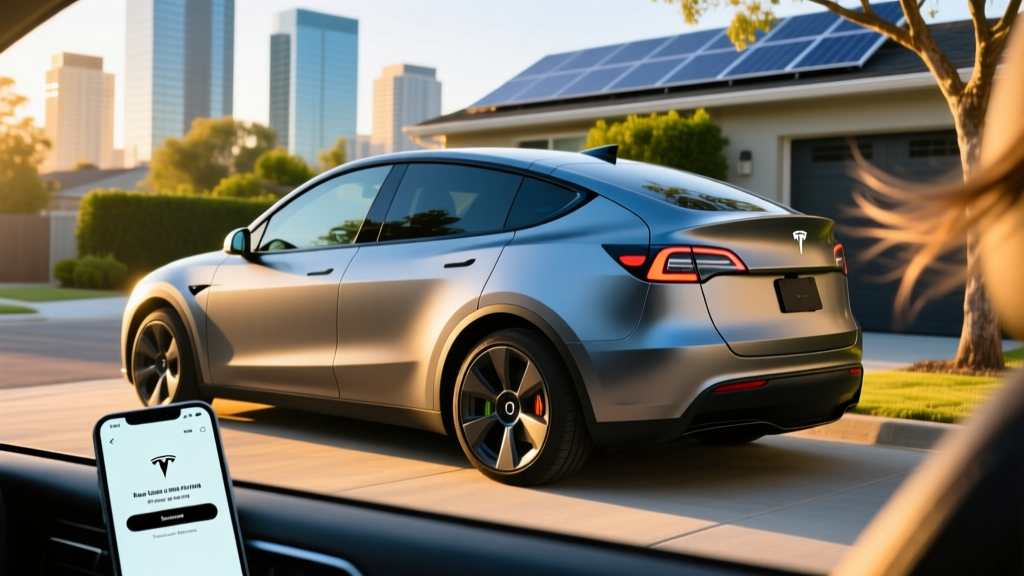
The Tesla Model Y remains one of the best-selling electric vehicles globally, and for good reason: it pairs crossover practicality with sedan-like efficiency. But beyond the EPA range sticker and 0-60 times, buyers increasingly search for details on Tesla Model Y seats — how many passengers fit, whether the optional third row is viable, and how cargo space compares to rivals like the Hyundai Ioniq 5 or Ford Mustang Mach-E. This 2026 profile covers the refreshed "Juniper" Model Y's interior, seating configurations, and the full ownership picture from range to tax credits.
2026 Tesla Model Y at a Glance
| Spec | Long Range AWD | Performance AWD | Standard Range RWD |
|---|---|---|---|
| EPA Range | 327 miles | 298 miles | 302 miles |
| Battery (Usable) | ~75 kWh (NMC) | ~75 kWh (NMC) | ~60 kWh (LFP) |
| Efficiency | 27 kWh/100 mi (126 MPGe) | 29 kWh/100 mi (117 MPGe) | 26 kWh/100 mi (130 MPGe) |
| Max DC Fast Charge | 250 kW | 250 kW | 250 kW |
| 10–80% DC Time | ~27 min | ~27 min | ~25 min |
| Level 2 Rate | 11.5 kW (~44 mi/hr) | 11.5 kW (~44 mi/hr) | 11.5 kW (~44 mi/hr) |
| 0–60 mph | 4.8 sec | 3.5 sec | 5.9 sec |
| Horsepower | 384 hp | 456 hp | 295 hp |
| Drivetrain | Dual-Motor AWD | Dual-Motor AWD | RWD |
| Base MSRP | $48,990 | $53,990 | $44,990 |
Tesla Model Y Seats: 5-Passenger Standard, 7-Passenger Option
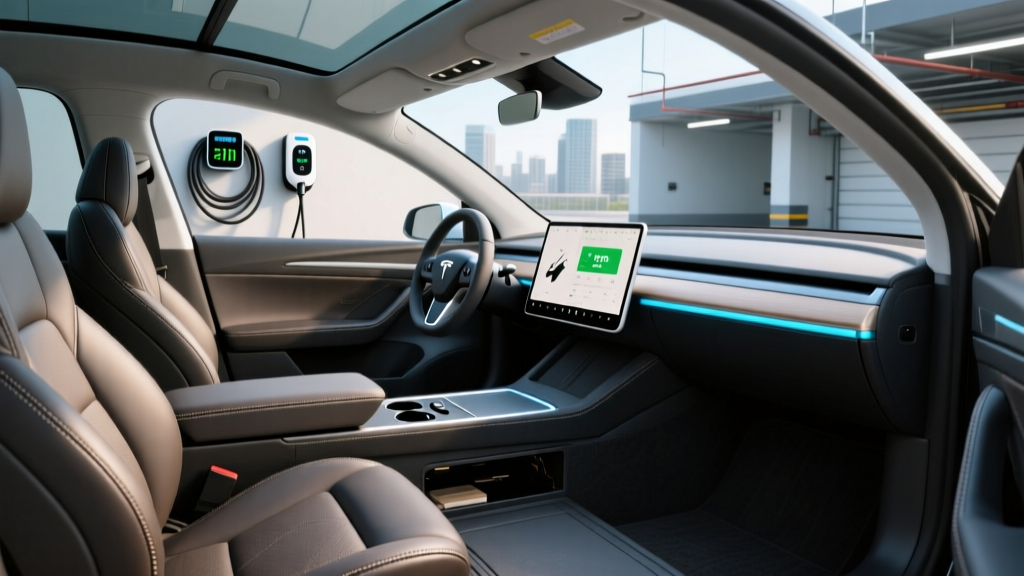
The 2026 Model Y comes standard with two rows of seating for five passengers. The Juniper refresh brought meaningful interior upgrades: ventilated front seats, ambient lighting, redesigned textile and vegan-leather upholstery, and improved cushion bolstering compared to pre-2025 models. Front-seat comfort has been a historical complaint, but the updated seats now offer better thigh support and lumbar adjustment.
Tesla offers an optional third-row seat on the Long Range AWD trim for approximately $2,500, bringing total capacity to seven passengers. However, this third row is best understood as a child-only space. Legroom in the rearmost row measures roughly 26.5 inches — tight even for shorter adults on trips beyond a few miles. Fold the third row flat, and you regain nearly all of the Model Y's generous cargo capacity.
For comparison, the three-row Kia EV9 offers 32.0 inches of third-row legroom and is a more practical choice if you regularly carry adults in all three rows. The Model Y's seven-seat configuration works well for families who need occasional extra seats for school carpools or short errands but don't want to step up to a larger, more expensive SUV.
Interior Dimensions and Cargo Space
| Dimension | Model Y (5-seat) | Model Y (7-seat, 3rd row folded) | Model Y (7-seat, all rows folded) |
|---|---|---|---|
| Front Headroom | 41.0 in | 41.0 in | 41.0 in |
| Front Legroom | 41.8 in | 41.8 in | 41.8 in |
| Rear Headroom | 39.4 in | 39.4 in | 39.4 in |
| Rear Legroom | 38.2 in | 38.2 in | 38.2 in |
| Cargo (behind 2nd row) | 30.2 cu ft | 12.8 cu ft | N/A |
| Cargo (2nd row folded) | 72.1 cu ft | 72.1 cu ft | 72.1 cu ft |
| Frunk | 4.1 cu ft | 4.1 cu ft | 4.1 cu ft |
The Model Y's 72.1 cubic feet of maximum cargo volume (with the second row folded in the five-seat configuration) remains class-leading. The hatchback design makes loading bulky items straightforward, and the front trunk (frunk) adds useful space for charging cables or a small bag. If you opt for the seven-seat layout, expect to fold the third row nearly all the time unless you're carrying small children back there — cargo space behind the raised third row shrinks to just 12.8 cubic feet.
Range, Efficiency, and Real-World Expectations
EPA Estimated Range: 327 miles (Long Range AWD) | 302 miles (Standard Range RWD) | 298 miles (Performance AWD)
Real-World Expectation: Plan for approximately 270–290 miles on highway-heavy road trips at 70–75 mph. In cold weather (below 32°F), expect a 15–25% range reduction depending on cabin heating demand and battery preconditioning. City driving with regenerative braking can match or slightly exceed the EPA sticker.
The Juniper Model Y's efficiency remains a core strength. At 27 kWh per 100 miles (Long Range AWD), it converts battery energy into distance more effectively than most rivals. The heat pump, standard across all trims, mitigates cold-weather losses better than resistance-based heating systems. Still, if you live in a region with harsh winters and regularly drive highway routes above 70 mph, budgeting 260–275 usable miles before needing a charge stop is a practical approach.
According to fueleconomy.gov, the Model Y Long Range AWD achieves 126 MPGe combined — placing it among the most efficient all-wheel-drive electric crossovers available.
Charging Speed: DC Fast, Level 2, and Home Setup
The 2026 Model Y supports a peak DC fast-charge rate of 250 kW at V3 (and V4) Tesla Superchargers. In practice, the charge curve peaks near 250 kW at a low state of charge (around 10–15% SoC) and tapers progressively above 50%. A 10–80% session takes approximately 27 minutes under ideal conditions — meaning a preconditioned battery and a stall capable of delivering full power.
| Charging Level | Power | Speed (Approx.) | Best Use Case |
|---|---|---|---|
| Level 1 (120V) | ~1.4 kW | ~5 miles/hr | Emergency / overnight trickle |
| Level 2 (240V, 48A) | 11.5 kW | ~44 miles/hr | Daily home charging |
| DC Fast (Supercharger V3) | Up to 250 kW | ~162 miles in 15 min | Road trips |
At home on a Level 2 Tesla Wall Connector (or any J1772/NACS-compatible 48-amp station), the Model Y adds roughly 44 miles of range per hour. A full overnight charge from 20% to 90% takes about 7–8 hours — more than sufficient for daily use. With the broader Supercharger network now open to NACS-equipped non-Tesla EVs, the Model Y still benefits from the most mature, reliable fast-charging ecosystem in North America.
Charging-curve reality check: The "250 kW" peak is sustained only briefly. Average power across a 10–80% session is closer to 150–170 kW. This is typical for NMC batteries in this class; LFP-equipped Standard Range models show a slightly flatter curve but lower total capacity.
Battery Chemistry, Warranty, and Longevity
Tesla uses two battery chemistries across the Model Y lineup:
- Long Range AWD and Performance: Nickel Manganese Cobalt (NMC) — higher energy density, better suited for maximizing range. Tesla recommends daily charging to 80% and 100% only for long trips.
- Standard Range RWD: Lithium Iron Phosphate (LFP) — slightly lower energy density but superior cycle life and thermal stability. Tesla recommends charging LFP batteries to 100% at least once per week to maintain accurate state-of-charge readings.
The battery and drive unit warranty covers 8 years or 120,000 miles (Long Range/Performance) and 8 years or 100,000 miles (Standard Range), whichever comes first. Tesla guarantees the battery will retain at least 70% of its original capacity during the warranty period. Real-world degradation data from fleet aggregators suggests most Model Y batteries lose approximately 10–12% capacity over the first 100,000 miles — well within the warranty threshold.
Pricing, Trims, and Federal Tax Credit Eligibility
| Trim | Base MSRP | Est. After §30D Credit | Destination |
|---|---|---|---|
| Standard Range RWD | $44,990 | ~$37,490* | $1,390 |
| Long Range AWD | $48,990 | ~$41,490* | $1,390 |
| Performance AWD | $53,990 | ~$46,490* | $1,390 |
*Estimated after the $7,500 federal tax credit under IRS §30D. Eligibility is not guaranteed for every buyer.
§30D Federal Tax Credit Requirements (2026):
- MSRP Cap: SUVs/crossovers must be at or below $80,000 (all Model Y trims qualify).
- Buyer Income Cap: Modified AGI must not exceed $150,000 (single), $225,000 (head of household), or $300,000 (joint filers).
- Battery Sourcing: Critical minerals and battery components must meet escalating domestic-content thresholds. Tesla's North American battery sourcing has historically met these requirements, but confirm current eligibility on the fueleconomy.gov tax credit page before purchasing.
- Point-of-Sale Transfer: Eligible buyers can transfer the credit to the dealer at purchase, reducing the out-of-pocket price directly rather than waiting for a tax refund.
Always verify eligibility with a tax professional and the IRS clean vehicle credits page before finalizing your purchase. Battery sourcing rules tighten annually, and eligibility can change between model years.
Technology, Driver Assistance, and the Juniper Interior
The 2026 Juniper refresh brought a significantly updated cabin: a redesigned 15.4-inch center touchscreen, rear-seat entertainment screen, ventilated front seats, acoustic glass for reduced road noise, and ambient interior lighting. The minimalist layout remains — no physical instrument cluster, with all driving information displayed on the central screen.
Autopilot and Full Self-Driving (Supervised): Every Model Y includes basic Autopilot (traffic-aware cruise control and lane centering). The optional FSD (Supervised) package adds automated lane changes, traffic-light recognition, and city-street navigation. However, this is an SAE Level 2 driver-assistance system — you must remain fully engaged, hands on or near the wheel, and eyes on the road at all times. It is not autonomous driving.
ADAS Limitation Warning: Tesla Autopilot and FSD (Supervised) are SAE Level 2 systems. They do NOT make the Model Y self-driving. The driver is legally and operationally responsible for all vehicle movements at all times. Only Level 4 services like Waymo operate without a human driver.
Pros and Cons
Pros
- Class-leading efficiency at 27 kWh/100 mi (Long Range)
- Access to the Supercharger network — the most reliable DC fast-charging infrastructure in the US
- Excellent cargo capacity (72.1 cu ft max) with a practical hatchback design
- Juniper interior upgrades: ventilated seats, quieter cabin, rear screen
- Strong performance across all trims (3.5-sec 0-60 on Performance)
- Over-the-air updates continuously add features
Cons
- Optional third row is child-only; not viable for adults
- Minimalist interior isn't for everyone — no physical buttons or gauge cluster
- Insurance premiums tend to run 15–25% higher than comparable non-Tesla crossovers
- Peak DC charging limited to 250 kW (some rivals now exceed 300 kW)
- Ride quality on larger wheels can feel firm on rough pavement
- FSD (Supervised) subscription cost ($99/mo or $8,000 one-time) with Level 2 limitations
Who the 2026 Model Y Suits Best
Choose the Model Y Long Range AWD if: You need a daily-driver crossover with 300+ miles of real-world range, frequent road trips on the Supercharger network, and enough cargo space for a family of four with gear. It's the volume trim for a reason.
Choose the Standard Range RWD if: You primarily commute under 60 miles round-trip, have reliable home Level 2 charging, and want the lowest entry price with LFP battery longevity benefits.
Choose the Performance AWD if: Acceleration and handling matter to you and you're willing to sacrifice 29 miles of EPA range for a 3.5-second 0-60 time and sport-tuned suspension.
Look elsewhere if: You regularly need three rows of adult-sized seating (consider the Kia EV9), prefer physical buttons and a traditional instrument cluster, or want a softer ride tuned for comfort over sportiness.
Frequently Asked Questions
What is the real-world range of the 2026 Tesla Model Y?
The EPA rates the Long Range AWD at 327 miles, but real-world highway driving at 70–75 mph typically yields 270–290 miles. In freezing temperatures, expect 240–265 miles depending on cabin heating use and whether you precondition the battery. City driving with regenerative braking can match or exceed the EPA estimate.
How fast does the Model Y charge at home and on the road?
On a Level 2 home charger (240V, 48A), the Model Y charges at 11.5 kW, adding roughly 44 miles of range per hour — a full overnight charge covers daily needs. At a V3 Supercharger (250 kW peak), a 10–80% session takes approximately 27 minutes, though sustained power averages 150–170 kW across the session due to charge-curve tapering.
Does the 2026 Tesla Model Y qualify for the federal EV tax credit?
All Model Y trims fall under the $80,000 SUV MSRP cap. Eligibility for the full $7,500 credit depends on your income (≤$300,000 joint / ≤$150,000 single), the vehicle's battery-sourcing compliance, and purchasing new from an authorized point of sale. Tesla's North American battery supply chain has historically met §30D requirements, but verify on fueleconomy.gov before purchasing. The credit can be transferred at the point of sale to reduce your purchase price directly.
Is the Model Y's optional third row worth it?
Only if you need occasional seating for small children. The third row offers approximately 26.5 inches of legroom — unusable for adults on anything beyond a very short trip. It also cuts cargo space behind the second row from 30.2 to 12.8 cubic feet. If you need regular seven-passenger capacity with adult-viable space, the Kia EV9 or a three-row PHEV like the Toyota Grand Highlander Hybrid is a better fit.
How does the Model Y compare to the Hyundai Ioniq 5 and Ford Mustang Mach-E?
The Model Y leads in efficiency, Supercharger network access, and cargo space. The Ioniq 5 offers faster peak charging (up to 350 kW on 800V architecture), a more distinctive design, and physical buttons. The Mach-E provides a more traditional driving feel and BlueCruise hands-free highway driving. All three are strong choices — your preference for charging ecosystem, interior design, and driver-assist philosophy will likely determine the winner.
What is the Model Y's battery warranty?
Tesla covers the battery and drive unit for 8 years or 120,000 miles on Long Range and Performance trims, and 8 years or 100,000 miles on Standard Range. The warranty guarantees at least 70% battery capacity retention during the coverage period.