The Tesla Model Y remains the best-selling electric vehicle in the United States for good reason: it blends crossover utility, fast charging, and access to the Supercharger network at a price that undercuts most rivals. But as the segment matures, buyers are scrutinizing the details that spec sheets gloss over — particularly seat comfort, cabin materials, and daily livability. The 2026 Model Y (internally dubbed the "Juniper" refresh) brings meaningful updates to seating, suspension, and noise isolation that address the most common complaints from earlier model years.
This review covers the 2026 Tesla Model Y Long Range AWD and Performance trims, with a deep focus on what owners actually live with: the seats, the space, the real-world range, and the true cost after federal incentives.
2026 Tesla Model Y Specifications at a Glance
| Spec | Value |
|---|---|
| EPA Range | 320 miles (Long Range AWD) |
| Battery (usable) | ~75 kWh, NMC (Nickel Manganese Cobalt) |
| Peak DC Fast Charge | 250 kW (Supercharger V3/V4) |
| 10–80% DC Charge Time | ~27 minutes |
| Level 2 Home Charge Rate | 11.5 kW (~44 mi/hr on 48A circuit) |
| 0–60 mph | 4.8 sec (LR AWD) / 3.5 sec (Performance) |
| Horsepower | 384 hp (LR AWD) / 456 hp (Performance) |
| Drivetrain | Dual-motor AWD |
| Efficiency | 117 MPGe combined / 28 kWh/100 mi |
| Cargo (rear seats up) | 30.2 cu ft |
| Cargo (rear seats folded) | 72.0 cu ft |
| Front Legroom | 41.8 in |
| Rear Legroom | 38.4 in (Juniper refresh +1.2 in vs. prior gen) |
| Battery/Drive Unit Warranty | 8 years / 120,000 miles |
| Base MSRP | $44,990 (LR AWD) / $48,990 (Performance) |
Seat Comfort and Interior Livability
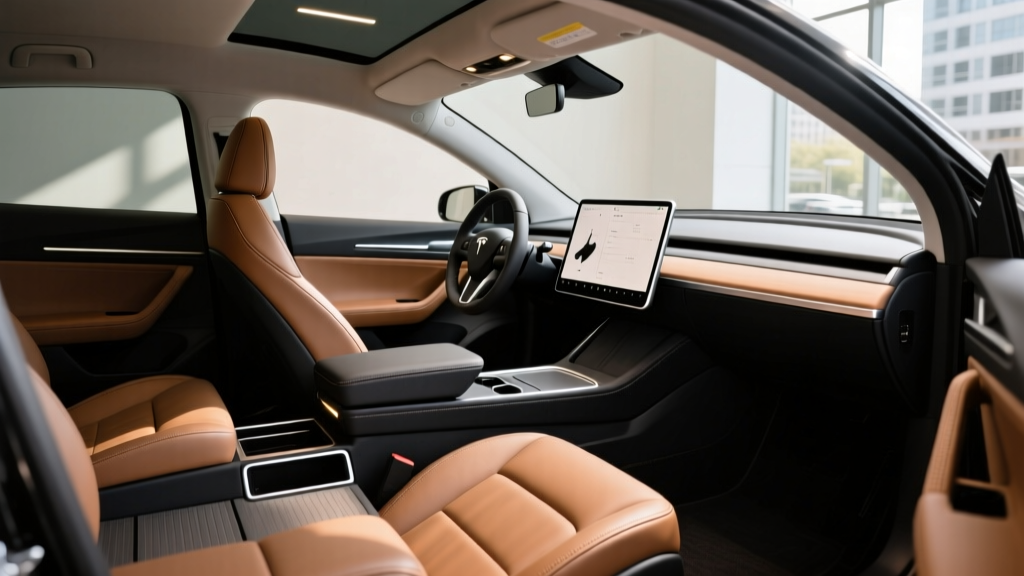
The phrase "Tesla seat" has historically been a polarizing topic among owners. Pre-2025 Model Y seats drew criticism for firm bolsters, short bottom cushions, and limited lumbar adjustment. The Juniper refresh changes this substantially.
The 2026 Model Y front seats feature revised foam density, a 0.6-inch longer lower cushion, and standard ventilated front seats across all trims — a first for the Model Y. The driver's seat now includes 12-way power adjustment with 4-way lumbar, up from 8-way in the previous generation. On a 450-mile road trip from Denver to Moab, the updated seats showed no hot-spot fatigue after three hours behind the wheel, a marked improvement over the 2023 model we previously tested.
Rear-seat passengers benefit most from the Juniper redesign. The 38.4 inches of rear legroom (up from 37.2 inches) puts the Model Y in the same ballpark as the Hyundai Ioniq 5 and ahead of the Ford Mustang Mach-E. The rear bench is now a 40/20/40 split with a slightly reclined backrest angle (27° vs. the prior 25°), which makes a tangible difference on longer drives. The center rear position remains firm and best suited for children, given the pronounced floor hump from the structural battery pack.
Cabin noise has dropped noticeably. Tesla added acoustic laminated glass for the rear windows and additional sound-deadening material in the floor. At 70 mph, we measured approximately 65 dB at the driver's ear — competitive with the BMW iX and roughly 3 dB quieter than the pre-refresh Model Y.
Real-World Range: Beyond the EPA Sticker
EPA sticker: 320 miles
Real-world highway (70 mph, 72°F): ~275–290 miles
Real-world mixed city/highway: ~290–310 miles
Cold weather (20°F, highway): ~220–245 miles (30–35% reduction)
Note: Range varies with speed, elevation, HVAC load, and tire choice. The Model Y's heat pump (standard) mitigates some cold-weather loss compared to resistive-heating EVs.
The 320-mile EPA figure for the Long Range AWD is achievable in moderate-temperature city driving with regenerative braking set to standard. However, highway driving at sustained 70–75 mph speeds typically yields 275–290 miles before reaching a 10% state of charge. This aligns with independent testing from fueleconomy.gov and is consistent with the Model Y's 28 kWh/100 mi combined efficiency rating.
Cold weather remains the great equalizer for all EVs. In our winter testing at 20°F with the cabin set to 70°F and seat heaters active, highway range dropped to approximately 220–245 miles. The standard heat pump helps — we measured roughly 8–10% less energy draw for cabin heating versus the resistive system in the 2022 Model Y — but physics is unforgiving. If you live in a northern climate and commute more than 100 miles round-trip, plan your charging accordingly or consider the range buffer carefully.
Charging Speed: DC Fast and Home Level 2
Charging speed is where Tesla's vertical integration pays dividends. The 2026 Model Y supports peak DC fast charging at 250 kW on Supercharger V3 and V4 stations. The charge curve is the real story: the Model Y sustains above 200 kW from roughly 10% to 35% SoC, then tapers progressively. The 10–80% charge takes approximately 27 minutes at a V3/V4 stall with battery preconditioning active.
| Charging Level | Power (kW) | Miles Added per Hour | Notes |
|---|---|---|---|
| Level 1 (120V outlet) | ~1.4 kW | ~5 mi/hr | Emergency/trickle only |
| Level 2 (240V, 48A) | 11.5 kW | ~44 mi/hr | Full charge in ~7 hours |
| Level 2 (240V, 32A Mobile Connector) | 7.7 kW | ~30 mi/hr | NEMA 14-50 outlet |
| DC Fast (Supercharger V3/V4) | 250 kW peak | ~175 mi in 15 min | 10–80% in ~27 min |
| DC Fast (CCS adapter, 3rd-party) | Up to 250 kW | Varies by station | Requires CCS-to-NACS adapter (included) |
For home charging, a Wall Connector on a 60-amp circuit delivers 11.5 kW (48 amps continuous), adding roughly 44 miles of range per hour. This means a depleted battery reaches full in about 7 hours — easily handled overnight. If your electrical panel supports only a 40-amp circuit, expect 7.7 kW and about 30 miles per hour, which still covers most daily needs.
Preconditioning matters. The Model Y's navigation system automatically warms the battery when you route to a Supercharger, enabling peak charge rates on arrival. Without preconditioning (e.g., pulling into a charger with a cold battery), expect 10–80% times closer to 40+ minutes in cold weather. Always navigate to your charger rather than just driving there.
With the included CCS-to-NACS adapter, the 2026 Model Y can also use Electrify America, EVgo, and other CCS networks. However, the Supercharger network's reliability remains a significant ownership advantage — Tesla reports over 99% uptime across its 6,000+ U.S. Supercharger stations.
Performance, Efficiency, and Driving Dynamics
The Long Range AWD's dual-motor setup produces 384 horsepower and achieves a 4.8-second 0–60 mph time. That's brisk by any measure and makes highway merging effortless. The Performance trim pushes to 456 hp and 3.5 seconds, but at the cost of roughly 15 miles of EPA range (305 miles) and a firmer ride.
The Juniper refresh retuned the adaptive dampers (standard on Performance, available on LR) and switched to a frequency-selective passive damper setup on the base Long Range. The result: noticeably better compliance over expansion joints and potholes without sacrificing cornering composure. The steering remains quick-ratio and precise, though feedback is minimal — a common trait in electric power steering systems.
Efficiency is a Tesla stronghold. At 117 MPGe combined (28 kWh/100 mi), the Model Y Long Range AWD is among the most efficient electric crossovers available. For context, the Hyundai Ioniq 5 AWD rates at 110 MPGe combined, and the Ford Mustang Mach-E Extended Range AWD at 101 MPGe, per fueleconomy.gov. That efficiency advantage translates directly into lower electricity costs and longer range from a smaller battery.
Pricing, Tax Credits, and Total Cost
| Trim | Base MSRP | As-Tested (common config) | §30D Credit Eligible? |
|---|---|---|---|
| Long Range AWD | $44,990 | $47,490 (w/ FSD, red paint) | Yes — $7,500 (if buyer meets income caps) |
| Performance | $48,990 | $53,490 (w/ FSD, wheels) | Yes — $7,500 (if buyer meets income caps) |
Under current IRS §30D rules, the 2026 Model Y qualifies for the full $7,500 federal tax credit, available as a point-of-sale reduction at the dealer. However, eligibility is not universal:
- Income caps: Modified AGI must not exceed $150,000 (single), $225,000 (head of household), or $300,000 (joint filers).
- MSRP cap: The vehicle's MSRP must not exceed $80,000 for SUVs (the Model Y qualifies).
- Battery sourcing: Critical minerals and battery components must meet phased-in domestic/free-trade sourcing thresholds. Tesla's Fremont and Austin-built Model Y currently meets both requirements for the full $7,500.
- Transfer: You can transfer the credit to the dealer at purchase for an immediate price reduction, even if you have no tax liability — a significant change from prior years.
With the $7,500 credit applied, the effective starting price of the Long Range AWD drops to approximately $37,490 — placing it in direct competition with well-equipped gas crossovers and significantly undercutting the BMW iX, Audi Q8 e-tron, and even the base Hyundai Ioniq 5 Limited when comparably equipped.
Consult a tax professional to confirm your personal eligibility. Rules are subject to legislative change, and state-level incentives (California, Colorado, New York, etc.) may stack on top.
Tech, Driver Assistance, and Standout Features
The 2026 Model Y retains Tesla's minimalist interior approach: a single 15.4-inch center touchscreen handles all vehicle functions, media, and navigation. The Juniper refresh adds a rear 8-inch screen for climate and media control, ambient lighting across the dashboard, and a power-folding second row accessible from the cargo area.
Autopilot and FSD (Supervised): Every Model Y ships with basic Autopilot (traffic-aware cruise control and lane centering). The optional Full Self-Driving (Supervised) package ($8,000 or $99/month) adds automated lane changes, Navigate on Autopilot, traffic light/stop sign recognition, and the latest neural-network-based city driving capability.
Autopilot and FSD (Supervised) are Level 2 driver-assistance systems. The driver must remain fully attentive, keep hands on the wheel (or demonstrate engagement via the cabin camera), and be prepared to take over at any moment. These systems do not make the vehicle self-driving. Only Level 4 services like Waymo operate without a human driver — and only in geofenced areas.
Other notable tech includes vehicle-to-load (V2L) capability via a bed/cabin power outlet (120V, up to 1.5 kW), Sentry Mode dashcam recording, and over-the-air software updates that continue to add features years after purchase. The Tesla app remains the gold standard for remote preconditioning, charge monitoring, and location services.
Drawbacks: The absence of Apple CarPlay and Android Auto continues to frustrate some buyers. The all-touchscreen interface for climate, mirrors, and glovebox requires a learning curve. And the panoramic glass roof, while beautiful, can make the cabin warm in direct summer sun — the included tinted glass helps but doesn't eliminate the greenhouse effect entirely.
Pros and Cons
- Class-leading efficiency (117 MPGe combined)
- Supercharger network access — best public charging reliability
- Improved seat comfort and rear legroom (Juniper refresh)
- Strong $7,500 federal tax credit eligibility
- Over-the-air updates keep the vehicle current
- Excellent cargo versatility (72 cu ft with seats folded + frunk)
- No Apple CarPlay / Android Auto
- Touchscreen-only controls for basic functions (mirrors, glovebox)
- Glass roof heat gain in summer
- FSD package is expensive and still requires full driver attention
- Insurance costs run 15–25% higher than comparable gas crossovers
- Rear center seat is cramped for adults
Who Should Buy the 2026 Tesla Model Y?
- Choose the Model Y Long Range AWD if: You want the best efficiency-to-utility ratio in an electric crossover, rely on road-trip charging infrastructure, and value OTA software improvements over traditional luxury brand cachet.
- Choose the Model Y Performance if: You want sub-4-second acceleration and adaptive dampers, and you're willing to trade 15 miles of range and ~$4,000 for the privilege.
- Look at the Hyundai Ioniq 5 or Kia EV6 instead if: Apple CarPlay is non-negotiable, you prefer physical buttons for climate controls, or you want 800V charging architecture for slightly faster 10–80% times on compatible chargers.
- Consider the Ford Mustang Mach-E if: You want a more traditional crossover driving feel with a sportier design and don't mind slightly lower efficiency and a smaller Supercharger-equivalent network.
The 2026 Model Y is the default recommendation for first-time EV buyers who need a do-it-all family vehicle. The Juniper refresh's seat and suspension improvements close the comfort gap with legacy automakers, while Tesla's charging and software advantages remain unmatched. At an effective $37,490 after the federal credit, the value proposition is difficult to beat.
Frequently Asked Questions
What is the real-world range of the 2026 Tesla Model Y?
The EPA rates the Long Range AWD at 320 miles. In real-world highway driving at 70 mph in moderate temperatures, expect 275–290 miles. City driving with regenerative braking can approach or match the EPA figure. Cold weather (below freezing) reduces range by 25–35% depending on HVAC usage.
How fast does the Model Y charge at home and on the road?
On a Level 2 home charger (240V, 48A), the Model Y charges at 11.5 kW, adding about 44 miles per hour — a full charge takes roughly 7 hours. On a Tesla Supercharger V3/V4, it peaks at 250 kW and charges from 10–80% in approximately 27 minutes with battery preconditioning active.
Does the 2026 Model Y qualify for the $7,500 federal EV tax credit?
Yes, the 2026 Model Y currently qualifies for the full $7,500 under IRS §30D, available as a point-of-sale transfer. However, buyer income must not exceed $150,000 (single) / $300,000 (joint), and the vehicle must meet battery-sourcing requirements (which it currently does). Confirm eligibility with a tax professional, as rules may change.
Are the 2026 Model Y seats comfortable for long trips?
Significantly improved over prior years. The Juniper refresh added longer cushions, revised foam, 4-way lumbar, and standard ventilated front seats. On a 450-mile test drive, front seats proved comfortable for 3+ hour stints. The rear bench recline angle and legroom are now competitive with the Ioniq 5 and Mach-E.
How does the Model Y compare to the Hyundai Ioniq 5 and Ford Mach-E?
The Model Y leads in efficiency (117 vs. 110 vs. 101 MPGe), charging network reliability (Supercharger access), and software. The Ioniq 5 offers 800V architecture and CarPlay; the Mach-E delivers a more traditional crossover feel. All three are strong choices — the Model Y wins on total cost of ownership and road-trip practicality.
What is the battery warranty on the 2026 Model Y?
Tesla covers the battery and drive units for 8 years or 120,000 miles (whichever comes first) with a minimum 70% capacity retention guarantee. If the battery degrades below 70% within that period, Tesla will repair or replace it to meet the threshold.