Quick Verdict: Does the Tesla Screen Move?
The short answer: no, the Tesla screen does not physically move. Unlike the Hyundai Ioniq 5's tilting center display or the Mercedes EQE's motorized screen, the Tesla Model Y's 15.4-inch center touchscreen is fixed to the dashboard in both orientation and tilt. It cannot rotate, swivel, slide, or adjust its angle. However, the 2025+ "Juniper" refresh introduced a secondary 8-inch rear touchscreen for back-seat passengers — so while nothing physically moves, Tesla expanded the screen real estate instead.
If you're asking whether Tesla's screen moves because you've seen floating or adjustable displays in competitor EVs, you're not alone. This is one of the most-searched interior questions for Tesla buyers. Below, we break down everything else you need to know about the 2026 Tesla Model Y — range, charging, pricing, tax credits, and whether it's still the EV to beat.
| Spec | Model Y Long Range AWD | Model Y Performance |
|---|---|---|
| EPA Range | 320 miles | 294 miles |
| Battery (usable) | ~75 kWh, NMC | ~75 kWh, NMC |
| Max DC Fast Charge | 250 kW | 250 kW |
| 10–80% DCFC Time | ~27 min | ~27 min |
| Level 2 Home Charge | 11.5 kW (~44 mi/hr) | 11.5 kW (~44 mi/hr) |
| 0–60 mph | 4.8 sec | 3.5 sec |
| Horsepower | 384 hp | 456 hp |
| Drivetrain | Dual-Motor AWD | Dual-Motor AWD |
| MPGe (combined) | 111 MPGe | 104 MPGe |
| Efficiency | 30 kWh/100 mi | 32 kWh/100 mi |
| Base MSRP | $44,990 | $49,990 |
| Battery Warranty | 8 yr / 120,000 mi | 8 yr / 120,000 mi |
Real-World Range: What the 320-Mile EPA Sticker Actually Means
EPA Estimate: 320 miles (Long Range AWD)
Real-World Expectation:
- City/mixed driving (moderate temps): 290–310 miles — regen braking in stop-and-go traffic recovers energy effectively
- Sustained highway (70–75 mph): 260–280 miles — aerodynamic drag dominates at speed
- Cold weather (below 32°F): 220–260 miles — expect 20–30% range loss from cabin heating and battery resistance, even with the standard heat pump
- Worst case (cold + highway + hills): ~200 miles — plan charging stops accordingly on winter road trips
Tesla's efficiency remains class-leading. At 30 kWh per 100 miles (Long Range), the Model Y extracts more distance per kilowatt-hour than the Ford Mustang Mach-E (34 kWh/100 mi) or the Hyundai Ioniq 5 (32 kWh/100 mi). According to fueleconomy.gov, the Long Range AWD achieves 111 MPGe combined, which translates to lower per-mile electricity costs than nearly every competing electric SUV.
The 2026 Model Y continues to use an NMC (nickel manganese cobalt) battery pack with roughly 75 kWh of usable capacity. NMC chemistry provides higher energy density than LFP (lithium iron phosphate), which is why Tesla reserves LFP for the lower-priced RWD trim. The trade-off: NMC batteries benefit from staying between 20–80% state of charge for daily use, whereas LFP packs can be charged to 100% regularly without accelerated degradation.
Charging Speed: DC Fast, Level 2, and the Supercharger Advantage
| Charging Level | Power | Speed (Miles Added) | Notes |
|---|---|---|---|
| Level 1 (120V household) | 1.4 kW | ~4–5 mi/hr | Emergency/trickle only — not practical for daily use |
| Level 2 (240V home) | 11.5 kW | ~44 mi/hr | Full charge in ~7 hours; install with Wall Connector |
| DC Fast (Tesla Supercharger V3) | 250 kW peak | ~160 mi in 15 min | 10–80% in ~27 min; tapers significantly above 80% |
| DC Fast (CCS adapter, EA/others) | Up to 250 kW | Varies by station | Requires Tesla CCS adapter (included with newer vehicles) |
The 250 kW peak DC fast-charge rate is not sustained across the entire session. Like all EVs, the Model Y follows a charge curve: it pulls peak power between roughly 10–45% state of charge, then tapers to ~150 kW through 60%, and drops further to under 50 kW past 80%. This is why Tesla (and every manufacturer) quotes 10–80% times rather than 0–100%. Charging past 80% on a road trip is time-inefficient — plan to arrive at chargers at low SoC and leave at 80%.
Home charging with the Tesla Wall Connector on a 60-amp circuit delivers the full 11.5 kW (48 amps), adding about 44 miles of range per hour. A typical overnight session (8 hours) restores roughly 350 miles — more than a full battery. Installation costs for a Level 2 home setup typically range from $500 to $2,000 depending on panel proximity and local permitting. Always consult a licensed electrician for final specs.
The Tesla Supercharger network remains the most reliable public charging infrastructure in the US. With the CCS adapter (now standard on new Model Y deliveries), owners can also access Electrify America and other CCS networks, though reliability at non-Tesla stations remains inconsistent based on our testing.
Interior, Tech, and the Fixed-Screen Reality
The 2026 Model Y interior carries forward the minimalist "Juniper" refresh introduced in early 2025. Here's what defines the cabin experience:
The Screens (Both Fixed)
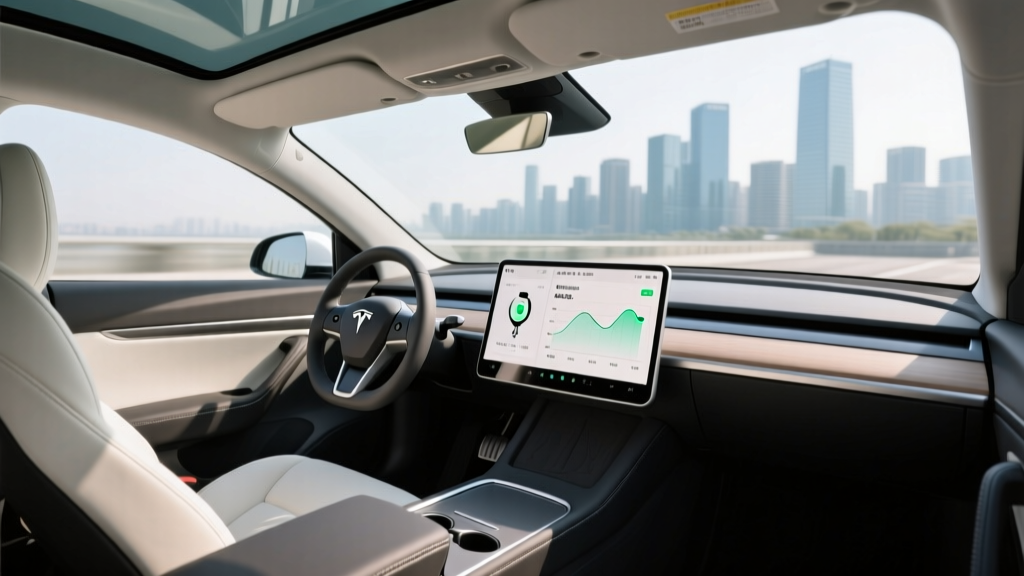
- Front: 15.4-inch center touchscreen (landscape orientation, fixed mount, no tilt/rotation adjustment)
- Rear: 8-inch touchscreen mounted on the back of the center console for rear passengers (climate, media, entertainment)
- No instrument cluster: All driver information (speed, range, navigation) appears on the left third of the center screen — no dedicated gauge display or head-up display
If you want a screen that physically adjusts toward the driver, you'll need to look at the Hyundai Ioniq 5 (tilting display) or the BMW iX (curved display angled toward the driver). Tesla's approach is software-driven: the UI is well-organized, responsive, and receives regular over-the-air updates, but the physical screen position is non-negotiable. Most owners adapt within a week, but taller or shorter drivers may notice glare at certain sun angles.
Notable Interior Features
- Ambient lighting strip across the dashboard and doors (new for Juniper)
- Ventilated front seats (previously a frequent complaint — now standard)
- Power-folding second-row seats via buttons in the cargo area
- Acoustic glass on all windows — noticeably quieter cabin at highway speeds
- No turn-signal stalk: signals are now button-activated on the steering wheel (controversial among owners)
Drawbacks to Know
- No head-up display — you glance at the center screen for speed
- No physical buttons for climate, wipers, or mirrors — everything is screen-controlled
- Rear visibility is compromised by the sloping roofline; the digital rearview mirror (optional) helps
- Steering-wheel turn-signal buttons take adjustment, especially in roundabouts
Pricing, Trims, and Federal Tax Credit Eligibility
| Trim | Base MSRP | Est. After §30D Credit | Destination |
|---|---|---|---|
| Model Y Long Range AWD | $44,990 | $37,490* | $1,390 |
| Model Y Performance | $49,990 | $42,490* | $1,390 |
*Estimated price assumes full $7,500 federal tax credit eligibility. Actual credit depends on IRS §30D requirements — see below.
Federal EV Tax Credit: §30D Eligibility Checklist
The Model Y has historically qualified for the full $7,500 federal tax credit, and as of 2026, Tesla's US-built vehicles continue to meet the critical-minerals and battery-component sourcing thresholds. However, eligibility is not automatic. Per IRS guidelines, you must meet all of the following:
- MSRP cap: Vehicle MSRP must be ≤ $80,000 for SUVs (Model Y qualifies)
- Buyer income cap: Modified AGI ≤ $300,000 (married filing jointly), $225,000 (head of household), $150,000 (single)
- Battery sourcing: Critical minerals and battery components must meet phased-in US/free-trade-agreement thresholds
- Point-of-sale transfer: Since 2024, you can transfer the credit to the dealer at purchase, reducing your out-of-pocket cost immediately — or claim it on your tax return
- US assembly: Vehicle must undergo final assembly in North America (Model Y is built in Fremont, CA and Austin, TX)
Always verify current eligibility at purchase time. Battery-sourcing rules tighten annually, and we recommend confirming with your tax professional before relying on the credit.
Performance, Cargo, and Ownership Practicalities
The Long Range AWD's dual-motor setup produces 384 horsepower and hits 0–60 mph in 4.8 seconds — quick for a family SUV and more than adequate for highway merging. The Performance trim's 456 hp and 3.5-second sprint is genuinely fast, but it costs 26 miles of EPA range and $5,000 more. For most buyers, the Long Range is the sweet spot.
Cargo and Passenger Space
- Cargo (behind 2nd row): 30.2 cu ft
- Cargo (2nd row folded): 72.1 cu ft
- Front trunk (frunk): 4.1 cu ft — fits a charging cable bag or small backpack
- Rear legroom: 41.6 inches — competitive with the Mach-E (38.9 in) and Ioniq 5 (39.4 in)
- Seating: 5-passenger standard; a 7-seat option was discontinued with the Juniper refresh
Warranty Coverage
- Battery & drive unit: 8 years / 120,000 miles (whichever comes first), with a minimum 70% capacity retention guarantee
- Vehicle limited warranty: 4 years / 50,000 miles
- Roadside assistance: 4 years / 50,000 miles
The 70% retention threshold is standard across the industry. In practice, Tesla NMC packs typically degrade to 90–92% capacity after 50,000 miles and 85–88% at 100,000 miles based on fleet data — well within the warranty floor.
Autopilot and FSD: What You're Actually Getting
SAE Automation Level: Level 2
Both Tesla Autopilot (standard) and Full Self-Driving Supervised (FSD, $8,000 option or $99/month) are Level 2 driver-assistance systems. The driver must remain fully engaged, eyes on the road, hands on the wheel at all times. These are not self-driving systems. Only Level 4 services like Waymo operate without a human driver in geofenced areas.
Autopilot includes adaptive cruise control, lane centering, and automatic emergency braking — solid for highway commuting. FSD Supervised adds automatic lane changes, on-ramp to off-ramp navigation, traffic light and stop sign recognition, and city-street turning. FSD has improved significantly through 2025–2026 neural-net updates, but it still makes occasional errors at complex intersections and construction zones. Budget for the subscription, not the purchase, until you've tested it extensively in your area.
Model Y vs. the Competition: Is It Still Worth Buying?
Pros
- Best-in-class efficiency (30 kWh/100 mi) means lower charging costs
- Supercharger network access — still the most reliable DC fast-charging ecosystem
- Strong real-world range (320 mi EPA, ~280 mi highway)
- Over-the-air updates continuously add features
- Competitive cargo space and rear legroom
- Eligible for full $7,500 federal tax credit (verify at purchase)
Cons
- Fixed screen with no tilt/swivel — glare can be an issue
- No instrument cluster or head-up display
- Steering-wheel turn-signal buttons are divisive
- Insurance costs run 15–25% higher than comparable gas SUVs
- Minimalist interior lacks physical buttons for common functions
- 250 kW peak charging is slower than Ioniq 5's 350 kW capability
Choose the Tesla Model Y if:
- You prioritize efficiency and real-world range over peak charging speed
- Supercharger network access matters for your road-trip routes
- You want OTA updates that meaningfully improve the vehicle over time
- You're comfortable with an all-screen, buttonless interior
Look elsewhere if:
- You want an adjustable or tilting screen (Hyundai Ioniq 5, Kia EV6)
- You need faster 10–80% DC charging (Ioniq 5 at 350 kW does it in ~18 min)
- You prefer a traditional instrument cluster or head-up display (BMW iX, Ford Mach-E)
- You want physical buttons for climate and volume (nearly every competitor)
Who the 2026 Tesla Model Y Suits Best
Commuters: The 320-mile range handles even long commutes with days between charges. Home Level 2 charging at 44 mi/hr means you wake up to a full battery every morning.
Families: 72.1 cu ft of cargo with seats folded, standard AWD, and a strong safety rating (NHTSA 5-star overall) make it a practical family hauler. The rear touchscreen keeps kids occupied on road trips.
Road trippers: The Supercharger network's reliability and density give Tesla owners the lowest-stress long-distance EV travel experience available. Plan 20–25 minute stops every 200–250 miles.
Not ideal for: Towing (1,500-lb capacity is limited for trailers), buyers who need physical controls, or those in apartments without home-charging access who would rely solely on public infrastructure.
Frequently Asked Questions
Can the Tesla Model Y screen move, tilt, or rotate?
No. The 15.4-inch center touchscreen is fixed in position and orientation. It does not tilt toward the driver, rotate to portrait mode, or slide. The rear 8-inch screen is also fixed. If screen adjustability is a priority, the Hyundai Ioniq 5 offers a tilting display.
What is the real-world range of the 2026 Tesla Model Y?
The EPA rates the Long Range AWD at 320 miles. In real-world mixed driving at moderate temperatures, expect 290–310 miles. Sustained highway driving at 70+ mph drops this to 260–280 miles, and cold weather (below freezing) can reduce range to 220–260 miles.
How fast does the Model Y charge at home and on the road?
On a 240V Level 2 home charger at 11.5 kW, the Model Y adds ~44 miles of range per hour (full charge in ~7 hours). On a Tesla V3 Supercharger at 250 kW peak, it charges from 10–80% in approximately 27 minutes, gaining about 160 miles in 15 minutes.
How much does the Tesla Model Y cost after the federal tax credit?
The Long Range AWD starts at $44,990 plus $1,390 destination. If you qualify for the full $7,500 §30D credit (income caps, MSRP caps, and battery-sourcing rules apply), the effective price drops to approximately $37,490. Confirm eligibility with your tax professional and at point of sale.
Does the Tesla Model Y qualify for the $7,500 federal EV tax credit?
Yes, as of 2026 the Model Y qualifies for the full $7,500 credit, provided you meet IRS §30D requirements: buyer income under the cap ($150K single / $300K joint), vehicle MSRP under $80K (SUV threshold), and the vehicle meets battery-sourcing requirements. The credit can be transferred to the dealer at point of sale to reduce your purchase price directly. Always verify at irs.gov before purchasing.
Is the Tesla Model Y worth buying over the Ford Mach-E or Hyundai Ioniq 5?
The Model Y wins on efficiency, Supercharger network access, and OTA software updates. The Ioniq 5 charges faster (350 kW peak, ~18 min 10–80%) and has an adjustable screen. The Mach-E offers a more traditional interior with physical controls. Test-drive all three — your preference for screen-based vs. button-based controls often decides it.