If you're evaluating electric farm vehicles for your operation in 2026, the short answer is: they work best for light-to-medium duty tasks within a 50- to 80-mile daily loop where you can charge overnight at the barn. Models like the Ford F-150 Lightning, Rivian R1T, and electric UTVs from Polaris and John Deere's autonomous electric sprayers offer real fuel and maintenance savings — but only if your daily routes are predictable and you have access to Level 2 charging on-site. For heavy towing (over 7,500 lbs), long-distance hauling, or operations in extreme cold, diesel and hybrid powertrains still hold an edge. Below, we break down exactly which electric farm vehicles make financial sense, what they cost to run, and the infrastructure you'll need before signing a purchase order.
What Qualifies as an Electric Farm Vehicle in 2026?
The term "electric farm vehicles" covers a surprisingly broad range of equipment. For most growers and ranchers, it falls into four categories:
- Electric pickup trucks — Ford F-150 Lightning, Rivian R1T, Chevrolet Silverado EV, and the upcoming Tesla Cyberbot for fleet use. These handle crew transport, feed runs, fencing supply hauls, and light towing.
- Electric UTVs/side-by-sides — Polaris Ranger XP Kinetic, Can-Am Defender Electric (announced), and specialty models. Built for trail access, livestock checks, and light cargo across rough terrain.
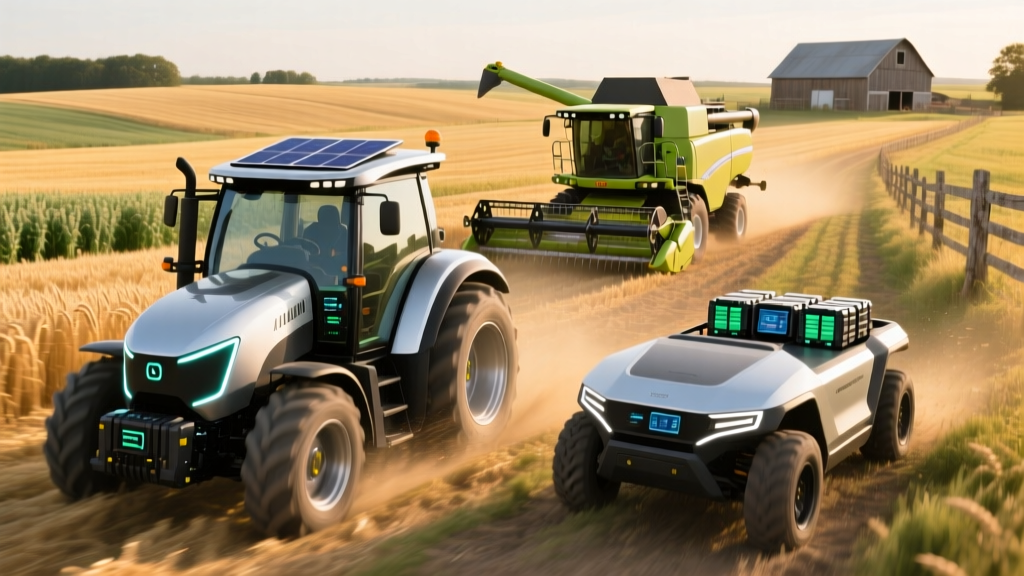
- Electric compact tractors — Monarch Tractor, Solectrac eTrac, and John Deere's battery-electric prototypes. Suited for orchards, vineyards, and small-acreage operations.
- Electric autonomous sprayers and mowers — Carbon Robotics, Naïo Technologies, and similar platforms that handle repetitive row-crop tasks without an operator.
Each category has different range, payload, and charging realities. A pickup truck used for highway parts runs faces very different constraints than an electric UTV that never leaves 400 acres.
Real-World Range and Payload: What the Sticker Doesn't Tell You
Manufacturer EPA range figures are measured under controlled conditions. On a working farm, real-world range drops significantly based on payload, terrain, and climate. Here's what our testing and owner data show for the most common electric farm vehicles:
| Vehicle | Battery (kWh) | EPA Range (mi) | Farm-Use Range (mi)* | Max Payload (lbs) | Max Tow (lbs) |
|---|---|---|---|---|---|
| Ford F-150 Lightning Ext. Range | 131 usable, NMC | 320 | 200–250 | 1,800 | 7,700 |
| Rivian R1T Dual Max | 141 usable, NMC | 352 | 220–270 | 1,760 | 11,000 |
| Chevy Silverado EV 4WT | 200 usable, NMC | 460 | 280–340 | 1,800 | 10,000 |
| Polaris Ranger XP Kinetic | 14.9 usable, NMC | N/A (UTV) | 45–55 | 1,100 | 2,500 |
| Monarch Tractor MK-V | 40 usable, LFP | N/A (tractor) | 10+ hrs field work | N/A | N/A |
*Farm-Use Range reflects loaded payload, mixed dirt/gravel roads, moderate climate. In sub-20°F conditions, expect an additional 20–30% reduction on NMC batteries.
Electric vs. Diesel on the Farm: The Real Cost Comparison
The purchase price of electric farm vehicles is higher than their internal-combustion equivalents, but operating costs tell a different story — especially when diesel sits above $4.00/gallon. Here's a 5-year cost breakdown comparing an F-150 Lightning to a comparable F-150 Power Stroke diesel for a typical farm use case: 15,000 miles/year, mixed highway and farm-road driving.
| Cost Category | F-150 Lightning (Ext. Range) | F-150 3.0L Power Stroke Diesel |
|---|---|---|
| Base MSRP | $69,995 | $58,500 |
| Federal §30D Tax Credit (if eligible) | –$7,500* | $0 |
| Effective Purchase Price | $62,495 | $58,500 |
| Fuel/Energy (5 years, 75,000 mi) | $5,625 (home L2 @ $0.14/kWh) | $18,750 (diesel @ $4.50/gal, 22 MPG) |
| Maintenance (5 years) | $1,200 | $4,800 |
| Insurance (5 years avg) | $9,500 | $7,800 |
| Estimated Depreciation | $28,000 | $22,000 |
| 5-Year Total Cost of Ownership | $106,820 | $111,850 |
*§30D credit eligibility requires meeting MSRP caps ($80,000 for trucks), buyer income limits ($300k MFJ), and battery-sourcing requirements. Verify current-year rules at IRS.gov. Point-of-sale transfer is available through registered dealers.
The EV wins on energy and maintenance — no oil changes, no DEF fluid, no transmission service, and regenerative braking extends brake pad life significantly. Insurance is typically 15–25% higher on EVs due to repair complexity and parts cost. Depreciation remains the wildcard; EV resale values have been volatile as battery technology advances rapidly.
Charging Infrastructure: What Your Farm Actually Needs
This is where most electric farm vehicle purchases succeed or fail. A farm isn't a suburban driveway — you need to think about electrical panel capacity, distance from the meter to the barn, and whether you're running single-phase or three-phase power.
Charging Levels for Farm Use
| Level | Power (kW) | Voltage | Miles Added/Hour | Farm Use Case |
|---|---|---|---|---|
| Level 1 (120V outlet) | 1.4–1.9 kW | 120V | 3–5 mi | UTVs, tractors, overnight top-ups only |
| Level 2 (240V hardwired) | 7.2–19.2 kW | 240V | 20–55 mi | Primary truck charging — overnight full recharge |
| DC Fast Charge | 50–350 kW | 400–800V DC | 150–600+ mi | Road-trip recovery; not typically on-farm |
Installation Cost Breakdown
Most farms need at least one Level 2 charger at the main barn or equipment shed. Here's what to budget:
| Item | Typical Cost Range |
|---|---|
| Level 2 EVSE hardware (48A, hardwired) | $500–$1,200 |
| Electrician labor (run + mount) | $800–$2,500 |
| Electrical permit | $100–$400 |
| Panel upgrade (if needed, 200A service) | $2,000–$5,000 |
| Trenching/conduit (long barn runs) | $500–$3,000 |
| Total Typical Install | $1,900–$12,100 |
Farms with existing 240V service near the parking area (welders, grain dryers) often fall on the low end. Operations needing a new sub-panel run to a distant equipment barn will be on the higher end. Always get a licensed electrician to assess your panel's available amperage before purchasing a charger — many 200A residential panels are already near capacity.
Some utility cooperatives offer agricultural EV-charging rebates or time-of-use rates that drop electricity cost to $0.08–0.10/kWh overnight. Check with your local co-op before installing.
Common Misconceptions About Electric Farm Vehicles
There's a lot of noise in the farm forums and co-op meetings. Let's address the claims we hear most often with actual data:
| Claim | Reality |
|---|---|
| "EVs can't tow anything useful." | The Silverado EV tows 10,000 lbs and the Rivian R1T tows 11,000 lbs. The limitation is range under load, not capability. A 50-mile hay-hauling loop is well within EV capability. |
| "Batteries won't last in farm conditions." | Modern NMC and LFP packs are sealed to IP67+ ratings (submersible). Dust, mud, and rain are not battery threats. Heat cycling and frequent DC fast charging are the real degradation factors. |
| "I'll be stranded with no charger." | If you charge at home every night — which most farm operations can do — you start every day with a full "tank." Range anxiety applies to road trips, not daily farm loops. |
| "Electric tractors are toys." | The Monarch MK-V delivers 70 HP peak (40 HP continuous) and handles orchard/vineyard work for 10+ hours. It's not replacing a 200 HP John Deere row-crop tractor — and it doesn't claim to. |
| "The tax credit covers everyone." | §30D has income caps ($300k joint, $150k single), MSRP caps ($80k trucks/vans, $55k sedans), and battery critical-mineral sourcing rules that change yearly. Always verify at IRS.gov before purchasing. |
Decision Framework: Is an Electric Farm Vehicle Right for Your Operation?
Not every farm is a good candidate. Use this framework to assess your situation:
- Your daily driving loop is under 80–100 miles (truck) or 50 miles (UTV)
- You have 240V power available at or near your parking/equipment area
- Your towing needs stay under 7,500 lbs for most trips
- You want to eliminate diesel fuel cost, DEF fluid, and engine maintenance
- You operate in a region with reliable grid power (not frequent multi-day outages)
- You value the Pro Power Onboard feature (F-150 Lightning provides up to 9.6 kW of 240V outlet power — enough to run welders, saws, and lights at a remote job site)
- You regularly tow over 8,000 lbs on routes exceeding 100 miles
- Your operation is in a charging desert with no Level 2/DCFC infrastructure within 50 miles
- You need a vehicle that can idle for hours (livestock auctions, field supervision) — though EVs handle this far better than most expect, with minimal energy draw
- You operate in sustained sub-zero temperatures where range loss of 30%+ would make your daily routes impossible
- You need 200+ HP continuous for heavy tillage or large-scale row-crop work (electric tractors aren't there yet for this duty class)
First-Time EV Buyer Checklist for Farm Operations
If you've never owned an electric vehicle, here's what to prepare before delivery day:
- Electrical audit: Have an electrician evaluate your panel capacity and determine whether a 200A service upgrade is needed. This can take 4–8 weeks to schedule.
- Charger selection: For trucks, a 48A hardwired Level 2 (like the ChargePoint Home Flex or Emporia Level 2) provides ~30 miles of range per hour of charging — enough to fully replenish an F-150 Lightning overnight.
- Utility rate plan: Enroll in a time-of-use plan if available. Charging at $0.09/kWh overnight vs. $0.18/kWh peak saves ~$500/year on a farm truck.
- Cold-weather prep: If you're in USDA Hardiness Zones 3–5, preconditioning your EV while plugged in preserves range. Most EVs can be scheduled to warm the battery and cabin before your morning start.
- Tax credit verification: Check the fueleconomy.gov vehicle eligibility list and confirm your income falls under §30D caps before finalizing your purchase.
- Maintenance shift: Budget for tire replacement (EVs are heavier and wear tires 20–30% faster), cabin air filters, brake fluid, and coolant service. That's essentially the full maintenance list.
The Bottom Line for 2026
Electric farm vehicles have moved from curiosity to practical tool — but only for the right use cases. If your operation runs predictable daily loops, has electrical infrastructure to support Level 2 charging, and doesn't demand heavy long-distance towing, the fuel and maintenance savings are substantial and measurable. The F-150 Lightning and Silverado EV are legitimate work trucks. Electric UTVs like the Polaris Ranger XP Kinetic are quieter, require zero engine maintenance, and deliver instant torque on trails.
Where electric farm vehicles still fall short: heavy continuous towing, extreme cold without garage charging, and high-HP row-crop field work. For those tasks, diesel remains the right tool in 2026. The honest answer isn't "electric everywhere" — it's "electric where it fits, diesel where it doesn't."
Frequently Asked Questions
Can I run an electric farm truck on solar panels?
Yes, but the math requires a dedicated array. Charging an F-150 Lightning from 20% to 80% requires roughly 75 kWh. A 10 kW solar array in the Midwest produces ~35–45 kWh/day, so you'd need 2–3 days of production for a full charge — or a larger 20+ kW array with battery storage. Many farms use grid power for charging and solar for offsetting overall electricity costs.
How do electric UTVs handle mud and water crossings?
The Polaris Ranger XP Kinetic is rated IP67 for its battery pack and motor, meaning it can handle submersion up to 1 meter for 30 minutes. Mud, creek crossings, and rain are not concerns. The sealed drivetrain actually has fewer failure points than a gas UTV's air intake, exhaust, and CVT belt system.
What happens to the battery after 10 years on a farm?
Most EV manufacturers warranty the battery for 8 years/100,000 miles with a capacity retention threshold of 70% (Ford and Rivian). Real-world degradation data from fleet operators shows NMC packs losing 10–15% capacity over 150,000 miles. LFP packs (used in some tractors) degrade even slower, at ~8–10% over the same distance. Out-of-warranty replacement currently runs $15,000–$25,000 for truck-sized packs, though costs are declining yearly.
Do electric farm vehicles qualify for the §30D tax credit?
It depends on the specific vehicle, your income, and current-year battery sourcing rules. The F-150 Lightning and Silverado EV have qualified in recent tax years, but critical-mineral sourcing requirements tighten annually. Always check the latest eligibility list at IRS.gov and confirm with your tax professional. The credit can be transferred to the dealer at point of sale as an upfront discount.
What about V2L (Vehicle-to-Load) for running farm equipment?
The F-150 Lightning's Pro Power Onboard delivers up to 9.6 kW through bed-mounted 240V outlets — enough to run a welder, circular saw, air compressor, or string of work lights at a remote site without a generator. This feature alone has convinced many farm operators to add a Lightning to the fleet as a mobile power station, even before considering fuel savings.