The Tesla Model Y doesn't need hype — it needs honest numbers. As the best-selling electric vehicle globally for multiple consecutive years, Tesla Model Y sales have outpaced every rival crossover from Hyundai, Ford, Volkswagen, and even Tesla's own sedan lineup. But dominance in sales doesn't automatically mean dominance in every spec category. In this 2026 profile, we break down the exact EPA range, charging curve realities, battery chemistry, pricing after federal incentives, and the ownership trade-offs that explain why this compact electric SUV keeps moving off lots — and where competitors are closing the gap.
2026 Tesla Model Y: Quick Specs at a Glance
| Spec | Long Range AWD | Performance | Rear-Wheel Drive (Standard) |
|---|---|---|---|
| EPA Range | 320 miles | 295 miles | 260 miles |
| Battery (usable) | ~75 kWh (NMC) | ~75 kWh (NMC) | ~60 kWh (LFP) |
| Drivetrain | Dual-Motor AWD | Dual-Motor AWD | Single-Motor RWD |
| Horsepower | 384 hp | 510 hp | 295 hp |
| 0–60 mph | 4.8 sec | 3.5 sec | 6.6 sec |
| Peak DC Fast Charge | 250 kW | 250 kW | 175 kW |
| 10–80% DC Time | ~25 min | ~25 min | ~30 min |
| Level 2 Home Rate | 11.5 kW (~44 mi/hr) | 11.5 kW (~44 mi/hr) | 11.5 kW (~44 mi/hr) |
| MPGe (combined) | 117 MPGe | 111 MPGe | 123 MPGe |
| Base MSRP | $48,990 | $54,990 | $39,990 |
| Battery Warranty | 8 yr / 120,000 mi | 8 yr / 120,000 mi | 8 yr / 100,000 mi |
Sources: fueleconomy.gov, Tesla specifications (2026 model year). Performance figures reflect current production vehicles.
Real-World Range: What the EPA Sticker Doesn't Tell You
The Model Y's efficiency advantage comes from its low drag coefficient (0.23 Cd) and Tesla's heat pump, which recovers waste heat from the drivetrain to warm the cabin — a meaningful advantage over resistance-heater-based EVs in winter. That said, the LFP battery in the RWD trim is slightly heavier and less energy-dense, which is why its EPA rating is lower despite being the most efficient per mile (123 MPGe combined, 27 kWh/100 mi).
If your commute is under 60 miles round-trip with home charging, the RWD trim's 260-mile range is more than sufficient. For road-trippers regularly covering 300+ miles between stops, the Long Range AWD's buffer is worth the premium — but plan charging stops at ~220-mile intervals on the highway to stay in the battery's fast-charging sweet spot.
Charging Speed and the Supercharger Advantage
The Model Y charges at up to 250 kW on DC fast chargers (Long Range and Performance trims), which is competitive but no longer class-leading. The Hyundai Ioniq 5 peaks at 350 kW, and the Kia EV6 at 240 kW with a faster taper curve. Here's what that means in practice:
| Charging Level | Power / Rate | Miles Added per Hour | Notes |
|---|---|---|---|
| Level 1 (120V) | ~1.4 kW | ~4–5 mi/hr | Emergency/trickle only |
| Level 2 (240V, 48A) | 11.5 kW | ~44 mi/hr | Full charge overnight (~7–8 hrs) |
| DC Fast (V3 Supercharger) | Peak 250 kW | ~200 mi in 15 min | Tapers above 60% SoC |
| DC Fast (CCS station) | Up to 250 kW | Same as Supercharger | Requires NACS adapter for non-Tesla networks |
Charging curve reality: The 250 kW peak is only sustained between roughly 10–40% state of charge. Above 60%, the rate drops to ~120 kW, and above 80% it falls below 50 kW. This is why Tesla's navigation system recommends charging to 80% on road trips — the last 20% takes nearly as long as the first 60%. If you're planning a 500-mile trip, expect 2 charging stops of 20–25 minutes each (10–80%), not one long stop.
The Model Y now ships with the NACS (North American Charging Standard) port natively, granting access to Tesla's Supercharger network — the most reliable DC network in the U.S. with over 6,000 stalls. Non-Tesla EVs are gradually gaining Supercharger access, but Model Y owners still benefit from seamless plug-and-charge integration and stall availability priority in some markets.
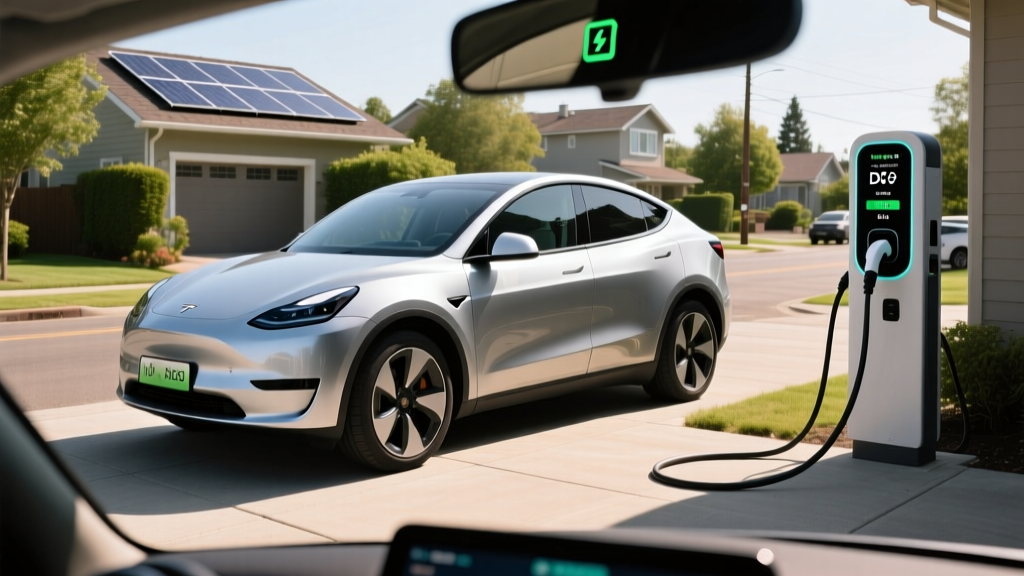
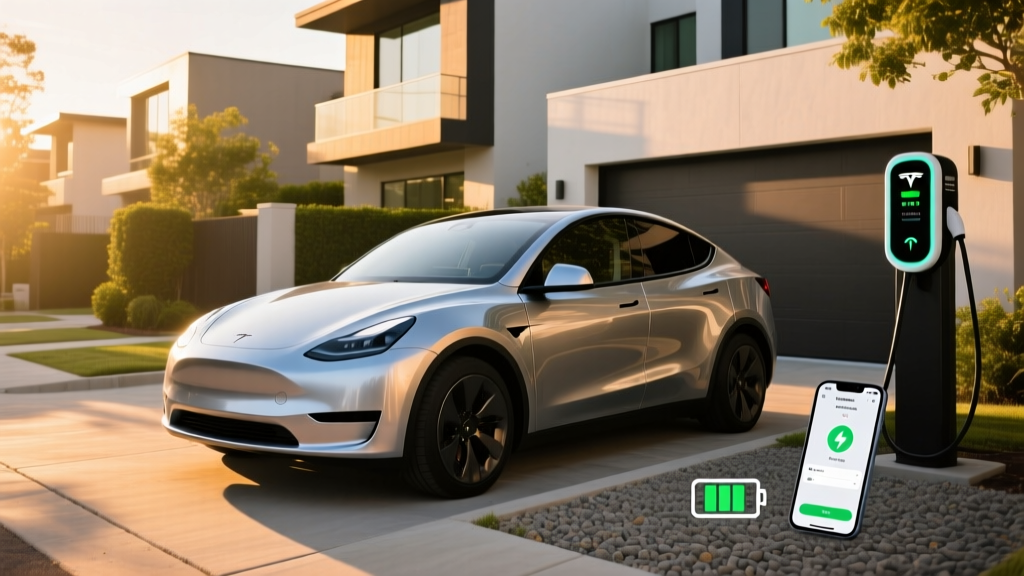
Home charging at 11.5 kW (48 amps on a 60-amp circuit) adds roughly 44 miles of range per hour. A full overnight charge from 20% to 100% takes about 8 hours — practical for any daily routine. Installation of a Tesla Wall Connector or equivalent Level 2 unit typically costs $800–$2,000 depending on panel capacity and run distance; a 200-amp electrical panel is generally required.
Battery Chemistry: LFP vs. NMC in the Model Y Lineup
Tesla uses two distinct battery chemistries across the Model Y trims, and the choice affects longevity, charging behavior, and daily usability:
| Factor | LFP (RWD Trim) | NMC (Long Range / Performance) |
|---|---|---|
| Energy Density | Lower (~160 Wh/kg cell) | Higher (~250 Wh/kg cell) |
| Cycle Life | 3,000+ cycles to 80% SoH | 1,500–2,000 cycles to 80% SoH |
| Daily Charging to 100% | Recommended | Not recommended (80% daily) |
| Cold-Weather Performance | Weaker (more range loss) | Better (heat pump + chemistry) |
| Cost | Lower (no cobalt/nickel) | Higher |
| Weight | Heavier pack for same range | Lighter for given capacity |
The LFP battery in the RWD trim is the durability champion — Tesla explicitly recommends charging it to 100% regularly, which simplifies ownership for commuters who want full range every morning without worrying about degradation. LFP cells also tolerate heat better and carry a lower fire risk. The trade-off is reduced cold-weather range (expect 30–35% loss in sub-freezing temperatures vs. 20–25% for NMC) and a heavier vehicle.
The NMC packs in the Long Range and Performance trims offer higher energy density (more range in a lighter package) and better cold-weather retention, but Tesla recommends daily charging to 80–90% to preserve long-term health. For owners who road-trip frequently and charge to 100% only before trips, this is a non-issue. For those without home charging who rely on daily public fast-charging to 100%, LFP is the wiser choice.
Pricing, Tax Credits, and the True Cost of Ownership
| Trim | Base MSRP | Est. §30D Credit | Effective Price | Notes |
|---|---|---|---|---|
| RWD (Standard) | $39,990 | Up to $7,500 | ~$32,490 | MSRP under $80K cap; LFP battery sourcing may qualify |
| Long Range AWD | $48,990 | Up to $7,500 | ~$41,490 | MSRP under $80K cap; NMC sourcing varies |
| Performance | $54,990 | Up to $7,500 | ~$47,490 | MSRP under $80K cap; confirm critical-mineral compliance |
Federal tax credit eligibility (§30D): All 2026 Model Y trims fall under the $80,000 MSRP cap for SUVs. However, the full $7,500 credit depends on two factors: (1) buyer income — adjusted gross income must not exceed $150,000 (single), $225,000 (head of household), or $300,000 (joint); and (2) battery sourcing — at least 50% of critical minerals must be extracted or processed in the U.S. or a free-trade-agreement country, and battery components must meet escalating domestic-content thresholds. Tesla has worked to localize its supply chain, but the exact credit amount can vary by production batch. Always verify current eligibility at irs.gov before purchasing. Since January 2024, the credit can be transferred to the dealer at point of sale, reducing the purchase price directly rather than waiting for tax filing.
5-year ownership cost comparison: The Model Y Long Range, driven 12,000 miles/year with home charging at $0.14/kWh, costs approximately $600/year in electricity — versus $1,800/year for a comparable gas crossover at 25 MPG and $3.75/gallon. Insurance runs higher than average (~$2,200/year nationally) due to repair costs. Maintenance is minimal: no oil changes, cabin air filter replacement every 2 years (~$50), and tire rotation every 6,250 miles. Tesla's 8-year/120,000-mile battery warranty covers degradation below 70% capacity, which Tesla's own data shows most packs won't hit within the warranty period.
Interior, Cargo, and Daily Livability
The Model Y's interior remains its most polarizing feature. The minimalist cabin centers on a 15.4-inch touchscreen that controls everything — including glovebox release, mirror adjustment, and vent direction. There is no instrument cluster, no physical buttons, and no Apple CarPlay or Android Auto. For some, this is elegant simplicity; for others, it's maddening distraction.
Cargo space: 30.2 cubic feet behind the second row (with five passengers), expanding to 72.1 cubic feet with the rear seats folded. The front trunk (frunk) adds 4.1 cubic feet — useful for charging cables or a small bag. These numbers beat the Ford Mustang Mach-E (29.7 cu ft rear) but trail the Hyundai Ioniq 5 (36.3 cu ft rear). The Model Y's hatchback design and low load floor make it practical for bulky items like strollers, bikes (with front wheel removed), or IKEA runs.
Passenger space: Front legroom is generous at 41.8 inches; rear legroom is 38.4 inches — adequate for adults on longer trips but not class-leading. The panoramic glass roof creates an airy feel, though it can increase cabin heat in summer (Tesla includes a tinted panel). Rear-seat comfort has improved in the 2025+ refresh with revised cushion foam and a slightly reclined seatback angle.
Tech highlights: The Model Y runs Tesla's latest infotainment software with Netflix/YouTube streaming while parked, a built-in trip planner with real-time Supercharger availability, and over-the-air updates that periodically add features. The premium audio system (14 speakers, 2 subwoofers) is genuinely excellent — competitive with $60K+ luxury vehicles. Wireless phone charging, ventilated front seats, and power-folding second-row seats round out the package.
Driver Assistance: Autopilot and FSD (Supervised)
Autopilot (included) provides adaptive cruise control and lane centering on highways — it's competent and smooth, comparable to Hyundai's Highway Driving Assist 2 or Ford's BlueCruise in hands-free zones. FSD (Supervised) is a $8,000 option (or $99/month subscription) that adds automatic lane changes, traffic-light recognition, and city-street navigation. As of 2026, FSD remains a work in progress: impressive in scope, inconsistent in execution. Most buyers are better served by the included Autopilot and saving the $8,000.
Safety ratings are strong: the Model Y earns a 5-star overall rating from NHTSA and a Top Safety Pick+ from IIHS (when equipped with acceptable headlights). The rigid battery pack contributes to a low rollover risk and excellent side-impact protection.
How the Model Y Compares to Key Rivals
| Spec | Tesla Model Y LR AWD | Hyundai Ioniq 5 Limited AWD | Ford Mustang Mach-E Premium AWD |
|---|---|---|---|
| EPA Range | 320 mi | 290 mi | 305 mi |
| Battery | ~75 kWh (NMC) | 77.4 kWh (NMC) | 91 kWh (NMC) |
| Peak DC Charge | 250 kW | 350 kW | 150 kW |
| 10–80% Time | ~25 min | ~18 min | ~38 min |
| 0–60 mph | 4.8 sec | 5.0 sec | 5.1 sec |
| Base MSRP (AWD) | $48,990 | $52,600 | $51,875 |
| Cargo (rear seats up) | 30.2 cu ft | 27.2 cu ft | 29.7 cu ft |
| Charging Network | Supercharger (native) | CCS / NACS adapter | CCS / NACS adapter |
The Model Y's sales dominance isn't explained by any single spec victory — it's the sum of advantages: Supercharger access, strong efficiency, proven reliability data, and aggressive pricing. The Ioniq 5 charges faster and has a more conventional interior with physical buttons. The Mach-E offers a more car-like driving feel and Ford dealer service. But neither matches the Model Y's combination of range, charging infrastructure, and price after tax credits.
Who Should Buy the Model Y — and Who Shouldn't
- You want the most reliable public charging network (Supercharger) without adapters
- Your budget is $40K–$55K and you qualify for the §30D tax credit
- You value efficiency (MPGe) over interior luxury or button-based controls
- You road-trip 2–4 times per year and need predictable 200+ mile range between stops
- You prefer over-the-air updates that add features post-purchase
- You want Apple CarPlay/Android Auto (Tesla doesn't support either)
- You prefer physical buttons and a traditional instrument cluster
- You need the fastest possible DC charging (Ioniq 5/EV6 at 350 kW)
- You want dealer-based service and loaner vehicles (Tesla service centers are limited in rural areas)
- You tow frequently — the Model Y's 3,500-lb tow rating is modest for its class
Pros and Cons
- Class-leading efficiency (117–123 MPGe combined)
- Native Supercharger access — most reliable U.S. DC network
- Strong real-world range (260–280 mi highway)
- Spacious hatchback cargo area with frunk
- Excellent OTA software and trip planner
- Competitive pricing after §30D credit
- LFP option for daily 100% charging without degradation worry
- Minimalist interior polarizing — no physical buttons or CarPlay
- DC charging speed (250 kW) lags Hyundai/Kia 800V platforms
- FSD (Supervised) is expensive and still inconsistent
- Service center availability limited outside major metros
- Insurance premiums 20–30% above class average
- Rear-seat comfort improved but still not best in class
Frequently Asked Questions
What is the real-world range of the Tesla Model Y?
The Long Range AWD delivers approximately 260–280 miles on the highway and can exceed 330 miles in city driving with regenerative braking. In cold weather (below freezing), expect 220–250 miles. The RWD trim with LFP battery sees slightly greater cold-weather loss (30–35%) due to chemistry characteristics.
How fast does the Model Y charge at home and on the road?
At home on a Level 2 charger (11.5 kW), the Model Y adds ~44 miles of range per hour, fully charging overnight in 7–8 hours. On DC fast chargers, the Long Range and Performance trims peak at 250 kW, achieving a 10–80% charge in ~25 minutes. The RWD trim peaks at 175 kW, taking ~30 minutes for 10–80%.
Does the 2026 Tesla Model Y qualify for the $7,500 federal tax credit?
All Model Y trims are under the $80,000 SUV MSRP cap. Eligibility for the full $7,500 depends on buyer income (under $150K single / $300K joint) and battery-sourcing compliance with critical-mineral and domestic-content rules. The credit can be transferred to the dealer at point of sale. Verify current eligibility at irs.gov before purchase, as sourcing requirements tighten annually.
Is the Model Y worth buying over the Hyundai Ioniq 5 or Ford Mach-E?
For buyers who prioritize charging-network reliability, efficiency, and software integration, the Model Y remains the default choice. The Ioniq 5 charges faster (350 kW vs. 250 kW) and has a more conventional interior. The Mach-E offers Ford dealer service and a more engaging driving feel. If Supercharger access matters to you — especially for road trips — the Model Y's advantage is significant.
How long will the Model Y battery last?
Tesla warranties the NMC battery (Long Range/Performance) for 8 years or 120,000 miles, whichever comes first, with coverage if capacity drops below 70%. The LFP battery (RWD) is warranted for 8 years or 100,000 miles. Real-world data from Tesla's fleet shows most NMC packs retain 85–90% capacity at 100,000 miles. LFP packs are expected to last longer due to superior cycle life, though large-scale data is still accumulating.
Can I tow with the Tesla Model Y?
The Model Y has a 3,500-pound tow rating (when equipped with the factory tow hitch). This handles a small utility trailer, a pair of jet skis, or a light camper. It's not suited for large boat trailers or heavy car-hauling — for that, consider the Ford F-150 Lightning or Rivian R1S.
Prices, specifications, and tax-credit rules reflect the 2026 model year and are subject to change. Always confirm current figures with Tesla and the IRS before purchasing.