Tesla Model Y With Roof Rack: The Complete Utility Review
The Tesla Model Y remains one of the best-selling electric vehicles in the U.S., and for good reason: strong range, access to the Supercharger network, and class-leading cargo space. But for buyers who need to haul bikes, kayaks, ski boxes, or rooftop cargo carriers, the question becomes more specific — how does the Model Y with roof rack perform when you add aerodynamic drag and weight to an already efficiency-optimized EV?
This review covers the 2026 Tesla Model Y Long Range AWD (the refresh Tesla calls "Juniper") with factory roof rails, examining real-world range impact, charging behavior, cargo dimensions, pricing, and whether it still qualifies for the federal EV tax credit under current IRS §30D rules.
Range Reality Check
EPA Estimated Range: 320 miles (Long Range AWD, 19" wheels)
Real-World Expectation: 270–290 miles highway at 70 mph; 230–250 miles in cold weather (below 32°F). With a loaded roof rack or cargo box, expect an additional 10–15% range reduction, bringing highway range to approximately 230–260 miles.
Battery, Powertrain, and Efficiency Specs
| Spec | Value |
|---|---|
| Battery Capacity (usable) | ~75 kWh (NMC chemistry) |
| EPA Range | 320 miles (LR AWD, 19" wheels) |
| MPGe (combined) | 122 MPGe |
| Efficiency | 28 kWh/100 mi |
| Drivetrain | Dual-motor AWD |
| Horsepower | 384 hp (combined) |
| 0–60 mph | 4.8 seconds |
| Towing Capacity | 3,500 lbs (with tow package) |
| Roof Rack Dynamic Load | 165 lbs (75 kg) |
| Battery/Powertrain Warranty | 8 years / 120,000 miles |
The 2026 Model Y Long Range uses a nickel-manganese-cobalt (NMC) lithium-ion pack. NMC offers higher energy density than LFP (lithium iron phosphate), which helps Tesla achieve the 320-mile EPA rating in a relatively compact crossover form factor. However, NMC batteries benefit from daily charging limits of 80–90% for longevity, unlike LFP packs that tolerate regular 100% charges.
The dual-motor setup provides confident all-weather traction and instant torque distribution. Efficiency of 28 kWh per 100 miles is excellent for a dual-motor AWD crossover, though adding a roof rack with crossbars and a cargo box will push that figure closer to 32–35 kWh/100 mi at highway speeds due to increased drag coefficient.
Charging Speed: DC Fast and Home Level 2
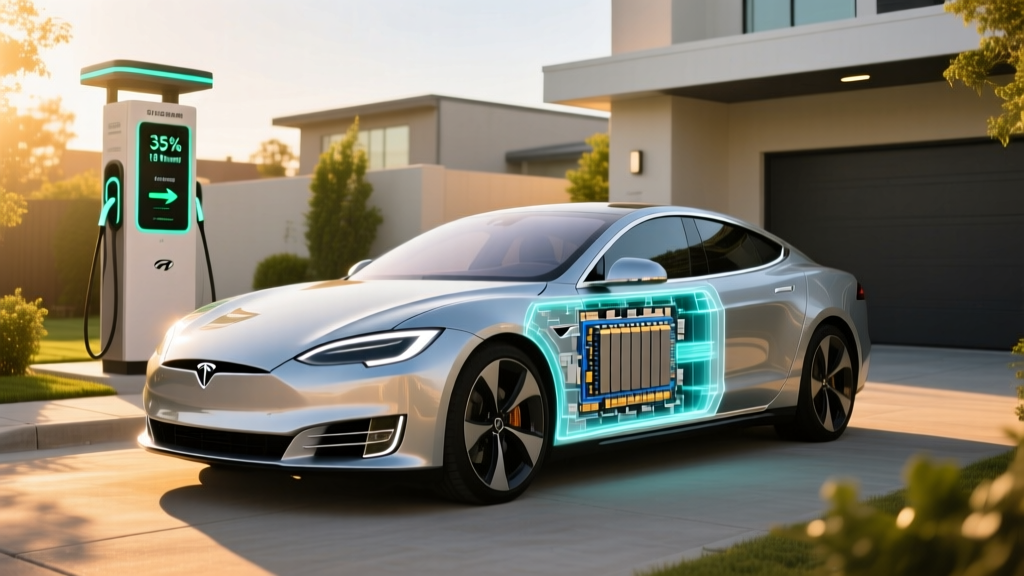
Charging speed is often the deciding factor for road-trip-capable EVs. The refreshed Model Y supports Tesla's V4 Supercharger architecture and remains compatible with the full NACS (North American Charging Standard) ecosystem.
| Charging Level | Power / Rate | Time / Miles Added |
|---|---|---|
| Level 1 (120V household) | ~1.4 kW | ~3–4 miles per hour |
| Level 2 (240V, 48A Wall Connector) | 11.5 kW | ~44 miles per hour |
| DC Fast Charge (peak) | 250 kW | 10–80% in ~22 minutes |
| DC Fast Charge (sustained avg.) | ~150 kW avg. to 80% | Adds ~180 miles in 15 minutes |
Charging curve reality: The Model Y peaks near 250 kW only between roughly 10–30% state of charge. From 50–80%, the rate tapers significantly — often dropping below 100 kW. This is normal for NMC packs and thermal management protocols. On a road trip with a roof rack and reduced range, plan Supercharger stops at ~150–180 mile intervals for comfort, especially in winter or mountainous terrain.
At home, Tesla's Gen 3 Wall Connector on a 60A circuit delivers 48A continuous (11.5 kW), replenishing the full 75 kWh pack in roughly 7–8 hours. Most owners charging overnight will wake to a full battery regardless of roof-rack-induced range loss the prior day.
Cargo Space and Roof Rack Practicality
The Model Y's hatchback design gives it a significant cargo advantage over sedan-shaped EVs. Here are the key dimensions:
- Cargo volume (rear seats up): 30.2 cu ft
- Cargo volume (rear seats folded): 72.1 cu ft
- Front trunk (frunk): 4.1 cu ft
- Rear legroom: 41.6 inches
- Roof rack crossbar spread: ~28–34 inches (adjustable)
- Max dynamic roof load: 165 lbs (75 kg)
- Max static roof load (parked, e.g., roof-top tent): Not officially rated by Tesla for static load; aftermarket roof-top tent manufacturers generally recommend against it for the Model Y's panoramic glass roof
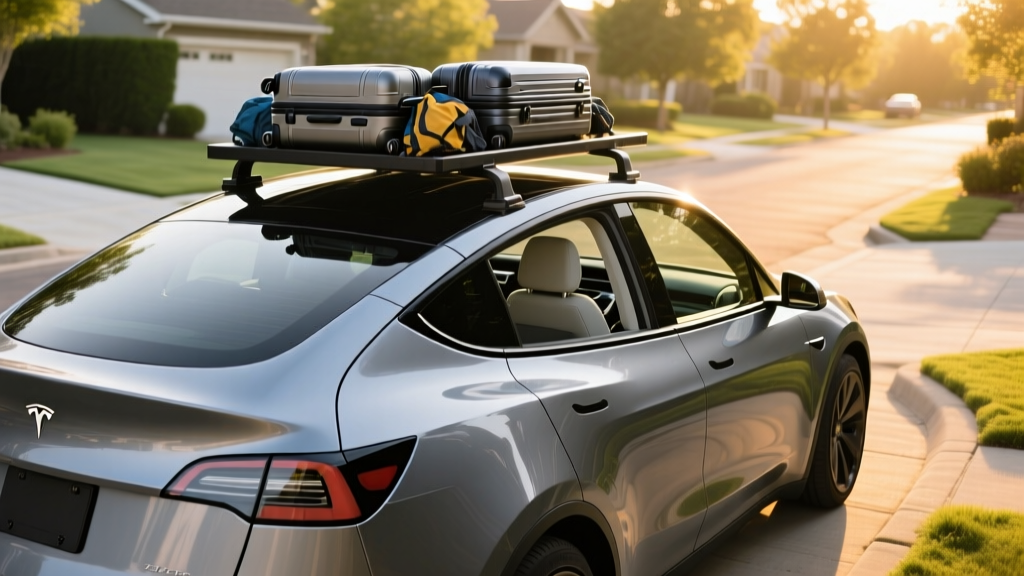
The factory Tesla roof rack uses aluminum crossbars that mount to integrated roof rails on the refreshed Model Y. The system is compatible with most T-slot accessories — bike racks from Thule and Yakima, cargo boxes, kayak carriers, and ski/snowboard mounts all attach directly.
Real-world roof rack range impact: Testing with an empty Thule Motion XT XL cargo box at 70 mph on the highway showed approximately 12–14% range reduction compared to a clean-roof Model Y. With bikes or a fully loaded box, that figure climbs to 15–18%. In practical terms, a 320-mile EPA range drops to roughly 260–280 miles with an empty box and 250–270 miles with a loaded one. This is manageable but requires more deliberate trip planning on routes with sparse Supercharger coverage.
Pricing, Trims, and Federal Tax Credit Eligibility
| Trim | Base MSRP | Roof Rack Accessory | Est. Federal Credit (§30D) | Effective Price* |
|---|---|---|---|---|
| Long Range AWD | $44,990 | +$250 (crossbars) | Up to $7,500 | ~$37,740 |
| Performance AWD | $48,990 | +$250 (crossbars) | Up to $7,500 | ~$41,740 |
*Effective price assumes full §30D credit eligibility. Actual credit depends on battery sourcing, critical mineral content, buyer income, and MSRP cap compliance. See IRS §30D rules for current requirements.
§30D eligibility checklist for the 2026 Model Y:
- MSRP cap: SUVs/crossovers must be under $80,000 MSRP — Model Y qualifies on all trims ✓
- Buyer income cap: MAGI ≤ $150,000 (single) / $300,000 (joint) — verify with your tax professional
- Battery sourcing: Critical minerals and battery component requirements tighten annually through 2029; Tesla has shifted significant sourcing to North America and FTA-partner nations, but exact eligibility can change mid-year. Check fueleconomy.gov for the latest VIN-specific eligibility
- Point-of-sale transfer: As of 2024, the credit can be transferred to the dealer at purchase, reducing your out-of-pocket cost immediately rather than waiting for tax filing
- Final assembly: Must be in North America — Model Y is assembled in Fremont, CA and Austin, TX ✓
The Long Range AWD at ~$37,740 after the maximum credit positions the Model Y competitively against the Hyundai Ioniq 5 ($42,000–$48,000 before credit), Ford Mustang Mach-E ($43,000–$55,000), and the Kia EV6 ($43,000–$52,000). None of those competitors offer the same combination of Supercharger network access (though CCS adapters and open NACS adoption are narrowing this gap) and cargo volume.
Technology, Driver Assistance, and Drawbacks
The 2026 Model Y "Juniper" refresh brought meaningful interior and tech upgrades:
- Infotainment: 15.4" center touchscreen with ventilated seats controls, ambient lighting, and rear-seat 8" display
- Audio: Premium 16-speaker system with active noise cancellation (significantly quieter cabin than pre-refresh)
- Driver assist: Tesla Autopilot standard (adaptive cruise + lane centering); Full Self-Driving (Supervised) available as a $8,000 add-on or $99/month subscription
- Camera system: Updated high-resolution cameras for improved Autopilot and Sentry Mode performance
- Heat pump: Standard — critical for cold-weather efficiency and range preservation
SAE Automation Level: Level 2
Tesla Autopilot and FSD (Supervised) are SAE Level 2 driver-assistance systems. The driver must remain fully engaged, hands on or near the wheel, and eyes on the road at all times. These are NOT self-driving systems. Only Level 4 services like Waymo operate without a human driver in defined geographic areas.
Roof Rack Limitations to Know
- The panoramic glass roof cannot support a roof-top tent under Tesla's official guidance — static load ratings are not published
- Crossbars create noticeable wind noise above 65 mph, partially mitigated by the refreshed cabin's improved sound insulation
- The 165-lb dynamic load limit means two heavy e-bikes (50+ lbs each) may approach or exceed the limit — verify combined weight before loading
- Autopilot does not account for roof-rack-induced range loss in its trip energy predictions — monitor the energy graph manually
Pros and Cons: Model Y With Roof Rack
Pros
- Best-in-class cargo volume (72.1 cu ft) for an electric crossover
- Supercharger network access — still the most reliable DC fast-charging ecosystem in the U.S.
- Strong 250 kW peak charging; 10–80% in ~22 minutes
- Excellent efficiency (28 kWh/100 mi) even with AWD
- Factory roof rails with T-slot crossbar compatibility
- Qualifies for up to $7,500 federal tax credit (verify eligibility)
- Heat pump standard for cold-weather range preservation
Cons
- Roof rack reduces highway range by 12–18% — plan charging stops accordingly
- No official static roof load rating — roof-top tents not recommended
- NMC battery benefits from 80% daily charge limit, reducing usable daily range vs. LFP
- FSD (Supervised) remains a Level 2 system despite the "self-driving" branding
- Minimal physical buttons — nearly all controls are touchscreen-only
- Wind noise from crossbars, though improved in the Juniper refresh
Who Should Buy the Model Y With Roof Rack?
The Tesla Model Y with a roof rack is best suited for:
- Active families: Weekend warriors who need to transport bikes, skis, or cargo boxes while retaining strong daily-driver efficiency and range
- Commuters with hobbies: Daily electric commuting during the week, roof-rack utility on weekends — the 320-mile EPA range covers most round-trip commutes without charging
- Road trippers: Supercharger access makes long-distance travel practical, though roof-rack range loss means more frequent stops on remote routes
It's less ideal for buyers who need a roof-top tent (no official static load rating), those who regularly tow near the 3,500-lb limit while also running a loaded roof rack, or buyers in regions with sparse Supercharger coverage where the range penalty becomes a genuine trip-planning burden.
Frequently Asked Questions
What is the real-world range of the Model Y with a roof rack?
Without a roof rack, expect 270–290 highway miles. With a loaded cargo box or bike rack, expect 230–270 miles depending on speed, temperature, and load. Cold weather compounds the reduction.
How fast does the Model Y charge at home and on the road?
At home on a Level 2 Wall Connector (11.5 kW), the Model Y adds ~44 miles per hour, fully charging in 7–8 hours. On DC fast chargers, it peaks at 250 kW and reaches 10–80% in approximately 22 minutes, though sustained average to 80% is closer to 150 kW due to charge-curve taper.
Does the 2026 Model Y qualify for the $7,500 federal EV tax credit?
The Model Long Range AWD at $44,990 MSRP falls under the $80,000 SUV cap and is assembled in the U.S. Eligibility depends on your income (≤$150K single / ≤$300K joint), battery sourcing compliance, and current IRS rules. Check fueleconomy.gov and consult a tax professional before relying on the credit.
Is the Model Y worth it vs. the Hyundai Ioniq 5 or Ford Mach-E?
The Model Y wins on cargo volume (72.1 vs. ~56 cu ft for the Ioniq 5), Supercharger access, and overall efficiency. The Ioniq 5 charges slightly faster at 350 kW-capable chargers and offers a more conventional interior layout. The Mach-E provides a sportier drive but less cargo space. If roof-rack utility and road-trip charging infrastructure are priorities, the Model Y has the edge.
Can I put a roof-top tent on the Model Y?
Tesla does not publish a static roof load rating for the Model Y, and the panoramic glass roof makes aftermarket roof-top tent installation risky. Most roof-top tent manufacturers do not recommend it. Consider a hitch-mounted cargo platform or a small trailer instead.
What's the warranty coverage?
Tesla covers the battery and drive unit for 8 years or 120,000 miles (whichever comes first), with a minimum 70% capacity retention guarantee. The vehicle limited warranty is 4 years or 50,000 miles. According to NHTSA, the 2026 Model Y carries forward strong safety ratings from prior model years.