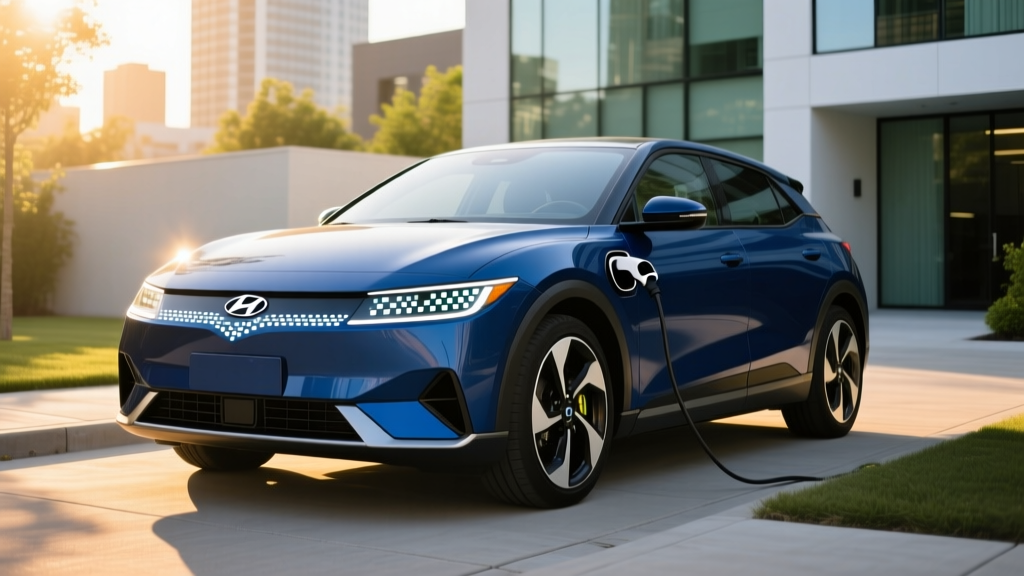
The Hyundai Ioniq 5 has been one of the most talked-about electric crossovers since its debut, and the 2026 model year keeps it competitive with the addition of the NACS charge port as standard equipment and expanded battery availability across trims. If you're searching for detailed Ioniq 5 specs — range, charging speeds, battery chemistry, pricing, and tax-credit eligibility — this profile gives you the exact numbers you need to make a purchase decision, along with the real-world context that spec sheets leave out.
Below we cover the full 2026 Hyundai Ioniq 5 lineup: the Standard Range RWD, the Long Range RWD, the Long Range AWD, and the high-performance Ioniq 5 N. We'll also address the questions that actually matter at the dealership — what range you'll see on a highway road trip, how fast it charges in practice, and whether you'll qualify for the federal EV tax credit.
2026 Ioniq 5 Specs at a Glance
| Specification | Standard Range RWD | Long Range RWD | Long Range AWD | Ioniq 5 N |
|---|---|---|---|---|
| EPA Range | 245 mi | 318 mi | 290 mi | 221 mi |
| Battery (usable) | 63.0 kWh | 84.0 kWh | 84.0 kWh | 84.0 kWh |
| Battery Chemistry | NMC | NMC | NMC | NMC |
| Horsepower | 168 hp | 225 hp | 320 hp | 640 hp (N Grin Boost) |
| 0–60 mph | ~7.5 sec | ~7.0 sec | ~5.0 sec | ~3.4 sec |
| Drivetrain | RWD (single motor) | RWD (single motor) | AWD (dual motor) | AWD (dual motor) |
| MPGe (combined) | 110 MPGe | 117 MPGe | 101 MPGe | 81 MPGe |
| kWh/100 mi | 31 | 29 | 33 | 42 |
| Max DC Fast Charge | ~150 kW | ~240 kW | ~240 kW | ~240 kW |
| 10–80% DCFC Time | ~24 min | ~18 min | ~18 min | ~18 min |
| Level 2 Charge Rate | 10.9 kW | 10.9 kW | 10.9 kW | 10.9 kW |
| Base MSRP | $42,975 | $46,925 | $50,975 | $67,675 |
Sources: EPA fueleconomy.gov, Hyundai USA. Prices exclude destination charge. 2026 model year specs as published.
Range and Efficiency: EPA vs. Real World
The headline number for the 2026 Ioniq 5 Long Range RWD is 318 miles EPA — one of the highest figures in the compact electric crossover segment. But the EPA sticker assumes a mix of city and highway driving at moderate temperatures, and your actual mileage will differ depending on how and where you drive.
- EPA combined: 318 miles
- Highway (70–75 mph, fair weather): ~265–280 miles
- City / suburban mixed driving: ~295–315 miles
- Cold weather (below 32°F, highway): ~210–240 miles (25–35% reduction)
The Ioniq 5's heat pump (standard on all trims) mitigates cold-weather range loss compared to EVs without active battery thermal management, but physics still wins in deep winter. Plan for ~220 miles of usable range on a freezing interstate run and you won't be caught short.
The Standard Range RWD's 245-mile EPA rating drops to roughly 195–210 miles on the highway. That's adequate for commuting and city life but requires more planning on road trips. The AWD Long Range trades about 28 miles of range for the traction and acceleration of dual motors — a worthwhile trade in snow-belt states.
Efficiency-wise, the Long Range RWD achieves 117 MPGe combined (29 kWh/100 mi), which is competitive with the Tesla Model Y Long Range (119 MPGe) and slightly better than the Ford Mustang Mach-E Extended Range RWD (105 MPGe). The Ioniq 5's E-GMP platform and low drag coefficient (0.284 Cd) contribute to this strong showing.
Charging Speeds: DC Fast, Level 2, and the NACS Advantage
Charging speed is where the Ioniq 5's 800-volt E-GMP architecture earns its keep. Most mainstream EVs use 400-volt systems that peak around 150 kW; the Ioniq 5 can accept up to ~240 kW on a compatible DC fast charger, filling the 84 kWh battery from 10% to 80% in approximately 18 minutes under ideal conditions.
| Charging Level | Power / Rate | Miles Added per Hour | Notes |
|---|---|---|---|
| Level 1 (120V household) | ~1.4 kW | ~3–4 mi/hr | Emergency/trickle only; ~85+ hrs for full charge |
| Level 2 (240V home) | 10.9 kW | ~32–36 mi/hr | Full charge in ~8–9 hrs; requires 48A circuit |
| DC Fast (CCS/NACS 350 kW station) | Peak ~240 kW | ~15–18 min (10–80%) | 800V architecture; tapers above 80% SoC |
| DC Fast (50 kW station) | 50 kW | ~120 mi/hr | Older chargers; ~65 min for 10–80% |
Understanding the charge curve: The Ioniq 5 does not sustain 240 kW for the entire session. Peak rate holds roughly between 10% and 45% state of charge, then tapers progressively. A 10–80% session averages around 150–170 kW, which is why the 18-minute figure holds. Charging from 80–100% slows dramatically to protect the NMC cells — expect another 25–35 minutes for that final 20%. On road trips, plan stops around 10–80% to minimize time at the charger.
For 2026, Hyundai has equipped the Ioniq 5 with the Tesla NACS charge port as standard, replacing the CCS1 port used on earlier model years. This gives Ioniq 5 owners native access to Tesla's Supercharger network (over 25,000 stalls in North America) without an adapter — a significant practical advantage for road-trip charging. For legacy CCS networks like Electrify America, Hyundai includes a NACS-to-CCS adapter.
At home on a Level 2 wall connector, the 10.9 kW onboard charger adds roughly 32–36 miles per hour. A full overnight charge from near-empty takes about 8–9 hours. Most owners charging from a typical daily commute (30–50 miles) will replenish in under two hours.
Performance and Drivetrain
The 2026 Ioniq 5 lineup spans from efficient commuter to legitimate performance machine:
- Standard Range RWD: 168 hp, 0–60 in ~7.5 seconds. Adequate for merging and city driving, but not exciting.
- Long Range RWD: 225 hp, 0–60 in ~7.0 seconds. The efficiency sweet spot — most buyers should start here.
- Long Range AWD: 320 hp, 0–60 in ~5.0 seconds. Dual-motor grip and confident acceleration in all weather.
- Ioniq 5 N: 640 hp (with N Grin Boost engaged), 0–60 in ~3.4 seconds. Track-capable with simulated gear shifts and N-specific suspension tuning.
All trims use Hyundai's E-GMP platform with a low center of gravity thanks to the under-floor battery pack. The AWD model's dual-motor setup provides torque-vectoring-like behavior through brake-based torque distribution. Towing capacity is rated at 2,300 lbs for AWD trims when equipped with the factory tow hitch — enough for a small utility trailer or a pair of dirt bikes, but not a camper.
Pricing, Trims, and Federal Tax Credit Eligibility
The 2026 Ioniq 5 is offered in four trim tiers (SE, SEL, Limited) across the Standard Range and Long Range powertrains, plus the standalone Ioniq 5 N. Here's the pricing landscape:
| Trim / Configuration | Base MSRP | Est. After §30D Credit* | Federal Credit Eligible |
|---|---|---|---|
| SE Standard Range RWD | $42,975 | ~$35,475 | Yes (up to $7,500) |
| SEL Long Range RWD | $49,775 | ~$42,275 | Yes (up to $7,500) |
| Limited Long Range AWD | $56,725 | ~$49,225 | Yes (up to $7,500) |
| Ioniq 5 N | $67,675 | ~$60,175 | Yes (up to $7,500) |
*Estimated prices assume full $7,500 §30D credit eligibility. Actual credit varies based on buyer income, battery sourcing, and point-of-sale transfer rules.
- MSRP cap: SUVs/crossovers must be ≤$80,000 (all Ioniq 5 trims qualify)
- Buyer income cap: ≤$150,000 single / ≤$225,000 head of household / ≤$300,000 joint (AGI)
- Battery sourcing: Critical minerals and battery components must meet phased-in domestic/free-trade sourcing thresholds — Hyundai has confirmed 2026 Ioniq 5 models assembled at the Metaplant in Georgia with qualifying battery supply chains
- Point-of-sale transfer: Buyers can transfer the credit to the dealer at purchase, reducing the sale price directly rather than waiting for a tax refund
Always verify current-year eligibility at IRS.gov before purchasing. Rules are subject to change, and your tax professional should confirm your specific situation.
A well-equipped Long Range AWD Limited — the volume trim for family buyers — starts at $56,725 and can reach ~$59,000 with packages and destination. After a potential $7,500 credit, the effective price lands near $51,500, which positions it competitively against the Tesla Model Y Long Range AWD (~$49,990 before credit) and the Ford Mustang Mach-E Premium AWD (~$51,995 before credit).
Interior Space, Cargo, and Daily Livability
The Ioniq 5's E-GMP skateboard platform and flat floor create an airy, spacious cabin that punches above its weight class. The wheelbase stretches 118.1 inches — longer than a Toyota RAV4 — and the interior reflects that.
- Front legroom: 41.7 inches
- Rear legroom: 39.4 inches (comfortable for adults on long trips)
- Cargo (rear seats up): 27.2 cu ft
- Cargo (rear seats folded): 59.3 cu ft
- Frunk (front trunk): 0.85 cu ft (AWD) / 2.0 cu ft (RWD) — enough for charging cables and a small bag
The dual 12.3-inch displays (instrument cluster and infotainment) run Hyundai's latest connected navigation with wireless Apple CarPlay and Android Auto. Physical buttons for climate control remain — a welcome contrast to the all-touchscreen approach of some competitors. The center console slides fore and aft ("Universal Island"), creating flexible storage or a pass-through to the rear seats.
Notable tech includes:
- Hyundai SmartSense: Forward collision avoidance, blind-spot monitoring, rear cross-traffic alert, lane-keeping assist, and highway driving assist (Level 2 ADAS)
- Highway Driving Assist 2 (HDA2): Adaptive cruise with lane-centering and automatic lane-change assist — a strong Level 2 system, though not a self-driving feature (driver must remain engaged at all times per SAE Level 2 standards)
- Vehicle-to-Load (V2L): An internal 120V outlet and external V2L adapter let you power devices or small appliances (up to 3.6 kW) from the traction battery — useful for camping or emergency backup
- Digital Side Mirrors: Available on Limited trim, replacing conventional mirrors with camera-based displays
Warranty and Battery Longevity
Hyundai backs the Ioniq 5 with one of the strongest warranties in the segment:
- Battery & powertrain: 10 years / 100,000 miles (whichever comes first)
- New vehicle limited: 5 years / 60,000 miles
- Roadside assistance: 5 years / unlimited miles
- Battery capacity retention threshold: Hyundai warrants the high-voltage battery against dropping below 70% of original capacity during the warranty period
The 84 kWh NMC (nickel-manganese-cobalt) battery pack in the Long Range models uses Hyundai's advanced thermal management system with liquid cooling and heating. This conditions the battery for optimal charging speeds and reduces degradation over time. Based on data from earlier E-GMP vehicles, expect roughly 5–8% capacity loss over the first 100,000 miles under normal use — well within the warranty threshold.
Battery care tips for longevity: Avoid routinely charging to 100% for daily use (set the charge limit to 80–90% for NMC chemistry). Use DC fast charging when you need it on road trips, but favor Level 2 at home for daily replenishment. Precondition the battery before fast charging in cold weather — the Ioniq 5 does this automatically when a DC fast charger is set as your navigation destination.
Ioniq 5 vs. Key Competitors
The compact electric crossover segment is crowded. Here's how the Ioniq 5 Long Range AWD stacks up against its most cross-shopped rivals:
| Spec | 2026 Ioniq 5 LR AWD | 2026 Tesla Model Y LR AWD | 2026 Mach-E Premium AWD (ER) |
|---|---|---|---|
| EPA Range | 290 mi | 320 mi | 290 mi |
| Battery | 84 kWh (NMC) | ~78 kWh (NMC) | 91 kWh (NMC) |
| Peak DCFC | ~240 kW | ~250 kW | ~150 kW |
| 10–80% DCFC | ~18 min | ~20 min | ~38 min |
| 0–60 mph | ~5.0 sec | ~4.8 sec | ~5.1 sec |
| Charge Port | NACS (native) | NACS (native) | NACS (native, 2025+) |
| Base MSRP (AWD) | $50,975 | ~$49,990 | ~$51,995 |
| Warranty | 10yr/100k mi | 8yr/120k mi | 8yr/100k mi |
The Ioniq 5 wins on: DC fast-charge speed consistency, interior material quality, V2L capability, warranty length, and physical button usability. Its retro-futuristic design also stands out in a sea of smoothed-over crossover shapes.
The Model Y wins on: Slightly higher range, Tesla's Supercharger network reliability (though the gap has narrowed with NACS adoption), and cargo volume (30.2 cu ft rear seats up).
The Mach-E wins on: Driving dynamics and steering feel (Ford's performance tuning heritage shows), and a slightly larger battery for those who prioritize maximum energy storage.
Pros, Cons, and Who Should Buy
- Class-leading 800V DC fast charging (~18 min 10–80%)
- Native NACS port with Supercharger access (no adapter needed)
- Spacious cabin with generous rear legroom (39.4 in)
- V2L capability (3.6 kW) for camping and emergencies
- Industry-leading 10yr/100k mi battery warranty
- Physical climate controls alongside modern infotainment
- Strong §30D tax credit eligibility across trims
- Standard Range model's 245-mi range limits road-trip utility
- Frunk is tiny on AWD (0.85 cu ft) — barely fits cables
- No rear wiper (visibility issue in rain/snow on some model years)
- Infotainment can be slow to respond vs. Tesla's system
- Rear visibility hampered by thick C-pillars (mitigated by cameras)
- Insurance costs run 15–25% higher than comparable gas crossovers
- Choose the Ioniq 5 Long Range RWD if: You commute 30–60 miles daily, want maximum range (318 mi) and efficiency, and live in a mild climate. This is the best-value configuration.
- Choose the Ioniq 5 Long Range AWD if: You need all-weather traction, carry passengers regularly (the 320 hp is a confidence boost), and take road trips where fast charging matters.
- Choose the Standard Range RWD if: You're budget-conscious, drive mostly in the city, have reliable home charging, and rarely exceed 150 miles in a day.
- Choose the Ioniq 5 N if: You want a performance EV that can handle track days and don't mind the 221-mile range and premium price.
- Look elsewhere if: You need maximum cargo space (Model Y wins), three rows of seating (Kia EV9 or Ioniq 9), or the absolute lowest price point (Chevrolet Equinox EV starts lower).
Frequently Asked Questions
What is the real-world range of the 2026 Hyundai Ioniq 5?
The Long Range RWD achieves 318 miles EPA combined. In real-world highway driving at 70–75 mph in fair weather, expect 265–280 miles. In cold weather (below freezing), plan for 210–240 miles on the highway. The Standard Range RWD delivers roughly 195–210 real-world highway miles.
How fast does the Ioniq 5 charge at home and on the road?
On a 350 kW DC fast charger, the Long Range models peak at ~240 kW and charge from 10–80% in about 18 minutes. At home on a Level 2 (240V) charger, the 10.9 kW onboard charger adds ~32–36 miles per hour, fully replenishing the 84 kWh battery in 8–9 hours. Level 1 (120V) trickle charging is only practical for emergencies at ~3–4 miles per hour.
Does the 2026 Ioniq 5 qualify for the $7,500 federal EV tax credit?
Yes — all 2026 Ioniq 5 trims fall under the $80,000 MSRP cap for SUVs/crossovers, and Hyundai's Georgia-built models with qualifying battery supply chains meet the §30D critical-mineral and battery-component sourcing requirements. However, buyer eligibility also depends on adjusted gross income (≤$150K single / ≤$300K joint). The credit can be transferred to the dealer at point of sale to reduce your purchase price directly. Confirm current rules at IRS.gov.
Is the Ioniq 5 worth buying over the Tesla Model Y?
It depends on your priorities. The Ioniq 5 charges faster on DC (18 min vs. ~20 min 10–80%), offers a longer powertrain warranty (10yr/100k vs. 8yr/120k), includes V2L, and has a more conventional interior with physical buttons. The Model Y offers slightly more range (~320 vs. 290 mi AWD), more cargo room, and Tesla's software ecosystem. With NACS now standard on the Ioniq 5, the Supercharger access gap that once favored Tesla exclusively has closed.
What is the battery chemistry, and how long will it last?
The 2026 Ioniq 5 uses NMC (nickel-manganese-cobalt) lithium-ion cells across all trims. NMC offers high energy density and strong fast-charging performance. Hyundai warrants the battery at 70% capacity retention for 10 years or 100,000 miles. Real-world data from E-GMP vehicles suggests 5–8% degradation over 100,000 miles with normal use. To maximize longevity, charge to 80–90% for daily driving and reserve 100% charges for road trips.
Can the Ioniq 5 tow, and what's the towing capacity?
The AWD Ioniq 5 is rated for 2,300 lbs of towing capacity with the factory hitch accessory. That covers a small utility trailer, bike rack, or light watercraft. The RWD model is not rated for towing. Keep in mind that towing reduces range significantly — expect a 30–50% range reduction depending on trailer weight and aerodynamics.
What charging networks work with the 2026 Ioniq 5?
The 2026 Ioniq 5 comes with a native NACS (North American Charging Standard) port, giving direct access to Tesla Superchargers, Rivian Adventure Network chargers, and any NACS-equipped public station. For CCS-based networks, Hyundai provides a NACS-to-CCS adapter. CHAdeMO chargers are not supported and are being phased out across North America.
Data sourced from fueleconomy.gov, Hyundai USA, and IRS.gov. Specifications and pricing reflect 2026 model year information available at time of publication. Always verify with your dealer and tax professional before purchasing.