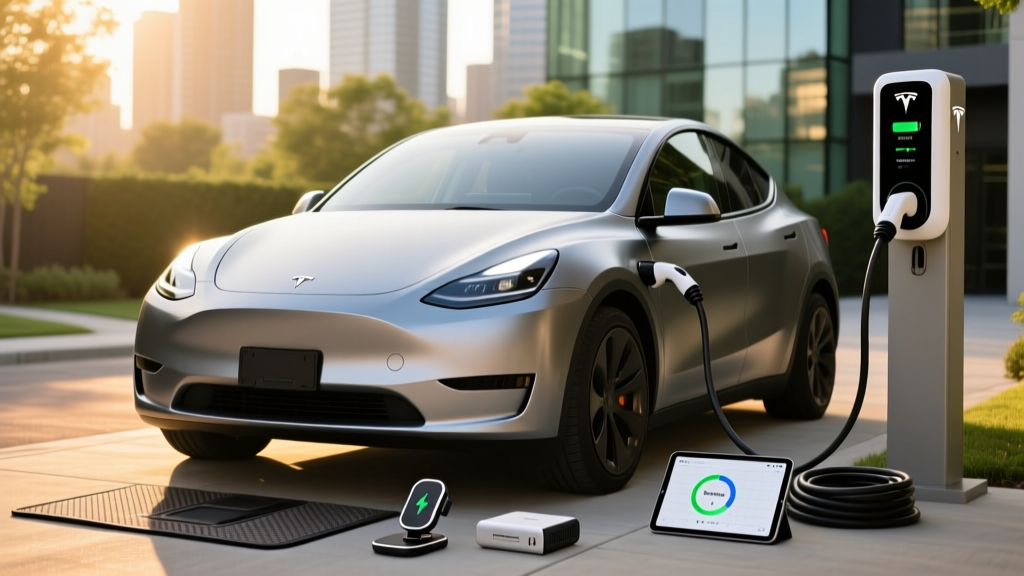
The Tesla Model Y remains the best-selling electric vehicle in the United States for good reason: it blends practicality, range, and access to the most reliable fast-charging network available. For 2026, the refreshed Model Y (internally dubbed "Juniper") arrives with a redesigned interior, improved ride quality, and updated powertrain efficiency. Whether you are a first-time EV buyer or upgrading from an older Model 3, this review covers every spec that matters — and the must-have Tesla accessories that make ownership genuinely better.
2026 Tesla Model Y Quick Specs
| Attribute | Long Range AWD | Performance |
|---|---|---|
| EPA Range | 320 miles | 295 miles |
| Battery (usable) | ~75 kWh, NMC | ~75 kWh, NMC |
| Drivetrain | Dual-Motor AWD | Dual-Motor AWD |
| Horsepower | 384 hp | 456 hp |
| 0–60 mph | 4.8 sec | 3.5 sec |
| Max DC Fast Charge | 250 kW | 250 kW |
| 10–80% DC Time | ~25 min | ~25 min |
| Level 2 Rate (11.5 kW) | ~44 mi/hr | ~44 mi/hr |
| MPGe (combined) | 111 MPGe | 102 MPGe |
| Efficiency | 30 kWh/100 mi | 33 kWh/100 mi |
| Cargo (rear seats up) | 30.2 cu ft | 30.2 cu ft |
| Cargo (rear seats folded) | 72.1 cu ft | 72.1 cu ft |
| Base MSRP | $46,630 | $52,130 |
| Battery Warranty | 8 yr / 120,000 mi | 8 yr / 120,000 mi |
Range and Efficiency: EPA vs. the Real World
Real-World Expectation: Expect 270–290 miles on mixed highway driving at 70–75 mph. In freezing temperatures (below 32°F), plan for a 20–30% reduction, dropping effective range to roughly 220–250 miles. City driving with regenerative braking recovers energy more effectively and can approach or slightly exceed the EPA sticker.
The 2026 Model Y Long Range achieves its 320-mile EPA rating thanks in part to improved aerodynamics from the Juniper refresh and a slightly higher-efficiency rear motor. The NMC (nickel manganese cobalt) battery pack offers strong energy density, though it is more sensitive to extreme cold than the LFP (lithium iron phosphate) chemistry found in the Standard Range variant.
Efficiency is rated at 30 kWh per 100 miles for the Long Range, which translates to 111 MPGe combined per fueleconomy.gov. That is competitive with the Hyundai Ioniq 5 (32 kWh/100 mi) and slightly better than the Ford Mustang Mach-E Extended Range (34 kWh/100 mi).
Charging Speed: Home, Destination, and DC Fast Charging
| Charging Level | Power | Speed (miles added) | Use Case |
|---|---|---|---|
| Level 1 (120V) | ~1.4 kW | ~5 mi/hr | Emergency / trickle |
| Level 2 (240V, 48A) | 11.5 kW | ~44 mi/hr | Home overnight charging |
| DC Fast (V3 Supercharger) | Peak 250 kW | ~162 mi in 15 min | Road trips |
| DC Fast (V4 Supercharger) | Peak 250 kW (current vehicles) | ~162 mi in 15 min | Road trips |
The Model Y supports a peak DC fast-charge rate of 250 kW on Tesla's V3 and V4 Superchargers. In practice, the charging curve peaks near 250 kW only between roughly 10–30% state of charge, then tapers progressively. The 10–80% session takes approximately 25 minutes under ideal battery preconditioning conditions. Above 80%, the rate drops sharply — charging from 80–100% can add another 20+ minutes, so plan your stops to leave at 80% unless you need the full battery for your destination.
At home, the onboard charger accepts up to 11.5 kW (48 amps on a 60-amp circuit), adding about 44 miles of range per hour. A full overnight session from 20% to 90% takes roughly 7–8 hours. Home charging installation typically costs $500–$2,000 depending on your panel capacity and run length — budget for a potential panel upgrade to 200A if your home has an older 100A service.
With the 2025 transition to the NACS (North American Charging Standard) connector now fully adopted, the Model Y natively uses the Tesla connector and accesses the Supercharger network directly. CCS adapters are available for use with Electrify America and other non-Tesla networks, though Supercharger reliability consistently outpaces third-party alternatives.
Performance and Driving Dynamics
The Long Range AWD pairs a permanent-magnet rear motor with an induction front motor for a combined 384 horsepower and a 4.8-second 0–60 mph time. The Performance trim bumps output to 456 hp and drops the sprint to 3.5 seconds, making it one of the quickest compact SUVs on the market regardless of powertrain.
The Juniper refresh brings a retuned suspension that meaningfully improves ride comfort over pre-2025 models. Road noise is reduced through additional acoustic insulation and redesigned wheel covers. The dual-motor AWD system provides confident all-weather traction, and the low center of gravity from the under-floor battery pack keeps body roll well-controlled in corners.
One-pedal driving via regenerative braking is seamless — lift off the accelerator and the car decelerates predictably, often eliminating the need for the brake pedal in stop-and-go traffic. The brake-by-wire system feels natural, a notable improvement over earlier Tesla implementations.
Interior, Technology, and Driver Assistance
The 2026 Model Y cabin is a significant step up from prior years. A ventilated front seat row (finally standard), ambient lighting, and improved material quality close the gap with luxury competitors. The 15.4-inch center touchscreen handles all vehicle controls, navigation, and entertainment — there are no physical buttons for climate or volume, which remains polarizing.
Rear-seat legroom measures 41.6 inches, and the 60/40 split-folding rear seats open up 72.1 cubic feet of cargo space. A small front trunk (frunk) adds 4.1 cubic feet for charging cables or a backpack.
Autopilot and FSD (Supervised): Every Model Y ships with Basic Autopilot (lane centering and adaptive cruise control). Full Self-Driving (Supervised) remains a $8,000 add-on or $99/month subscription. It adds automatic lane changes, traffic light and stop sign recognition, and navigation-guided on/off-ramp handling.
Pricing, Trims, and Federal Tax Credit Eligibility
| Trim | Base MSRP | Est. After §30D Credit | Destination |
|---|---|---|---|
| Long Range AWD | $46,630 | $39,130* | $1,390 |
| Performance | $52,130 | $44,630* | $1,390 |
*Tax credit estimates assume full $7,500 eligibility. Verify your qualification below.
The 2026 Model Y falls under the SUV MSRP cap of $80,000 for the IRS §30D federal tax credit. However, eligibility is not automatic — you must meet all of the following:
- Income caps: Modified AGI ≤ $150,000 (single), $225,000 (head of household), or $300,000 (joint)
- MSRP cap: Vehicle base price must not exceed $80,000 (SUV classification — Model Y qualifies)
- Battery sourcing: Critical minerals and battery components must meet phased-in percentage thresholds from US or FTA-partner countries — Tesla's supply chain has adapted, but verify the specific VIN at fueleconomy.gov before purchasing
- Point-of-sale transfer: You may elect to transfer the credit to the dealer at purchase, reducing your out-of-pocket cost immediately — the dealer handles IRS paperwork
Consult a tax professional to confirm your eligibility, as rules can shift and individual circumstances vary.
Must-Have Tesla Accessories for the Model Y
After testing dozens of accessories across multiple Model Y ownership cycles, these are the ones that deliver genuine utility — not just aesthetic filler:
1. Tesla Mobile Connector Bundle ($200)
Essential as a backup and for travel. Includes NEMA 5-15 (standard 120V) and NEMA 14-50 (240V, up to 32A / ~30 mi/hr) adapters. Keep it in the frunk for destinations without a Wall Connector.
2. CCS Combo Adapter ($250)
Opens access to Electrify America, EVgo, and other CCS-equipped public chargers. While Superchargers cover most road-trip needs, the CCS adapter is critical insurance for rural routes or when Superchargers are offline.
3. All-Weather Interior Floor Mats ($175–$225)
Tesla's OEM all-weather liners are precisely molded to the Model Y's footwells and cargo area. They trap snow, mud, and spilled coffee far better than generic options. Worth the premium over third-party alternatives for the fit alone.
4. Jowua or Fanttik Console Dock ($60–$90)
The Model Y's center console lacks built-in device charging alignment. A dedicated MagSafe or Qi2 dock keeps your phone visible and charging without sliding around — a small but transformative daily improvement.
5. Pet Liner / Cargo Mat ($125–$165)
If you haul dogs or gear, a waterproof cargo-area liner protects the carpet from claws, mud, and spills. Look for one with a lip that wraps over the load sill when the hatch is open.
6. Screen Protector (Matte or Anti-Glare, $25–$40)
The 15.4-inch touchscreen collects fingerprints aggressively. A matte-film protector reduces glare in direct sunlight and makes cleaning far easier without affecting touch responsiveness.
7. Tire Inflator / Portable Air Compressor ($40–$70)
The Model Y does not include a spare tire. A compact 12V inflator (running from the 16V or USB-C port with an adapter) lets you address slow leaks or seasonal pressure changes without a service-center visit.
Pros
- Class-leading Supercharger network access
- 320-mile EPA range is genuinely road-trip capable
- Strong efficiency (30 kWh/100 mi) keeps charging costs low
- Improved ride comfort and cabin quality in Juniper refresh
- Spacious cargo area (72.1 cu ft) with practical frunk
- Over-the-air updates continuously add features
Cons
- No physical buttons — everything routes through the touchscreen
- FSD (Supervised) is expensive and still requires full driver attention
- Cold-weather range loss is more pronounced than LFP competitors
- No Apple CarPlay or Android Auto support
- Insurance premiums run 15–25% higher than comparable non-Tesla EVs
- Rear visibility is compromised by the sloping roofline
Who Should Buy the 2026 Tesla Model Y?
Choose the Model Y Long Range if: You want a do-it-all electric SUV with the longest proven range in its class, access to the best fast-charging network, and a practical cargo layout for family duty. It is the default answer for most EV shoppers who need one vehicle to handle commuting, road trips, and daily errands.
Choose the Model Y Performance if: Acceleration matters to you and you are willing to trade 25 miles of range for a 3.5-second 0–60 time and track-tuned suspension. The premium is justified for driving enthusiasts but harder to recommend purely on practicality.
Look elsewhere if: You require Apple CarPlay/Android Auto, prefer physical controls, or live in an area with no Supercharger access and limited CCS infrastructure. The Hyundai Ioniq 5 and Kia EV6 offer more conventional interfaces with comparable range.
Frequently Asked Questions
What is the real-world range of the 2026 Tesla Model Y?
The EPA rates the Long Range AWD at 320 miles. In real-world highway driving at 70–75 mph, expect 270–290 miles. In freezing weather, that drops to approximately 220–250 miles due to battery heating demands and reduced regenerative braking efficiency.
How fast does the Model Y charge at home and on the road?
At home on a 240V/48A Level 2 circuit, the Model Y charges at 11.5 kW, adding roughly 44 miles of range per hour (a full 20–90% session takes about 7–8 hours). On a V3 Supercharger, it peaks at 250 kW and charges from 10–80% in approximately 25 minutes.
Does the 2026 Model Y qualify for the $7,500 federal EV tax credit?
The Model Y is eligible, but your personal qualification depends on income limits (≤$300,000 joint AGI), the vehicle's MSRP (under the $80,000 SUV cap), and battery-sourcing compliance. Verify your specific VIN at fueleconomy.gov and consult a tax professional before relying on the credit.
How does the Model Y compare to the Hyundai Ioniq 5 and Ford Mach-E?
The Model Y leads in range (320 vs. 303 mi for Ioniq 5, 312 mi for Mach-E ER) and charging-network reliability. The Ioniq 5 charges faster (10–80% in ~18 min on 800V architecture) and offers CarPlay. The Mach-E provides a more traditional interior layout. All three are strong — the Model Y's advantage is the Supercharger ecosystem and efficiency.
What is the battery warranty on the Model Y?
Tesla covers the battery and drive units for 8 years or 120,000 miles (whichever comes first) with a minimum 70% capacity retention guarantee. If the battery degrades below 70% within that period, Tesla will repair or replace it at no cost.
Is FSD (Supervised) worth buying?
For most buyers, no — Basic Autopilot handles highway cruising well, and FSD's $8,000 price (or $99/month) is steep for a system that still demands full driver supervision. It is worth trying via the monthly subscription for a few months before committing to a purchase.
What are the best must-have Tesla accessories for a new Model Y owner?
Start with the Mobile Connector bundle, CCS adapter, and all-weather floor mats. Add a console phone dock, screen protector, and cargo liner based on your use case. Skip the third-party wraps and chrome-delete kits until you have lived with the car for a few months.