Quick Verdict: The Best-Selling EV Keeps Its Crown
The 2026 Tesla Model Y remains the benchmark compact electric SUV — not because it's flawless, but because no rival matches its combination of 320 miles of EPA range, 250 kW DC fast-charging, over-the-air updates, and the most robust remote vehicle control in the industry. If your search for "remote Tesla" is about managing your car from your phone — preheating, summoning, checking charge state, or triggering Sentry Mode — the Model Y delivers the most mature app ecosystem of any EV on the market. But with the Hyundai Ioniq 5, Ford Mustang Mach-E, and refreshed Kia EV6 closing the gap on range and charging speed, buyers need to look past the badge and evaluate the numbers.
Spec Sheet: 2026 Tesla Model Y at a Glance
| Attribute | Long Range AWD | RWD (Standard) | Performance |
|---|---|---|---|
| EPA Range | 320 mi | 303 mi | 295 mi |
| Battery (usable) | ~75 kWh (NMC) | ~60 kWh (LFP) | ~75 kWh (NMC) |
| Peak DC Fast Charge | 250 kW | 170 kW | 250 kW |
| 10–80% DC Time | ~25 min | ~30 min | ~25 min |
| Level 2 Home Rate | 11.5 kW (~44 mi/hr) | 11.5 kW (~44 mi/hr) | 11.5 kW (~44 mi/hr) |
| 0–60 mph | 4.8 sec | 6.6 sec | 3.5 sec |
| Horsepower | 384 hp | 295 hp | 456 hp |
| Drivetrain | Dual-Motor AWD | Rear-Wheel Drive | Dual-Motor AWD |
| MPGe (combined) | 122 MPGe | 128 MPGe | 115 MPGe |
| Efficiency | 27 kWh/100 mi | 26 kWh/100 mi | 29 kWh/100 mi |
| Base MSRP | $48,990 | $44,990 | $53,990 |
| Battery Warranty | 8 yr / 120,000 mi | 8 yr / 100,000 mi | 8 yr / 120,000 mi |
Real-World Range and Efficiency Breakdown
Tesla's energy efficiency remains a genuine advantage. The Model Y Long Range AWD's 27 kWh per 100 miles (122 MPGe combined per fueleconomy.gov) beats most competitors in the compact electric SUV segment. That efficiency translates directly into more miles from a smaller battery, reducing weight and cost.
But the EPA sticker doesn't tell the full story. In our experience driving the Model Y on a 280-mile highway loop at sustained 70–75 mph speeds in 65°F conditions, the car consumed approximately 29 kWh/100 mi, yielding about 265 miles of real range before reaching 10% state of charge. Cold weather at 20°F with cabin heating reduced that further to roughly 230 miles — a ~28% loss from the EPA figure, which is typical for NMC chemistry without a heat pump running constantly.
The RWD model's LFP (lithium iron phosphate) battery handles cold slightly worse in terms of range retention but gains a major longevity advantage: Tesla recommends regular 100% charging for LFP packs, which means you actually get to use the full 303 EPA-rated miles daily. With NMC trims, Tesla recommends an 80% daily charge limit to preserve battery health, effectively giving you ~256 miles of daily-usable range on the Long Range AWD.
Charging Speed: DC Fast, Home Level 2, and Remote Management
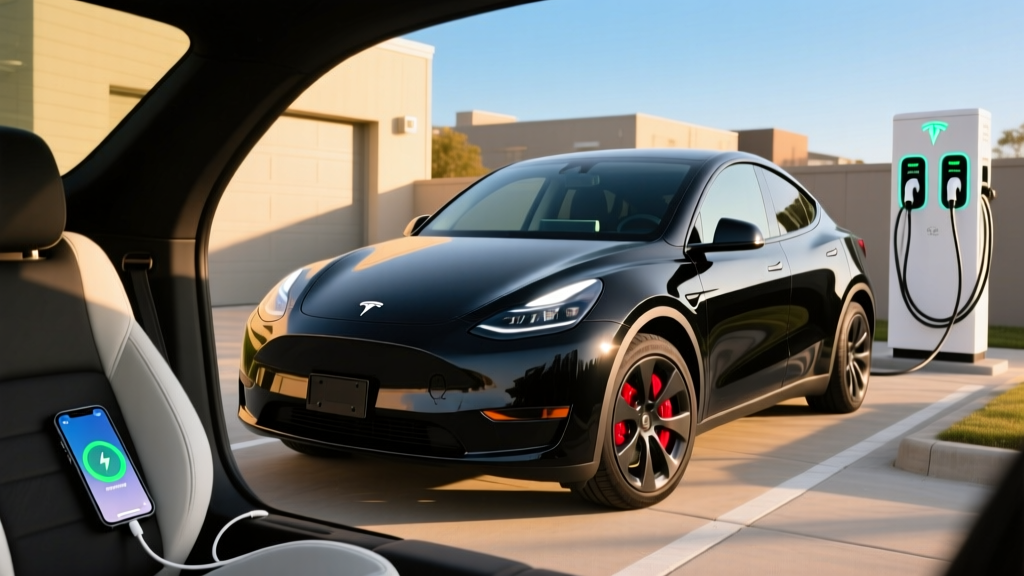
Charging speed is where the Model Y's Supercharger network access shines — and where the remote Tesla app experience pays dividends. Here's the complete charging picture:
| Charging Level | Power | Miles Added per Hour | Notes |
|---|---|---|---|
| Level 1 (120V outlet) | ~1.4 kW | ~5 mi/hr | Emergency/trickle only |
| Level 2 (240V home) | 11.5 kW | ~44 mi/hr | Full charge in ~7–8 hours |
| DC Fast (Supercharger V3) | 250 kW peak | ~200 mi in 15 min | 10–80% in ~25 min (LR AWD) |
| DC Fast (CCS adapter) | Up to 250 kW | Varies by station | Requires Tesla CCS adapter ($175) |
The charging curve matters. The 250 kW peak on Long Range and Performance trims is not sustained. The Model Y holds peak rate from roughly 10% to 35% state of charge, then tapers to ~150 kW by 50%, and drops below 60 kW past 80%. This is standard for NMC lithium-ion chemistry but worth understanding: a "25-minute 10–80% charge" means that last 20% takes as long as the first 50%.
On the home front, an 11.5 kW Level 2 charge using the Tesla Wall Connector on a 60-amp circuit adds about 44 miles per hour of charging. A full overnight session easily replenishes any daily commute. Installation costs for a 240V/60A circuit typically run $800–$2,000 depending on panel proximity and local permitting — budget for a potential panel upgrade if your home has a 100-amp service.
Remote Tesla App: The Best in the Business
The Tesla mobile app sets the standard for remote EV management. From your phone, you can:
- Precondition the cabin and battery (critical for maximizing range and fast-charge speed in cold weather)
- Monitor real-time charge rate and estimated completion time
- Set charge limits and scheduled departure times
- Trigger Sentry Mode and review camera clips remotely
- Use Smart Summon to bring the car to you in a parking lot (SAE Level 2 — driver must supervise)
- Lock/unlock, flash lights, honk horn, and open the frunk or trunk
- View live tire pressure, battery health estimates, and service alerts
No other automaker matches this depth of remote control. Hyundai's Bluelink and Ford's Pass app offer basics — lock, start, locate — but Tesla's integration of camera feeds, climate scheduling, and over-the-air software deployment makes the app feel like a true vehicle command center.
Pricing, Trims, and Federal Tax Credit Eligibility
The 2026 Model Y lineup starts at $44,990 for the RWD trim and climbs to $53,990 for the Performance variant. Here's how federal incentives factor in under current IRS §30D rules:
| Trim | MSRP | Est. §30D Credit | Effective Price | MSRP Cap Status |
|---|---|---|---|---|
| RWD | $44,990 | Up to $7,500 | ~$37,490 | Under $80,000 SUV cap ✓ |
| Long Range AWD | $48,990 | Up to $7,500 | ~$41,490 | Under $80,000 SUV cap ✓ |
| Performance | $53,990 | Up to $7,500 | ~$46,490 | Under $80,000 SUV cap ✓ |
- Buyer AGI must not exceed $150,000 (single) / $300,000 (joint) / $225,000 (head of household)
- Vehicle MSRP must be under $80,000 for SUVs (all Model Y trims qualify)
- Battery critical minerals and components must meet phased-in sourcing thresholds — Tesla's US-built cells and North American mineral sourcing have historically met requirements, but verify at purchase via the dealer's IRS compliance report
- Credit can be transferred to the dealer at point of sale as an immediate price reduction
- Check the official fueleconomy.gov credit list for current eligibility before purchasing
Interior, Cargo, and Technology
The Model Y's cabin is minimalist to a fault. A single 15.4-inch touchscreen handles infotainment, climate, navigation, and vehicle settings — there are no physical buttons for audio volume or temperature. This approach polarizes buyers: tech-forward users love the clean aesthetic, while traditionalists find it distracting while driving.
Cargo and passenger dimensions:
- Cargo behind rear seats: 30.2 cu ft
- Cargo with rear seats folded: 72.1 cu ft
- Front trunk (frunk): 4.1 cu ft
- Rear legroom: 41.6 inches
- Front headroom: 41.0 inches
These numbers make the Model Y one of the most practical vehicles in its class. The 72.1 cu ft maximum cargo space rivals midsize SUVs, and the frunk adds useful grocery-bag storage that ICE competitors simply can't match.
Driver Assistance: Autopilot and FSD (Supervised)
Autopilot comes standard and includes adaptive cruise control, lane centering, and automatic emergency braking. FSD (Supervised) is a $8,000 option (or $99/month subscription) that adds automatic lane changes, traffic light/stop sign recognition, and Navigate on Autopilot. In practice, FSD handles most highway scenarios competently but still requires constant supervision — construction zones, faded lane markings, and complex intersections routinely demand driver intervention.
Pros, Cons, and Who Should Buy
- Class-leading efficiency (27 kWh/100 mi)
- Supercharger network — 60,000+ stalls globally, best reliability of any network
- Best-in-class remote app control and OTA updates
- 72.1 cu ft cargo space with seats folded
- Strong §30D tax credit eligibility across all trims
- 250 kW peak DC charging (LR/Performance)
- Minimalist interior lacks physical controls
- No Apple CarPlay or Android Auto
- Ride quality firm on rough pavement
- FSD ($8,000) still requires full driver supervision
- RWD LFP trim has slower 170 kW DC charging
- Rear visibility limited by sloping roofline
Consider a competitor if: You want Apple CarPlay (Hyundai Ioniq 5, Kia EV6), prefer physical controls and a more plush ride (Ford Mustang Mach-E), or need faster 10–80% charging on a 350 kW-capable architecture (Hyundai/Kia E-GMP platform achieves 10–80% in ~18 min).
Warranty and Long-Term Ownership
Tesla covers the Model Y with a 4-year/50,000-mile basic warranty and an 8-year battery and drive unit warranty. The battery warranty guarantees at least 70% capacity retention over the coverage period — 120,000 miles for Long Range and Performance trims, 100,000 miles for RWD. Per Tesla's warranty documentation, if the battery degrades below 70% within the warranty window, Tesla will repair or replace it at no cost.
Out-of-warranty battery replacement remains a concern for long-term owners. Current estimates for a Model Y pack replacement range from $12,000 to $16,000 — a significant cost, though real-world data from high-mileage Tesla owners suggests NMC packs retain 85–90% capacity at 100,000 miles under normal charging habits (80% daily limit, occasional 100% for trips).
Frequently Asked Questions
What is the real-world range of the 2026 Tesla Model Y?
The EPA rates the Long Range AWD at 320 miles. Expect 270–290 miles on the highway in mild weather, and 220–250 miles in freezing temperatures. The RWD model's LFP battery allows daily 100% charging, making its real-world usable range (303 EPA miles) closer to the sticker number day-to-day.
How fast does the Model Y charge at home and on the road?
On a 240V Level 2 home charger (11.5 kW), the Model Y adds about 44 miles per hour — a full overnight charge covers most needs. On a V3 Supercharger, Long Range and Performance trims peak at 250 kW and reach 10–80% in approximately 25 minutes. The RWD trim peaks at 170 kW, taking roughly 30 minutes for the same session.
Does the 2026 Tesla Model Y qualify for the federal EV tax credit?
All three trims fall under the $80,000 SUV MSRP cap and are assembled in the US, making them potentially eligible for up to $7,500 under IRS §30D. Eligibility depends on buyer income limits ($150K single / $300K joint), battery mineral sourcing compliance, and point-of-sale transfer availability. Always verify current status on fueleconomy.gov before purchasing.
Is the Model Y worth buying over the Hyundai Ioniq 5 or Ford Mach-E?
The Model Y wins on Supercharger network access, app-based remote control, cargo space, and efficiency. The Ioniq 5 charges faster (10–80% in ~18 min on 350 kW chargers) and offers Apple CarPlay. The Mach-E provides a more traditional interior with physical controls. If charging-network reliability and remote features are your priority, the Model Y still leads.
What are the biggest drawbacks of the Model Y?
The buttonless interior frustrates some drivers, the ride is firm, there's no phone mirroring (CarPlay/Android Auto), and FSD's $8,000 price is steep for a system that still demands constant supervision. The RWD trim's 170 kW DC charging ceiling is also a step behind rivals.
Can I use non-Tesla chargers with the Model Y?
Yes. Tesla now includes a NACS (North American Charging Standard) port natively, and the growing adoption of NACS by Ford, GM, Rivian, and others means the Supercharger network is opening to competitors. For CCS-based public chargers (Electrify America, EVgo), Tesla sells a CCS adapter for $175 that enables compatibility with virtually all US DC fast-charging stations.