The Tesla Model Y Rear-Wheel Drive (RWD) occupies a narrow but important slot in the EV market: it is the least expensive way into a Tesla crossover, and for many buyers, the most rational one. Stripped of the dual-motor complexity and the larger NMC battery found in the Long Range and Performance trims, the RWD model trades some range and all-weather traction for a lower sticker price, lighter curb weight, and the durability advantages of a lithium iron phosphate (LFP) battery. For 2026, Tesla has refreshed the Model Y with a new interior, revised suspension tuning, and the NACS connector native to the Supercharger network. Here is everything a prospective buyer needs to know before signing the order sheet.
Quick Verdict: Who the RWD Model Y Is For
The 2026 Tesla Model Y Rear-Wheel Drive is the right pick if you live in a mild or moderate climate, charge primarily at home, and want a spacious electric SUV under $45,000 before incentives. It is not the right pick if you regularly tow, need all-wheel-drive traction for mountain winters, or want the longest possible road-trip range. Think of it as the efficiency-and-value play in the Model Y lineup — the trim that makes the strongest total-cost-of-ownership argument.
Choose the RWD Model Y if: You commute under 60 miles round-trip, have home Level 2 charging, live where winters are mild or roads are well-plowed, and want the lowest entry price.
Choose the Long Range AWD instead if: You face frequent snow, need AWD traction, tow (up to 3,500 lb vs 2,000 lb), or regularly drive 300+ miles between charges.
Spec Table: 2026 Tesla Model Y Rear-Wheel Drive at a Glance
| Spec | Value |
|---|---|
| EPA Range | 321 miles |
| Usable Battery | ~60 kWh (LFP chemistry) |
| Efficiency | 125 MPGe combined / 27 kWh/100 mi |
| Peak DC Fast Charge | 250 kW (V3 Supercharger) |
| 10–80% DC Charge | ~25 minutes |
| Level 2 Home Charge | 11.5 kW / ~44 mi/hr |
| 0–60 mph | 6.6 seconds |
| Horsepower | 295 hp (single rear motor) |
| Drivetrain | Rear-wheel drive |
| Cargo (rear seats up / folded) | 30.2 / 72.1 cu ft |
| Rear Legroom | 41.6 inches |
| Towing Capacity | 2,000 lb |
| Base MSRP | $44,990 (incl. destination) |
| Battery Warranty | 8 years / 100,000 mi |
Range & Efficiency: Real-World vs. EPA Sticker
The EPA rates the 2026 Model Y RWD at 321 miles. That figure is competitive for the segment and sufficient for almost any daily commute with ample margin. But the EPA test cycle blends city and highway driving under moderate temperatures, and real-world results diverge based on speed, climate, and terrain.
🔋 Real-World Range Expectations
- City / suburban (50–65 mph, mild weather): 300–330 mi — often meets or beats EPA
- Highway (75 mph sustained, mild weather): ~260–280 mi
- Cold weather (20°F, highway + cabin heat): ~210–240 mi (30–35% reduction)
- Hot weather (95°F+, A/C heavy): ~275–295 mi
The LFP battery's smaller gross capacity means less buffer for cold-weather losses compared to the Long Range's ~75 kWh NMC pack. Preconditioning the battery while plugged in (a standard Tesla feature) mitigates this significantly.
Efficiency is strong at 125 MPGe combined (27 kWh per 100 miles), per fueleconomy.gov. That translates to roughly $0.04–$0.06 per mile on residential electricity at the national average of $0.16/kWh — about one-third the per-mile fuel cost of a 25 MPG gas crossover at $3.50/gallon.
Charging Speed: DC Fast, Level 2, and the Charge Curve Reality
Charging speed is where the RWD's smaller LFP battery reveals both strengths and limitations. The peak rate is 250 kW on a V3 Supercharger, but sustained rate matters more than peak.
| Charging Level | Power | Speed | Notes |
|---|---|---|---|
| Level 1 (120V outlet) | ~1.4 kW | ~5 mi/hr | Emergency / overnight trickle only |
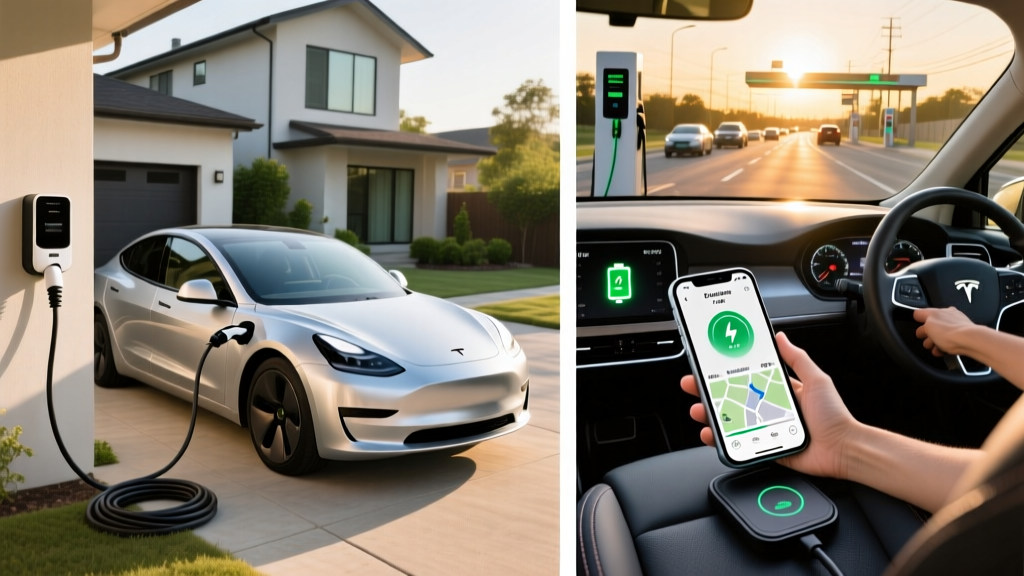
| Level 2 (240V, 48A Wall Connector) | 11.5 kW | ~44 mi/hr | Full charge in ~6 hours |
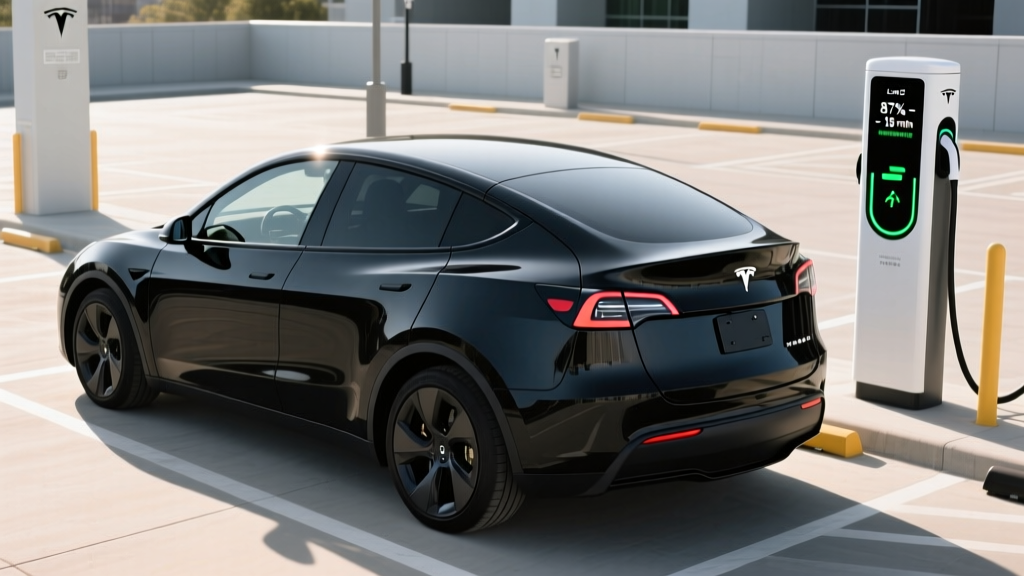
| DC Fast (V3 Supercharger) | Peak 250 kW | 10–80% in ~25 min | Tapers above 60%; preconditioning essential |
| DC Fast (CCS adapter, 3rd-party) | Up to 150–180 kW | 10–80% in ~30–35 min | Varies by network; Electrify America, EVgo |
Charge curve reality check: The 250 kW peak is reached only between roughly 5–15% State of Charge (SoC). By 50% SoC, the rate has typically dropped to ~120 kW, and above 80%, it falls below 40 kW. This is why Tesla (and all EV makers) quote 10–80% times rather than 0–100%. For road trips, plan to charge in the 10–80% window and skip topping off unless you need the final miles — that last 20% can take as long as the first 70%.
One LFP-specific advantage: Tesla recommends charging LFP batteries to 100% at least once per week for accurate SoH calibration. Unlike NMC packs (where daily 80% limits prolong life), LFP chemistry tolerates full charges without meaningful degradation penalty. This effectively gives RWD owners the full 321-mile usable capacity daily, while Long Range NMC owners are better served by an 80% daily limit (~256 usable miles).
Performance & Driving Dynamics
The single rear motor produces 295 horsepower and launches the Model Y RWD to 60 mph in 6.6 seconds. That is not Performance-quick, but it is genuinely quick for a family crossover — faster than most gas-powered competitors in the segment and more than adequate for highway merging and passing.
Rear-wheel drive means the RWD model is lighter (by roughly 200 lb) than the dual-motor variants, which benefits efficiency and gives the steering a slightly more direct feel. The trade-off is traction: on wet pavement the traction control manages wheelspin competently, but in deep snow or on unplowed uphill grades, AWD is meaningfully better. Winter tires help substantially but do not fully close the gap.
The 2026 refresh brought revised damper tuning that improves ride compliance over the previous generation's firm setup. Road noise remains well-controlled, and the low center of gravity keeps body roll modest through corners. Regenerative braking offers one-pedal driving with strong deceleration, though Tesla removed the driver-adjustable regen strength setting — it is always on, always strong.
Interior, Cargo & Technology
The 2026 Model Y interior received a material and design overhaul: ventilated front seats, ambient lighting, a rear-seat touchscreen, and improved sound insulation. The minimalist approach remains — no physical instrument cluster, no stalks (turn signals are steering-wheel buttons), and virtually all controls route through the 15.4-inch center touchscreen.
Cargo and space:
- Rear cargo (seats up): 30.2 cu ft
- Rear cargo (seats folded): 72.1 cu ft
- Front trunk (frunk): 4.1 cu ft
- Rear legroom: 41.6 in
- Seating: 5 passengers (7-seat option not available on RWD)
The cargo area is among the largest in the compact electric SUV segment. The frunk is small but useful for charging cables. The optional tow hitch is limited to 2,000 lb on the RWD — half the Long Range's capacity.
Tech highlights:
- 15.4-inch center touchscreen with navigation, streaming, and gaming
- 8-camera Tesla Vision suite (no radar or ultrasonic sensors)
- Basic Autopilot standard (lane centering + adaptive cruise)
- Enhanced Autopilot ($6,000) or FSD Supervised ($8,000) optional
- Over-the-air updates, Sentry Mode, Dog Mode, phone-as-key
- Native NACS connector — full Supercharger network access without adapters
⚠️ Driver-Assist, Not Self-Driving
Tesla's Autopilot and FSD (Supervised) are SAE Level 2 systems. The driver must remain fully attentive, hands on or near the wheel, and ready to take over at any moment. These are not autonomous systems. FSD Supervised can navigate on-ramps, traffic lights, and city streets, but it makes errors and requires constant supervision. Only Level 4 robotaxi services (Waymo, Zoox) operate without a human driver.
Pricing, Trims & Federal Tax Credit Eligibility
The 2026 Model Y RWD starts at $44,990 including destination. That places it under the IRS §30D MSRP cap of $80,000 for SUVs. The key question is whether the buyer qualifies for the full $7,500 federal credit, which can now be transferred to the dealer at point of sale as an instant discount.
| Item | Amount |
|---|---|
| Base MSRP (incl. destination) | $44,990 |
| Common upgrades (paint, wheels, interior) | +$1,000–$3,500 |
| As-tested typical price | $47,500 |
| Federal §30D credit (if eligible) | –$7,500 |
| Effective price after credit | $37,490–$40,000 |
- MSRP cap: Vehicle must be under $80,000 (Model Y qualifies)
- Buyer income cap: AGI ≤ $150,000 single / $225,000 head of household / $300,000 joint
- Battery sourcing: Must meet critical-mineral and battery-component requirements that phase in annually — verify current-year compliance on Tesla's checkout page and IRS.gov §30D guidance
- Point-of-sale transfer: Eligible buyers can apply the credit as an instant dealer discount rather than waiting for a tax refund
- Assembly: Must be assembled in North America (Model Y: Fremont, CA or Austin, TX — qualifies)
Critical caveat: Battery-sourcing and critical-mineral rules tighten each year. A trim that qualifies in January may lose eligibility if supply chains shift. Always confirm eligibility at purchase — do not assume last year's rules still apply. A tax professional can verify your specific situation.
Warranty & Long-Term Battery Outlook
Tesla covers the Model Y RWD battery and drive unit for 8 years or 100,000 miles, whichever comes first, with a minimum 70% capacity retention guarantee. The limited vehicle warranty is 4 years / 50,000 miles.
The LFP chemistry in the RWD is a longevity advantage. LFP cells typically endure 3,000–5,000+ full charge cycles before reaching 80% capacity, compared to roughly 1,000–2,000 cycles for NMC. For a 60 kWh pack with 300 miles of range, that translates to a theoretical 900,000+ cycle-miles — far beyond the vehicle's mechanical life. Real-world degradation data from high-mileage Tesla LFP packs shows roughly 5–8% loss over the first 100,000 miles, with the curve flattening significantly after the initial break-in period.
If out-of-warranty replacement were ever needed, current LFP pack replacement costs run approximately $8,000–$12,000 (parts + labor), though this figure is expected to decline as battery costs continue their long-term downward trend.
Pros & Cons
✅ Pros
- Lowest entry price in the Model Y lineup
- LFP battery: longer cycle life, 100% daily charging OK
- Strong efficiency (125 MPGe / 27 kWh/100 mi)
- Class-leading cargo space and Supercharger network access
- OTA updates continuously add features
- Eligible for full $7,500 §30D credit (if buyer qualifies)
❌ Cons
- No AWD — limited snow/ice traction
- 2,000 lb tow rating (half the Long Range)
- Cold-weather range loss more pronounced with smaller battery
- Turn-signal buttons on steering wheel are polarizing
- Regen braking not adjustable
- Panel gaps and build quality still inconsistent vs legacy OEMs
How It Compares: Model Y RWD vs. Key Rivals
The RWD Model Y does not compete in a vacuum. Here is how it stacks up against the closest alternatives in 2026:
| Metric | Tesla Model Y RWD | Hyundai Ioniq 5 (Std Range RWD) | Ford Mustang Mach-E (Select RWD) |
|---|---|---|---|
| EPA Range | 321 mi | 290 mi | 250 mi |
| Peak DC Charge | 250 kW | 175 kW | 150 kW |
| 0–60 mph | 6.6 sec | 7.2 sec | 6.3 sec |
| Base MSRP | $44,990 | $42,600 | $42,995 |
| Cargo (seats up) | 30.2 cu ft | 27.2 cu ft | 29.7 cu ft |
| Charging Network | NACS native (Supercharger) | CCS (adapter for NACS) | CCS (adapter for NACS) |
The Model Y RWD wins on range, cargo, and charging-network convenience. The Ioniq 5 undercuts on price and offers a more conventional interior layout. The Mach-E delivers sportier steering feel but trails on range and charging speed. For buyers who prioritize Supercharger reliability and resale value, the Tesla remains the default choice.
Ownership Costs: 5-Year Estimate
| Category | 5-Year Cost (Est.) |
|---|---|
| Purchase (after $7,500 credit) | ~$37,490 |
| Electricity (15,000 mi/yr, $0.16/kWh avg) | ~$4,050 |
| Insurance (national EV avg) | ~$12,500 |
| Maintenance (tires, cabin filter, wipers) | ~$2,200 |
| Estimated depreciation | ~$14,000 |
| Total 5-Year Cost | ~$70,240 |
EV insurance premiums remain 15–25% higher than comparable gas vehicles. Maintenance is dramatically lower — no oil changes, no transmission fluid, brake pads last 100,000+ miles thanks to regenerative braking.
Frequently Asked Questions
What is the real-world range of the Tesla Model Y Rear-Wheel Drive?
The EPA rates it at 321 miles. In real-world driving, expect 260–280 miles at highway speeds in mild weather, 300+ miles in city driving, and 210–240 miles in cold winter conditions with cabin heat running. Preconditioning while plugged in helps recover some of the cold-weather loss.
How fast does the Model Y RWD charge at home and on the road?
On a 48-amp Level 2 home charger (Tesla Wall Connector), it adds about 44 miles of range per hour, reaching a full charge in roughly 6 hours. On a V3 Supercharger at peak 250 kW, it charges from 10–80% in about 25 minutes. Actual speed depends on battery temperature and state of charge — always precondition before fast charging.
How much does the Model Y RWD cost after tax credits?
The base MSRP is $44,990. If you qualify for the full $7,500 federal §30D credit (meeting income, battery-sourcing, and MSRP requirements), the effective price drops to approximately $37,490 before state incentives. Always verify current-year eligibility on IRS.gov before purchasing.
Does the Tesla Model Y RWD qualify for the $7,500 federal EV tax credit?
The vehicle itself qualifies — it is assembled in North America, under the $80,000 SUV MSRP cap, and Tesla's LFP battery supply chain has met critical-mineral and component-sourcing thresholds. However, the buyer must also meet income limits (≤$150K single / ≤$300K joint). Battery-sourcing rules tighten annually, so confirm at the time of purchase.
Is the Model Y RWD worth buying over the Long Range or competitors?
For mild-climate commuters who charge at home and don't need AWD or towing, the RWD is the strongest value in the lineup — you save $5,000+ over the Long Range and gain LFP longevity. If you face harsh winters, tow frequently, or want maximum road-trip range, the Long Range AWD justifies the premium. Against rivals like the Ioniq 5 or Mach-E, the Model Y RWD wins on Supercharger access, cargo space, and efficiency, though its minimalist interior and non-adjustable regen won't appeal to everyone.
What is the LFP battery, and why does it matter?
LFP (lithium iron phosphate) is a battery chemistry that sacrifices some energy density (hence the smaller 60 kWh pack and lower range vs NMC) in exchange for longer cycle life, greater thermal stability, and lower cost. LFP batteries tolerate daily 100% charging without accelerated degradation — a practical advantage for owners who want the full range available every day.
Can I charge a Model Y RWD at non-Tesla charging stations?
Yes. The 2026 Model Y uses the NACS connector natively. Tesla Superchargers are the primary network, but a growing number of third-party networks (Electrify America, EVgo) are adding NACS cables. For older CCS-only stations, Tesla sells a CCS adapter. CHAdeMO stations are effectively obsolete and not supported.