Quick Answer: Does Toyota Make an Electric Highlander?
As of early 2026, Toyota does not sell an all-electric Highlander in the United States. The Highlander nameplate remains a three-row midsize SUV offered exclusively as a conventional hybrid (HEV). Toyota's closest electric SUV offerings are the bZ4X (a compact two-row EV with ~252 miles of EPA range) and the newly announced bZ Large SUV (a three-row electric concept previewing a production model expected for late 2026 or 2027). Buyers specifically searching for an "electric Highlander Toyota" are likely looking for a three-row electric family SUV with Toyota reliability — and right now, that exact vehicle doesn't exist on dealer lots.
If you need three rows and Toyota badging today, the Grand Highlander Hybrid (up to 36 MPG combined, starting around $40,770) is the closest match. If you need a true battery-electric three-row SUV, you'll need to look at competitors like the Kia EV9, Hyundai Ioniq 9, or Rivian R1S. Below, we break down exactly what Toyota offers, what's coming, and how to decide.
Toyota's 2026 Electrified SUV Lineup: What Actually Exists
Toyota's approach to electrification has been cautious and hybrid-heavy. For 2026, the brand offers several electrified SUVs, but only one battery-electric model — and it's not a three-row family hauler.
| Model | Powertrain | EPA Range / MPG | Seating | Starting MSRP (2026) |
|---|---|---|---|---|
| Toyota bZ4X | BEV (71.4 kWh, NMC) | 252 mi (EPA) | 5 | $38,465 |
| Toyota Highlander Hybrid | HEV (2.5L + electric motors) | 36 MPG combined | 7 | $41,815 |
| Toyota Grand Highlander Hybrid | HEV (2.5L Hybrid MAX) | 36 MPG combined (Hybrid MAX: 27 MPG) | 7-8 | $40,770 |
| Toyota RAV4 Prime (PHEV) | PHEV (18.1 kWh + 2.5L) | 42 mi electric / 38 MPG combined | 5 | $44,230 |
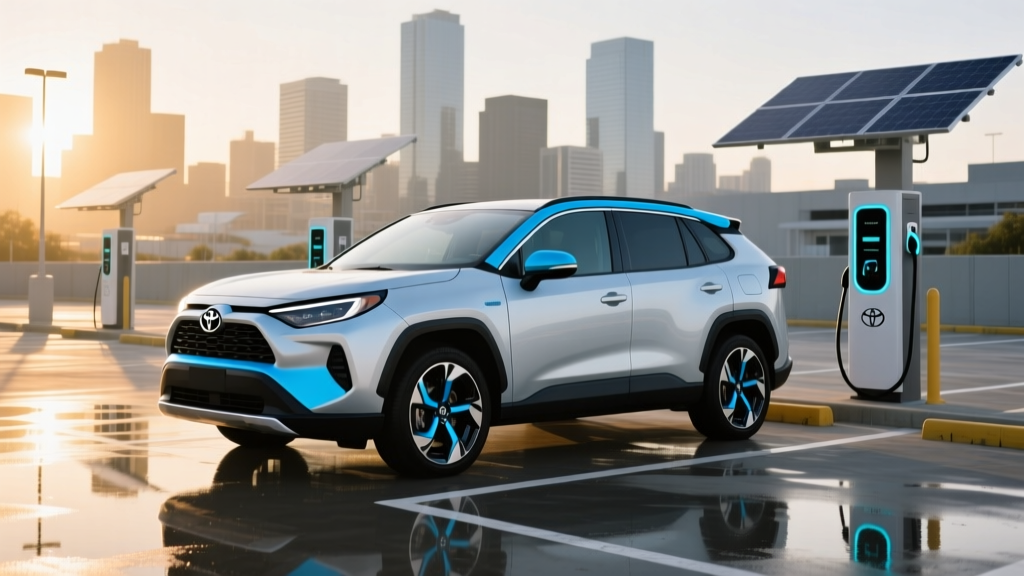
The bZ4X is Toyota's only all-electric vehicle currently on sale in the U.S. It's a competent compact crossover, but with two rows and 252 miles of EPA range, it doesn't fill the "electric Highlander" role that many families are searching for. According to fueleconomy.gov, the bZ4X achieves approximately 114 MPGe combined with its 71.4 kWh lithium-ion battery pack.
The bZ Large SUV: Toyota's Three-Row Electric Future
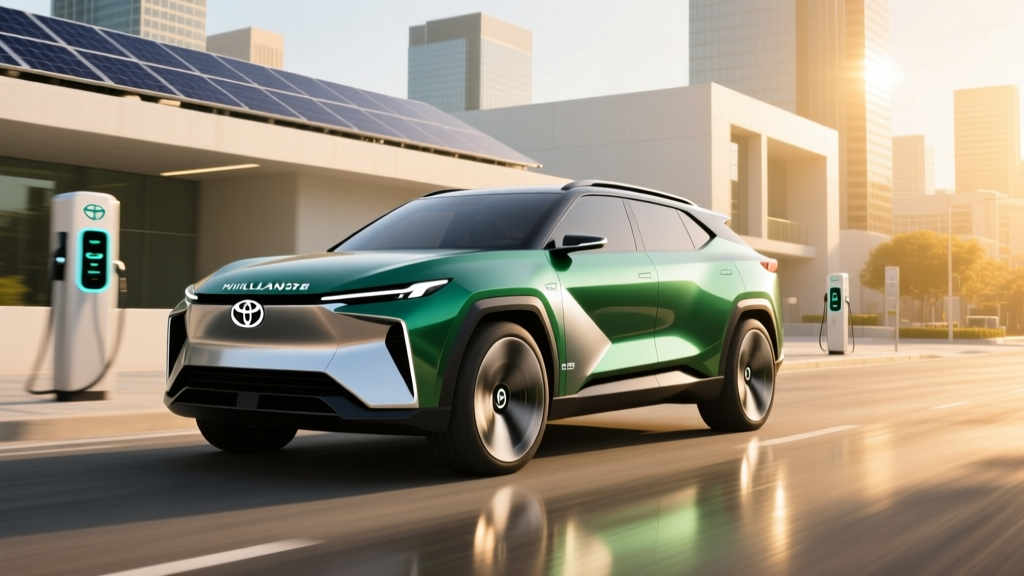
Toyota has previewed a three-row electric SUV under the bZ Large SUV nameplate, shown as a concept at the 2025 New York International Auto Show. Production is expected to begin at Toyota's Georgetown, Kentucky plant, likely for the 2027 model year — meaning it won't appear in showrooms until late 2026 at the earliest.
What we know so far (preliminary/announced specs):
- Platform: Dedicated EV architecture (not a modified gas platform)
- Battery: Expected 90-100+ kWh usable capacity, likely NMC chemistry
- Range: Toyota has targeted 300+ miles EPA, though final numbers are unconfirmed
- Charging: Expected to support 150+ kW DC fast charging with NACS connector (following Toyota's commitment to the Tesla charging standard)
- Seating: Three rows, 7-passenger capacity
- Pricing: Not announced — expect $50,000-$65,000 range based on segment positioning
Important caveat: These are preliminary estimates based on concept details and industry analysis. Final EPA range, battery capacity, charging speeds, and pricing will not be confirmed until closer to launch. We'll update this article when official specs are released.
EV vs. Hybrid: The Highlander Hybrid as a Bridge
For families who want Toyota reliability and three rows now, the Grand Highlander Hybrid deserves serious consideration — especially if home charging access is uncertain or you frequently take long road trips.
| Factor | Grand Highlander Hybrid (HEV) | Comparable 3-Row EV (e.g., Kia EV9) |
|---|---|---|
| Starting Price | $40,770 | $54,900 |
| Fuel/Energy Cost (15,000 mi/yr) | ~$1,670/yr (gas at $3.30/gal, 36 MPG) | ~$660/yr (electric at $0.15/kWh, 3.0 mi/kWh) |
| Annual Fuel Savings (EV) | — | ~$1,010/yr |
| Range / Refueling | ~500 mi / 5 min fill-up | 270-304 mi / 25-35 min (10-80% DC) |
| Home Charging Needed? | No | Strongly recommended |
| Maintenance (5-yr est.) | ~$2,800 (oil, filters, brakes) | ~$1,200 (cabin filter, tire rotation, fluid top-off) |
| Federal Tax Credit (§30D) | Not eligible (HEV) | Up to $7,500 (varies by sourcing/income) |
| Cold-Weather Impact | Minimal MPG loss | 20-30% range reduction at 20°F |
The math tells a nuanced story. A three-row EV like the Kia EV9 costs roughly $14,000 more upfront but saves about $1,010 annually on fuel and ~$320/year on maintenance. That's ~$1,330/year in savings, meaning it takes roughly 10.5 years to break even on the price premium — before factoring in the federal tax credit. If you qualify for the full §30D credit of $7,500, the break-even drops to about 5 years.
However, §30D eligibility is complex for 2026. The credit requires:
- Buyer income below $150,000 (single) or $300,000 (joint)
- Vehicle MSRP under $80,000 for SUVs
- Battery components and critical minerals meeting North American sourcing thresholds (which tighten annually)
- The vehicle must be on the IRS qualified list — not all EVs qualify for the full amount
Always verify current eligibility on irs.gov and consult a tax professional before purchasing based on credit assumptions.
Real-World Ownership: What First-Time EV Buyers Must Know
If you're considering any three-row electric SUV while waiting for Toyota's offering, here are the practical realities that spec sheets don't always reveal:
Home Charging Is Non-Negotiable for Most Owners
Public DC fast charging works for road trips, but daily EV ownership lives or dies on home charging. A Level 2 home charger (240V, 32-48 amps / 7.7-11.5 kW) adds roughly 25-37 miles of range per hour of charging. Most EV owners charge overnight and wake up "full" every morning.
Installation cost reality: Expect $800-$2,500 for a professional Level 2 installation if your electrical panel has capacity. If you need a panel upgrade (common in older homes, 100-amp to 200-amp), add $1,500-$4,000. Always get a quote from a licensed electrician before purchasing an EV.
Highway Range Is Less Than the EPA Sticker
EPA range estimates use a mixed driving cycle. On sustained highway driving at 70-75 mph, expect to use about 80-85% of the EPA range in mild weather. In cold weather (below 30°F), battery chemistry limitations and cabin heating can reduce range by 20-30%. A 300-mile EPA-rated EV might deliver 210-240 real-world miles on a cold winter highway trip.
DC Fast Charging Slows Above 80%
When manufacturers advertise "10-80% in 25 minutes," they're being honest about the useful charging window. Above 80% state of charge, the charging curve tapers significantly to protect battery health. Charging from 80-100% can take as long as the 10-80% session. On road trips, plan to charge to 80% and go — it's dramatically faster.
Common Misconceptions About an Electric Highlander
| Myth | Fact |
|---|---|
| "Toyota makes an electric Highlander" | No all-electric Highlander exists as of 2026. The Highlander is hybrid-only. A three-row bZ EV is expected for 2027. |
| "The bZ4X is Toyota's electric Highlander" | The bZ4X is a compact 2-row crossover, significantly smaller than a Highlander with less cargo room and no third row. |
| "EV batteries need replacing every 5 years" | Modern NMC and LFP batteries are designed for 150,000-200,000+ miles. Toyota's hybrid battery warranty covers 10 years/150,000 miles. Degradation is typically 10-15% over 10 years. |
| "EVs cost more to own in every scenario" | EVs have higher upfront costs but lower fuel and maintenance. Break-even varies by electricity rates, driving miles, and tax credit eligibility — typically 4-8 years for high-mileage drivers. |
| "I can rely entirely on public charging" | Possible but inconvenient. Public DC charging costs 2-3x more per kWh than home charging, and station reliability varies. Home Level 2 is strongly recommended. |
Decision Framework: What Should You Actually Buy?
Choose the Grand Highlander Hybrid if:
- You need three rows and Toyota reliability today
- You don't have reliable home charging access (apartment, street parking)
- You frequently drive 400+ miles in a single day or through charging-desert regions
- You live in extreme cold climates where EV range loss is a daily concern
- Your budget is under $50,000 and you can't wait for a new model launch
Choose a competitor's 3-row EV (Kia EV9, Hyundai Ioniq 9) if:
- You have home Level 2 charging or can install it
- You qualify for the §30D federal tax credit (check IRS qualified vehicles list)
- Your daily driving is under 200 miles round-trip with occasional road trips
- You want the lowest per-mile energy cost and minimal maintenance
- You're comfortable with a non-Toyota brand for your family SUV
Wait for Toyota's bZ Large SUV if:
- You specifically want a Toyota-badged three-row EV and can wait until late 2026/2027
- Toyota's hybrid reliability track record is a dealbreaker for your household
- Your current vehicle has 12-18+ months of useful life remaining
- You want NACS (Tesla Supercharger) access from launch — Toyota has committed to the standard
5-Year Cost Comparison: Grand Highlander Hybrid vs. Kia EV9
| Cost Category | Grand Highlander Hybrid (LE) | Kia EV9 (Light RWD) |
|---|---|---|
| Purchase Price (MSRP) | $40,770 | $54,900 |
| Federal Tax Credit | $0 | Up to $7,500 (if eligible) |
| Effective Purchase Price | $40,770 | $47,400 |
| Fuel/Energy (5 yrs, 15k mi/yr) | $8,350 | $3,300 |
| Maintenance (5 yrs est.) | $2,800 | $1,200 |
| Insurance (5 yrs est.) | $7,500 | $8,750 (EVs typically 10-20% more) |
| Home Charger Install (one-time) | $0 | $1,200 (avg Level 2) |
| 5-Year Total Cost | $59,420 | $61,850 |
The totals are remarkably close — within ~$2,400 over five years — even with the EV's higher purchase price and insurance. The EV's fuel and maintenance savings nearly offset the premium. For drivers covering more than 15,000 miles annually, the EV pulls ahead faster. For lower-mileage drivers, the hybrid's lower upfront cost may be the smarter financial play.
Note: Insurance costs vary significantly by driver profile, location, and carrier. Get quotes for both vehicles before deciding. EV insurance premiums are generally 10-20% higher due to repair costs and battery replacement risk.
Frequently Asked Questions
Will Toyota release an all-electric Highlander?
Toyota has not announced an electric vehicle carrying the "Highlander" name. Instead, the company is developing a three-row electric SUV under the bZ series (previewed as the bZ Large SUV concept), expected to enter production in late 2026 or 2027 at the Georgetown, Kentucky plant. It will serve the same market segment as the Highlander but under different branding.
What is the closest Toyota to an electric Highlander?
The closest current option is the Toyota Grand Highlander Hybrid — a three-row SUV with up to 36 MPG combined, starting at $40,770. For an all-electric Toyota, the bZ4X is the only option, but it's a smaller two-row crossover with 252 miles of range and no third row.
Does the Toyota Highlander Hybrid qualify for the federal EV tax credit?
No. The §30D federal tax credit applies only to plug-in electric vehicles (BEVs and PHEVs with sufficient battery capacity). The Highlander Hybrid is a conventional HEV — it cannot be plugged in and does not qualify. The Toyota RAV4 Prime (PHEV) may qualify for partial credit depending on current sourcing requirements.
How much would a Toyota three-row EV cost?
Toyota has not announced pricing for the bZ Large SUV. Based on segment positioning against the Kia EV9 ($54,900-$73,900) and Hyundai Ioniq 9 (estimated $50,000-$65,000), a reasonable estimate is $50,000-$65,000 depending on trim and battery configuration. Final pricing will be confirmed closer to launch.
Is it worth waiting for Toyota's electric SUV or should I buy now?
If your current vehicle is reliable and you have 12-18 months of flexibility, waiting gives you Toyota's EV platform with NACS Supercharger access. If you need a three-row family SUV now, the Grand Highlander Hybrid or a competitor EV (Kia EV9) are strong, proven options available today.