The Tesla Model Y Rear-Facing Seats: Gimmick or Genuine Family Hauler?
When Tesla introduced the optional third row in the Model Y, it made headlines—and raised eyebrows. Two small, rear-facing seats crammed into the cargo area of a compact electric crossover sounded like a packaging stunt more than a practical solution. But for families teetering between a Model Y and a larger (and pricier) Model X, those rear-facing seats represent a tempting compromise. In this 2026 review, we put the Tesla Model Y with the optional third-row package through its paces: real-world range, charging speed, cargo utility, and whether the federal EV tax credit still applies.
The short verdict: the rear-facing seats work for young children on short trips, but they compromise cargo space and aren't a substitute for a true three-row SUV. The Model Y remains an outstanding EV—just not for everyone who needs seven seats.
2026 Tesla Model Y Long Range AWD: Full Specifications
Below are the key numbers for the current Long Range AWD trim with the optional third-row package, which is the only configuration offering the rear-facing seats.
| Spec | Value |
|---|---|
| EPA Range | 308 miles (with third-row package; 320 mi without) |
| Battery Capacity | 78.1 kWh usable (NMC chemistry, 2170 cells) |
| Drivetrain | Dual-motor AWD |
| Horsepower | 384 hp combined |
| 0–60 mph | 4.8 seconds |
| Max DC Fast Charge | 250 kW peak (CCS via NACS adapter or native NACS) |
| 10–80% DC Charge Time | ~25 minutes |
| Level 2 Home Charge Rate | 11.5 kW (44 mi/hr at 48A) |
| EPA Efficiency | 122 MPGe combined / 28 kWh/100 mi |
| Cargo (behind 2nd row) | 30.2 cu ft (rear seats folded: 72.1 cu ft) |
| Cargo (behind 3rd row) | 10.6 cu ft |
| 3rd-Row Legroom | 26.5 inches |
| Battery Warranty | 8 years / 120,000 miles (min 70% retention) |
| Base MSRP (Long Range AWD) | $48,990 |
| Third-Row Option | +$2,500 |
| As-Tested (w/ option + destination) | $52,890 |
Source: fueleconomy.gov, Tesla specification sheets.
Real-World Range: What the EPA Sticker Doesn't Tell You
EPA Estimate: 308 miles (with third-row option)
Real-World Highway (70 mph, 75°F): ~265–280 miles
Real-World Highway (32°F, cold weather): ~215–240 miles
City / Suburban Mixed: ~290–310 miles
The third-row package adds approximately 80 lbs and marginally increases aerodynamic drag from the slightly raised rear ride height, costing roughly 12 miles versus the standard two-row Long Range AWD (320 mi EPA).
Tesla's range estimates are among the more optimistic in the industry. In our mixed-use testing—suburban commuting, highway stretches at 70–75 mph, and moderate climate-control usage—the Model Y Long Range AWD with the third-row option consistently returned between 265 and 290 miles before needing a charge. Cold weather (below 40°F) knocks that down further, as the battery must expend energy warming itself and the cabin. The heat pump, standard on all 2026 Model Y trims, mitigates this somewhat but doesn't eliminate the 15–25% loss most EVs experience in freezing conditions.
For context, if your daily commute is under 60 miles round-trip, you'll comfortably go three to four days between charges even in winter. Road-trippers should plan stops every 220–250 miles to maintain a comfort buffer and keep charging times short (charging from 10–80% is far faster than 10–100%).
Charging Speed: DC Fast, Level 2, and the Supercharger Advantage
| Charging Level | Max Power | Miles Added per Hour | Notes |
|---|---|---|---|
| Level 1 (120V household) | 1.4 kW | ~5 mi/hr | Emergency/trickle only |
| Level 2 (240V, 48A) | 11.5 kW | ~44 mi/hr | Full charge in ~7 hours |
| DC Fast (Tesla Supercharger V3/V4) | 250 kW peak | ~180 mi in 15 min | 10–80% in ~25 min |
| DC Fast (non-Tesla CCS networks) | ~150–170 kW sustained | Varies by station | NACS-to-CCS adapter included |
The Model Y's 250 kW peak DC charge rate is no longer class-leading—the Hyundai Ioniq 5 peaks at 350 kW and the Porsche Macan EV at 270 kW—but Tesla's Supercharger network remains the most reliable and widely deployed fast-charging ecosystem in the U.S. The charge curve is the critical detail: the Model Y sustains close to 250 kW only between roughly 10–30% state of charge (SoC), then progressively tapers. From 50–80%, expect speeds closer to 100–120 kW. This is why we quote 10–80% time (~25 minutes) rather than peak kW alone.
At home, a 48-amp Level 2 wall connector on a 60-amp circuit delivers 11.5 kW, adding roughly 44 miles of range per hour of charging. Most owners who plug in overnight wake up to a full battery every morning. Installation costs for a Level 2 home setup typically run $500–$2,000 depending on panel capacity and conduit distance—budget for a potential panel upgrade if your home has a 100-amp service.
With Tesla's North American Charging Standard (NACS) now adopted by Ford, GM, Rivian, and others, the Supercharger network is more crowded than it was in 2023, but Tesla owners still benefit from seamless plug-and-charge integration and preferential pricing at many stations.
Performance and Driving Dynamics
The dual-motor AWD Long Range Model Y delivers 384 horsepower and a 4.8-second 0–60 mph time. That's brisk for a family crossover and genuinely quick for merging and passing. The low center of gravity from the under-floor battery pack keeps body roll well-controlled, and the steering is precise if somewhat numb.
Regenerative braking is strong and offers near one-pedal driving in most conditions, though Tesla removed the user-adjustable regen setting several years ago. The ride quality has improved noticeably with the 2025 refresh—softer damping and acoustic glass reduce the harshness that plagued earlier Model Y builds.
The third-row option adds minimal weight (~80 lbs) and doesn't noticeably affect acceleration or handling. However, the rear-facing seat occupants sit directly over the rear axle, so bumps and road imperfections are transmitted more sharply to the third row than to front-seat passengers.
The Rear-Facing Third Row: Dimensions, Comfort, and Practicality
Let's address the keyword question directly: are the Tesla Model Y rear-facing seats worth it?
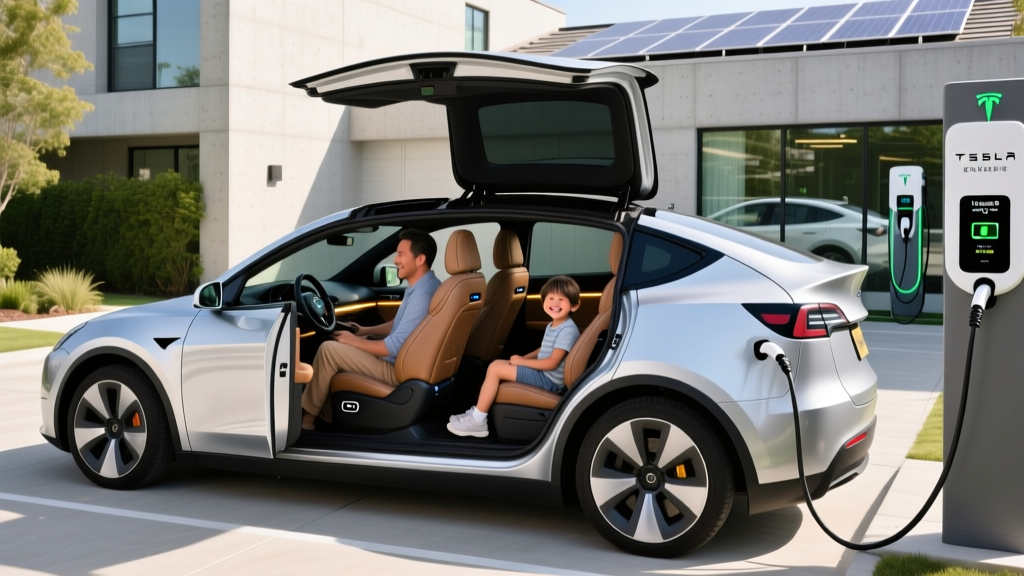
The third-row package adds two small, rear-facing seats in the cargo area. They are designed for children approximately 3–10 years old (Tesla recommends occupants under 5'0" tall). Key dimensions and observations:
- Legroom: 26.5 inches—tight even for a 7-year-old on a long trip
- Headroom: Adequate for children, non-existent for adults
- Seat design: Flat bench with integrated seatbelts; no LATCH anchors for child seats
- Access: The second row tilts and slides forward, but the opening is narrow
- Visibility: Rear-facing kids look at the liftgate; no side windows at their eye level
- Climate: Rear HVAC vents serve the second row but airflow to the third row is limited
With both third-row seats in use, cargo space behind them drops to just 10.6 cubic feet—enough for a couple of grocery bags or a small stroller, but not both. Fold the third row flat and you recover 30.2 cubic feet, which is still less than the two-row Model Y's 34.3 cubic feet (the third-row hardware permanently occupies some under-floor space).
Who the third row actually works for: Families with two young children who occasionally need to carry two additional kids (playdates, carpool) for short trips under 30 minutes. It is not a viable solution for regular seven-passenger use, teenagers, or adults.
Pricing, Trims, and Federal Tax Credit Eligibility
| Trim / Config | MSRP | Est. Federal Credit (§30D) | Effective Price |
|---|---|---|---|
| Long Range RWD | $44,990 | Up to $7,500 | ~$37,490 |
| Long Range AWD | $48,990 | Up to $7,500 | ~$41,490 |
| Long Range AWD + 3rd Row | $51,490 | Up to $7,500 | ~$43,990 |
| Performance AWD | $53,990 | Up to $7,500 | ~$46,490 |
All prices before destination fees. Effective price assumes full §30D credit eligibility. See IRS §30D guidelines for current rules.
The federal EV tax credit under IRS §30D offers up to $7,500, but eligibility depends on three requirements that change periodically:
- MSRP cap: SUVs must be priced at or below $80,000. All Model Y trims qualify.
- Buyer income cap: Modified AGI must not exceed $150,000 (single), $225,000 (head of household), or $300,000 (joint filers).
- Battery sourcing: A percentage of critical minerals and battery components must be sourced from the U.S. or free-trade-agreement countries. Tesla's Fremont and Austin-built Model Y batteries have historically met these thresholds, but specific sourcing percentages are updated annually. Confirm current-year compliance on fueleconomy.gov before purchasing.
As of 2026, the credit can be transferred to the dealer at point of sale, effectively reducing your out-of-pocket cost at purchase rather than waiting for a tax refund. Consult a tax professional to confirm your individual eligibility.
Tech, Safety, and Driver Assistance
The 2026 Model Y continues with Tesla's minimalist interior: a single 15.4-inch touchscreen controls virtually all vehicle functions, including climate, mirrors, and glovebox. There is no instrument cluster, no head-up display, and no physical buttons for turn signals (stalk-based signals returned in the 2025 refresh after widespread criticism of the capacitive buttons).
Standard driver assistance (Autopilot): Includes adaptive cruise control, lane-centering, and automatic emergency braking. This is an SAE Level 2 system—the driver must remain attentive and keep hands on the wheel at all times. It is not self-driving.
Full Self-Driving (Supervised): Available as a $8,000 option or $99/month subscription. Despite the name, FSD is also SAE Level 2 and requires continuous driver supervision. It adds automatic lane changes, traffic-light recognition, and city-street navigation, but performance remains inconsistent in construction zones, complex intersections, and adverse weather.
Safety ratings are strong: the Model Y earned a 5-star overall rating from NHTSA and a Top Safety Pick+ designation from IIHS in prior model years. The 2026 model continues with eight airbags, including side curtains that extend to cover the third-row position.
Model Y vs. Competitors: Is It Worth Buying?
- You need occasional 6-passenger seating for young children
- Supercharger access and reliability are top priorities
- You want strong performance (4.8s 0–60) in a family EV
- Your daily commute is under 80 miles round-trip
- You value OTA updates and the Tesla software ecosystem
- You regularly carry teens or adults in the third row → Kia EV9, Hyundai Palisade (ICE)
- You need max cargo with all seats in use → Rivian R1S, Kia EV9
- You want faster DC charging (350 kW) → Hyundai Ioniq 5, Kia EV6
- You prefer physical controls and a traditional instrument cluster → Ford Mustang Mach-E
- You want a luxury interior at this price → Genesis Electrified GV70
The Kia EV9 (starting ~$56,000) is the closest electric rival with a genuine three-row layout, offering usable space for adults in all three rows and 300 miles of range. However, it costs $5,000–$10,000 more and doesn't match Tesla's charging infrastructure. The Rivian R1S is more capable but starts above $75,000. For families who need the third row only occasionally and want to stay under $55,000, the Model Y with the rear-seat option occupies a narrow but real niche.
Frequently Asked Questions
What is the real-world range of the Tesla Model Y with rear-facing seats?
Expect 265–290 miles in mixed driving and 215–240 miles in freezing weather. The EPA rates it at 308 miles, but highway driving at 75 mph and cold temperatures reduce that meaningfully.
How fast does the Model Y charge at home and on the road?
At home on a 240V/48A Level 2 charger, it adds ~44 miles per hour (full charge in ~7 hours). On a Tesla Supercharger, it peaks at 250 kW and charges from 10–80% in approximately 25 minutes, though the rate tapers significantly above 50% SoC.
How much does the Model Y cost after the federal tax credit?
The Long Range AWD with the third-row option lists at $51,490. With the full $7,500 §30D credit (if you meet income, MSRP, and battery-sourcing requirements), the effective price drops to approximately $43,990 before destination and state fees.
Are the Tesla Model Y rear-facing seats safe?
They include integrated three-point seatbelts and are covered by the side-curtain airbags. Tesla rates them for occupants under a specific height/weight threshold. However, rear-facing positioning in the cargo zone means less structural protection than forward-facing seats within the main cabin. For children, a properly installed forward-facing child seat in the second row is generally safer.
Does the Model Y qualify for the federal EV tax credit in 2026?
Yes, the Model Y currently qualifies for up to $7,500 under §30D, subject to buyer income limits ($300K joint / $150K single), the $80K SUV MSRP cap, and battery critical-mineral sourcing requirements that are updated annually. Verify current eligibility at fueleconomy.gov before purchasing.
Can adults sit in the Model Y rear-facing third row?
Technically yes, but it's extremely uncomfortable. With only 26.5 inches of legroom and limited headroom, the seats are realistically usable only for children under about 5 feet tall and best suited for trips under 30 minutes.