Quick Verdict: The 2026 Tesla Model Y at a Glance
The 2026 Tesla Model Y remains the benchmark compact electric SUV — not because it leads every category, but because its combination of Supercharger access, efficiency, and cargo versatility is difficult to beat for the price. With the refreshed "Juniper" styling introduced for the 2025 model year now fully established, the 2026 lineup carries over with minor software and packaging tweaks. If you're running the numbers through a Tesla calculator — weighing purchase price against federal tax credits, charging costs, and real-world range — this review gives you every figure you need to make an informed decision.
The 2026 Model Y is offered in two primary trims: the Long Range AWD and the Performance AWD. A base rear-wheel-drive variant has been intermittently available in recent years; check Tesla's configurator for current availability, as trim offerings shift quarterly.
| Spec | Long Range AWD | Performance AWD |
|---|---|---|
| EPA Range | 320 miles | 298 miles |
| Battery (usable) | ~75 kWh (NMC) | ~75 kWh (NMC) |
| MPGe (combined) | 111 MPGe | 102 MPGe |
| kWh/100 mi | 30 | 33 |
| 0–60 mph | 4.8 sec | 3.5 sec |
| Horsepower | ~384 hp | ~456 hp |
| Drivetrain | Dual-motor AWD | Dual-motor AWD |
| Peak DC Fast Charge | 250 kW | 250 kW |
| 10–80% DC Time | ~27 min | ~27 min |
| Level 2 Home Charge | 11.5 kW (~44 mi/hr) | 11.5 kW (~44 mi/hr) |
| Cargo (behind 2nd row) | 30.2 cu ft | 30.2 cu ft |
| Cargo (max, seats folded) | 72.0 cu ft | 72.0 cu ft |
| Base MSRP | $44,990 | $48,990 |
Source: EPA / fueleconomy.gov and Tesla manufacturer specifications. Pricing reflects base MSRP before destination; final configurations may vary.
Real-World Range: What the EPA Sticker Doesn't Tell You
EPA Estimate: 320 miles (Long Range AWD) / 298 miles (Performance AWD)
Real-World Expectation: In mixed driving at moderate temperatures (60–80°F), expect 270–300 miles from the Long Range trim. Sustained highway driving at 75+ mph drops this to roughly 240–270 miles. In freezing conditions (below 32°F), range loss of 15–30% is typical, meaning winter highway range can dip to 200–230 miles depending on cabin heat usage and terrain.
Tesla's heat pump — standard on all 2026 Model Y trims — significantly mitigates cold-weather loss compared to older EVs using resistive heating, but physics still applies. Battery chemistry (NMC) is more sensitive to cold than LFP, so preconditioning the battery before fast charging in winter is essential. The Tesla navigation system does this automatically when a Supercharger is set as your destination.
Efficiency in city driving with frequent regenerative braking opportunities can push the Long Range model close to or slightly above its EPA figure. Tesla's one-pedal driving mode maximizes energy recapture, and the Model Y's ~30 kWh/100 mi combined rating makes it one of the most efficient electric SUVs in its class.
Charging Speed and Infrastructure: DC Fast, Level 2, and Home Setup
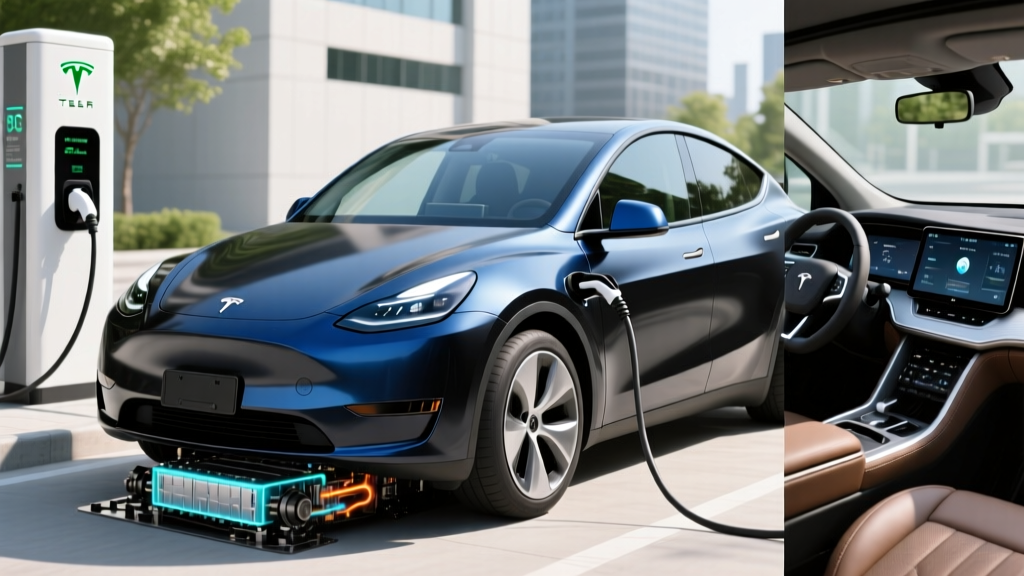
Charging speed is where the Model Y's Supercharger network advantage becomes tangible. Here's a breakdown by charging level:
| Level | Power (kW) | Miles Added per Hour | Use Case |
|---|---|---|---|
| Level 1 (120V household) | ~1.4 kW | ~5 mi/hr | Emergency / overnight trickle |
| Level 2 (240V home, 48A) | 11.5 kW | ~44 mi/hr | Daily home charging |
| DC Fast (Supercharger V3/V4) | Peak 250 kW | ~200 mi in 15 min | Road trips |
Understanding kW vs kWh: kW (kilowatts) measures charging power — how fast energy flows into the battery. kWh (kilowatt-hours) measures battery capacity — how much energy the battery stores. The Model Y's ~75 kWh battery charged at a peak rate of 250 kW will fill fastest between 10–50% State of Charge (SoC). Above 80%, the charge curve tapers significantly to protect battery health, which is why 10–80% is the standard metric.
At a V3 Supercharger (250 kW peak), the Long Range Model Y typically adds ~150–170 miles in 15 minutes under ideal conditions (warm battery, low SoC). The 10–80% charge takes approximately 27 minutes, though real-world sessions at busy stations with shared power cabinets may run 32–35 minutes. V4 Supercharger stalls, now expanding across the network, offer similar peak rates with improved cable management and, in some locations, integrated payment terminals.
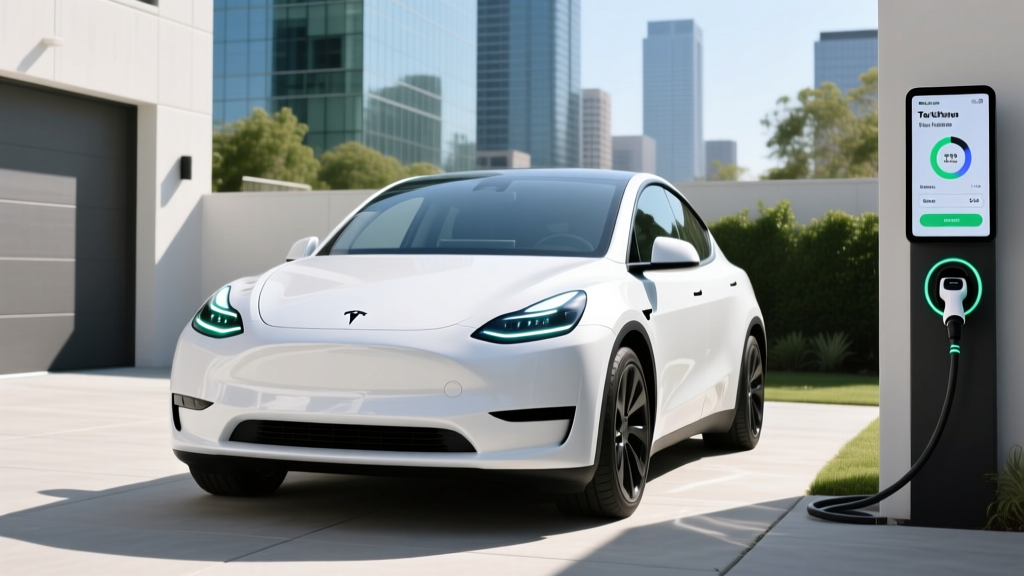
For home charging, a Tesla Wall Connector on a 60-amp circuit delivers the full 11.5 kW (48 amps), replenishing the battery at roughly 44 miles of range per hour. An overnight 8-hour session adds ~350 miles — more than enough for any daily commute. Installation costs for a Level 2 home setup typically range from $800–$2,500 depending on panel capacity and conduit run length; a 200-amp electrical panel is generally sufficient, but older homes may require a panel upgrade ($1,500–$3,000 additional).
The 2026 Model Y uses the NACS (North American Charging Standard) connector natively — the same connector now adopted by Ford, GM, Rivian, and most major automakers. This means full, unrestricted access to every Supercharger stall without adapters. For CCS-compatible public chargers (Electrify America, EVgo), a NACS-to-CCS adapter may be required; Tesla sells one for approximately $250.
Performance, Drivetrain, and Efficiency
Both Model Y trims use dual-motor all-wheel drive with independent front and rear electric motors. The Long Range AWD delivers ~384 horsepower and a 4.8-second 0–60 mph time — quick enough to merge confidently and pass without hesitation. The Performance trim bumps output to ~456 horsepower with a 3.5-second 0–60, placing it in sports-sedan territory despite its crossover body style.
Ride quality on the Juniper-refreshed Model Y is noticeably improved over pre-2025 models, with revised suspension tuning that absorbs road imperfections more compliantly. The Performance trim includes a lowered sport suspension, 21-inch wheels, and performance brakes — trade-offs include a firmer ride and slightly reduced range due to larger, heavier wheels and stickier tires.
Efficiency figures from fueleconomy.gov show the Long Range at 111 MPGe combined (30 kWh/100 mi) and the Performance at 102 MPGe combined (33 kWh/100 mi). These are excellent numbers for an AWD electric SUV; for comparison, the Hyundai Ioniq 5 AWD rates at roughly 101 MPGe combined.
Pricing, Tax Credit Calculator, and Total Cost
Running the numbers on a Tesla calculator requires understanding not just the sticker price but the full incentive landscape. Here's the current pricing structure:
| Trim | Base MSRP | Destination | As-Tested (typical) | Est. After §30D Credit* |
|---|---|---|---|---|
| Long Range AWD | $44,990 | $1,390 | $46,380 | ~$38,880 |
| Performance AWD | $48,990 | $1,390 | $50,380 | ~$42,880 |
*Federal Tax Credit (§30D) Eligibility — Critical Rules for 2026:
- Credit Amount: Up to $7,500, split between a critical minerals requirement ($3,750) and a battery component requirement ($3,750). Tesla's US-assembled battery packs have historically met both thresholds, but sourcing rules tighten annually — verify current-year compliance on IRS.gov.
- MSRP Cap: SUVs/pickups/vans must be at or below $80,000 MSRP. Both Model Y trims qualify comfortably.
- Buyer Income Cap: Modified adjusted gross income (MAGI) must not exceed $150,000 (single), $225,000 (head of household), or $300,000 (joint filing).
- Point-of-Sale Transfer: As of 2024, the credit can be transferred to the dealer at purchase, reducing your out-of-pocket cost immediately rather than waiting for a tax refund. Tesla supports this at checkout.
- Assembly: Vehicle must undergo final assembly in North America. The Model Y is assembled at Giga Texas and Giga Berlin (US-market vehicles are Texas-built), satisfying this requirement.
Tax rules change frequently. This information reflects 2026 guidelines — consult a tax professional and verify at IRS.gov before purchasing.
Beyond the purchase price, the Model Y's total cost of ownership benefits from low "fuel" costs. At the US average electricity rate of ~$0.16/kWh, charging the Long Range's 75 kWh battery from 0–100% costs approximately $12.00, yielding a cost per mile of roughly $0.04. Compare this to a 25 MPG gas SUV at $3.50/gallon: $0.14 per mile. Over 15,000 miles annually, that's a ~$1,500/year fuel savings.
Interior, Cargo, Technology, and Driver Assistance
The Juniper refresh brought meaningful interior improvements: ventilated front seats, ambient lighting, a rear-seat touchscreen, and improved sound insulation. The minimalist cabin centers on a 15.4-inch front touchscreen handling all vehicle controls, navigation, media, and climate. Physical buttons remain minimal — a design choice that polarizes buyers but keeps the dashboard clean.
Cargo capacity is a Model Y strong suit. Behind the second row, you get 30.2 cubic feet — competitive with the Ford Mustang Mach-E and slightly behind the Hyundai Ioniq 5. Fold the 60/40 split rear seats and capacity expands to 72.0 cubic feet, enough for furniture-scale hauling. The front trunk (frunk) adds a useful 4.1 cubic feet for groceries or charging cables.
Passenger space accommodates four adults comfortably, with 41.8 inches of front legroom and 37.2 inches of rear legroom. The rear floor is flat (no transmission tunnel), improving middle-seat comfort. A third-row option was previously offered on select configurations but reduces cargo space significantly and is best suited for small children.
Tesla Autopilot comes standard and includes Traffic-Aware Cruise Control and Autosteer (lane-centering). The optional Full Self-Driving (Supervised) package ($8,000 one-time or $99/month subscription as of early 2026) adds Navigate on Autopilot, Auto Lane Change, Autopark, and traffic light/stop sign recognition.
Important — SAE Automation Level: Both Autopilot and FSD (Supervised) are SAE Level 2 driver-assistance systems. The driver must remain fully engaged, hands on or near the wheel, and eyes on the road at all times. These are not self-driving systems. Only Level 4 services like Waymo operate without a human driver. Tesla's steering-wheel torque monitoring and cabin camera enforce driver attention.
FSD Limitations: FSD (Supervised) does not handle all road conditions. Construction zones, faded lane markings, adverse weather, and unmapped roads can cause disengagements. The driver is legally responsible for the vehicle at all times. NHTSA continues to investigate Autopilot/FSD-related incidents — review NHTSA.gov for current safety data.
Battery Warranty, Longevity, and Degradation
Tesla covers the Model Y's battery and drive unit with an 8-year / 120,000-mile warranty (Long Range and Performance), guaranteeing a minimum of 70% battery capacity retention over that period. The vehicle's basic limited warranty runs 4 years / 50,000 miles.
The Model Y uses NMC (nickel manganese cobalt) lithium-ion cells, which offer higher energy density than LFP but are more sensitive to sustained high SoC. Best practices for long-term NMC health include:
- Set daily charge limit to 80% (the car's software makes this easy)
- Charge to 100% only before long road trips
- Avoid leaving the car at very low SoC (below 10%) for extended periods
- Use preconditioning for DC fast charging, especially in cold weather
Real-world degradation data from Tesla fleet reports suggests NMC packs lose approximately 5–8% capacity over the first 50,000 miles, after which the degradation curve flattens significantly. Many high-mileage Tesla owners report 85–90% State of Health (SoH) at 100,000 miles — well within the warranty threshold.
Pros and Cons: The Honest Assessment
Pros
- Best-in-class Supercharger network access (native NACS)
- Excellent efficiency — 111 MPGe combined (Long Range)
- Strong cargo versatility (72 cu ft max, flat load floor)
- Quick 10–80% DC charging (~27 min at 250 kW)
- Over-the-air updates add features post-purchase
- Strong resale value relative to EV segment average
- Qualifies for full $7,500 federal tax credit (verify eligibility)
Cons
- Minimalist interior not for everyone (no physical knobs for climate/volume)
- FSD ($8,000) is expensive and still requires full driver supervision
- Insurance premiums run 15–30% higher than comparable gas SUVs
- Panel gaps and build consistency still trail legacy luxury brands
- Performance trim's 21-inch wheels reduce range and ride comfort
- No Apple CarPlay / Android Auto — Tesla's native infotainment only
- Rear visibility is compromised by the sloping roofline
Who Should Buy the 2026 Tesla Model Y?
Choose the Model Y Long Range AWD if: You commute 30–80 miles daily, want access to the most reliable DC fast-charging network in the US, need versatile cargo space for a young family, and value efficiency over outright performance. At ~$38,880 after the federal credit, it's one of the best-value electric SUVs available.
Choose the Model Y Performance if: You want sports-sedan acceleration in a practical crossover body, don't mind sacrificing ~22 miles of range and some ride comfort, and enjoy track-day or canyon-carving capability.
Look at competitors instead if: You want a more traditional interior with physical controls (Hyundai Ioniq 5, Kia EV6), need a larger battery for 350+ mile road-trip range without charging stops, or prefer Apple CarPlay integration. The Ford Mustang Mach-E and Chevrolet Equinox EV are also strong alternatives with different trade-offs in range, price, and charging speed.
Frequently Asked Questions
What is the real-world range of the 2026 Tesla Model Y?
The EPA rates the Long Range AWD at 320 miles and the Performance at 298 miles. In real-world mixed driving, expect 270–300 miles (Long Range). Highway driving at 75+ mph reduces this to 240–270 miles, and cold weather below freezing can drop range by 15–30%, yielding 200–230 miles in winter highway conditions.
How fast does the Model Y charge at home and on the road?
At home on a Level 2 (240V, 48A) Tesla Wall Connector, the Model Y charges at 11.5 kW, adding roughly 44 miles of range per hour — a full overnight charge covers any daily commute. On DC fast chargers (Tesla Supercharger V3/V4), it peaks at 250 kW, completing a 10–80% charge in approximately 27 minutes under ideal conditions.
How much does the 2026 Model Y cost after the federal tax credit?
The Long Range AWD starts at $44,990 MSRP plus $1,390 destination, totaling ~$46,380. With the full $7,500 §30D federal tax credit applied at point of sale, the effective price drops to approximately $38,880. The Performance trim starts at $48,990, or ~$42,880 after credit. Eligibility depends on buyer income, battery sourcing compliance, and MSRP caps — verify at IRS.gov.
Does the 2026 Tesla Model Y qualify for the $7,500 federal EV tax credit?
As of 2026, the Model Y qualifies for the full $7,500 §30D credit, assuming the buyer meets income thresholds (under $150K single / $300K joint) and the vehicle's battery sourcing satisfies critical minerals and component requirements. Tesla assembles the US-market Model Y at Giga Texas, meeting the North American final assembly requirement. Rules can change — always verify current eligibility on IRS.gov.
Is the Model Y worth buying vs. the Hyundai Ioniq 5 or Ford Mustang Mach-E?
The Model Y wins on Supercharger network access, cargo space, and efficiency. The Ioniq 5 offers a more distinctive design, physical interior controls, Apple CarPlay, and competitive (though slightly slower) 800V charging capability at compatible stations. The Mach-E provides a more traditional driving feel and available CarPlay. If reliable, ubiquitous fast charging is your top priority, the Model Y's native NACS/Supercharger advantage is difficult to replicate.
What are the biggest drawbacks of owning a Tesla Model Y?
The most common owner complaints center on the lack of physical controls (everything runs through the touchscreen), no Apple CarPlay/Android Auto support, higher-than-average insurance costs, and occasional panel-gap inconsistencies. FSD's $8,000 price tag is steep for a system that still requires full driver attention. Service center wait times can also be longer than legacy dealerships in some markets.
How long will the Model Y battery last?
Tesla warranties the battery for 8 years / 120,000 miles with a minimum 70% capacity retention guarantee. Real-world fleet data suggests NMC packs retain 85–90% health at 100,000 miles when properly maintained (daily 80% charge limit, preconditioning for fast charges). Many Tesla vehicles have exceeded 200,000 miles on original battery packs, though individual results depend heavily on charging habits and climate.