If you're researching a Tesla in Randolph, NJ — whether you live in Morris County or commute down Route 10 toward Parsippany — the Model Y remains the most practical entry point into the Tesla ecosystem. It's the best-selling EV in the United States for good reason: crossover utility, access to the Supercharger network, and efficiency that punches above its weight class. But buying an EV in northern New Jersey comes with specific considerations: cold winters that sap range, older home electrical panels that complicate Level 2 charging, and a patchwork of local incentives layered on top of federal tax credits.
This guide gives you the exact numbers you need — EPA range, real-world cold-weather expectations, charging speeds, 2026 pricing, and IRS §30D tax credit eligibility — so you can decide whether a Model Y fits your Randolph driveway and your budget.
2026 Tesla Model Y: Core Specifications at a Glance
| Spec | Long Range RWD | Long Range AWD | Performance |
|---|---|---|---|
| EPA Range | 320 mi | 292 mi | 277 mi |
| Battery (usable) | ~75 kWh (NMC) | ~75 kWh (NMC) | ~75 kWh (NMC) |
| Drivetrain | RWD, single motor | Dual-motor AWD | Dual-motor AWD |
| Horsepower | ~346 hp | ~384 hp | ~510 hp |
| 0–60 mph | 6.5 sec | 5.0 sec | 3.5 sec |
| MPGe (combined) | 120 MPGe | 111 MPGe | 106 MPGe |
| Efficiency | 28 kWh/100 mi | 30 kWh/100 mi | 32 kWh/100 mi |
| Base MSRP | $44,990 | $47,990 | $52,490 |
| Cargo (rear seats up) | 30.2 cu ft | ||
| Cargo (rear seats folded) | 72.0 cu ft | ||
| Battery Warranty | 8 years / 120,000 miles | ||
Source: fueleconomy.gov and Tesla's official specifications page. MSRP excludes destination fee and applicable taxes. Specs reflect the refreshed "Juniper" Model Y platform.
Real-World Range: What Randolph Winters Actually Do to Your Battery
Real-World Expectation: ~260–285 miles on the highway in mild weather (65–70 mph); ~220–250 miles in Morris County winter conditions (25–35°F with cabin heat).
Why: Cold temperatures increase battery internal resistance, and cabin heating draws significant energy. Lithium-ion batteries also charge more slowly when cold until preconditioning warms the pack.
Randolph sits in USDA Hardiness Zone 6b, where January lows average around 18°F. In our experience with NMC-pack Teslas in similar northern climates, expect a 20–30% range reduction when temperatures consistently sit below freezing. That 320-mile EPA figure becomes roughly 230–255 miles of usable range on a cold January morning.
The good news: the Model Y's heat pump (standard on all current trims) is significantly more efficient than resistive cabin heating. If you precondition the cabin and battery while still plugged in at home — something the Tesla app makes trivial — you recover a meaningful portion of that winter penalty. For a Randolph-to-Philadelphia round trip (~190 miles), even in February, a single charge is feasible, though you'll want a Supercharger buffer stop for comfort.
Charging Speeds: Supercharger, Home Level 2, and What to Expect
Understanding charging requires distinguishing between kW (kilowatts — the rate of power delivery, like water pressure) and kWh (kilowatt-hours — the total energy stored, like the size of the tank). The Model Y's ~75 kWh battery is the tank; a 250 kW Supercharger is the pressure filling it.
| Charging Level | Power (kW) | Rate | Typical Use Case |
|---|---|---|---|
| Level 1 (120V household) | ~1.4 kW | ~3–5 mi/hr | Emergency / trickle top-up |
| Level 2 (240V home, 48A) | 11.5 kW | ~37 mi/hr | Daily overnight charging |
| DC Fast Charge (V3 Supercharger) | Peak 250 kW | 10–80% in ~25 min | Road trips |
| DC Fast Charge (V4 Supercharger) | Peak 250 kW* | 10–80% in ~22 min | Road trips (newer stations) |
*The Model Y's onboard architecture caps peak DC acceptance around 250 kW. V4 Supercharger posts can deliver more, but the vehicle is the bottleneck.
The Charging Curve Reality
Tesla's "250 kW peak" figure is exactly that — a peak. In practice, the Model Y sustains roughly 200–250 kW between approximately 10% and 35% State of Charge (SoC), then tapers progressively. From 50% to 80%, expect an average rate closer to 80–120 kW. This is why the 10–80% metric (~25 minutes) is far more useful than the peak kW number alone.
Home Charging in Randolph
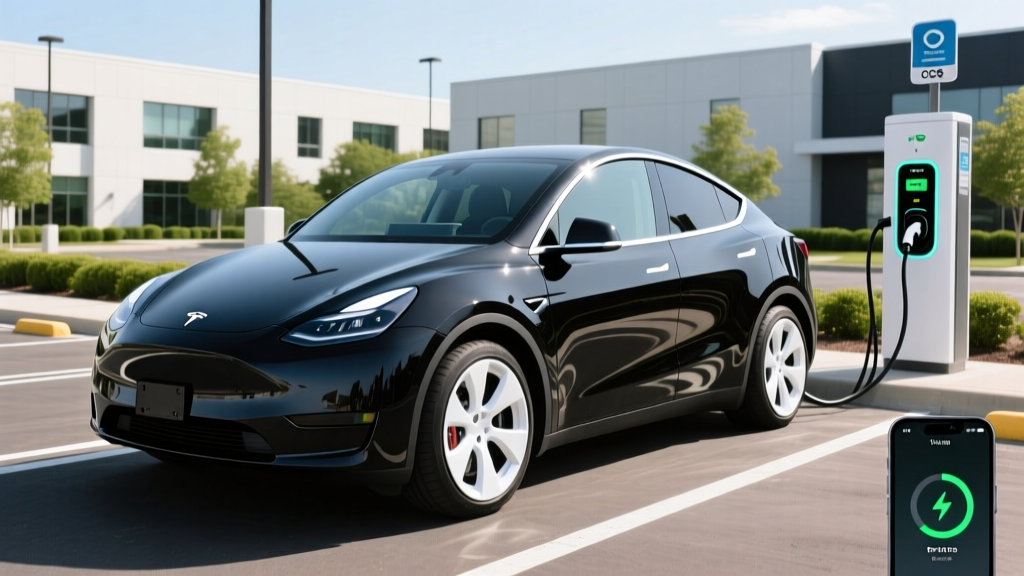
Most Randolph homes have 200-amp electrical panels, which can typically support a 48-amp (11.5 kW) Level 2 circuit. A Tesla Wall Connector installed by a licensed electrician on a 60-amp breaker delivers a full charge overnight in roughly 7–8 hours from near-empty. Installation costs in Morris County typically range from $800 to $2,500, depending on panel proximity and whether conduit runs through finished walls. Older homes with 100-amp panels may require a panel upgrade ($1,500–$3,000) — get a quote from a licensed electrician before purchasing.
The nearest Superchargers to Randolph include the Rockaway Townsquare station (V3, ~10 minutes away) and the Ledgewood Mall corridor. For I-80 and I-287 corridor commuters, Supercharger access is excellent.
Performance, Interior, and Tech: What You're Getting
The Model Y's performance credentials are well established. Even the base Long Range RWD hits 60 mph in 6.5 seconds — brisk by any crossover standard. The Performance trim's 3.5-second sprint puts it in sports-car territory, with dual-motor torque vectoring that handles New Jersey's rain-slicked Route 46 on-ramps with confidence.
Interior and Cargo
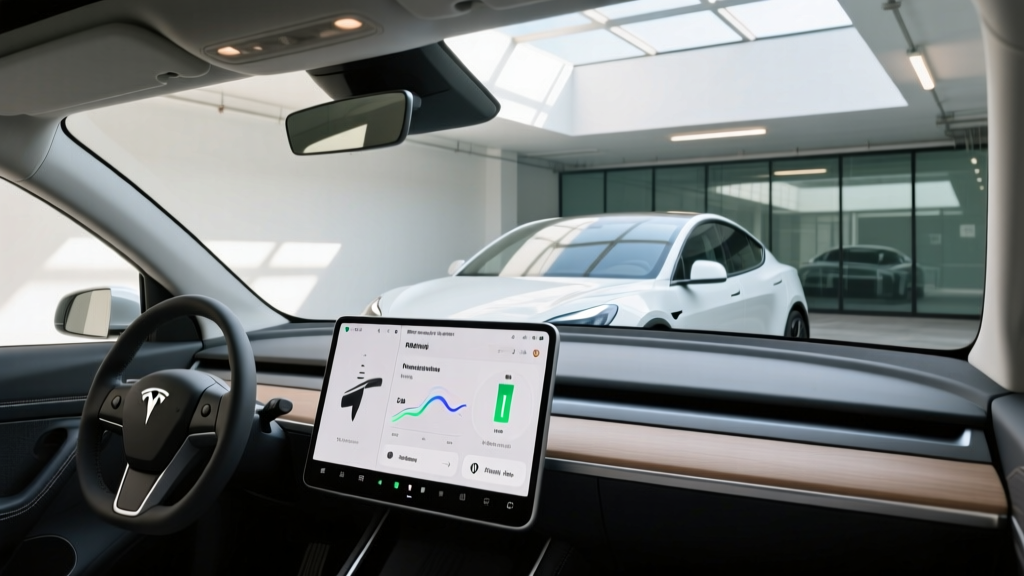
The refreshed Juniper interior brings a more refined dashboard, ventilated front seats, ambient lighting, and a rear-seat touchscreen for passengers. Cargo space is generous: 30.2 cubic feet behind the second row, expanding to 72.0 cu ft with seats folded — enough for a Costco run or weekend ski gear for four.
Legroom is adequate for adults in the rear (approximately 41.6 inches), though the sloping roofline cuts into headroom for passengers over 6 feet. The front trunk (frunk) adds roughly 4.1 cu ft for charging cables or a small bag.
Driver Assistance: Autopilot and FSD (Supervised)
Tesla's Autopilot and Full Self-Driving (Supervised) are Level 2 driver-assistance systems per SAE International. The driver must remain fully engaged — hands on the wheel, eyes on the road — at all times. These systems do not make the vehicle self-driving. Only Level 4 robotaxi services (Waymo, Zoox) operate without a human driver in defined geographic zones.
Standard Autopilot includes Traffic-Aware Cruise Control and Autosteer, which handles lane-centering on highways competently. FSD (Supervised), available as a $8,000 one-time purchase or $99/month subscription in 2026, adds Navigate on Autopilot (highway interchanges), Autopark, and city-street traffic light/stop sign handling. It's impressive in well-mapped suburban areas like Randolph but requires constant supervision — construction zones, faded lane markings on County Route 513, and erratic drivers all demand human override.
Standout Tech
- 15.4-inch center touchscreen with excellent responsiveness and native navigation
- Over-the-air updates that add features post-purchase
- Sentry Mode (360° camera surveillance when parked)
- Dog Mode, Camp Mode, and Theater Mode for lifestyle flexibility
- Native Supercharger network integration with automatic routing and preconditioning
Notable Drawbacks
- No Apple CarPlay or Android Auto — Tesla's ecosystem is closed
- Minimalist interior isn't for everyone (no physical buttons, stalks removed in refresh)
- Panel gap consistency has improved but still draws criticism vs. legacy luxury brands
- Insurance premiums in NJ tend to run 15–25% higher than comparable gas crossovers
2026 Pricing and Federal Tax Credit Eligibility
| Trim | Base MSRP | Destination | Max §30D Credit | Est. Net Price* |
|---|---|---|---|---|
| Long Range RWD | $44,990 | $1,390 | Up to $7,500 | ~$38,880 |
| Long Range AWD | $47,990 | $1,390 | Up to $7,500 | ~$41,880 |
| Performance | $52,490 | $1,390 | Up to $7,500 | ~$46,380 |
*Net price assumes full $7,500 credit eligibility. Actual credit depends on battery sourcing, buyer income, and MSRP cap compliance. Verify current eligibility at irs.gov.
IRS §30D Tax Credit Checklist (2026 Rules)
- MSRP Cap: Vehicle base MSRP must not exceed $80,000 for SUVs/crossovers (all Model Y trims qualify).
- Buyer Income Cap: Modified AGI must not exceed $150,000 (single), $225,000 (head of household), or $300,000 (married filing jointly).
- Battery Sourcing: The credit splits into two halves — $3,750 for critical minerals sourcing and $3,750 for battery component manufacturing. Sourcing requirements tighten annually. Verify current Model Y eligibility on the IRS clean vehicle credit page or through Tesla's checkout flow, which displays credit eligibility at point of sale.
- Point-of-Sale Transfer: As of 2024, buyers can transfer the credit to the dealer at purchase, reducing the upfront price directly rather than waiting for a tax refund. Tesla participates in this program.
- Assembly: Vehicle must undergo final assembly in North America (Model Y is assembled in Fremont, CA, and Austin, TX — both qualify).
Model Y vs. Key Competitors: Is It the Right Choice?
| Attribute | Tesla Model Y LR AWD | Hyundai Ioniq 5 Limited AWD | Ford Mustang Mach-E Premium AWD |
|---|---|---|---|
| EPA Range | 292 mi | 290 mi | 290 mi |
| Peak DC Charge | 250 kW | 240 kW | 150 kW |
| 10–80% Time | ~25 min | ~18 min | ~36 min |
| 0–60 mph | 5.0 sec | 5.1 sec | 5.1 sec |
| Charging Network | Tesla Supercharger (native) | NACS (Supercharger access via adapter) | NACS (Supercharger access via adapter) |
| Cargo (rear up) | 30.2 cu ft | 27.2 cu ft | 29.7 cu ft |
| Base MSRP (AWD) | $47,990 | $54,200 | $48,995 |
- You want native, seamless Supercharger access without adapters
- Over-the-air updates and Tesla's software ecosystem matter to you
- You value class-leading cargo space and efficiency (kWh/100 mi)
- You live near reliable Supercharger stations (Randolph has excellent coverage)
- Fastest DC charging speed is a priority (10–80% in ~18 min on 800V architecture)
- You prefer physical buttons, Apple CarPlay, and a more traditional cockpit
- V2L (vehicle-to-load) capability for powering devices is important
- You prefer a Ford dealer experience for service and familiarity
- You want BlueCruise hands-free driving on approved highways
Who Should Buy the Model Y in Randolph, NJ?
The Model Y is a strong fit for:
- Daily commuters: Route 10, I-287, and I-80 corridor commuters will use roughly 40–60% of battery on a round trip to Midtown Manhattan or Jersey City, recharging overnight at home.
- Families: Two adults and two children fit comfortably; rear-facing car seats install without major front-seat compromise. Cargo handles strollers and groceries easily.
- Road trippers: Supercharger coverage along I-95, I-80, and the NJ Turnpike is dense. New York-to-DC is one stop; Randolph-to-Montreal is two.
It's less ideal for:
- Heavy towing: The Model Y is rated for 3,500 lbs — adequate for a small utility trailer but not a boat or camper. If you need 5,000+ lb towing, look at the Rivian R1S or F-150 Lightning.
- Buyers without home charging access: If you live in a Randolph condo or apartment without garage/outlet access, relying solely on public charging is possible but adds time and cost. Confirm your parking situation first.
Pros and Cons at a Glance
Pros
- Best-in-class efficiency (28–32 kWh/100 mi)
- Native Supercharger network — no adapters, no payment friction
- Class-leading cargo volume (72 cu ft max)
- Strong performance across all trims
- Over-the-air updates continuously improve the vehicle
- Heat pump standard — critical for NJ winters
- Eligible for up to $7,500 federal credit (verify eligibility)
Cons
- No Apple CarPlay / Android Auto
- Minimalist controls require touchscreen dependency
- Insurance costs in NJ run higher than gas equivalents
- Panel gap quality inconsistent vs. legacy premium brands
- FSD (Supervised) is expensive and still requires full driver attention
- Winter range loss of 20–30% is real and must be planned for
Frequently Asked Questions
What is the real-world range of the Tesla Model Y in New Jersey winters?
Expect approximately 220–255 miles from a full charge when temperatures sit below freezing, compared to the EPA-rated 277–320 miles depending on trim. Preconditioning while plugged in mitigates some of this loss. The heat pump is a significant efficiency advantage over resistive heating.
How fast does the Model Y charge at home and on the road?
On a 48-amp Level 2 home charger (240V), the Model Y adds roughly 37 miles of range per hour — a full overnight charge from near-empty takes about 7–8 hours. On a V3 or V4 Supercharger, it peaks at 250 kW and charges from 10–80% in approximately 22–25 minutes, though the charging curve tapers significantly above 50% SoC.
How much does a Model Y actually cost after the federal tax credit?
The Long Range RWD starts at $44,990 plus $1,390 destination. If you qualify for the full $7,500 §30D credit (based on income, battery sourcing, and MSRP cap compliance), your effective price drops to approximately $38,880. Confirm your eligibility on the IRS website and through Tesla's point-of-sale credit transfer at checkout.
Does the 2026 Model Y qualify for the $7,500 federal EV tax credit?
All Model Y trims fall under the $80,000 MSRP cap for SUVs. Eligibility for the full $7,500 depends on your modified AGI (≤$150K single / ≤$300K joint), the vehicle's battery component and critical mineral sourcing compliance, and North American final assembly (which the Model Y satisfies). Rules tighten annually — verify current status at fueleconomy.gov and irs.gov.
Is the Model Y worth buying over the Hyundai Ioniq 5 or Ford Mach-E?
The Model Y wins on cargo space, native Supercharger integration, and overall efficiency. The Ioniq 5 charges faster on DC (800V architecture) and offers CarPlay. The Mach-E provides a more traditional dealer service experience. For Randolph buyers who prioritize hassle-free road-trip charging and software features, the Model Y remains the strongest all-around pick.
Can I install a Level 2 charger in my Randolph home?
Most Randolph homes with 200-amp panels can support a 48-amp (11.5 kW) Level 2 charger on a dedicated 60-amp circuit. Installation typically costs $800–$2,500 depending on panel proximity and wiring complexity. Homes with older 100-amp panels may need a panel upgrade ($1,500–$3,000). Always get a quote from a licensed electrician before committing.
Is Tesla's Autopilot or FSD actually self-driving?
No. Both Autopilot and FSD (Supervised) are SAE Level 2 driver-assistance systems. They require the driver to remain fully attentive with hands on the steering wheel and eyes on the road at all times. FSD can handle many city and highway scenarios but is not autonomous — construction zones, adverse weather, and unexpected road conditions require immediate human intervention.
Bottom Line for Randolph Buyers
The 2026 Tesla Model Y remains the default recommendation for most EV shoppers in the Morris County area. Its combination of range, efficiency, cargo practicality, and Supercharger access is difficult to beat — especially when the federal tax credit brings the effective price into the high $30Ks. The real-world winter range penalty is genuine but manageable with home charging and preconditioning. Before you order, confirm your home's electrical capacity for Level 2 charging, verify your §30D credit eligibility, and test-drive the refresh at the nearest Tesla showroom. The numbers support the hype — but only if your specific situation (commute, parking, panel capacity) aligns.