If you own a Tesla — or you're shopping for one — the Tesla app software update cycle is one of the most consequential ownership experiences in the EV market. Unlike legacy automakers that push one or two over-the-air (OTA) patches a year, Tesla routinely ships substantive updates that alter vehicle behavior, unlock new driver-assist features, and refine energy management. In early 2026, the latest wave of Tesla app software updates (version 2026.x series) brought changes to route planning, battery preconditioning logic, and the FSD (Supervised) stack.
But software doesn't exist in a vacuum. The car underneath the code still has to deliver range, charging speed, cargo space, and value. This review examines the 2026 Tesla Model Y Long Range AWD — Tesla's volume seller — through the lens of its latest software capabilities and the hard hardware specs that matter to buyers.
Range, Battery, and Real-World Efficiency
The 2026 Model Y Long Range AWD carries an EPA-estimated range of 320 miles on a full charge. That figure comes from a usable battery capacity of approximately 75 kWh (gross ~79 kWh), using a mix of NMC (nickel manganese cobalt) cells sourced from multiple suppliers. The standard-range RWD variant, by contrast, uses LFP (lithium iron phosphate) chemistry in a ~60 kWh pack, good for an EPA 260 miles.
EPA 320 miles is measured on a mixed city/highway cycle at moderate temperatures. Expect approximately 270–290 miles in sustained 70 mph highway driving (aerodynamic drag cuts efficiency sharply above 65 mph). In cold weather (below 30°F), plan for 220–250 miles of usable range — the heat pump helps, but cabin heating and battery warming still consume significant energy. City driving with frequent regenerative braking recovers energy and can push real-world results close to or even above the EPA sticker.
Efficiency on the EPA cycle rates at 122 MPGe combined, translating to roughly 28 kWh per 100 miles. That's competitive with the Hyundai Ioniq 5 (114 MPGe combined) and slightly behind the more aerodynamic Lucid Air. The 2026 software update refined the thermal management algorithm, reducing unnecessary battery preconditioning events and shaving roughly 1–2% off energy consumption in mild-weather city driving.
| Spec | Value |
|---|---|
| EPA Range | 320 miles |
| Battery (usable) | ~75 kWh (NMC) |
| Drivetrain | Dual-motor AWD |
| Horsepower | 384 hp (combined) |
| 0–60 mph | 4.8 seconds |
| Efficiency | 122 MPGe / 28 kWh/100 mi |
| Max DC Fast Charge | 250 kW (peak) |
| 10–80% DC Charge Time | ~27 minutes |
| Level 2 Home Charge Rate | 11.5 kW (~44 mi/hr) |
| Cargo (rear seats up) | 30.2 cu ft |
| Cargo (rear seats folded) | 72.1 cu ft |
| Rear Legroom | 36.5 in |
| Base MSRP | $48,990 |
| Battery Warranty | 8 years / 120,000 miles |
Charging Speed: DC Fast, Level 2, and the Software Edge
Charging speed remains one of the Model Y's strongest selling points, amplified by Tesla's proprietary Supercharger network and the 2026 software updates that improved charge-curve management.
| Level | Power | Miles Added per Hour | Notes |
|---|---|---|---|
| Level 1 (120V) | ~1.4 kW | ~3–4 mi/hr | Emergency/trickle only |
| Level 2 (240V, 48A) | 11.5 kW | ~44 mi/hr | Home Wall Connector; full charge ~8 hrs |
| DC Fast (Supercharger V3) | 250 kW peak | ~200 mi in 15 min | 10–80% in ~27 min; tapers above 80% |
| DC Fast (Supercharger V4) | Up to 350 kW (future-capable) | TBD | Current Model Y hardware caps at ~250 kW |
A critical ownership note: the Model Y's peak 250 kW charge rate is not sustained. The charge curve peaks around 20–30% State of Charge (SoC) and begins tapering above 50%, dropping to roughly 100 kW by 70% and below 50 kW past 85%. This is normal for NMC chemistry and is managed by the battery management system (BMS). The 2026 Tesla app software update improved preconditioning accuracy — the car now initiates battery warming earlier when navigating to a Supercharger in cold conditions, helping you hit peak charge rates faster upon arrival.
With the North American Charging Standard (NACS) connector now adopted industry-wide, the Model Y natively accesses Tesla Superchargers without adapters. The 2026 software update also expanded the in-car navigation's ability to route through third-party NACS chargers from Electrify America and other networks that have transitioned to NACS, reducing one of the last friction points for cross-country travel.
Performance and Driving Dynamics
The 2026 Model Y Long Range AWD produces 384 horsepower from its dual-motor setup, launching from 0–60 mph in 4.8 seconds. The Performance trim (starting at $53,990) bumps output to approximately 456 hp with a 3.5-second 0–60 time and includes track mode, larger brakes, and a lowered suspension.
Ride quality has improved incrementally over prior model years, with retuned dampers that better absorb sharp impacts. The Model Y still favors firmness over plushness — it handles well on twisty roads but transmits more road texture than a Hyundai Ioniq 5 or Ford Mustang Mach-E. Steering is precise and quick but largely numb, which suits the car's tech-forward persona but won't satisfy driving enthusiasts seeking feedback.
Regenerative braking remains strong and predictable. The 2026 software update reintroduced a user-selectable regen intensity option (after Tesla briefly removed it in 2024), allowing drivers to choose between Standard and Low regen. One-pedal driving is still achievable on the Standard setting in most conditions.
Software, Tech, and the Tesla App Experience
This is where the Tesla app software update story becomes central. The 2026 Model Y runs Tesla's latest vehicle software, accessible and monitored through the Tesla mobile app (iOS/Android). Key features and recent changes include:
- FSD (Supervised) v13.x: The latest Full Self-Driving stack operates at SAE Level 2 — the driver must remain fully attentive with hands on the wheel and eyes on the road. FSD (Supervised) handles highway lane changes, on-ramp-to-off-ramp navigation, traffic light recognition, and city street turns. It is not autonomous driving (Level 4); Waymo remains the only broadly available Level 4 robotaxi service in select US cities.
- Enhanced Route Planning: The 2026 update overhauled the trip planner to factor in real-time Supercharger stall availability, elevation changes, and wind direction — producing more accurate arrival SoC estimates.
- Cabin Overheat Protection: Now configurable via the Tesla app with a temperature threshold slider rather than a simple on/off toggle.
- Energy App Redesign: The in-car energy consumption display now shows a projected range based on the last 5, 15, or 30 miles of driving, giving a more realistic picture than the rated-range display.
- Sentry Mode Improvements: Reduced phantom triggers and a new "Sentry Mode Live Camera Access" feature that streams from the car's cameras directly to the Tesla app when an event is detected.
- Smart Summon: Updated to navigate more complex parking structures, though it remains a convenience feature, not a substitute for driver attention.
Autopilot and FSD (Supervised) are SAE Level 2 systems. The driver must remain fully engaged — monitoring the road, keeping hands on the wheel, and ready to take over instantly. These are not "self-driving" systems. Only Level 4 services like Waymo One (available in Phoenix, San Francisco, Los Angeles) operate without a human driver.
The Tesla app itself received a significant UI overhaul in late 2025, consolidating vehicle controls, energy monitoring (for Powerwall owners), and service scheduling into a unified interface. The app now supports multiple driver profiles with individualized settings pushed to the car upon approach.
Pricing, Tax Credits, and Total Cost
The 2026 Tesla Model Y lineup starts at $44,990 for the Long Range RWD (if available in your market) and $48,990 for the Long Range AWD. The Performance trim starts at $53,990. Destination fees add approximately $1,390.
| Trim | Base MSRP | Est. After §30D Credit | Credit Eligibility |
|---|---|---|---|
| Long Range RWD | $44,990 | ~$37,490 | Up to $7,500 (if sourcing + income rules met) |
| Long Range AWD | $48,990 | ~$41,490 | Up to $7,500 (if sourcing + income rules met) |
| Performance AWD | $53,990 | ~$46,490 | Up to $7,500 (if sourcing + income rules met) |
Federal tax credit eligibility under IRS §30D is not automatic. For 2026, the key requirements include:
- MSRP Cap: The vehicle's MSRP must not exceed $80,000 for SUVs (the Model Y qualifies as an SUV per IRS classification).
- Buyer Income Cap: Modified adjusted gross income (MAGI) must not exceed $300,000 (joint filers), $225,000 (head of household), or $150,000 (single filers).
- Battery Sourcing: A percentage of critical minerals and battery components must be sourced from the US or free-trade-agreement countries. Tesla has progressively improved domestic sourcing, but the exact credit amount ($3,750 or $7,500) depends on the specific battery batch and current DOE/Fueleconomy.gov listings.
- Point-of-Sale Transfer: As of 2024, buyers can transfer the credit to the dealer at purchase, receiving the discount upfront rather than waiting to claim it on their tax return.
Always verify current eligibility on fueleconomy.gov and consult a tax professional — sourcing requirements tighten annually and can shift with supply chain changes.
Cargo, Interior, and Practicality
The Model Y remains one of the most practical compact electric SUVs. With rear seats up, you get 30.2 cubic feet of cargo space; fold them flat and that expands to 72.1 cubic feet — enough for furniture-store runs or camping gear for a family of four. The front trunk (frunk) adds roughly 4.1 cubic feet for charging cables or a small bag.
Rear-seat legroom measures 36.5 inches, adequate for adults on long trips, though the upright seatback angle and relatively flat cushion draw complaints from taller passengers. The panoramic glass roof creates an airy feel but contributes to cabin heat soak in summer — the 2026 software update's improved cabin overheat management helps mitigate this when parked.
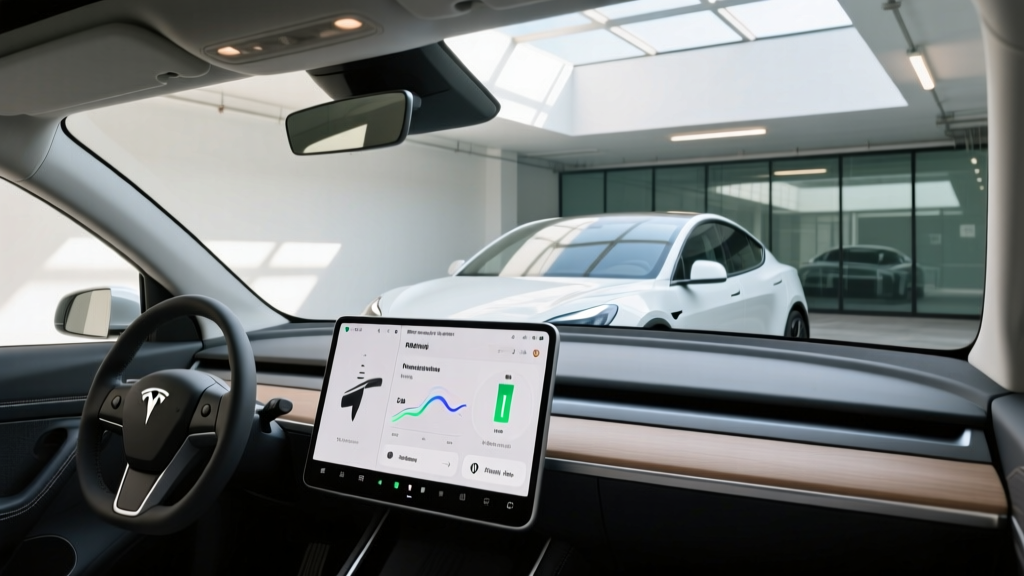
The minimalist interior consolidates nearly all controls into the 15.4-inch center touchscreen. No instrument cluster, no stalks (turn signals and gear selection are on the steering wheel and screen, respectively). This polarizes buyers: some love the clean aesthetic; others find screen-diverted attention a safety concern. The 2026 software update added a customizable shortcuts bar at the bottom of the screen, reducing the number of taps needed for common functions like climate adjustments and media controls.
Warranty, Reliability, and Ownership Costs
Tesla covers the Model Y's battery and drive unit for 8 years or 120,000 miles (whichever comes first), with a capacity retention threshold of 70%. The basic vehicle limited warranty runs 4 years or 50,000 miles. These terms are competitive with the industry — Hyundai offers 10-year/100,000-mile battery coverage on the Ioniq 5, which is more generous.
Insurance costs for the Model Y tend to run 15–25% higher than comparable non-Tesla EVs, driven by higher repair costs and parts pricing. Expect annual premiums in the $1,800–$2,600 range depending on your location, age, and driving record.
Maintenance is minimal: no oil changes, no spark plugs, brake pad life is extended by regenerative braking (many owners report original pads at 80,000+ miles). Cabin air filter replacement every 2 years and tire rotation every 6,250 miles are the primary scheduled items.
- Best-in-class Supercharger network access (17,000+ stalls in North America)
- Continuous OTA software updates that add real features, not just bug fixes
- Strong 250 kW DC fast-charging capability with smart preconditioning
- Class-leading cargo volume for the segment
- Competitive real-world efficiency (28 kWh/100 mi)
- Point-of-sale tax credit transfer reduces upfront cost
- Stalkless steering wheel requires adaptation (turn signals on wheel)
- Rear-seat comfort lags behind Hyundai Ioniq 5 and Ford Mach-E
- Insurance premiums run higher than segment average
- FSD (Supervised) requires $8,000 option or $99/mo subscription — not included
- Build quality inconsistency still reported by some owners (panel gaps, paint)
- No Apple CarPlay or Android Auto integration
Who Should Buy the 2026 Model Y?
- You road-trip frequently and want the most reliable DC fast-charging network
- You value continuous software improvements and app integration
- You need maximum cargo space in a compact electric SUV
- You want a proven, high-volume EV with strong resale value
- Rear-seat passenger comfort is a top priority (try the Ioniq 5 or Mach-E)
- You prefer physical controls and a traditional instrument cluster
- You want Apple CarPlay/Android Auto
- You're seeking the longest warranty coverage (Hyundai's 10-year battery warranty leads)
Frequently Asked Questions
What is the real-world range of the 2026 Tesla Model Y?
The EPA rates the Long Range AWD at 320 miles. In real-world highway driving at 70 mph, expect 270–290 miles. In cold weather below 30°F, plan for 220–250 miles. City driving with regen braking can approach or exceed the EPA figure.
How fast does the Model Y charge at home and on the road?
At home on a Level 2 Tesla Wall Connector (11.5 kW / 48A), the Model Y adds roughly 44 miles of range per hour, reaching a full charge from empty in about 8 hours. On a V3 Supercharger (250 kW peak), 10–80% takes approximately 27 minutes, with the charge rate tapering significantly above 80% SoC.
Does the 2026 Model Y qualify for the federal EV tax credit?
It can qualify for up to $7,500 under IRS §30D, but eligibility depends on your income (MAGI caps apply), the vehicle's battery sourcing compliance, and the MSRP cap ($80,000 for SUVs — the Model Y clears this). Verify current eligibility on fueleconomy.gov and consult a tax professional. The credit can be transferred at point of sale for an upfront discount.
How often do Tesla app software updates arrive?
Tesla typically pushes major software updates every 4–8 weeks, with minor patches more frequently. The 2026 update series has delivered improvements to FSD (Supervised), route planning, energy tracking, and Sentry Mode. Updates download over Wi-Fi and install while the car is parked.
Is FSD (Supervised) worth the extra cost?
FSD (Supervised) costs $8,000 upfront or $99/month. It is an SAE Level 2 driver-assist system — not autonomous driving. It excels on highways and has improved in city driving, but you must remain fully attentive. Many owners find it reduces fatigue on long trips; others feel basic Autopilot (included) is sufficient. Try the monthly subscription before committing to the full purchase.
How does the Model Y compare to the Hyundai Ioniq 5 and Ford Mustang Mach-E?
The Model Y leads in charging network access (Superchargers), software update frequency, and cargo space. The Ioniq 5 offers faster peak charging (up to 350 kW on 800V architecture, 10–80% in ~18 min), a more comfortable rear seat, and a longer battery warranty. The Mach-E provides a more traditional interior layout with physical controls and Apple CarPlay. All three qualify for partial or full federal tax credits depending on sourcing and buyer eligibility.