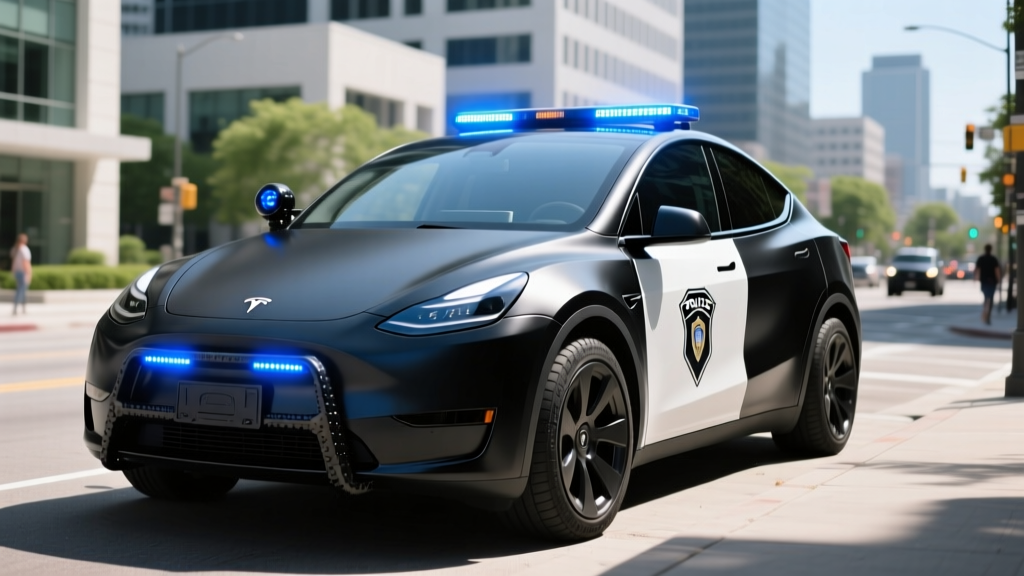
Police departments across the U.S. are quietly swapping their V8 sedans and Explorer interceptors for something radically different: the Tesla Model Y. From Fremont, California, to South Pasadena and dozens of smaller agencies in between, the Tesla police car has moved from novelty to mainstream fleet option. But does a battery-electric crossover actually hold up to the brutal demands of law enforcement — idling for hours, high-speed pursuits, 12-hour shifts, and the relentless stop-start of patrol duty?
We've analyzed fleet data, departmental pilot program results, and the 2026 Model Y Long Range AWD specifications to answer that question with real numbers. This isn't a consumer review repainted with a lightbar — it's a fleet-buyer's assessment of whether Tesla's best-selling crossover earns its place behind the badge.
2026 Tesla Model Y Long Range AWD: Fleet Spec Table
| Specification | 2026 Model Y Long Range AWD |
|---|---|
| EPA Estimated Range | 320 miles |
| Battery Capacity (Usable) | ~75 kWh (NMC chemistry) |
| Drivetrain | Dual-Motor AWD |
| Horsepower | 384 hp (combined) |
| 0–60 mph | 4.8 seconds |
| Top Speed | 135 mph (electronically limited) |
| Peak DC Fast Charge | 250 kW |
| 10–80% DC Charge Time | ~25 minutes |
| Level 2 Home/Depot Charge | 11.5 kW (~44 mi/hr) |
| EPA Efficiency | 122 MPGe combined / 27 kWh/100 mi |
| Cargo Volume (behind 2nd row) | 30.2 cu ft |
| Cargo Volume (max, seats folded) | 72.1 cu ft |
| Rear Legroom | 41.6 inches |
| Battery & Drive Unit Warranty | 8 years / 120,000 miles |
| Base MSRP | $44,990 |
Real-World Range for Patrol and Pursuit Duty
EPA Sticker: 320 miles
Real-World Highway (70+ mph): ~265–280 miles
Patrol Duty (stop-start, idle-heavy): ~240–270 miles equivalent
Cold Weather (below 32°F): ~210–240 miles (20–30% reduction)
Source: Fleet pilot data and fueleconomy.gov
For a typical 12-hour patrol shift covering 80–150 miles, the Model Y's real-world range provides a comfortable buffer. Several departments running pilot programs — including agencies in California and Texas — have reported that a single charge handles a full shift with 40–60% State of Charge remaining. The critical caveat is climate control: running cabin heat in winter and the battery thermal management system consumes energy continuously, even when the vehicle is stationary at a scene or stakeout.
Unlike a gas cruiser that burns fuel idling at roughly 0.5–0.8 gallons per hour, the Model Y draws approximately 1–3 kW while stationary with climate control active. Over a 12-hour shift with significant idle time, that translates to roughly 12–36 kWh — a meaningful chunk of the 75 kWh usable battery. Departments in northern climates should plan for mid-shift opportunity charging or assign the Model Y to shifts and zones where depot charging between calls is feasible.
Charging Infrastructure: The Fleet Depot Equation
A Tesla police car is only as useful as the charging infrastructure supporting it. Fleet charging operates on a fundamentally different model than consumer charging, and departments must plan accordingly.
| Charging Level | Power (kW) | Rate (miles added/hr) | Fleet Use Case |
|---|---|---|---|
| Level 1 (120V) | ~1.4 kW | ~5 mi/hr | Not viable for fleet |
| Level 2 (240V, 48A) | 11.5 kW | ~44 mi/hr | Overnight depot charging (primary) |
| DC Fast Charge | Up to 250 kW | Up to ~1,000 mi/hr (peak) | Mid-shift opportunity / emergency top-up |
Overnight depot charging is the backbone of EV fleet operations. At 11.5 kW on a Level 2 circuit, a depleted Model Y recovers roughly 350 miles of range in an 8-hour off-shift window — more than enough to replenish a full patrol day. Most fleet installations use networked Level 2 chargers from providers like ChargePoint or EVgo at per-port costs of $3,000–$7,000 installed, plus electrical infrastructure upgrades.
DC fast charging at 250 kW peak (via Tesla Supercharger V3/V4 stalls or CCS-equipped public chargers with adapter) delivers a 10–80% charge in approximately 25 minutes. However, the charging curve tapers significantly above 80% — a full 10–100% session takes closer to 45–50 minutes. For mid-shift top-ups, a 15–20 minute stop can recover 120–160 miles of range, enough to finish most shifts.
The Tesla Supercharger network gives the Model Y a unique advantage: access to over 25,000 fast-charging stalls in North America with proven reliability rates above 95%. Departments can also equip the Model Y with a NACS-to-CCS adapter for access to Electrify America and other public networks, expanding coverage for highway patrol and inter-agency mutual aid responses.
Pursuit Performance: 0–60 in 4.8 Seconds
The dual-motor AWD powertrain produces 384 combined horsepower and delivers instant torque — a characteristic that fundamentally changes pursuit dynamics. The 4.8-second 0–60 mph time outpaces most traditional police interceptors, including the Ford Police Interceptor Utility Hybrid (7.4 seconds) and the retired Dodge Charger Pursuit V8 (5.4 seconds for the 5.7L HEMI variant).
Instant electric torque means acceleration is linear and immediate from any speed — there's no downshift lag, no turbo spool-up. In real-world pursuit scenarios reported by pilot departments, officers noted the Model Y's ability to close gaps quickly and maintain speed effortlessly on freeway ramps. The low center of gravity (battery pack mounted under the floor) provides confident handling through corners, though the vehicle's 4,400-lb curb weight is noticeable during aggressive direction changes.
Regenerative braking is another operational advantage. The one-pedal driving capability reduces brake wear dramatically — several departments have reported 50–70% reductions in brake pad replacement frequency compared to conventional cruisers. Over a 5-year fleet lifecycle, that translates to thousands of dollars in maintenance savings per vehicle.
Upfit Costs and Patrol-Specific Modifications
A stock Model Y is not a police car. Converting it into a patrol-ready vehicle requires a dedicated upfit package, and this is where costs and complexity diverge sharply from traditional interceptors.
Typical police upfit components include:
- Emergency lightbar and perimeter lighting (LED, integrated)
- Siren and PA system
- Prisoner transport partition (rear seat cage)
- Weapon lock / rifle rack
- Center console equipment mount (MDT, radio, controls)
- Heavy-duty seat covers and rear-seat vinyl (easy clean)
- Push bumper / bull bar
- Dash and interior camera system
- Upfitted electrical system with auxiliary battery for emergency equipment
Specialized EV upfitters like Setina Manufacturing and Whelen Engineering have developed Tesla-specific packages, but the market is still maturing. Upfit costs for a Model Y patrol conversion typically range from $15,000 to $25,000 depending on equipment levels — comparable to or slightly higher than a Ford Explorer Interceptor upfit due to the custom fabrication required for the Tesla's unibody architecture and touchscreen-centric interior.
One persistent challenge: the Model Y's minimalist interior and reliance on the central touchscreen for virtually all vehicle controls complicates the integration of traditional police equipment mounts. Departments report that aftermarket solutions are improving, but officers accustomed to physical buttons and knobs for lights, siren, and radio may face a learning curve.
Total Cost of Ownership: EV Fleet vs. Gas Interceptor
The financial argument for a Tesla police car hinges on total cost of ownership (TCO), not sticker price. Here's a 5-year / 100,000-mile comparison based on fleet data and EPA efficiency figures:
| Cost Category | Tesla Model Y LR AWD | Ford PIU Hybrid (Gas) |
|---|---|---|
| Base Vehicle MSRP | $44,990 | $44,000 (approx.) |
| Upfit Cost | $18,000–$22,000 | $12,000–$18,000 |
| Fuel/Energy (100k mi) | $3,200–$4,800 (electricity) | $10,500–$13,000 (gasoline) |
| Maintenance (5 yr) | $2,500–$4,000 | $7,000–$10,000 |
| Brake Replacement | $400–$800 | $2,000–$3,500 |
| Estimated 5-Year TCO | $70,000–$78,000 | $78,000–$90,000 |
The energy cost advantage is stark. At a national average commercial electricity rate of $0.13–$0.18 per kWh and the Model Y's consumption of 27 kWh per 100 miles, fuel cost works out to roughly $0.035–$0.049 per mile. The Ford PIU Hybrid, averaging 17–20 MPG combined in patrol duty at $3.20/gallon, costs approximately $0.16–$0.19 per mile in fuel alone. Over 100,000 miles, that's a $7,000–$9,000 fuel savings per vehicle.
Maintenance savings compound further. No oil changes, no transmission fluid, no spark plugs, no exhaust system repairs, and dramatically reduced brake wear due to regenerative braking. Departments report annual maintenance reductions of 40–60% per EV unit.
Federal Tax Credit and Fleet Purchase Incentives
Under IRS §30D rules, the Model Y may qualify for up to $7,500 in federal tax credits. However, fleet purchases present unique considerations:
- MSRP Cap: SUVs/vans must be under $80,000 MSRP — the Model Y qualifies at $44,990 base.
- Income Cap: Modified AGI limits apply ($300k joint / $225k HOH / $150k single). Municipal fleet purchases are typically not subject to individual income caps but cannot claim the personal credit.
- Commercial Clean Vehicle Credit (§45W): Tax-exempt entities (including most police departments) may qualify for a direct payment of up to $7,500 per vehicle under §45W instead of §30D.
- Battery Sourcing: Critical minerals and battery component requirements phase in progressively. Verify current-year compliance on the IRS qualified vehicles list.
- Point-of-Sale Transfer: For individual officer take-home vehicles purchased personally, the credit can be applied at the dealership at purchase.
Tech, Safety, and the Autopilot Question
The Model Y's technology suite is both its greatest strength and its most debated feature in a law enforcement context.
Standard safety and tech features include:
- Tesla Autopilot (adaptive cruise, lane-keeping, auto emergency braking)
- 8-camera surround vision system
- 15.4-inch central touchscreen with navigation
- Over-the-air software updates (continuous feature improvement)
- Sentry Mode (parked surveillance with cameras recording)
- HEPA air filtration system (Bio-Weapon Defense Mode — relevant for hazmat/chemical scenes)
- 5-star NHTSA overall safety rating
Tesla Autopilot and even FSD (Supervised) are SAE Level 2 driver-assistance systems. The driver must remain fully engaged, hands on or near the wheel, eyes on the road, and ready to take over instantly. These systems do NOT make the Model Y autonomous. No current production vehicle sold to consumers or fleets is self-driving. Misuse of driver-assist features in a patrol context could create serious liability exposure for departments.
That said, Autopilot's adaptive cruise and lane-centering reduce officer fatigue during long highway patrols and extended transport drives. The 8-camera system provides exceptional situational awareness — effectively a built-in dashcam and perimeter camera system that integrates with Sentry Mode for evidence capture when the vehicle is parked at a scene.
Pros and Cons: The Tesla Police Car Verdict
✅ Pros
- 60–70% lower fuel cost vs. gas interceptors
- 40–60% maintenance reduction (no oil, fewer brakes)
- 4.8-sec 0–60 — outpaces most pursuit vehicles
- Instant torque for responsive pursuit acceleration
- Supercharger network: 25,000+ stalls, 95%+ uptime
- Over-the-air updates add features post-purchase
- 8-camera system doubles as evidence/surveillance tool
- Zero tailpipe emissions — meets municipal sustainability mandates
- HEPA filtration for hazmat scene protection
❌ Cons
- Requires depot charging infrastructure investment ($50k–$200k+)
- Upfit market still maturing — fewer turnkey options
- Touchscreen-only controls complicate equipment integration
- 20–30% range loss in cold climates
- 4,400-lb weight affects tire wear and handling limits
- Not suitable for rural areas with sparse charging
- 135 mph top speed may limit some highway pursuit scenarios
- Battery replacement cost: $12,000–$16,000 out of warranty
- Collision repair costs higher than conventional cruisers
Who Should Field a Tesla Police Car?
The Model Y as a patrol vehicle works best for specific operational profiles:
Ideal use cases: Urban and suburban departments with predictable shift patterns, depot-based operations, and daily mileage under 150 miles. Agencies in mild-to-warm climates with sustainability mandates. Departments that can invest in Level 2 depot charging and leverage the §45W commercial clean vehicle credit.
Poor fits: Rural agencies covering vast territories with limited charging infrastructure. Departments requiring sustained high-speed pursuit above 135 mph. Agencies in extreme cold climates without heated garages. Departments that cannot budget for upfront charging infrastructure.
For many mid-size and large municipal agencies, the Tesla police car has crossed from experiment to proven fleet asset — with the financial math increasingly favoring electrification over a 5-year lifecycle. The key is matching the vehicle to the mission, not the other way around.
Frequently Asked Questions
What is the real-world range of the Tesla Model Y as a police car?
The EPA rates the 2026 Model Y Long Range AWD at 320 miles. In patrol duty with climate control, stop-start driving, and equipment power draw, expect 240–270 miles of usable range per charge. Cold weather reduces this to approximately 210–240 miles.
How fast does a Tesla police car charge?
On a DC fast charger, the Model Y peaks at 250 kW and charges from 10–80% in approximately 25 minutes. On a Level 2 depot charger at 11.5 kW, it adds roughly 44 miles per hour — sufficient for a full overnight recharge during an 8-hour off-shift window.
How much does a Tesla police car cost after incentives?
Base MSRP is $44,990 plus $15,000–$25,000 in upfit costs, totaling roughly $60,000–$70,000 per vehicle. Tax-exempt municipal agencies may qualify for up to $7,500 per vehicle through the §45W Commercial Clean Vehicle Credit as a direct payment. Net cost: approximately $52,500–$62,500 depending on upfit level.
Is the Tesla Model Y worth buying vs. the Ford Police Interceptor Utility?
For urban/suburban departments with depot charging, the Model Y offers lower 5-year TCO (estimated $70k–$78k vs. $78k–$90k for the Ford PIU Hybrid) driven by fuel and maintenance savings. For rural or extreme-climate operations, the Ford PIU Hybrid remains the more practical choice due to established infrastructure and refueling flexibility.
Does the Tesla Model Y qualify for the federal EV tax credit?
Under current IRS §30D rules, the Model Y qualifies based on MSRP (under $80,000 SUV cap). Individual buyers must meet income limits. Tax-exempt government entities typically claim the §45W Commercial Clean Vehicle Credit instead, which provides a direct payment rather than a tax offset. Battery sourcing requirements must be verified annually on the IRS qualified vehicle list.
How long does the Tesla Model Y battery last in fleet service?
Tesla warranties the battery and drive unit for 8 years or 120,000 miles, whichever comes first, with a minimum 70% capacity retention guarantee. Real-world fleet data suggests NMC batteries in moderate climates retain 85–90% capacity at 100,000 miles with proper charging practices (avoiding frequent 100% charges and DC fast-charging exclusively). Out-of-warranty battery replacement costs approximately $12,000–$16,000.