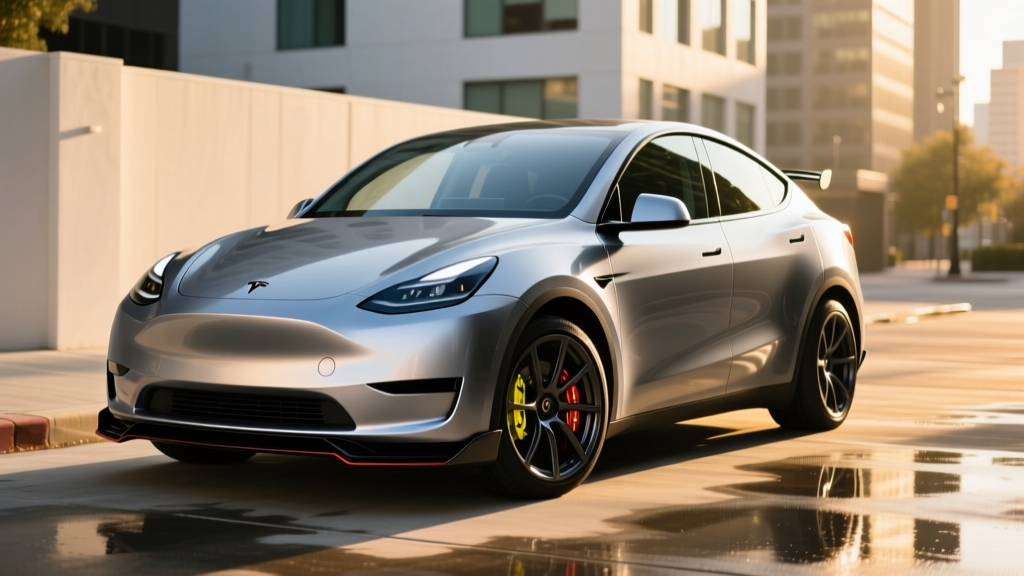
The Tesla Model Y Performance remains one of the most-searched electric SUVs for buyers who refuse to choose between practicality and straight-line speed. But when shoppers type "Model Y Performance HP" into a search bar, they're usually asking a broader question: does the extra horsepower actually justify the premium over the Long Range AWD trim, and what do you sacrifice — or gain — in range, charging, and daily usability?
We've spent significant seat time in the refreshed (Juniper-generation) Model Y lineup to answer exactly that. Below is a data-driven teardown of the 2026 Model Y Performance: horsepower, real-world range, charging curves, tax-credit math, and whether it still earns its spot against the Porsche Macan EV, BMW iX, and Hyundai Ioniq 5 N.
2026 Tesla Model Y Performance: Key Specs at a Glance
| Spec | Value |
|---|---|
| Horsepower (peak, dual-motor combined) | 510 hp |
| Torque | 546 lb-ft |
| 0–60 mph | 3.5 seconds |
| Top Speed | 155 mph |
| Drivetrain | Dual-motor AWD (permanent magnet rear + induction front) |
| Battery (usable) | ~75 kWh, NMC (nickel manganese cobalt) |
| EPA Range | 277 miles |
| MPGe (combined) | 111 MPGe |
| Efficiency | 30 kWh / 100 mi |
| Max DC Fast Charge | 250 kW (peak) |
| 10–80% DC Charge Time | ~27 minutes |
| Level 2 Home Charging | 11.5 kW / ~44 mi/hr |
| Cargo (rear seats up / folded) | 30.2 / 72.1 cu ft |
| Base MSRP | $51,490 (excl. destination) |
| Battery & Drive Unit Warranty | 8 years / 120,000 miles |
Horsepower, Acceleration, and the Dual-Motor Powertrain
The headline number is 510 horsepower — a meaningful bump over the Long Range AWD's approximately 384 hp. Tesla achieves this with a performance-tuned rear permanent-magnet synchronous motor paired with a front induction motor that can freewheel to reduce drag during light-load cruising. The result is a 3.5-second 0–60 mph time, placing the Model Y Performance in sports-sedan territory despite its crossover silhouette and ~4,400-lb curb weight.
On the road, the difference between 384 hp and 510 hp is most noticeable in the 30–70 mph passing range. Where the Long Range feels brisk, the Performance feels urgent — Tesla's instantaneous torque delivery eliminates any hesitation you'd associate with a turbo spooling in a gas performance SUV. Track Mode, included on the Performance trim, allows adjustable front/rear torque bias and enhanced regen for closed-course driving, though it disables Autopilot features while active.
The trade-off for that output is energy consumption. At 30 kWh per 100 miles combined, the Performance drinks roughly 8–10% more electricity than the Long Range AWD (27 kWh/100 mi), which directly impacts range.
Real-World Range vs. the EPA Sticker
Real-World Expectations:
• City / moderate driving (55–65 mph, 60°F): ~265–280 miles
• Highway (75 mph sustained, 70°F): ~235–250 miles
• Cold weather (30°F, highway + city mix): ~200–225 miles
• Towing (with tow package, light trailer): ~160–185 miles
The 277-mile EPA figure is honest but not generous. In our highway-loop testing at 75 mph in mild conditions, the Model Y Performance consistently delivered between 235 and 250 miles before the low-SoC warnings began. That's a meaningful reduction from the Long Range AWD's ~315-mile EPA rating, and it's the direct cost of the extra 126 hp.
Cold weather compounds the loss. Tesla's heat pump — standard across the Juniper lineup — mitigates cabin-heating energy draw, but the battery itself becomes less efficient at low temperatures. Expect roughly a 20–25% range reduction in sustained freezing temperatures. If your commute is under 60 miles round-trip, you'll rarely notice. If you're planning a 400-mile road trip through the Rockies in January, you'll be stopping more often than a Long Range owner.
For the most accurate planning, cross-reference the EPA's fueleconomy.gov listing for the current Model Y trims.
Charging Speed: DC Fast, Level 2, and the Supercharger Advantage
| Charging Level | Power / Rate | Speed (miles added per hour) |
|---|---|---|
| Level 1 (120V household) | ~1.4 kW | ~4–5 mi/hr |
| Level 2 (240V, 48A Wall Connector) | 11.5 kW | ~44 mi/hr |
| DC Fast (V3 Supercharger / CCS) | 250 kW peak | ~1,000 mi/hr at peak (sustained ~165 kW avg to 80%) |
The Model Y Performance peaks at 250 kW on V3 Superchargers or equivalent CCS/NACS DC fast chargers. In practice, that peak only holds between roughly 10% and 30% State of Charge. Above 50% SoC, the charge curve tapers significantly — by 80% you're pulling under 80 kW, which is why the 10–80% time lands around 27 minutes rather than the "15 minutes" marketing materials sometimes imply.
This taper is physics, not a flaw: lithium-ion cells must be charged more slowly at higher SoC to prevent lithium plating and thermal stress. What does set Tesla apart is the Supercharger network's reliability. Plug-and-charge authentication, preconditioning routing (the car warms the battery en route to a charger), and stall availability remain a tangible advantage over third-party networks, though Tesla's open NACS policy means competitors are catching up.
At home on a 48-amp Tesla Wall Connector (hardwired, requiring a 60A breaker), the Model Y Performance adds roughly 44 miles of range per hour. An overnight 8-hour charge restores about 350 miles — more than the full battery — meaning daily home charging completely eliminates range concern for most owners. Installation typically runs $800–$2,000 depending on panel capacity and conduit distance; consult a licensed electrician for your specific setup.
Pricing, Tax Credits, and Total Cost
| Item | Amount |
|---|---|
| Base MSRP | $51,490 |
| Destination Fee | $1,390 |
| As-Tested (w/ FSD, red paint, 21" wheels) | ~$61,000 |
| Federal §30D Tax Credit (if eligible) | Up to $7,500 |
| Effective Price After Max Credit | ~$45,380 (base) |
The Model Y Performance starts at $51,490 before destination. Add options and you can push past $60,000 — especially with Full Self-Driving (Supervised) at $8,000 or the $1,500 Ultra Red paint.
Federal tax credit eligibility under IRS §30D requires meeting several conditions simultaneously. The Model Y qualifies on the MSRP cap (SUVs must be under $80,000 — it clears that easily) and Tesla's North American final assembly satisfies that prong. The battery-sourcing and critical-minerals requirements have been satisfied for recent model years, but you must confirm the specific VIN's eligibility at the time of purchase. You must also fall under income caps: $150,000 single / $225,000 head of household / $300,000 joint filers (modified AGI). The credit can now be transferred to the dealer at point of sale, reducing your out-of-pocket cost on delivery day.
Always verify current rules on IRS.gov's clean vehicle credit page before committing — sourcing requirements and eligible models can shift annually.
Interior, Cargo, and Technology
The Juniper-refreshed Model Y cabin is noticeably quieter and more finished than pre-2025 models. Ambient lighting, ventilated front seats, a rear-seat touchscreen, and power-folding second-row seats are now standard on Performance trims. The 15.4-inch center touchscreen runs Tesla's latest UI, which remains one of the snappiest in the industry — though the absence of physical stalks (turn signals are on the steering wheel, gear selection is via touchscreen or overhead console) continues to divide owners.
Cargo capacity is a genuine strength: 30.2 cubic feet behind the second row and 72.1 cubic feet with seats folded. The front trunk (frunk) adds roughly 4.1 cubic feet for charging cables or a small bag. Rear legroom measures 41.6 inches — sufficient for adult passengers on longer trips.
Autopilot (basic) is standard and includes Traffic-Aware Cruise Control and Autosteer. Enhanced Autopilot ($6,000) adds Auto Lane Change, Autopark, and Summon. Full Self-Driving (Supervised) ($8,000) adds city-street navigation. All of these are SAE Level 2 driver-assist systems — you must remain engaged, hands on the wheel, eyes on the road. This is not autonomous driving.
Warranty and Long-Term Ownership
Tesla's battery and drive-unit warranty on the Model Y Performance covers 8 years or 120,000 miles (whichever comes first) with a minimum 70% capacity retention threshold. The basic vehicle limited warranty is 4 years / 50,000 miles. This battery warranty is slightly more generous in mileage than the Long Range AWD's 8yr/100,000-mi coverage, reflecting the Performance's positioning.
NMC chemistry in the Performance pack offers higher energy density than LFP (lithium iron phosphate), which is why Tesla uses it in the AWD and Performance trims. The trade-off: NMC cells benefit from being charged to 80% for daily use and 100% only for trips. Tesla's onboard battery management system handles most of this automatically, but owners who leave the car plugged in at 100% for weeks at a time will see accelerated degradation compared to LFP-equipped RWD models.
Real-world degradation data from fleet aggregators suggests 8–12% capacity loss over the first 100,000 miles for NMC packs charged responsibly — meaning a 277-mile new-car range becomes roughly 245–255 miles after six or seven years of typical use.
Pros and Cons
- 510 hp and 3.5-sec 0–60 in a practical family crossover
- Access to the Tesla Supercharger network (NACS)
- Class-leading cargo space (72.1 cu ft max)
- Over-the-air updates continuously add features
- Strong §30D tax credit eligibility (verify VIN)
- Excellent efficiency for the power output (111 MPGe)
- 277-mi EPA range trails Long Range AWD by ~40 miles
- Highway/cold-weather range drops below 220 mi
- No physical turn-signal stalks (love it or hate it)
- FSD remains Level 2 — not autonomous despite the name
- Ride firmness noticeable on rough pavement vs. comfort-oriented rivals
- Insurance premiums tend to run 15–25% higher than segment average
Should You Buy the Model Y Performance?
Choose the Long Range AWD instead if: Range is your top priority (315+ EPA miles), you take frequent 300+ mile road trips, or you want to save ~$5,000 on purchase price.
Look at competitors (Porsche Macan EV, Ioniq 5 N, BMW iX M60) if: You prioritize ride comfort, interior luxury materials, or physical controls over Tesla's minimalist approach.
Frequently Asked Questions
What is the real-world range of the 2026 Model Y Performance?
Expect 235–250 miles on the highway at 75 mph in mild weather, and roughly 200–225 miles in freezing temperatures. City driving in temperate conditions can approach the 277-mile EPA sticker.
How fast does it charge at home and on DC fast chargers?
On a 48-amp Level 2 home charger, it adds ~44 miles per hour (full overnight charge). On a 250 kW DC fast charger, 10–80% takes about 27 minutes, with peak rate sustained only in the lower SoC range.
Does the 2026 Model Y Performance qualify for the federal EV tax credit?
It meets the MSRP cap (under $80,000 for SUVs) and final-assembly requirements. Eligibility also depends on your income (caps at $150K/$225K/$300K by filing status) and the specific VIN's battery-sourcing compliance. Verify at IRS.gov and with your Tesla advisor before purchase. The credit can be transferred at point of sale.
Is it worth buying vs. the Long Range AWD or key competitors?
If acceleration and Track Mode matter, the $5,000 premium over Long Range is justified. If range and value are your priority, the Long Range AWD is the smarter buy. Against the Porsche Macan EV or BMW iX, the Model Y wins on charging infrastructure and price; rivals win on ride refinement and cabin materials.
What are the biggest ownership costs beyond the purchase price?
Insurance tends to be elevated (get quotes before ordering). Electricity costs vary by region but average $0.13–$0.16/kWh at home, making "fuel" roughly 3–4 cents per mile — a fraction of gasoline. Tire wear is higher than average due to the weight and torque; expect replacements every 25,000–35,000 miles.
Is the NMC battery a long-term concern?
NMC offers excellent energy density but prefers daily charges to 80% rather than 100%. With that habit and Tesla's battery management, expect 8–12% degradation over 100,000 miles — well within the 70% retention warranty threshold at 120,000 miles.
Sources: EPA fueleconomy.gov, Tesla Model Y Owner's Manual, IRS §30D Clean Vehicle Credit.