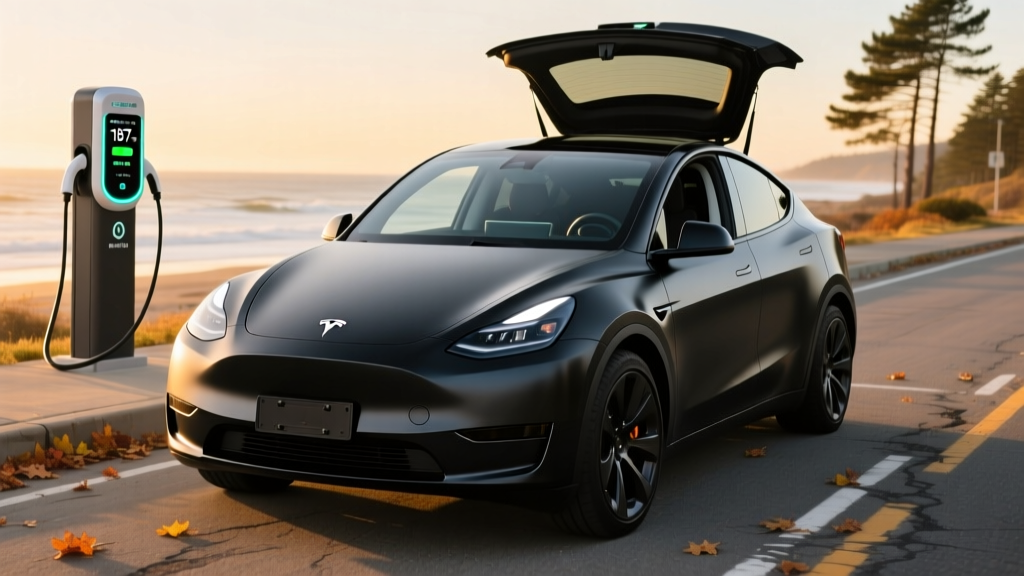
The 2025 Tesla Model Y Performance occupies a narrow but compelling lane in the electric-crossover market: it delivers sports-sedan acceleration in a practical five-seat SUV body, while retaining access to the most reliable public fast-charging network in North America. After the "Juniper" refresh brought revised styling, an updated interior, and minor efficiency tweaks, the Performance variant remains the enthusiast's pick in the Model Y lineup. But with competitors like the Ford Mustang Mach-E GT, BMW iX M60, and Porsche Macan Electric closing the gap on dynamics and interior refinement, the question is whether Tesla's speed-and-software formula still holds up in 2025.
This review breaks down every number that matters — EPA range versus what you'll actually see on the highway in January, real DC fast-charging curves (not just peak kW), total cost after federal tax credits, and the ownership quirks that spec sheets don't mention.
2025 Tesla Model Y Performance: Spec Sheet at a Glance
| Specification | 2025 Model Y Performance |
|---|---|
| EPA Range | 277 miles |
| Battery (usable) | ~75 kWh, NMC (nickel manganese cobalt) |
| Drivetrain | Dual-motor AWD |
| Horsepower | ~456 hp (combined) |
| 0–60 mph | 3.3 seconds |
| Top Speed | 155 mph |
| Max DC Fast Charge | 250 kW (peak) |
| 10–80% DC Charge Time | ~27 minutes |
| Level 2 Home Charge (11.5 kW) | ~36 miles per hour |
| EPA Efficiency | 111 MPGe combined (30 kWh/100 mi) |
| Cargo Volume (rear seats up/down) | 30.2 / 72.0 cu ft |
| Front Legroom / Rear Legroom | 41.8 in / 37.7 in |
| Battery & Drive Unit Warranty | 8 years / 120,000 miles |
| Base MSRP (before incentives) | $52,490 (excl. destination) |
Real-World Range: What the EPA Sticker Doesn't Tell You
Real-World Highway (70 mph, moderate weather): ~240–255 miles
Real-World Cold Weather (below 32°F, highway): ~200–225 miles
Real-World City / Suburban Mix: ~260–275 miles
The 2025 Model Y Performance carries an EPA range rating of 277 miles. That figure is derived from a standardized laboratory test cycle that blends city and highway driving — useful for comparison shopping, but rarely what you'll experience on a single road-trip leg.
In real-world highway driving at 70–75 mph in 60–80°F conditions, expect approximately 240 to 255 miles before you need to stop. The Performance model's 21-inch Überturbine wheels, stickier summer-performance tires, and slightly lower ride height increase rolling resistance and aerodynamic drag compared to the Long Range trim's 19-inch setup. That costs you roughly 25 miles of EPA-rated range versus the Long Range AWD's 302-mile sticker.
Cold weather is the bigger range variable. Lithium-ion NMC batteries lose efficiency in freezing temperatures due to increased internal resistance and the energy demand of cabin heating (the Model Y uses a heat pump, which helps but doesn't eliminate the penalty). In sustained sub-freezing highway driving, plan for 200 to 225 miles of usable range. Tesla's navigation system is generally accurate at predicting remaining charge when you use the built-in trip planner, which accounts for elevation, temperature, and speed — a genuine advantage over third-party route planners that ignore thermal conditions.
For daily commuting of 40–60 miles round trip, range is a non-issue. You'll charge at home overnight and rarely think about it. The 277-mile figure becomes meaningful only on road trips, where Tesla's Supercharger network spacing (typically 120–180 miles apart on major corridors) means you'll stop for 15–25 minutes every 2 to 2.5 hours regardless.
Charging Speed: DC Fast Charging and Home Setup
Charging speed is where the Model Y Performance's 2025 architecture shows both its strengths and its plateau. The vehicle supports a peak DC fast-charge rate of 250 kW via its native NACS (North American Charging Standard) connector — which is also the Tesla Supercharger connector.
| Charging Method | Power / Rate | Estimated Time or Range Added |
|---|---|---|
| DC Fast Charge (Supercharger V3/V4) | Up to 250 kW peak | 10–80% in ~27 min; ~175 mi in 15 min |
| DC Fast Charge (CCS adapter, 3rd-party) | Up to ~170 kW typical | 10–80% in ~35 min |
| Level 2 Home (48A / 11.5 kW) | 11.5 kW | ~36 mi/hr; full charge in ~8 hours |
| Level 2 Home (32A / 7.7 kW) | 7.7 kW | ~24 mi/hr; full charge in ~11 hours |
| Level 1 (120V / 12A) | ~1.4 kW | ~4 mi/hr; emergency use only |
Understanding the charge curve: The 250 kW figure is a peak, not a sustained rate. The Model Y Performance's charging curve is aggressive in the 10–40% state-of-charge (SoC) window, where it can pull close to 250 kW. Between 40–60%, it tapers to roughly 150–170 kW. Above 80%, the rate drops sharply to protect battery longevity — often below 50 kW. This is why the industry-standard metric is 10–80% time rather than 0–100%. For road-trip planning, you'll typically charge from ~10% to ~70–80% in about 20–27 minutes at a V3 Supercharger (250 kW capable).
Preconditioning matters. The Model Y automatically precondition its battery when you navigate to a Supercharger, warming the pack to optimal charging temperature. If you arrive at a Supercharger without preconditioning (for instance, by driving to one you found manually), your initial charge rate may be significantly lower — especially in cold weather. Always navigate to the charger via the car's built-in system.
Home charging: For Level 2 home charging, the Model Y's onboard charger accepts up to 11.5 kW (48 amps). This requires a 60-amp dedicated circuit installed by a licensed electrician — typically a NEMA 14-50 outlet or a hardwired Tesla Wall Connector. At 11.5 kW, you'll recover roughly 36 miles of range per hour of charging, meaning an overnight session easily replenishes a full day's driving. Installation costs typically range from $500 to $2,000 depending on panel proximity and local permitting, with the Tesla Wall Connector priced around $475 for the hardware.
Performance: 3.3 Seconds and Then Some
The Model Y Performance earns its badge. Dual electric motors — one on each axle — deliver a combined output of approximately 456 horsepower and an EPA-tested 0–60 mph time of 3.3 seconds. That figure is repeatable, not a one-run hero number, because electric motors deliver maximum torque from zero RPM without the lag of a turbocharger or the traction limitations of a rear-drive layout.
The AWD system is fully electric, with no mechanical linkage between axles. The rear motor is a permanent-magnet synchronous unit optimized for efficiency at cruise, while the front induction motor can disconnect when not needed to reduce parasitic drag. In practice, this means the car launches with all four wheels gripping and squats hard without drama — even on wet pavement.
The Performance trim adds a lowered sport suspension (approximately 0.5 inches lower than the Long Range), larger brakes, and the 21-inch Überturbine wheels with performance tires. The trade-off is a firmer ride that transmits more road imperfections into the cabin than the Long Range. On smooth interstate, it's composed; on broken urban pavement, you'll feel the difference. Track Mode, accessible from the touchscreen, allows adjustable front/rear torque distribution and stability-control intervention for closed-course driving.
Compared to the Ford Mustang Mach-E GT (0–60 in 3.5 seconds, 480 hp), the Model Y Performance is fractionally quicker to 60 but offers less peak power. Against the BMW iX M60 (0–60 in 3.6s, 610 hp), the Tesla is lighter and quicker off the line despite the BMW's power advantage. The Model Y's edge is consistency: its powertrain doesn't heat-soak after repeated launches the way some competitors do.
Interior, Cargo, and Daily Practicality
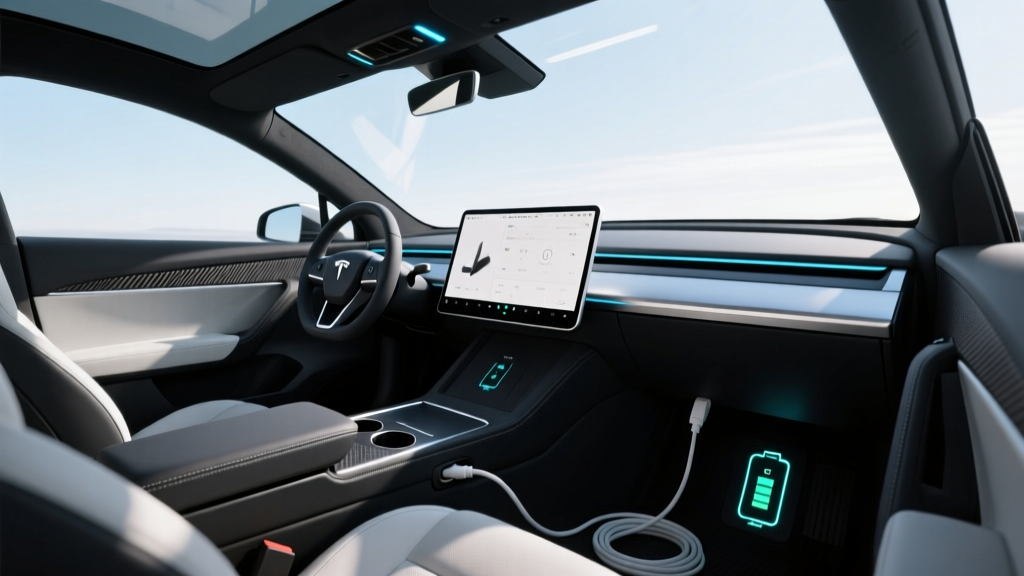
The 2025 "Juniper" refresh brought subtle but meaningful interior updates: ambient lighting, ventilated front seats, a rear-seat touchscreen for climate and media control, power-folding second-row seats, and improved sound-deadening materials. The minimalist aesthetic remains — no instrument cluster, no physical stalks (turn signals are now on the steering wheel face), and virtually all vehicle controls live on the 15.4-inch center touchscreen.
Cargo space: 30.2 cubic feet behind the second row, expanding to 72.0 cubic feet with the rear seats folded. The front trunk (frunk) adds roughly 4.1 cubic feet for charging cables or a small bag. These numbers trail the Ford Mustang Mach-E (29.7 / 59.7 cu ft) in total volume but the Model Y's boxier roofline makes the space more usable for tall items.
Passenger room: Front legroom is generous at 41.8 inches. Rear legroom at 37.7 inches is adequate for adults on shorter trips but tighter than a midsize SUV like the Hyundai Ioniq 5 (39.4 inches rear). The panoramic glass roof creates an airy feel, though it offers no physical shade — Tesla includes a removable fabric panel stored in the trunk.
Towing: The Model Y Performance is rated to tow up to 3,500 pounds when equipped with the optional tow hitch ($1,000 from Tesla). Towing will cut range roughly in half at highway speeds, so plan Supercharger stops accordingly.
Pricing, Tax Credits, and Total Cost
| Cost Item | Amount |
|---|---|
| Base MSRP (Performance AWD) | $52,490 |
| Destination / Order Fee | ~$1,390 |
| Paint Upgrades (e.g., Ultra Red, Quicksilver) | $1,000–$2,500 |
| Full Self-Driving (Supervised) | $8,000 one-time or $99/mo |
| As-Tested Price (with FSD, premium paint) | ~$63,380 |
| Federal Tax Credit (§30D, if eligible) | Up to $7,500 |
| Effective Price After Max Credit | ~$46,380 |
Federal tax credit eligibility (§30D): As of 2025, the Model Y qualifies for up to $7,500 in federal tax credits, but eligibility is not automatic. According to IRS guidelines, you must meet all of the following:
- MSRP cap: The vehicle must have an MSRP at or below $80,000 for SUVs. The Model Y Performance clears this at $52,490 base — even with FSD and paint options, it stays well under the cap.
- Buyer income cap: Modified adjusted gross income must not exceed $150,000 (single filer), $225,000 (head of household), or $300,000 (joint filer).
- Battery sourcing requirements: The $7,500 credit is split into two halves — $3,750 for critical-minerals sourcing and $3,750 for battery-component manufacturing. Tesla sources components from multiple suppliers, and the exact credit amount available can vary by production batch. Check the official fueleconomy.gov tax credit lookup for the specific VIN eligibility before purchasing.
- Point-of-sale transfer: As of 2024, you can transfer the credit to the dealer at the point of sale, reducing your purchase price immediately rather than waiting to claim it on your tax return.
State and local incentives vary by jurisdiction and may stack on top of the federal credit. Consult your state's energy office or a tax professional for specifics.
Driver Assistance and Technology
Tesla's Autopilot and Full Self-Driving (Supervised) are Level 2 driver-assistance systems under the SAE J3016 framework. The driver must remain fully engaged, with hands on the wheel and eyes on the road, at all times. These systems do NOT make the vehicle self-driving.
The Model Y ships with Tesla's Basic Autopilot (traffic-aware cruise control and lane-centering) at no extra cost. The optional Full Self-Driving (Supervised) package ($8,000 or $99/month) adds automated lane changes, navigation-guided on/off-ramp transitions, traffic-light and stop-sign recognition with automatic response, and a "summon" feature for low-speed parking-lot maneuvers.
In practice, FSD (Supervised) handles well-marked highways competently but can make unexpected decisions in construction zones, complex intersections, or when lane markings degrade. It requires constant vigilance — you are the driver, and you are liable. For most buyers, Basic Autopilot covers the daily commute use case (maintaining speed and lane position in traffic) without the $8,000 premium.
The infotainment system remains one of the most responsive in the industry, running on a custom AMD Ryzen processor. Features include native Spotify/Apple Music/Tidal streaming, a built-in web browser, Netflix/YouTube/Theater (while parked), and over-the-air software updates that have historically added meaningful features (e.g., battery preconditioning improvements, new UI layouts, dashcam enhancements) years after purchase.
Pros and Cons
- 3.3-second 0–60 is supercar-quick in a family SUV
- Access to 6,000+ Tesla Supercharger stalls (most reliable DC network in the US)
- Class-leading software, OTA updates, and app integration
- Strong efficiency: 111 MPGe / 30 kWh per 100 mi
- Practical cargo space with frunk + 72 cu ft max
- 8-yr/120,000-mi battery & drive unit warranty
- Firmer ride on 21-inch wheels; road noise noticeable on rough surfaces
- No physical turn-signal stalks or instrument cluster (learning curve)
- Rear legroom trails rivals like the Ioniq 5 and EV6
- FSD at $8,000 is a steep upsell for a Level 2 system
- Range penalty of ~25 miles vs Long Range due to performance wheels/tires
- Single touchscreen for all controls can be distracting
Who Should Buy the 2025 Model Y Performance?
Choose the Model Y Performance if: You want sports-sedan acceleration with SUV practicality, you value access to the Supercharger network for road trips, and you're comfortable with a touchscreen-centric interface. It's ideal for performance-oriented commuters who take occasional road trips and have reliable home charging.
Choose the Model Y Long Range instead if: You prioritize range (302 mi EPA) and ride comfort over 0–60 times, you frequently drive on rough roads, or you want to save ~$4,000 on the purchase price.
Look at competitors if: You want a traditional instrument cluster and physical controls (Ford Mach-E GT), a luxury badge and quieter cabin (BMW iX), or 800V ultra-fast charging architecture (Hyundai Ioniq 5 N, Kia EV6 GT).
Frequently Asked Questions
What is the real-world range of the 2025 Tesla Model Y Performance?
The EPA rates it at 277 miles. In real-world highway driving at 70 mph in moderate temperatures, expect 240–255 miles. In cold weather (below 32°F), plan for 200–225 miles. City driving with regenerative braking can push closer to the EPA number or slightly above.
How fast does the Model Y Performance charge at home and on the road?
On DC fast charging (Tesla V3 Supercharger), it peaks at 250 kW and charges from 10–80% in approximately 27 minutes, adding roughly 175 miles in 15 minutes. At home on a 48-amp Level 2 charger (11.5 kW), it recovers about 36 miles of range per hour — a full overnight charge covers any daily driving need.
Does the 2025 Model Y Performance qualify for the $7,500 federal EV tax credit?
It can qualify for up to $7,500 under IRS §30D, but eligibility depends on your income (under $300,000 joint / $150,000 single), the vehicle's MSRP (under $80,000 for SUVs — the Model Y clears this), and battery-component/critical-mineral sourcing requirements that can vary by production batch. Always verify eligibility for your specific VIN at fueleconomy.gov and consult a tax professional.
Is the Model Y Performance worth it over the Long Range?
If acceleration, sport suspension, and the 21-inch wheel aesthetic matter to you, the ~$4,000 premium is justified. If you prioritize maximum range (302 vs 277 miles), a softer ride, and lower cost, the Long Range AWD is the more pragmatic choice. Both share the same battery pack and software features.
How long will the Model Y Performance's battery last?
Tesla warranties the battery and drive unit for 8 years or 120,000 miles (whichever comes first), guaranteeing a minimum of 70% capacity retention. Real-world data from Tesla's fleet suggests NMC packs in Model Y vehicles typically retain 85–90% capacity after 100,000 miles when charged primarily on Level 2 and not regularly held at 100% SoC. For daily use, Tesla recommends setting the charge limit to 80–90%.
Can I charge a Model Y Performance at non-Tesla chargers?
Yes. The 2025 Model Y uses the NACS connector natively, which is now the standard adopted by Ford, GM, Rivian, and others. For CCS-equipped chargers (Electrify America, EVgo, most non-Tesla networks), you'll need a NACS-to-CCS adapter — Tesla sells one for approximately $250. Charge speeds on third-party networks may be slightly lower than on Superchargers due to handshake and protocol differences.