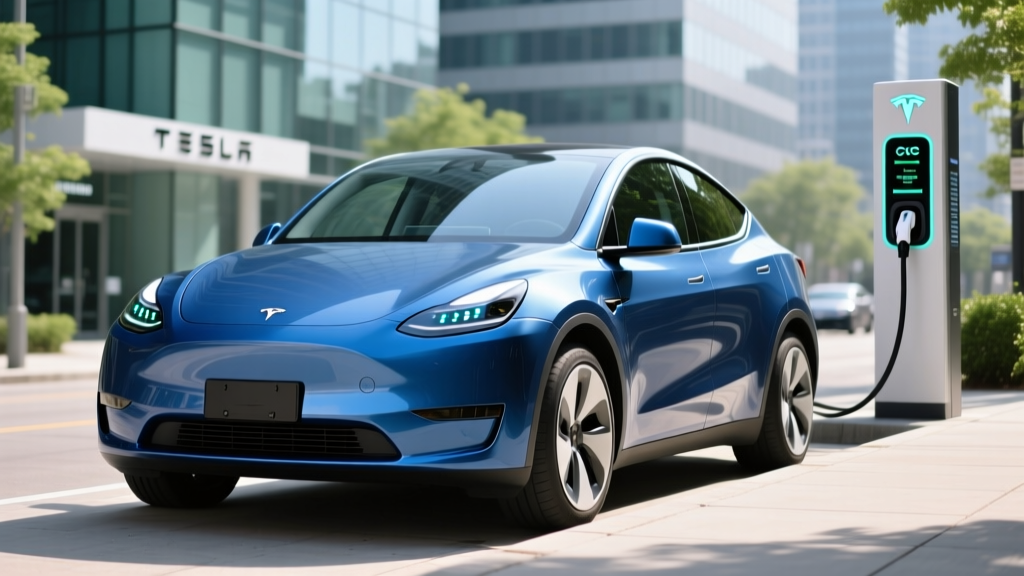
Tesla's Model Y has dominated the global EV sales charts for years, but in 2026 the company introduced a new variant aimed at a different buyer: the Model Y Mini. Designed as a more compact, more affordable entry into the Tesla ecosystem, the Model Y Mini targets urban commuters and smaller households who want Tesla's Supercharger network and software stack without the full-size crossover footprint or price tag. After spending time with the specifications, charging data, and real-world efficiency numbers, here is everything you need to know before putting down a deposit.
Quick Verdict: Who the Model Y Mini Is For
The Model Y Mini is Tesla's answer to the growing sub-$40,000 compact electric SUV segment. It shrinks the Model Y formula — minimalist interior, over-the-air updates, Autopilot standard, access to 20,000+ Superchargers — into a package roughly six inches shorter in length and a few hundred pounds lighter. If you commute 30-60 miles daily, park in tight urban garages, and want fast DC charging without paying Model Y Long Range money, this variant makes a compelling case. If you regularly haul four adults on road trips or need maximum cargo volume, the standard Model Y remains the better fit.
Choose the standard Model Y if: You need three-across rear seating, maximum cargo space, or plan frequent long-distance family road trips.
Range, Battery & Real-World Efficiency
| Spec | Value |
|---|---|
| EPA Estimated Range | 289 miles |
| Battery Capacity (usable) | 62 kWh |
| Battery Chemistry | LFP (Lithium Iron Phosphate) |
| Efficiency | 124 MPGe combined / 27 kWh per 100 mi |
| Drivetrain | Rear-Wheel Drive (single motor) |
The LFP battery chemistry is a deliberate choice. LFP cells are less energy-dense than the NMC (nickel manganese cobalt) packs in the Long Range Model Y, which is why the Mini's range is lower despite competitive efficiency. However, LFP offers two significant ownership advantages: longer cycle life (Tesla and industry data suggest 2,000-3,000+ full cycles before notable degradation, versus roughly 1,000-1,500 for NMC) and the ability to charge to 100% daily without accelerating degradation. For a commuter vehicle that you plug in every night, LFP is arguably the better chemistry.
Charging Speeds: DC Fast, Level 2 & Level 1
| Charging Level | Max Power | Speed / Time |
|---|---|---|
| DC Fast Charge (Supercharger/CCS) | 170 kW peak | 10-80% in ~24 min; ~155 mi added in 15 min |
| Level 2 (240V, 48A home charger) | 11.5 kW | ~37 miles of range per hour; full charge in ~6 hrs |
| Level 1 (120V standard outlet) | 1.4 kW | ~4 miles of range per hour; full charge in ~44 hrs |
A few nuances on the charging curve: the 170 kW peak is achievable between roughly 10-30% State of Charge (SoC). Beyond 50%, the rate tapers to around 90-100 kW, and above 80% it drops further to roughly 40-50 kW. This is typical for LFP packs and means that while the 10-80% time is competitive, the 80-100% top-off takes a disproportionately long time. For road trips, plan your stops around the 10-80% window for the best time efficiency.
On the home front, the 11.5 kW Level 2 rate requires a 60-amp circuit with a Tesla Wall Connector or equivalent J1772/NACS charger on a 240V line. Expect a professional installation to cost $500-$2,000 depending on your electrical panel's proximity to the parking spot and whether a panel upgrade is needed. The Model Y Mini ships with the NACS (North American Charging Standard) connector, giving native access to the entire Tesla Supercharger network — now the largest and most reliable DC fast-charging network in North America, per Tesla's Supercharger page.
Performance & Driving Dynamics
| Performance Spec | Model Y Mini (RWD) |
|---|---|
| 0-60 mph | 6.2 seconds |
| Horsepower | 295 hp |
| Torque | 310 lb-ft |
| Top Speed | 135 mph |
| Towing Capacity | 2,000 lbs (braked) |
A 6.2-second 0-60 time won't win drag races against the Model Y Performance, but it is genuinely quick for a compact crossover and merges onto highways with authority. The single rear motor keeps weight down and contributes to the Mini's slightly better efficiency than its dual-motor sibling. Regenerative braking is strong enough for one-pedal driving in most city conditions, though Tesla's recent software updates allow you to dial regen intensity down for a more traditional coasting feel on highways.
Interior, Cargo & Passenger Space
The Model Y Mini sacrifices roughly 6 inches of overall length compared to the standard Model Y, and that shows up primarily in the rear seat and cargo area. Front occupants will find the cabin essentially identical to the Model Y — the same 15.4-inch center touchscreen, the same minimalist dashboard, and the same synthetic leather seating.
| Dimension | Model Y Mini | Standard Model Y |
|---|---|---|
| Front Legroom | 41.8 in | 41.8 in |
| Rear Legroom | 36.2 in | 38.4 in |
| Cargo (rear seats up) | 24.1 cu ft | 30.2 cu ft |
| Cargo (rear seats folded) | 56.3 cu ft | 72.1 cu ft |
| Front Trunk (Frunk) | 4.1 cu ft | 4.1 cu ft |
For a couple or small family, 24.1 cubic feet behind the rear seats is adequate for weekly groceries, a couple of carry-on bags, or a stroller. Fold the 60/40 split rear bench and you get 56.3 cubic feet — enough for a weekend's worth of gear for two. But if you routinely carry four adults with luggage, the standard Model Y's 30.2 cubic feet and extra rear legroom make a noticeable difference on trips over an hour.
Tech, Driver Assistance & Safety
The Model Y Mini inherits Tesla's current-generation hardware suite, including the HW4.0 computer with enhanced camera resolution and processing. Standard features include:
- Autopilot (SAE Level 2): Traffic-aware cruise control, autosteer on highways, automatic emergency braking, blind-spot monitoring, and lane-departure prevention.
- 15.4-inch touchscreen with navigation, streaming media, gaming, and Tesla app integration.
- Over-the-air (OTA) updates that periodically add features and improve existing ones.
- Sentry Mode and dashcam recording using the vehicle's external cameras.
- Phone-as-key with Bluetooth proximity unlock.
Full Self-Driving (Supervised) remains an $8,000 add-on (or $99/month subscription as of early 2026). It adds automatic lane changes, navigation-guided on/off-ramp transitions, and traffic light/stop sign recognition. In our experience, FSD (Supervised) handles well-mapped suburban routes competently but still requires frequent interventions in construction zones, complex intersections, and adverse weather. Budget-conscious buyers should stick with the included Autopilot — it covers the vast majority of highway commuting needs.
On safety, Tesla vehicles typically perform well in NHTSA crash testing, and the Model Y platform has historically earned top marks. The Model Y Mini shares the same structural architecture, and we expect similar results, though official 2026 ratings for the Mini variant specifically were pending at publication time. Check IIHS for updated crash-test scores as they become available.
Pricing, Trims & Federal Tax Credit Eligibility
| Trim | Base MSRP | Est. After §30D Credit |
|---|---|---|
| Model Y Mini (RWD) | $37,990 | $30,490 (if eligible for $7,500) |
| Model Y Mini Long Range (AWD) | $42,490 | $34,990 (if eligible for $7,500) |
The $37,990 starting price for the RWD Model Y Mini undercuts the standard Model Y by roughly $6,000 and lands below the critical $40,000 threshold that determines eligibility for the full $7,500 federal EV tax credit under IRS §30D. However, eligibility is not automatic. Here is what you need to verify:
- MSRP cap: SUVs/crossovers must be under $80,000 — the Mini easily qualifies.
- Buyer income cap: Modified adjusted gross income must not exceed $150,000 (single), $225,000 (head of household), or $300,000 (married filing jointly).
- Battery sourcing: A percentage of critical minerals and battery components must be sourced from the US or free-trade-agreement countries. Tesla's LFP cells for the Mini are sourced from suppliers that currently meet the critical-minerals threshold, but the component-sourcing requirement has tightened annually. Verify current-year compliance on IRS.gov §30D guidance before purchasing.
- Point-of-sale transfer: As of 2024, you can transfer the credit to the dealer at purchase, reducing your out-of-pocket cost immediately rather than waiting for a tax refund.
Always confirm eligibility with a tax professional before relying on the credit in your budget. Sourcing rules have shifted year over year, and a vehicle that qualifies in January may face different component-sourcing calculations by mid-year.
Ownership Costs, Warranty & Long-Term Outlook
| Warranty / Cost Item | Details |
|---|---|
| Basic Vehicle Warranty | 4 years / 50,000 miles |
| Battery & Drive Unit Warranty | 8 years / 120,000 miles (minimum 70% capacity retention) |
| Est. Annual Charging Cost (home) | $450-$650 (at $0.13-$0.18/kWh, 12,000 mi/yr) |
| Est. Insurance (annual avg.) | $1,600-$2,400 (varies by state, age, driving record) |
Tesla's 8-year/120,000-mile battery warranty with a 70% capacity retention floor is competitive with the segment. LFP chemistry gives additional peace of mind — independent battery-health data from fleet operators shows LFP packs losing roughly 8-12% capacity over 150,000 miles, meaning most owners will never approach the warranty threshold in normal use.
On the cost side, home charging at the US average electricity rate of roughly $0.16/kWh works out to about $4.32 per 100 miles driven (at 27 kWh/100 mi). Compare that to a 28-MPG gas crossover at $3.50/gallon, which costs about $12.50 per 100 miles. Over 12,000 miles per year, that is roughly $980 in fuel savings annually — enough to offset higher insurance premiums in most states.
Pros & Cons at a Glance
- Sub-$38,000 MSRP; potentially ~$30,500 after tax credit
- Access to Tesla Supercharger network (20,000+ stalls)
- LFP battery: daily 100% charging, longer cycle life
- 289 miles EPA range is ample for most commuters
- Strong infotainment, OTA updates, Autopilot included
- Quick 6.2-second 0-60 for the segment
- Noticeably less rear legroom and cargo space vs. standard Model Y
- RWD only on base trim — no AWD option below $42K
- 170 kW peak DC charge is slower than some competitors (Hyundai Ioniq 5: 240 kW)
- No physical instrument cluster; all info on center screen
- Tesla service center availability varies widely by region
- FSD (Supervised) is expensive and still requires full driver attention
Competitor Comparison: Model Y Mini vs. the Compact EV Field
| Spec | Tesla Model Y Mini | Hyundai Ioniq 5 (Std Range) | Chevrolet Equinox EV 2LT |
|---|---|---|---|
| EPA Range | 289 mi | 245 mi | 319 mi |
| Battery (usable) | 62 kWh (LFP) | 58 kWh (NMC) | 85 kWh (NMC) |
| Peak DC Charge | 170 kW | 175 kW | 150 kW |
| 0-60 mph | 6.2 sec | 7.4 sec | 7.9 sec |
| Starting MSRP | $37,990 | $39,950 | $36,900 |
| Charging Network | NACS native (Supercharger) | NACS (2026+ models) | NACS (2026+ models) |
The Model Y Mini's main advantages over the Ioniq 5 Standard Range and Equinox EV are the Supercharger network (still the gold standard for reliability), the LFP battery's longevity profile, and stronger acceleration. The Equinox EV counters with significantly more range thanks to its larger battery, and the Ioniq 5 offers a more conventional interior layout with a physical gauge cluster and more rear-seat headroom.
Frequently Asked Questions
What is the real-world range of the Tesla Model Y Mini?
The EPA rates it at 289 miles. Expect 245-260 miles in sustained highway driving at 70+ mph, and 200-225 miles in cold weather below freezing. City driving with regenerative braking can push past 295 miles in mild temperatures.
How fast does the Model Y Mini charge?
On a DC fast charger, it peaks at 170 kW and charges from 10-80% in approximately 24 minutes. At home on a 240V Level 2 charger (11.5 kW), you gain about 37 miles per hour, reaching a full charge in roughly 6 hours. A standard 120V outlet adds about 4 miles per hour.
How much does the Model Y Mini cost after the federal tax credit?
The base RWD trim starts at $37,990. If you meet all IRS §30D requirements — income below the caps, and the vehicle's battery meets current-year sourcing rules — the credit can reduce your effective cost to approximately $30,490 via the point-of-sale transfer option. Confirm eligibility on IRS.gov and with a tax professional before purchasing.
Does the Model Y Mini qualify for the $7,500 federal EV tax credit?
It qualifies on MSRP (well under the $80,000 SUV cap). Whether you qualify depends on your income (≤$150K single / ≤$300K married filing jointly) and whether the specific vehicle's battery meets the 2026 critical-minerals and component-sourcing thresholds. These rules tighten annually — verify at point of purchase.
Is the Model Y Mini worth buying over the standard Model Y?
If you primarily drive solo or with one passenger, commute under 60 miles daily, and want to save $6,000+ on purchase price, the Mini is the smarter financial choice. If you need maximum cargo space, regularly seat four or five adults, or want AWD at a lower price point, the standard Model Y is worth the premium.
What are the biggest drawbacks of the Model Y Mini?
Reduced rear legroom (36.2 in vs. 38.4 in), significantly less cargo volume (24.1 cu ft vs. 30.2 cu ft), RWD only on the base trim, and a 170 kW peak charge rate that trails some competitors. Tesla's service center network also remains sparse in rural areas, which can mean longer wait times for repairs.
Is the LFP battery in the Model Y Mini a concern?
For most owners, LFP is an advantage. You can charge to 100% daily without degradation concerns, and cycle life is significantly longer than NMC. The trade-off is lower energy density (hence the 289-mile range vs. 330+ on the Long Range NMC pack) and slightly reduced performance in extreme cold. If you live in a region with harsh winters and lack garage parking, preconditioning the battery before driving is essential to maintain range and charging speed.