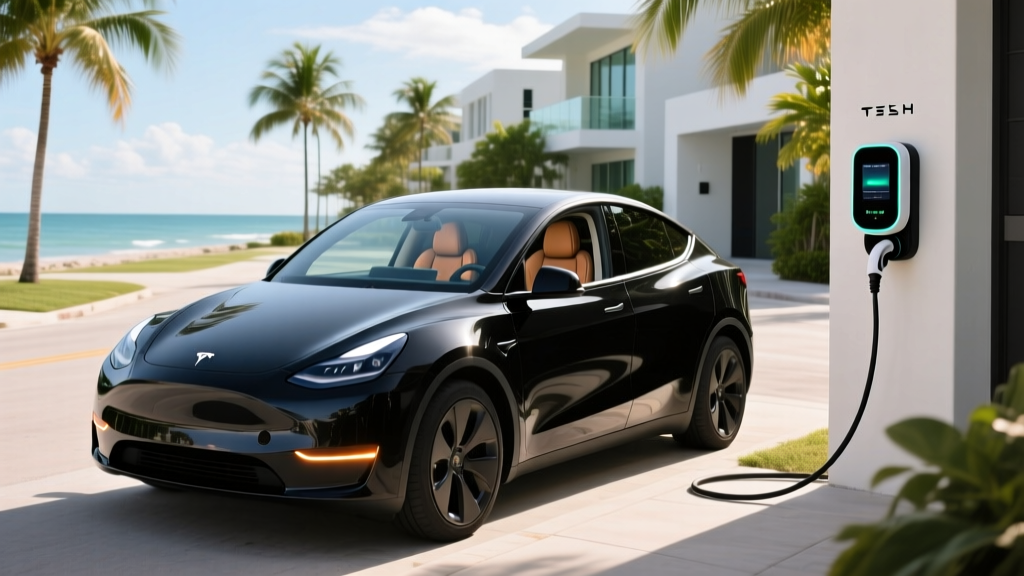
If you're searching for a Tesla in Miami Gardens, you're likely weighing the refreshed Model Y against a growing field of electric SUVs. The 2026 Model Y (the "Juniper" refresh that debuted for the 2025 model year) brings meaningful updates to range, ride quality, cabin materials, and charging architecture. But does it still deserve its position as America's best-selling EV—especially for South Florida drivers dealing with heat, stop-and-go traffic on I-95, and hurricane-season power concerns?
This review breaks down every number that matters: real-world range in Florida heat, DC fast-charge speeds at Superchargers along the Turnpike, exact pricing after federal tax credits, and how it compares to the Hyundai Ioniq 5 and Ford Mustang Mach-E. No fluff—just the data you need to decide.
2026 Tesla Model Y: Core Specifications at a Glance
| Spec | Long Range AWD | Performance AWD | RWD (Standard) |
|---|---|---|---|
| EPA Range | 320 mi | 295 mi | 300 mi |
| Battery (usable) | ~75 kWh (NMC) | ~75 kWh (NMC) | ~60 kWh (LFP) |
| Drivetrain | Dual Motor AWD | Dual Motor AWD | Rear-Wheel Drive |
| Horsepower | 384 hp | 456 hp | 295 hp |
| 0-60 mph | 4.8 sec | 3.5 sec | 6.6 sec |
| Peak DC Fast Charge | 250 kW | 250 kW | 170 kW |
| 10-80% DC Charge | ~24 min | ~24 min | ~30 min |
| Level 2 Home Charge | 11.5 kW (~44 mi/hr) | 11.5 kW (~44 mi/hr) | 7.7 kW (~30 mi/hr) |
| MPGe (combined) | 111 MPGe | 103 MPGe | 119 MPGe |
| Base MSRP | $46,630 | $53,630 | $39,990 |
| Battery Warranty | 8 yr / 120,000 mi | 8 yr / 120,000 mi | 8 yr / 100,000 mi |
Source: EPA / fueleconomy.gov and Tesla specifications. Prices reflect 2026 model-year MSRP before destination fees.
Real-World Range: What Miami Gardens Drivers Actually Get
Real-World Expectation: ~270-290 miles in South Florida conditions
Highway (75+ mph on Turnpike): ~250-265 miles
City / Stop-and-Go (I-95 corridor): ~290-310 miles (regen braking helps)
Hot Day with A/C Maxed (95°F+): ~275-295 miles — heat is less punishing than cold, but cabin cooling still draws ~2-3 kW continuously
Miami Gardens' climate is actually one of the better environments for EV range. Unlike northern states where lithium-ion batteries lose 20-30% range in sub-freezing temperatures, South Florida's warm weather keeps battery chemistry operating near its ideal thermal window. The Juniper refresh also introduced an improved heat pump system that manages cabin cooling more efficiently than the pre-2025 Model Y.
Where you'll lose range is sustained highway driving. At 80 mph on Florida's Turnpike heading toward Orlando, expect the 320-mile Long Range to deliver closer to 250-265 miles before you need a Supercharger stop. That's because aerodynamic drag increases exponentially with speed, and the Model Y's crossover profile creates more drag than the Model 3 sedan. For the typical Miami Gardens commute—Palmetto Expressway at 55-65 mph with regenerative braking recovering energy at every red light—you'll land closer to the EPA number.
Charging Speed & Miami-Area Infrastructure
The 2026 Model Y Long Range and Performance trims peak at 250 kW on V3/V4 Superchargers, achieving a 10-80% charge in approximately 24 minutes. The RWD Standard trim with its LFP battery peaks lower at 170 kW and takes roughly 30 minutes for the same session.
| Charging Method | Power | Miles Added/Hour | Best Use Case |
|---|---|---|---|
| Level 1 (120V outlet) | ~1.4 kW | ~5-6 mi/hr | Emergency / overnight trickle |
| Level 2 (240V home, 48A) | 11.5 kW | ~44 mi/hr | Daily home charging |
| DC Fast (Supercharger V3) | 250 kW peak | ~1,000+ mi/hr (peak) | Road trips, rapid top-ups |
| DC Fast (CCS adapter, EA) | Up to 150 kW | ~600 mi/hr (peak) | Non-Tesla network backup |
The charging curve reality: That 250 kW peak only holds between roughly 10-30% state of charge. By 50% SoC, the rate tapers to ~150 kW, and above 80% it drops below 60 kW. This is why Tesla (and every other manufacturer) quotes 10-80% times—charging the final 20% can take as long as the first 80%.
For Miami Gardens owners, the Supercharger network is a major advantage. There are V3 stalls at Dolphin Mall, Aventura Mall, and multiple locations along I-95 and the Turnpike. Tesla's NACS connector is now the industry standard, with Ford, GM, Rivian, and others adopting it—but Tesla owners still get priority access and the most seamless plug-and-charge experience.
Home charging setup: A Tesla Wall Connector installed on a 60-amp circuit delivers the full 11.5 kW (48A continuous). In Miami-Dade County, expect to pay $800-$1,800 for a professional installation if your electrical panel has capacity. Older homes in Miami Gardens built in the 1970s-80s may need a panel upgrade ($1,500-$3,000) to support a dedicated 60-amp circuit. Always get a licensed electrician to assess your panel before ordering equipment.
Pricing, Trims & Federal Tax Credit Eligibility
| Trim | Base MSRP | Destination | Est. Total | §30D Credit Eligibility |
|---|---|---|---|---|
| Model Y RWD | $39,990 | $1,390 | $41,380 | Up to $7,500 (if sourcing rules met) |
| Model Y Long Range AWD | $46,630 | $1,390 | $48,020 | Up to $7,500 (if sourcing rules met) |
| Model Y Performance AWD | $53,630 | $1,390 | $55,020 | Up to $7,500 (if sourcing rules met) |
Federal tax credit (§30D) rules for 2026: The Model Y qualifies for up to $7,500, but eligibility depends on several factors that change frequently:
- MSRP cap: SUVs must be under $80,000 — all Model Y trims clear this easily.
- Buyer income cap: Modified AGI must not exceed $150,000 (single), $225,000 (head of household), or $300,000 (joint). Miami-Dade median household income is ~$55,000, so most local buyers qualify on income.
- Battery sourcing: At least 80% of critical minerals and 100% of battery components must be sourced from the US or FTA partners. Tesla's shifting supply chain means eligibility can change month-to-month.
- Point-of-sale transfer: As of 2024, you can transfer the credit to the dealer at purchase, reducing your out-of-pocket cost immediately rather than waiting for tax filing.
Always verify current eligibility on IRS.gov before purchasing, and consult a tax professional. Sourcing requirements have tightened progressively since 2023, and specific trim/battery combinations may or may not qualify in any given month.
For Florida specifically, there is no state EV tax credit as of 2026. However, Miami-Dade County offers some utility rebates through FPL (Florida Power & Light) for home charger installation—check FPL's current EV programs for availability.
Performance, Ride Quality & the Juniper Refresh
The Juniper update transformed the Model Y from a firm-riding, sparsely finished crossover into something genuinely refined. Key changes for 2025-2026:
- Acoustic glass on all windows reduces highway noise by a noticeable margin on I-95
- Retuned suspension with frequency-selective dampers absorbs Miami's notorious speed bumps and pothole-riddled surface streets far better than the pre-refresh model
- Ambient lighting, ventilated front seats, and power-folding second row bring the interior closer to luxury-competitor standards
- Light bar and turn signals on the steering wheel replace the stalk-based design (controversial—some love it, others don't)
Performance numbers remain strong. The Long Range AWD's 4.8-second 0-60 time is quicker than any gas-powered compact SUV in its price range, and the dual-motor setup provides confident traction during South Florida's sudden afternoon downpours. The Performance trim's 3.5-second sprint is genuinely sports-car territory, though the stiffer suspension tuning sacrifices some of the ride comfort gains.
ADAS note: Tesla's Autopilot and Full Self-Driving (Supervised) remain SAE Level 2 driver-assistance systems. You must keep your hands on the wheel and eyes on the road at all times. FSD (Supervised) handles highway interchanges and city streets with increasing competence, but it is not autonomous driving—it makes mistakes, and you are legally and physically responsible for the vehicle.
Cargo, Passenger Space & Family Practicality
The Model Y's crossover form factor delivers practical advantages over the Model 3 sedan that matter for families:
| Dimension | Model Y (2026) | Competitor: Ioniq 5 |
|---|---|---|
| Cargo (behind 2nd row) | 30.2 cu ft | 27.2 cu ft |
| Cargo (2nd row folded) | 72.1 cu ft | 59.3 cu ft |
| Front legroom | 41.8 in | 41.7 in |
| Rear legroom | 37.5 in | 39.4 in |
| Frunk (front trunk) | 4.1 cu ft | 0.85 cu ft |
| Towing capacity | 3,500 lbs | Not rated (US) |
The 72.1 cubic feet of total cargo space with seats folded is class-leading among electric crossovers. The frunk is large enough for a charging cable bag and groceries. For Miami Gardens families, the optional third-row seat (available on Long Range) provides occasional 7-passenger capability, though the third row is best suited for children under about 5'4".
Rear legroom at 37.5 inches is adequate but tighter than the Ioniq 5's 39.4 inches—something to consider if you regularly carry tall teenagers or adults in back. The panoramic glass roof creates an airy feel but does let in significant heat; the Juniper refresh includes a slightly more tinted glass panel, but a sunshade accessory is still recommended for South Florida summers.
Model Y vs. Key Competitors: Which Should You Buy?
- You want access to the Supercharger network (still the most reliable DC fast-charging infrastructure)
- Over-the-air updates and the Tesla app ecosystem matter to you
- You value cargo space and the frunk for family hauling
- You want the strongest resale value among EVs
- You want 800V architecture and faster 10-80% charging (~18 min at 350 kW chargers)
- Rear passenger comfort is a priority (more legroom, softer ride)
- You prefer physical buttons and a more conventional infotainment layout
- V2L (vehicle-to-load) capability matters for hurricane-season backup power
- You prefer a more engaging, car-like driving feel
- BlueCruise hands-free highway driving appeals to you (still Level 2, but genuinely hands-off on mapped highways)
- You want a traditional dealership service experience in Miami-Dade
Pros, Cons & Final Verdict
- 320-mile EPA range (Long Range) handles Miami-to-Orlando round trips with one charge stop
- Supercharger network is the gold standard for road-trip reliability
- Juniper refresh fixed the ride quality complaints
- Class-leading cargo space (72.1 cu ft)
- Strongest EV resale value in the market
- OTA updates continuously add features
- Excellent efficiency (111 MPGe combined)
- 250 kW peak charge rate trails 800V competitors (Ioniq 5 at 350 kW)
- No Apple CarPlay or Android Auto—Tesla's ecosystem only
- Steering-wheel turn signals take real adjustment
- Rear legroom is tighter than some competitors
- Glass roof still admits significant heat in South Florida summers
- Service center wait times in Miami can stretch weeks for non-critical repairs
- Tax credit eligibility fluctuates with sourcing rule changes
Verdict: For Miami Gardens drivers, the 2026 Model Y Long Range AWD at ~$48,020 before credits remains the default electric SUV recommendation. It's not the fastest-charging or the most comfortable in back, but the combination of range, Supercharger access, cargo utility, and resale value is unmatched. If you can charge at home and your daily drive is under 80 miles, you'll rarely think about range—and when you do need to road-trip, the infrastructure just works.
Frequently Asked Questions
What is the real-world range of the Tesla Model Y in Miami?
Expect 270-290 miles in mixed South Florida driving from the Long Range AWD (EPA-rated 320 miles). City driving with regenerative braking gets you closer to 310 miles; sustained 80 mph highway driving drops it to around 250-265 miles. Florida's warm climate is favorable for battery efficiency compared to cold-weather states.
How fast does the Model Y charge at home and on the road?
At home on a 240V/48A Tesla Wall Connector, the Long Range adds approximately 44 miles of range per hour (11.5 kW)—a full overnight session easily replenishes a day's driving. On the road, V3 Superchargers deliver up to 250 kW, achieving 10-80% in about 24 minutes. The RWD Standard trim charges slower at 170 kW peak (~30 minutes 10-80%).
Does the 2026 Model Y qualify for the $7,500 federal tax credit?
The Model Y meets the MSRP cap (under $80,000 for SUVs) and most buyers meet income requirements. However, eligibility depends on battery component and critical mineral sourcing rules that change periodically. Check the IRS qualified vehicles list at the time of purchase. The credit can be transferred at point of sale to reduce your purchase price immediately.
Is the Model Y worth it vs. the Ioniq 5 or Mach-E?
It depends on your priorities. The Model Y wins on cargo space, Supercharger access, and resale value. The Ioniq 5 charges faster (800V architecture) and offers more rear legroom plus V2L backup power. The Mach-E provides a sportier driving feel and Ford dealership service. For most Miami buyers who can charge at home and take occasional road trips, the Model Y's ecosystem advantages tip the scales.
How does hurricane season affect EV ownership in Miami Gardens?
Power outages are the main concern. A Model Y with 75 kWh of battery can serve as a limited backup power source via a third-party inverter (Tesla does not offer native V2L/V2H on the Model Y, unlike the Cybertruck or competitors like the Ioniq 5). Keep your battery above 80% during storm watches, and have a plan for where to charge if your neighborhood loses power for multiple days—Superchargers at major retail centers often have backup generators.
What does Model Y maintenance cost compared to a gas SUV?
Routine maintenance is minimal: cabin air filter replacement (~$50-80 every 2 years), tire rotation, wiper fluid, and brake fluid checks. There are no oil changes, spark plugs, or transmission service. Expect ~$300-500/year in maintenance vs. $800-1,200/year for a comparable gas SUV. However, tire wear is higher on EVs due to instant torque and vehicle weight—budget for tire replacement every 25,000-35,000 miles.
What is the battery warranty and expected lifespan?
Tesla covers the Model Y Long Range and Performance battery for 8 years or 120,000 miles (whichever comes first), with a minimum 70% capacity retention guarantee. The RWD Standard trim is covered for 8 years or 100,000 miles. Real-world data from high-mileage Tesla owners suggests NMC batteries typically retain 85-90% capacity at 100,000 miles with normal charging habits. The LFP battery in the RWD trim is known for even slower degradation and can be charged to 100% regularly without concern.
For the latest safety ratings, see NHTSA.gov. For insurance cost estimates in Miami-Dade, contact local providers directly—EV insurance premiums in South Florida tend to run 15-25% higher than comparable gas vehicles due to repair costs and parts pricing.