The Verdict: America's Best-Selling EV Earns Its Reputation
The Tesla Model Y Long Range remains the benchmark compact electric SUV that every competitor measures itself against. For 2026, the refreshed "Juniper" generation brings a quieter cabin, ventilated front seats, a rear passenger touchscreen, and subtly improved aerodynamics that help preserve its class-leading efficiency. If you need a two-row electric crossover that can genuinely handle road trips, daily commuting, and family duty without compromise, the Model Y Long Range is still the default answer — though the gap from rivals like the Hyundai Ioniq 5, Ford Mustang Mach-E, and Chevrolet Equinox EV has narrowed considerably.
This review covers the dual-motor All-Wheel-Drive Long Range trim, which continues to be the volume seller in the Model Y lineup. We'll break down real-world range versus the EPA sticker, actual charging speeds at public DC fast chargers, total cost after federal tax credits, and whether this is still the smartest EV buy in 2026.
Range, Battery & Efficiency: The Numbers That Matter
Real-World Expectation: ~275–295 miles on mixed highway/city driving at 70 mph; ~240–260 miles in sustained sub-30°F winter conditions. The Model Y's heat pump helps mitigate cold-weather losses compared to older EVs, but expect a 15–25% range reduction in freezing temperatures.
The 2026 Model Y Long Range AWD packs a 75 kWh usable battery (approximately 78.1 kWh gross) using NMC (Nickel Manganese Cobalt) chemistry. Tesla sources cells from multiple suppliers including Panasonic and CATL depending on the production batch and factory. NMC chemistry offers higher energy density than LFP (lithium iron phosphate), which is why the Long Range trim achieves more miles per pound of battery than the base RWD Model Y, which uses LFP cells.
On the efficiency front, the EPA rates the 2026 Model Y Long Range AWD at 122 MPGe combined, which translates to roughly 28 kWh per 100 miles. That's exceptional for a 4,400-pound AWD crossover and a direct result of Tesla's industry-leading thermal management, low-drag Juniper bodywork, and the SiC (silicon carbide) inverters in the drive units. For context, the Hyundai Ioniq 5 AWD returns 110 MPGe combined, and the Ford Mustang Mach-E Extended Range AWD lands at 101 MPGe.
| Spec | Value |
|---|---|
| EPA Range | 320 miles |
| Battery (Usable / Gross) | 75 kWh / ~78.1 kWh |
| Battery Chemistry | NMC |
| MPGe (City / Hwy / Combined) | 127 / 117 / 122 |
| Efficiency | ~28 kWh/100 mi |
| Drivetrain | Dual-Motor AWD |
| Horsepower | 384 hp (combined) |
| 0–60 mph | 4.8 seconds |
| Top Speed | 125 mph |
| Cargo (Behind 2nd Row / Max) | 30.2 cu ft / 72.1 cu ft |
| Rear Legroom | 38.8 inches |
| Curb Weight | ~4,398 lbs |
| Towing Capacity | 3,500 lbs |
Source: fueleconomy.gov and Tesla.com
Charging Speed: DC Fast Charging & Home Level 2
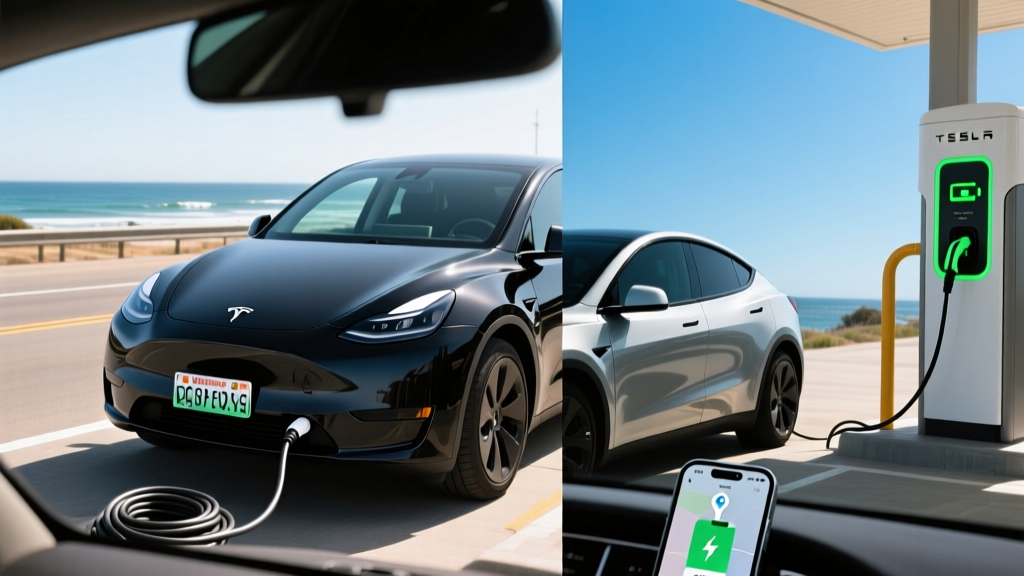
Charging speed remains one of the Model Y Long Range's strongest suits, thanks to Tesla's mature Supercharger network and the vehicle's sophisticated thermal preconditioning. When you navigate to a Supercharger (or any DC fast charger), the car automatically warms or cools the battery to the optimal temperature for maximum charge acceptance — a feature many competitors still lack or require manual activation for.
| Charging Level | Power / Rate | Speed / Time |
|---|---|---|
| Level 1 (120V household) | ~1.4 kW | ~4–5 miles per hour |
| Level 2 (240V, 48A home charger) | 11.5 kW | ~44 miles per hour; 0–100% in ~8 hours |
| DC Fast Charge (peak) | 250 kW (Supercharger V3/V4) | 10–80% in ~25 minutes |
| DC Fast Charge (CCS adapter, 3rd-party) | Up to 250 kW (station dependent) | Varies; typically 10–80% in ~28–32 min |
A critical detail many spec sheets gloss over: the 250 kW peak is not sustained. The Model Y Long Range holds its peak charge rate from roughly 10–30% State of Charge (SoC), then tapers progressively. From 50–80%, you're averaging closer to 100–130 kW. This is normal lithium-ion charge-curve behavior, but it means the advertised "250 kW" figure applies only to a narrow SoC window. The 10–80% time of approximately 25 minutes remains competitive, though newer 800V architectures like the Hyundai Ioniq 5's can achieve 10–80% in roughly 18 minutes at a 350 kW charger.
For home charging, Tesla's Wall Connector at 48 amps delivers 11.5 kW, replenishing the 75 kWh battery from empty in about 8 hours. This is the practical sweet spot: plug in when you get home, and the car is fully charged by morning. If your home electrical panel supports a 60A circuit, this is the setup to pursue. Expect a professional installation to cost between $500 and $2,000 depending on your panel's proximity to the garage and whether a panel upgrade is needed.
Performance & Driving Dynamics
The dual-motor AWD powertrain produces a combined 384 horsepower and launches the Model Y Long Range from 0 to 60 mph in 4.8 seconds. That's quick enough to merge onto any freeway with authority and still delivers the instant, linear torque delivery that defines the EV driving experience. The single-speed reduction gear means no shift interruptions — just a seamless surge of acceleration.
Ride quality in the Juniper generation has improved noticeably. Tesla retuned the suspension with new frequency-selective dampers and added more sound deadening. The result is a crossover that absorbs highway expansion joints and rough pavement with less crashiness than the pre-2025 model. Road noise is measurably lower, though the Model Y still isn't as whisper-quiet as a Genesis GV60 or BMW iX.
Regenerative braking remains aggressive in Tesla's one-pedal driving mode, which allows you to drive almost exclusively with the accelerator in stop-and-go traffic. However, unlike some competitors, Tesla does not offer adjustable regen levels — it's one setting, and it's strong. New EV drivers may need a week to adapt.
Interior, Tech & Driver Assistance
The 2026 Juniper interior is a meaningful step up. The minimalist dashboard now features ambient lighting strips, ventilated front seats (finally), and a new 8-inch rear touchscreen that lets back-seat passengers control climate, media, and entertainment. The 15.4-inch front touchscreen runs Tesla's latest software with Netflix, YouTube, and Arcade capability while parked.
Cargo space remains a strong point: 30.2 cubic feet behind the second row and 72.1 cubic feet with the rear seats folded — enough for a week's camping gear or a Costco haul. The front trunk (frunk) adds another 4.1 cubic feet for charging cables and smaller items.
Tesla's Autopilot and Full Self-Driving (Supervised) are SAE Level 2 driver-assistance systems. They can steer, accelerate, and brake within a lane and can handle highway interchanges, but the driver must remain fully engaged — hands on the wheel, eyes on the road. These are not self-driving systems. Tesla's camera-only "Tesla Vision" approach lacks LiDAR or radar redundancy, which some competitors use for added confidence in low-visibility conditions. Always verify your state's regulations regarding FSD usage.
Standard Autopilot includes Traffic-Aware Cruise Control and Autosteer. The $8,000 FSD (Supervised) upgrade adds Navigate on Autopilot (automatic highway lane changes and off-ramp navigation), Smart Summon, and traffic-light/stop-sign recognition. Whether FSD is worth the cost remains debatable — it's impressive on well-marked highways but can be hesitant in complex urban environments and construction zones.
Pricing, Trims & Federal Tax Credit Eligibility
The 2026 Tesla Model Y Long Range AWD starts at a base MSRP of $48,990 (including destination fee). Adding common options like the $1,000 Deep Blue Metallic paint, $1,000 20-inch Helix wheels, and the $8,000 FSD package can push an as-tested price to roughly $58,990. The Performance trim, which drops 0–60 to 3.5 seconds and adds track-oriented hardware, starts around $53,990.
| Item | Amount |
|---|---|
| Base MSRP (Long Range AWD) | $48,990 |
| Typical As-Tested (with options) | $53,000–$59,000 |
| Federal §30D Tax Credit (maximum) | Up to $7,500 |
| Effective Price After Max Credit | From ~$41,490 |
- MSRP Cap: SUVs/vans/pickups must be ≤ $80,000 MSRP. The Model Y qualifies.
- Buyer Income Cap: Modified Adjusted Gross Income ≤ $300,000 (joint filers), $225,000 (head of household), $150,000 (single). Exceed this and you lose the credit entirely.
- Battery Sourcing: The $7,500 credit splits into two halves — $3,750 for critical-minerals sourcing and $3,750 for battery-component manufacturing. Sourcing requirements tighten annually. Tesla's North American battery supply chain has historically qualified for the full credit, but verify current-year status on fueleconomy.gov before purchasing.
- Point-of-Sale Transfer: As of 2024, you can transfer the credit to the dealer at purchase, reducing your out-of-pocket cost immediately rather than waiting for a tax refund.
- Tax Liability: This is a non-refundable credit. You must owe at least $7,500 in federal income tax to benefit fully (the point-of-sale transfer effectively bypasses this for most buyers).
Always confirm eligibility with a tax professional and check the latest rules at IRS.gov. Rules and sourcing requirements change.
Ownership Costs & Warranty
Tesla covers the Model Y Long Range with a 4-year/50,000-mile basic vehicle warranty and an 8-year/120,000-mile battery and drive unit warranty. The battery warranty guarantees the pack will retain at least 70% of its original capacity during the warranty period. If degradation exceeds 30% within that window, Tesla will repair or replace the battery at no cost.
Insurance costs for the Model Y tend to run 15–25% higher than comparable gas-powered crossovers, driven by Tesla's higher repair costs after collisions (aluminum body panels, integrated battery structure). Expect annual premiums in the $1,800–$2,800 range depending on your location, driving record, and coverage level. Shopping multiple insurers — including Tesla's own insurance product, available in many states — is essential.
Maintenance costs are minimal: no oil changes, no spark plugs, no transmission fluid. Cabin air filter replacement every 2–3 years, tire rotation every 6,250 miles, and brake fluid checks are the primary service items. Tesla's mobile service handles many repairs at your home or office, though body shop wait times after collisions can stretch to weeks in some markets.
Model Y Long Range vs. Key Competitors
| Spec | Tesla Model Y LR AWD | Hyundai Ioniq 5 AWD | Ford Mach-E ER AWD |
|---|---|---|---|
| EPA Range | 320 mi | 290 mi | 300 mi |
| Battery (Usable) | 75 kWh | 77.4 kWh | 91 kWh |
| Peak DC Fast Charge | 250 kW | 350 kW (800V) | 150 kW |
| 10–80% DC Time | ~25 min | ~18 min | ~38 min |
| MPGe Combined | 122 | 110 | 101 |
| 0–60 mph | 4.8 sec | 5.1 sec | 5.1 sec |
| Base MSRP | $48,990 | $50,600 | $49,995 |
| Cargo (Rear Seats Up) | 30.2 cu ft | 27.2 cu ft | 29.7 cu ft |
- You prioritize maximum range and efficiency above all else.
- You want access to the Tesla Supercharger network — still the most reliable and extensive DC fast-charging network in the U.S.
- Cargo capacity and cabin space are top priorities for family use.
- You value over-the-air software updates that meaningfully improve the car over time.
- Hyundai Ioniq 5: You want faster DC charging (18 min 10–80% on 350 kW chargers) and prefer a more conventional interior with physical buttons and a traditional instrument cluster.
- Ford Mach-E: You prefer a more engaging, car-like driving feel and want Apple CarPlay/Android Auto (Tesla uses its proprietary infotainment only).
- Chevrolet Equinox EV: Budget is paramount — the Equinox EV starts significantly lower and still offers 300+ miles of range, though with slower DC charging.
Pros & Cons
- Class-leading 320-mile EPA range and 122 MPGe efficiency
- Supercharger network access — still the gold standard for road-trip charging reliability
- Spacious cabin with 72.1 cu ft max cargo and excellent rear legroom
- Quick 4.8-second 0–60 with standard dual-motor AWD
- Juniper refresh brings meaningful noise reduction and seat ventilation
- Over-the-air updates continuously add features
- Strong resale value relative to most EV competitors
- No Apple CarPlay or Android Auto — Tesla's proprietary system only
- FSD (Supervised) costs $8,000 and remains a Level 2 system, not autonomous driving
- DC fast-charge peak of 250 kW trails 800V competitors like Ioniq 5
- Insurance premiums run 15–25% above segment average
- Minimalist interior isn't for everyone — no physical buttons, no traditional gauges
- Build quality, while improved, can still show panel-gap variance
- Turn-signal stalks removed in Juniper; signals now on the steering wheel rim
Who Should Buy the 2026 Tesla Model Y Long Range?
The Model Y Long Range is best suited for families and commuters who want one vehicle that handles daily school runs, highway commutes, weekend road trips, and the occasional Costco haul — all without visiting a gas station. If you can install a Level 2 charger at home (the single biggest quality-of-life factor in EV ownership), the Model Y Long Range's 320-mile range means you'll rarely think about charging in daily life and can confidently tackle 250-mile highway trips with a single 20-minute Supercharger stop.
It's also a strong pick for road-trippers who regularly drive 200–400 mile routes. The Supercharger network's reliability and coverage still outpace Electrify America, EVgo, and ChargePoint for interstate travel, particularly in rural corridors. If you live in a region with sparse public charging infrastructure, Tesla's network advantage is even more significant.
The Model Y Long Range is less ideal for buyers who prioritize the fastest possible DC charging (look at Hyundai/Kia's 800V E-GMP platform), those who demand Apple CarPlay/Android Auto integration, or anyone who wants a luxury-badge experience at this price point (consider the Genesis GV60 or BMW iX xDrive40, though both cost more).
Frequently Asked Questions
What is the real-world range of the 2026 Tesla Model Y Long Range?
The EPA rates it at 320 miles, but expect roughly 275–295 miles in real-world mixed driving at highway speeds (70 mph), and approximately 240–260 miles in sustained freezing temperatures. Driving style, terrain, and climate-control usage all impact range. Tesla's in-car range estimator (displayed as a percentage) is generally accurate when using the "Trip" meter rather than the default rated-range display.
How fast does the Model Y Long Range charge?
On a Tesla V3/V4 Supercharger or equivalent 250 kW DC fast charger, expect a 10–80% charge in approximately 25 minutes. On a 48A Level 2 home charger (240V), the car gains about 44 miles of range per hour and fully charges in roughly 8 hours. Peak 250 kW is only sustained from ~10–30% SoC; the charge rate tapers significantly above 50%.
Does the 2026 Tesla Model Y qualify for the $7,500 federal EV tax credit?
The Model Y Long Range has historically qualified for the full $7,500 under IRS §30D, but eligibility depends on your income (≤ $300,000 joint / $150,000 single), the vehicle's MSRP (must be ≤ $80,000 for SUVs), and current battery-sourcing requirements. Tesla's North American supply chain has generally met these thresholds, but sourcing rules tighten annually. Always verify on fueleconomy.gov and consult a tax professional before relying on the credit.
Is the Model Y Long Range worth buying over the competition?
If you value maximum range, Supercharger network access, cargo space, and Tesla's software ecosystem, it remains the segment leader. If faster DC charging, Apple CarPlay, or a more conventional interior matter more, the Hyundai Ioniq 5 or Ford Mustang Mach-E are compelling alternatives. Test-drive at least two competitors before committing.
How long will the Model Y battery last?
Tesla's NMC battery packs have demonstrated strong longevity in real-world fleet data, with most owners reporting less than 10% degradation after 100,000 miles. The battery warranty guarantees at least 70% capacity retention for 8 years or 120,000 miles. To maximize longevity, Tesla recommends daily charging to 80–90% and only charging to 100% when needed for longer trips. Out-of-warranty battery replacement currently costs approximately $12,000–$16,000, though prices continue to decline.
Can I charge a Tesla Model Y on non-Tesla charging networks?
Yes. Since 2025, Tesla has opened many Supercharger stalls to non-Tesla EVs, and Tesla vehicles can use CCS-based networks (Electrify America, EVgo, ChargePoint) with a CCS adapter. Tesla sells an official CCS adapter, and newer Model Y vehicles ship with the NACS (North American Charging Standard) port natively. The expanding openness of the Supercharger network to other brands, and vice versa, means Tesla owners now have more public charging options than ever — though the Tesla app and in-car navigation still provide the most seamless experience on Superchargers.