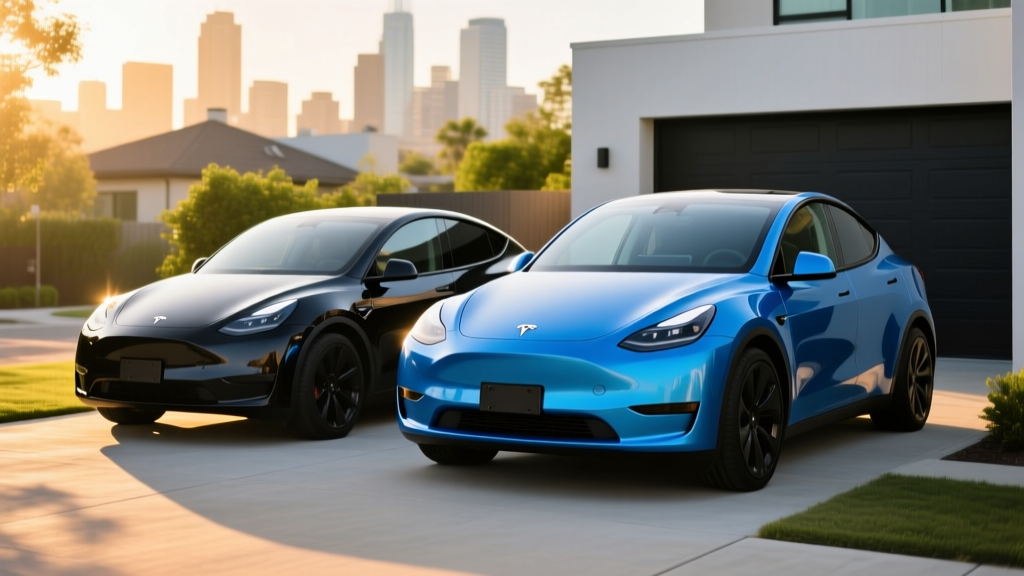
The Tesla Model Y Long Range remains the default answer for buyers seeking a practical, efficient electric SUV with access to the most reliable fast-charging network in North America. For 2026, the refreshed "Juniper" Model Y Long Range carries over the architectural improvements introduced in early 2025 — a stiffer body structure, ventilated front seats, a rear touchscreen, and ambient lighting — while refining powertrain efficiency and suspension tuning. With an EPA-estimated 320 miles of range, a NACS-native charging advantage, and segment-leading cargo volume, it continues to set the benchmark in the midsize electric crossover segment.
But benchmark status doesn't mean it's flawless. The minimalist interior still polarizes, the ride on 20-inch wheels can be firm, and the $7,500 federal tax credit now comes with sourcing and income strings that trip up many buyers. This review breaks down every number that matters — from real-world range to charging-curve behavior to total cost of ownership — so you can decide if the Model Y Long Range earns your garage space.
Spec Sheet: 2026 Tesla Model Y Long Range at a Glance
| Specification | Value |
|---|---|
| EPA Range | 320 miles |
| Usable Battery Capacity | ~75 kWh (NMC lithium-ion) |
| Drivetrain | Dual-motor AWD |
| Horsepower | 384 hp (combined) |
| 0–60 mph | 4.8 seconds |
| Top Speed | 125 mph |
| Max DC Fast Charge Rate | 250 kW (peak) |
| 10–80% DC Charge Time | ~25 minutes |
| Level 2 Home Charge Rate | 11.5 kW (~44 mi/hr) |
| EPA Efficiency | 111 MPGe combined (30 kWh/100 mi) |
| Cargo Volume (rear seats up) | 30.2 cu ft |
| Cargo Volume (rear seats folded) | 72.0 cu ft |
| Front Headroom / Legroom | 41.0 in / 41.8 in |
| Rear Headroom / Legroom | 39.4 in / 39.5 in |
| Curb Weight | ~4,398 lbs |
| Towing Capacity | 3,500 lbs |
| Battery & Drive Unit Warranty | 8 years / 120,000 miles |
| Base MSRP | $44,990 (before incentives) |
Real-World Range: What 320 EPA Miles Actually Means
Real-World Expectation: 270–300 miles highway; 290–315 miles mixed city/highway; 230–260 miles in sustained sub-30°F cold weather
The EPA's 320-mile figure for the 2026 Model Y Long Range is competitive within its class, but as with every EV, your actual mileage depends heavily on driving conditions. In our experience and consistent with third-party highway range tests, sustained 70–75 mph interstate driving reduces range to roughly 270–300 miles. The Model Y's aerodynamic efficiency (drag coefficient of 0.23 Cd) helps mitigate highway losses compared to boxier rivals, but physics still applies.
Cold weather is the bigger range killer. In sustained temperatures below 30°F, expect a 15–25% reduction, landing you in the 230–260 mile window. The Juniper refresh carries over the heat pump introduced with earlier Model Y revisions, which recovers waste heat from the powertrain to warm the cabin more efficiently than resistive heating. Preconditioning the battery while plugged in — a feature Tesla has offered for years — remains essential for preserving range and enabling peak DC charging speeds in cold conditions.
City driving with frequent regenerative braking opportunities is where the Model Y Long Range shines, routinely matching or slightly exceeding its EPA sticker. Owners with short, moderate-speed commutes and access to home charging will find 320 miles more than sufficient for a full week between charges.
Charging Performance: DC Fast, Level 2, and the Supercharger Advantage
| Charging Level | Power (kW) | Speed (miles of range per hour) | Notes |
|---|---|---|---|
| Level 1 (120V household) | ~1.4 kW | ~5 mi/hr | Emergency/trickle only |
| Level 2 (240V, 48A) | 11.5 kW | ~44 mi/hr | Full charge in ~7–8 hours; ideal for home |
| DC Fast Charge (peak) | 250 kW | Up to ~1,000 mi/hr (at peak) | 10–80% in ~25 min; tapers above 80% |
| Tesla Supercharger V4 | Up to 250 kW | Varies by state of charge | Native NACS; no adapter needed |
The Model Y Long Range peaks at 250 kW on DC fast chargers — a figure it shares with V3 and V4 Tesla Superchargers as well as third-party networks using the NACS connector. A 10–80% session takes approximately 25 minutes under optimal conditions (battery preconditioned, ambient temperature above 50°F). However, as with all lithium-ion packs, the charging curve tapers significantly above 80%. Charging from 80–100% can add another 20–30 minutes, which is why Tesla's navigation system typically routes you to arrive at chargers with enough buffer to leave at 80%.
For home charging, the onboard 11.5 kW AC charger is a strong point. On a 48-amp, 240-volt Level 2 circuit — the most common home installation for EV owners — you'll recover roughly 44 miles of range per hour, meaning a full overnight session easily replenishes even a heavily depleted battery. Most owners who charge at home nightly or every other night will never need to visit a public charger except on road trips.
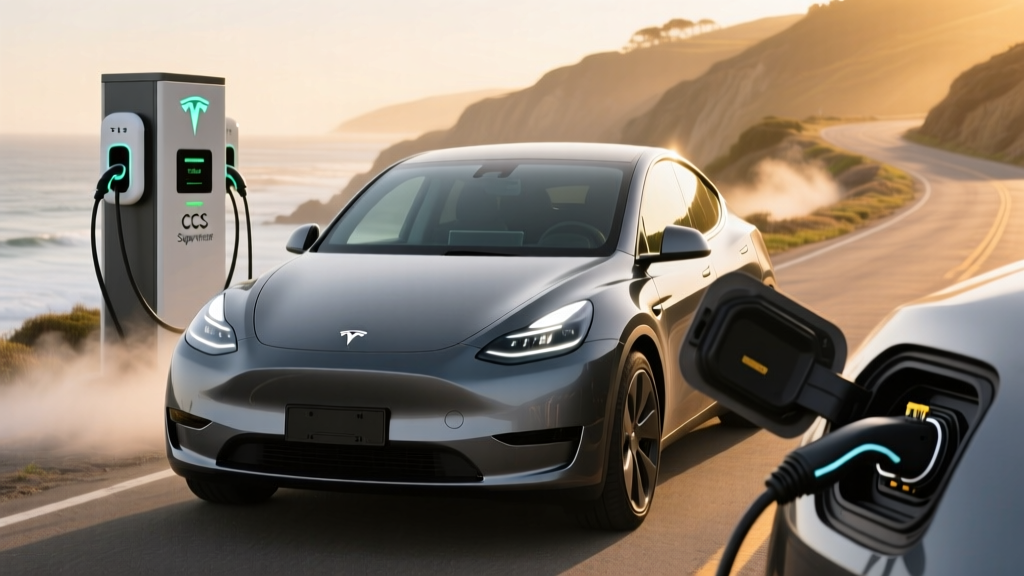
The NACS connector is now the North American standard, and Tesla's native compatibility means no adapter is needed at Superchargers. For CCS-equipped public chargers (Electrify America, EVgo, etc.), a NACS-to-CCS adapter is required, though availability of CCS stations continues to decline as networks convert to NACS.
Performance and Driving Dynamics
The dual-motor all-wheel-drive powertrain produces 384 horsepower and launches the Model Y Long Range to 60 mph in 4.8 seconds. That's quick by any measure and decisively quicker than most gas-powered midsize SUVs in this price bracket. Acceleration is linear and immediate, with the characteristic EV torque delivery that makes merging and passing effortless.
The Juniper suspension revisions have improved ride quality over pre-2025 models, with better damping over sharp impacts. That said, models equipped with the optional 20-inch wheels transmit more road imperfections into the cabin than the standard 19-inch setup. If ride comfort is a priority, stick with the 19-inch Gemini wheels — they also add roughly 10–15 miles of EPA range due to lower rolling resistance.
Steering is precise but light, and the low center of gravity (battery pack mounted under the floor) keeps body roll well-controlled through corners. The Model Y Long Range is not a sports SUV, but it handles with a composure that belies its 4,400-pound curb weight. One-pedal driving via regenerative braking is intuitive once acclimated, though Tesla's regen settings are less granular than competitors like Hyundai's paddle-adjustable system.
Interior, Cargo, and Technology
The 2026 Model Y's cabin carries forward the Juniper refresh's improvements: ventilated front seats, a power-folding second row, ambient lighting, and a rear 8-inch touchscreen for passengers. The 15.4-inch front touchscreen remains the command center for navigation, climate, media, and vehicle settings — there are no physical buttons or a traditional instrument cluster. This minimalism is either refreshing or frustrating depending on your preference; steering-wheel scroll buttons and voice commands handle most secondary functions.
Cargo space is a Model Y hallmark. With 30.2 cubic feet behind the second row and 72.0 cubic feet with the seats folded, it outpaces the Ford Mustang Mach-E (29.7 / 59.7 cu ft) and rivals many gas-powered compact SUVs. The front trunk (frunk) adds additional storage for charging cables or a small bag. The optional third row (available on specific trims) provides seating for up to seven, though the rearmost seats are best reserved for small children.
On the tech front, Tesla's infotainment software remains the most responsive and frequently updated in the industry, with over-the-air (OTA) updates adding features regularly. The built-in navigation with real-time Supercharger routing is genuinely best-in-class for road trip planning. Wireless Apple CarPlay and Android Auto are notably absent — Tesla uses its own interface exclusively, which is a dealbreaker for some buyers accustomed to phone projection.
Pricing, Trims, and Federal Tax Credit Eligibility
| Trim | Base MSRP | Est. After §30D Credit* | Destination |
|---|---|---|---|
| Model Y Long Range AWD | $44,990 | ~$37,490 | $1,390 |
| Model Y Long Range AWD (w/ 20" wheels) | $46,990 | ~$39,490 | $1,390 |
| Model Y Performance | $48,990 | ~$41,490 | $1,390 |
*Federal tax credit estimates assume buyer eligibility. Actual credit depends on IRS §30D requirements. See details below.
The 2026 Model Y Long Range starts at $44,990 before destination charges. Adding the $1,390 destination fee brings the out-the-door base to $46,380 before any incentives. The Performance trim, which drops 0–60 to 3.5 seconds and adds track-oriented hardware, starts at $48,990.
Federal Tax Credit (§30D): The Model Y currently qualifies for up to $7,500 under the IRS §30D clean vehicle credit, which can now be transferred to the dealer at point of sale as an upfront price reduction. However, eligibility is not automatic. Buyers must meet all of the following:
- Income caps: Modified adjusted gross income (MAGI) must not exceed $150,000 (single), $225,000 (head of household), or $300,000 (joint filers).
- MSRP cap: The vehicle's MSRP must not exceed $80,000 for SUVs — the Model Y clears this easily.
- Battery sourcing: A percentage of critical minerals and battery components must be sourced from the U.S. or free-trade-agreement countries. These thresholds increase annually. Tesla has largely localized its supply chain, but verify current-year eligibility on fueleconomy.gov before purchase.
- Point-of-sale transfer: Since 2024, buyers can transfer the credit to the dealer for an immediate price reduction rather than waiting to claim it on their tax return.
Always confirm eligibility with your tax professional and the IRS's official vehicle eligibility list before finalizing your purchase, as sourcing rules and credit availability can shift with regulatory updates.
Warranty and Long-Term Battery Outlook
Tesla covers the Model Y's battery pack and drive units for 8 years or 120,000 miles, whichever comes first, with a minimum 70% capacity retention guarantee during that period. The limited vehicle warranty is 4 years or 50,000 miles. These terms are competitive with the broader EV market, though some competitors like Hyundai offer longer bumper-to-bumper coverage.
Regarding battery longevity, the NMC (nickel manganese cobalt) chemistry in the Long Range variant offers a strong balance of energy density and cycle life. Real-world data from high-mileage Tesla owners and fleet analyses suggest typical degradation of 10–15% over the first 100,000 miles, with the curve flattening thereafter. Best practices for longevity include avoiding frequent 100% charges (daily charging to 80–90% is recommended by Tesla for NMC packs), minimizing DC fast charging when Level 2 is available, and using preconditioning in extreme temperatures.
If a battery replacement were ever needed out of warranty, current estimates from Tesla service centers place the cost between $12,000 and $16,000 for a Model Y pack — a significant expense, though one that very few owners encounter within the vehicle's practical lifespan.
Driver Assistance: Autopilot and FSD (Supervised)
Every Model Y comes with Tesla's Basic Autopilot, which includes adaptive cruise control, lane-centering, and automatic emergency braking. The optional Full Self-Driving (Supervised) package, currently priced at $8,000 (or $99/month), adds features like automatic lane changes, navigate-on-autopilot for highway interchanges, traffic light and stop sign recognition, and city street driving assistance.
In practice, Autopilot excels on well-marked highways and reduces fatigue on long trips. FSD's city-street capability has improved substantially through iterative neural-network updates, but it still requires attentive monitoring and occasional intervention. Buyers should evaluate FSD through the free trial before committing to the purchase, and should not factor it into their purchase decision as a substitute for attentive driving.
Pros and Cons
Pros
- 320-mile EPA range covers most daily and road-trip needs
- 250 kW DC fast charging with native NACS / Supercharger access
- Class-leading cargo volume (72.0 cu ft max)
- Best-in-class OTA software updates and navigation
- 4.8-second 0–60 with standard dual-motor AWD
- Heat pump standard for efficient cold-weather operation
- Strong resale value relative to EV segment average
Cons
- No wireless Apple CarPlay or Android Auto
- Minimalist interior lacks physical controls — polarizing
- Firm ride on 20-inch wheels
- FSD (Supervised) is expensive and still requires full driver attention
- No heads-up display
- Panel gaps and build consistency have improved but still trail legacy OEMs
- Rear visibility is limited; relies heavily on backup camera
Who Should Buy the 2026 Tesla Model Y Long Range?
- You want maximum Supercharger network access for road trips
- You need cargo space that rivals gas-powered compact SUVs
- You value OTA software updates and a tech-forward ownership experience
- You commute 30–60 miles daily and can charge at home
- You want AWD capability with sub-5-second acceleration
- You prefer physical buttons and traditional infotainment (look at the Hyundai Ioniq 5 or Kia EV6)
- You want a more comfortable, luxury-oriented ride (BMW iX, Genesis Electrified GV70)
- You need three rows with genuinely usable third-row space (Kia EV9)
- You want Apple CarPlay/Android Auto integration
The Model Y Long Range is the default midsize electric SUV for a reason: it does nearly everything well, and nothing else in its price range matches the combination of efficiency, charging speed, cargo space, and software sophistication. It's the EV equivalent of a Toyota RAV4 — not the most exciting choice, but the one that satisfies the widest range of needs. If the minimalist interior and Tesla-specific ecosystem work for you, the 2026 Model Y Long Range remains the segment benchmark.
Frequently Asked Questions
What is the real-world range of the 2026 Tesla Model Y Long Range?
Expect 270–300 miles on the highway, 290–315 miles in mixed driving, and 230–260 miles in sustained cold weather (below 30°F). The EPA rates it at 320 miles, but real-world conditions — especially speed, temperature, and terrain — consistently reduce that figure by 5–30%.
How fast does the Model Y Long Range charge at home and on the road?
On a 240V Level 2 home charger (48A), it charges at 11.5 kW, adding roughly 44 miles of range per hour — a full charge takes about 7–8 hours. On DC fast chargers, it peaks at 250 kW and charges from 10–80% in approximately 25 minutes under optimal conditions.
Does the 2026 Model Y qualify for the $7,500 federal EV tax credit?
It can, but eligibility depends on your income (MAGI caps apply), the vehicle's battery sourcing compliance with current-year IRS §30D rules, and the MSRP cap (which the Model Y clears). The credit can be transferred to the dealer at point of sale for an immediate price reduction. Confirm eligibility on fueleconomy.gov and with a tax professional before purchasing.
How much does the Model Y Long Range cost after incentives?
With the full $7,500 federal credit applied, the base Long Range AWD drops from $46,380 (MSRP + destination) to approximately $38,880. State and utility incentives may reduce the cost further — check your local programs via the AFDC state incentive database.
Is the Model Y Long Range worth buying over the Hyundai Ioniq 5 or Kia EV6?
The Model Y wins on cargo space, Supercharger access, software, and efficiency. The Ioniq 5 and EV6 offer faster peak charging on 800V architecture (up to 350 kW), physical controls, Apple CarPlay/Android Auto, and in some trims, vehicle-to-load (V2L) capability. Your decision likely hinges on whether Supercharger network access and Tesla's software ecosystem outweigh the rivals' interior refinement and charging architecture.
What is the battery warranty on the Model Y Long Range?
Tesla covers the battery and drive units for 8 years or 120,000 miles with a guaranteed minimum 70% capacity retention. The bumper-to-bumper limited warranty is 4 years or 50,000 miles.
Is Tesla's Full Self-Driving worth the $8,000 upgrade?
For most buyers, no — at least not yet. FSD (Supervised) is a Level 2 driver-assist system that still requires full attention and hands-on-wheel engagement. It's impressive on highways and improving in cities, but it does not replace the driver. Take the free trial before committing, and don't expect autonomous capability.