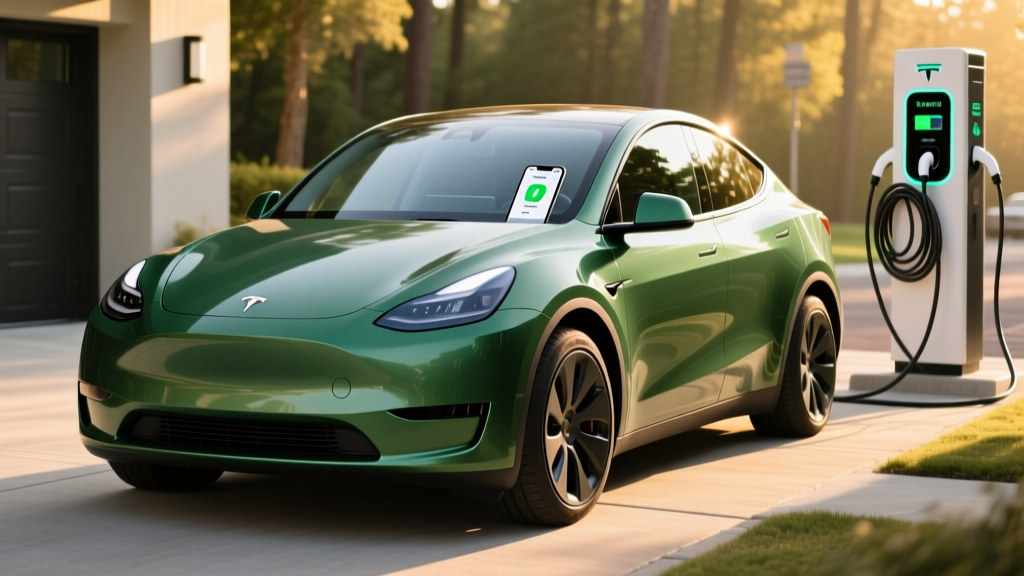
The Tesla Model Y received its first major refresh — internally codenamed "Juniper" — for the 2025 model year, and the 2026 version carries forward those changes with minor software and packaging tweaks. If you've been searching for Tesla Model Y Juniper updates to figure out whether the refreshed crossover is worth your money in 2026, this review breaks down every spec that matters: real-world range, charging speed, pricing after federal tax credits, and how it stacks up against the Hyundai Ioniq 5, Ford Mustang Mach-E, and Chevrolet Equinox EV.
The Juniper refresh brought a redesigned front fascia with a full-width light bar, ventilated front seats, a rear-seat touchscreen, ambient lighting, power-folding second-row seats, and acoustic glass across all trims. Under the skin, Tesla refined the heat-pump system and suspension tuning. The result is a quieter, more comfortable, and slightly more efficient Model Y — but the fundamental architecture (battery, motors, 400V charging) remains unchanged.
2026 Model Y Juniper: Full Spec Sheet
| Spec | Long Range RWD | Long Range AWD | Performance AWD |
|---|---|---|---|
| EPA Range | 320 mi | 308 mi | 285 mi |
| Battery (usable) | ~75 kWh (NMC) | ~75 kWh (NMC) | ~75 kWh (NMC) |
| Drivetrain | Rear-Wheel Drive | Dual-Motor AWD | Dual-Motor AWD |
| Horsepower | ~346 hp | ~384 hp | ~456 hp |
| 0–60 mph | 5.8 sec | 4.8 sec | 3.5 sec |
| Max DC Fast Charge | 250 kW | 250 kW | 250 kW |
| 10–80% DC Time | ~25 min | ~25 min | ~25 min |
| Level 2 Charge Rate | 11.5 kW (~44 mi/hr) | 11.5 kW (~44 mi/hr) | 11.5 kW (~44 mi/hr) |
| MPGe (combined) | 123 MPGe | 117 MPGe | 111 MPGe |
| Efficiency | 27 kWh/100 mi | 29 kWh/100 mi | 30 kWh/100 mi |
| Base MSRP | $44,990 | $47,990 | $52,490 |
Note: Tesla adjusts pricing and configurations frequently. Verify current trims on Tesla's configurator before purchasing.
Range & Efficiency: EPA vs. the Real World
EPA Sticker: 308 miles
Mixed real-world (city/suburban): ~280–300 miles
Sustained highway (75 mph): ~250–270 miles
Cold weather (below 32°F, highway): ~200–230 miles
The Long Range RWD trim leads the lineup at an EPA-estimated 320 miles, but the Long Range AWD — the volume seller — comes in at 308 miles. According to fueleconomy.gov, the Long Range AWD achieves 117 MPGe combined (29 kWh/100 mi).
In practice, the Juniper's improved heat pump helps mitigate cold-weather range loss compared to the pre-refresh Model Y, but physics still governs: expect 20–30% range reduction in sustained sub-freezing highway driving. Tesla's cabin preconditioning and battery warming (activated automatically when navigating to a Supercharger) remain among the best in the industry for preserving charge speed in cold weather.
The ~75 kWh usable NMC (nickel manganese cobalt) battery pack prioritizes energy density over cycle life. If you plan to keep the vehicle beyond 150,000 miles and want maximum longevity, note that Tesla does not currently offer an LFP (lithium iron phosphate) option in the Model Y — unlike the Model 3 RWD.
Charging Speed: DC Fast, Level 2, and the Curve Reality
| Charging Level | Power (kW) | Speed (miles of range added) | Notes |
|---|---|---|---|
| Level 1 (120V household) | ~1.4 kW | ~3–5 mi/hr | Emergency/top-off only |
| Level 2 (240V, 48A home) | 11.5 kW | ~44 mi/hr | Full charge in ~7 hours |
| DC Fast (Tesla Supercharger V3) | Peak 250 kW | ~200 mi in 15 min | 10–80% in ~25 min |
| DC Fast (CCS adapter, non-Tesla) | Peak 250 kW | Varies by network | Adapter included on 2025+ models |
The Model Y remains on a 400-volt architecture, which limits peak DC charging to 250 kW. That's a meaningful gap versus 800V competitors like the Hyundai Ioniq 5 (which peaks at ~240 kW but sustains higher power longer thanks to its architecture). On a Tesla V3 Supercharger, the Model Y will hit 250 kW briefly between roughly 15–35% state of charge, then taper progressively. Expect the 10–80% session to take approximately 25 minutes in warm conditions — closer to 30–35 minutes in cold weather even with preconditioning.
For home charging, the onboard 11.5 kW charger fills the ~75 kWh battery from empty in roughly 7 hours on a 48-amp Level 2 circuit (requiring a 60-amp breaker). Most owners charging overnight from 20–80% will see a full replenish in 4–5 hours. Installation costs for a home Level 2 setup typically range from $800 to $2,500 depending on panel capacity and run length — consult a licensed electrician for your specific situation.
The Juniper Model Y ships with a NACS (North American Charging Standard) port natively, giving it first-party access to the entire Tesla Supercharger network — now exceeding 25,000 stalls in North America. A CCS1 adapter is included for use with Electrify America, EVgo, and other non-Tesla networks.
Performance, Ride, and What Juniper Changed
The Performance trim's 3.5-second 0–60 mph time remains blistering for a family crossover, and even the Long Range RWD at 5.8 seconds outpaces most gas-powered competitors in its class. Tesla's dual-motor AWD system provides confident all-weather traction, and the low center of gravity (battery pack under the floor) keeps body roll well-controlled in corners.
What the Juniper refresh actually changed on the road:
- Acoustic glass on all windows reduces wind and road noise noticeably at highway speeds
- Retuned suspension softens the ride over sharp impacts — a frequent complaint on pre-2025 Model Ys
- Ventilated front seats (a first for Model Y) improve comfort on hot days
- Power-folding second row adds convenience for cargo loading
- Rear 8-inch touchscreen gives rear passengers climate and media control
The result is a Model Y that finally feels competitive with the Hyundai Ioniq 5 and Kia EV6 on refinement, not just efficiency and charging infrastructure.
Pricing, Trims, and Federal Tax Credit Eligibility
| Trim | Base MSRP | Est. After §30D Credit* | Eligible? |
|---|---|---|---|
| Long Range RWD | $44,990 | ~$37,490 | Yes (if sourcing rules met) |
| Long Range AWD | $47,990 | ~$40,490 | Yes (if sourcing rules met) |
| Performance AWD | $52,490 | ~$44,990 | Yes (under $80K SUV cap) |
*Estimated prices assume full $7,500 federal tax credit under IRS §30D. Eligibility depends on multiple factors — see checklist below.
- Vehicle MSRP cap: SUVs must be under $80,000 — all Model Y trims qualify
- Buyer income cap: AGI ≤ $150,000 (single), $225,000 (head of household), $300,000 (joint)
- Battery sourcing: Must meet critical-minerals and battery-component requirements (phased thresholds increase annually through 2029)
- FEOC restriction: Battery components cannot be sourced from a "foreign entity of concern" (primarily targeting Chinese supply chains)
- Point-of-sale transfer: As of 2024, the credit can be transferred to the dealer at purchase for an immediate price reduction — no need to wait for tax filing
- Assembly: Vehicle must undergo final assembly in North America (Model Y is built in Fremont, CA and Austin, TX)
Rules change frequently. Verify current eligibility at irs.gov and consult a tax professional before purchasing.
All Model Y trims fall well under the $80,000 SUV MSRP cap. The primary risk to credit eligibility in 2026 is battery-sourcing compliance — Tesla has been actively reshoring its supply chain, but the critical-minerals and FEOC thresholds tighten each year. Check the DOE's eligible vehicle list before committing.
Cargo Space, Interior, and Daily Practicality
The Model Y's crossover shape gives it a decisive cargo advantage over the Model 3 sedan:
- Cargo (rear seats up): 30.2 cu ft
- Cargo (rear seats folded): 72.1 cu ft
- Frunk (front trunk): 4.1 cu ft
- Rear legroom: 41.6 inches
- Front headroom: 41.0 inches
The Juniper's power-folding second row makes cargo loading easier, and the rear touchscreen keeps passengers entertained on long trips. However, the panoramic glass roof — while visually striking — has no shade, and cabin temperatures can spike in direct summer sun. Many owners add an aftermarket roof shade.
The 15.4-inch center touchscreen handles all vehicle functions, navigation, media, and climate. There are no physical buttons or stalks — turn signals are on the steering wheel, and gear selection is via the screen or a capacitive strip on the console. This minimalist approach divides buyers: some love it, others find it distracting while driving.
Driver Assistance: Autopilot, FSD, and SAE Level Reality
Tesla Autopilot and FSD (Supervised) are SAE Level 2 driver-assistance systems. They provide steering, acceleration, and braking assistance but require the driver to remain fully attentive with hands on the wheel and eyes on the road at all times. These are NOT self-driving systems. Only Level 4 services like Waymo operate without a human driver — and those are limited to specific geofenced areas.
Every Model Y includes Basic Autopilot (adaptive cruise control + lane centering) at no extra cost. The Enhanced Autopilot package ($6,000) adds automatic lane changes, Navigate on Autopilot, and Smart Summon. Full Self-Driving (Supervised) ($8,000 or $99/month subscription) adds traffic-light and stop-sign recognition, and city-street autosteer.
FSD (Supervised) continues to improve through over-the-air updates, and Tesla's vision-only approach (no lidar or radar) has shown meaningful progress in 2025–2026. However, NHTSA continues to scrutinize Tesla's Autopilot/FSD engagement and crash data. Treat these systems as convenience features that reduce fatigue — not as replacements for an attentive driver.
Warranty and Long-Term Ownership
| Component | Coverage |
|---|---|
| Basic Vehicle | 4 years / 50,000 miles |
| Battery & Drive Unit | 8 years / 120,000 miles (Long Range) 8 years / 120,000 miles (Performance) |
| Battery Capacity Retention | Minimum 70% over warranty period |
Tesla's 8-year/120,000-mile battery warranty guarantees at least 70% capacity retention. If the battery degrades below that threshold within the warranty window, Tesla will repair or replace it. In practice, NMC batteries in Tesla vehicles have shown strong longevity — most owners report 5–8% degradation over the first 100,000 miles based on fleet data, though individual results vary based on charging habits (frequent DC fast charging and regularly charging to 100% accelerate wear).
For maximum battery longevity, Tesla recommends daily charging to 80–90% and reserving 100% charges for road trips. The vehicle's battery management system includes a substantial top and bottom buffer, meaning the usable ~75 kWh is actually drawn from a physically larger pack — this buffer management is a key reason Tesla batteries age well.
Who the 2026 Model Y Juniper Is For
Choose the Model Y if:
- You want access to the most reliable and extensive DC fast-charging network (Tesla Superchargers)
- You need crossover cargo space with sedan-like efficiency
- You value OTA software updates and a tech-forward cabin
- You live in a region with harsh winters and want excellent AWD traction with a heat pump
Look elsewhere if:
- You want 800V charging architecture for faster sustained DC speeds (see Ioniq 5, EV6)
- You prefer physical buttons, knobs, and a traditional instrument cluster
- You want an LFP battery for maximum cycle life and 100% daily charging tolerance (see Model 3 RWD)
- You need three-row seating or more than 72 cu ft of cargo space
Pros and Cons at a Glance
- Class-leading Supercharger network access
- Excellent efficiency (27–30 kWh/100 mi)
- Juniper ride and noise improvements
- Spacious cargo area with frunk
- Strong performance across all trims
- Over-the-air updates keep features current
- Eligible for full $7,500 federal credit (sourcing dependent)
- 400V architecture limits sustained DC charge speed
- No physical buttons — all controls via touchscreen
- Glass roof lacks shade; hot cabin in summer sun
- NMC battery not ideal for daily 100% charging
- FSD costs extra and remains Level 2 (not autonomous)
- Insurance costs above segment average
- Minimal annual styling differentiation
2026 Tesla Model Y Juniper — FAQ
What is the real-world range of the 2026 Tesla Model Y?
The Long Range AWD (the most popular trim) carries an EPA estimate of 308 miles. In mixed real-world driving, expect 280–300 miles. Sustained highway driving at 75 mph drops that to roughly 250–270 miles, and cold-weather highway driving below freezing can reduce range to 200–230 miles.
How fast does the Model Y Juniper charge?
On a Tesla V3 Supercharger, it peaks at 250 kW and charges from 10–80% in approximately 25 minutes in warm conditions. At home on a 48-amp Level 2 charger (11.5 kW), it adds about 44 miles of range per hour, fully replenishing in roughly 7 hours.
How much does the 2026 Model Y cost after tax credits?
The Long Range RWD starts at $44,990 and could drop to approximately $37,490 with the full $7,500 federal §30D credit applied at point of sale — assuming you meet income limits and the vehicle meets current battery-sourcing requirements. Verify eligibility at irs.gov before purchasing.
Is the Model Y Juniper worth buying vs. the Ioniq 5 or Mach-E?
The Model Y wins on charging infrastructure access, efficiency, and cargo space. The Hyundai Ioniq 5 offers faster sustained DC charging (800V architecture), a more distinctive design, and physical controls. The Ford Mustang Mach-E provides a more traditional driving feel and BlueCruise hands-free driving on mapped highways. Your choice should hinge on which charging network you'll use most and whether you prefer a minimalist or traditional interior.
Does the 2026 Model Y qualify for the federal EV tax credit?
All trims fall under the $80,000 SUV MSRP cap and are assembled in North America. Eligibility for the full $7,500 credit depends on your adjusted gross income (≤$300K joint, ≤$150K single) and whether the battery meets 2026 critical-minerals and FEOC sourcing thresholds. Check the DOE's eligible vehicle list and consult a tax professional.
What are the biggest changes in the Juniper refresh?
The Juniper update added a full-width front light bar, acoustic glass, ventilated front seats, a rear passenger touchscreen, power-folding second-row seats, ambient interior lighting, retuned suspension for a softer ride, and an improved heat pump. The battery, motors, and 400V charging architecture are unchanged.