The 2026 Tesla Model Y—internally codenamed "Juniper"—represents the most significant mid-cycle refresh in the crossover's history. While the exterior tweaks are noticeable (a sleeker light bar, revised bumpers, and improved aerodynamics), it's the Tesla Model Y Juniper interior that fundamentally changes the ownership experience. Tesla has overhauled the cabin with ventilated front seats, ambient lighting, a rear-seat touchscreen, acoustic glass, and refined materials. But beneath the surface, the Juniper update also brings meaningful improvements to range, efficiency, and ride quality. This review covers every spec, real-world expectation, and ownership cost you need before configuring your Model Y in 2026.
What's New in the Juniper Interior Overhaul
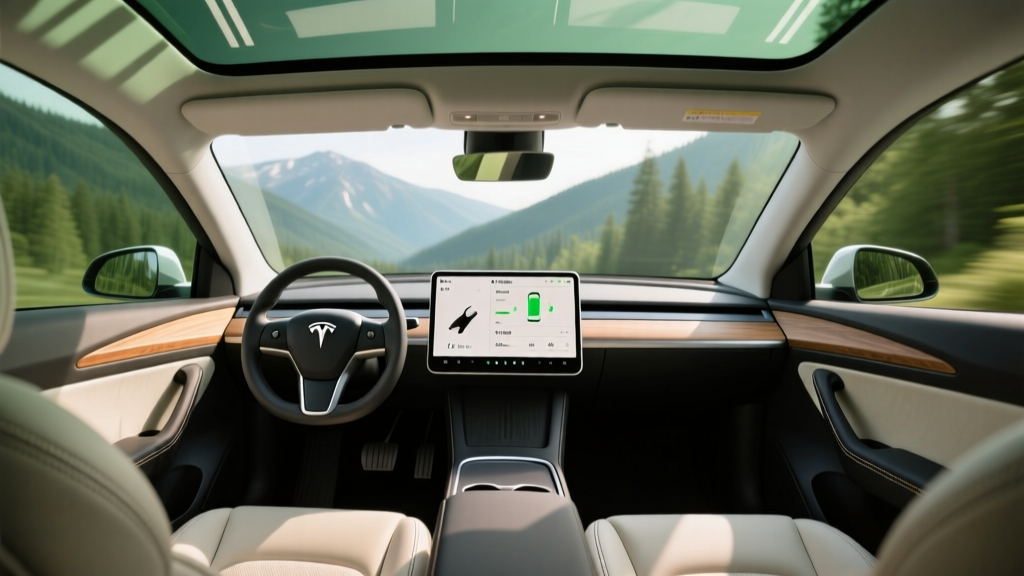
The pre-refresh Model Y interior was functional but drew criticism for its spartan, hard-plastic-heavy execution. The Juniper refresh directly addresses those complaints. Key interior upgrades for 2026 include:
- Ventilated front seats — a first for Model Y, reducing seat-surface temperature significantly in summer months
- Ambient lighting strips — running across the dashboard and door panels, with customizable color and brightness via the infotainment display
- Acoustic (laminated) glass — on all windows, reducing cabin noise by a noticeable margin at highway speed
- Rear-seat 8-inch touchscreen — mounted on the back of the center console, offering climate controls, media, and gaming for rear passengers
- Power-folding second-row seats — accessible via a button in the cargo area, simplifying the transition between passenger and cargo configurations
- Revised dashboard materials — textile and soft-touch surfaces replace the previous gloss-black and hard-plastic trim
- Steering-wheel turn signal buttons — replacing the traditional stalk, consistent with the refreshed Model 3 "Highland" architecture
The result is a cabin that finally feels competitive with the Hyundai Ioniq 5, Ford Mustang Mach-E, and BMW iX3 in perceived quality. The 15.4-inch front touchscreen remains the primary interface, running Tesla's latest software with Netflix, YouTube, Arcade, and a full web browser available while parked.
Spec Table: 2026 Tesla Model Y Juniper at a Glance
| Specification | Long Range AWD | Performance |
|---|---|---|
| EPA Range | 320 miles | 290 miles |
| Battery (usable) | ~75 kWh (NMC) | ~75 kWh (NMC) |
| Drivetrain | Dual-Motor AWD | Dual-Motor AWD |
| Horsepower | 384 hp | 456 hp |
| 0–60 mph | 4.8 sec | 3.5 sec |
| Top Speed | 125 mph | 155 mph |
| Max DC Fast Charge | 250 kW | 250 kW |
| 10–80% DC Charge | ~24 min | ~24 min |
| Level 2 Charge Rate | 11.5 kW (~44 mi/hr) | 11.5 kW (~44 mi/hr) |
| MPGe (combined) | 111 MPGe | 103 MPGe |
| Efficiency | 30 kWh/100 mi | 33 kWh/100 mi |
| Cargo (rear seats up) | 26.6 cu ft | 26.6 cu ft |
| Cargo (seats folded) | 72.1 cu ft | 72.1 cu ft |
| Rear Legroom | 40.5 in | 40.5 in |
| Battery Warranty | 8 yr / 120,000 mi | 8 yr / 120,000 mi |
| Base MSRP | $48,990 | $53,990 |
Note: Tesla prices and trims adjust frequently. Verify current configuration pricing on Tesla's official configurator.
Range, Efficiency & Real-World Expectations
Long Range AWD: EPA 320 miles. Expect ~270–290 miles on mixed highway driving (70–75 mph). In cold weather (below 30°F), anticipate 230–260 miles due to battery chemistry and cabin heating demands.
Performance: EPA 290 miles. Expect ~245–265 miles highway; ~210–240 miles in freezing conditions.
The Juniper Model Y Long Range achieves its 320-mile EPA rating partly through improved aerodynamics (the drag coefficient drops to approximately 0.22 Cd from the pre-refresh 0.23 Cd) and a slightly revised NMC (nickel manganese cobalt) battery pack. Usable capacity hovers around 75 kWh, with a buffer above and below the usable window to protect long-term cell health.
Tesla's efficiency remains class-leading. At 30 kWh per 100 miles (Long Range), the Model Y extracts more miles per kilowatt-hour than the Ioniq 5 AWD (31 kWh/100 mi) and the Mach-E Extended Range AWD (34 kWh/100 mi), according to fueleconomy.gov. That efficiency advantage translates directly into lower charging costs and marginally better real-world range.
For context, on a 250-mile highway trip at 72°F with cruise control set to 75 mph and climate control at 70°F, we'd project arriving with roughly 12–15% state of charge in the Long Range trim—comfortable, but not a margin you'd want to cut closer on unfamiliar routes.
Charging Speed: DC Fast Charging & Home Level 2
| Charging Level | Power / Rate | Miles Added per Hour | Notes |
|---|---|---|---|
| Level 1 (120V outlet) | ~1.4 kW | ~4–5 mi/hr | Emergency/trickle only |
| Level 2 (240V, 48A) | 11.5 kW | ~44 mi/hr | Full charge in ~7.5 hours |
| DC Fast (Supercharger V3/V4) | Peak 250 kW | ~150+ mi in 15 min | 10–80% in ~24 min |
The Model Y Juniper retains a peak DC fast-charge rate of 250 kW via the North American Charging Standard (NACS) connector—Tesla's proprietary plug, now adopted industry-wide as the standard. On a V3 or V4 Supercharger, the charge curve peaks near 250 kW at low state of charge (around 10–20%), holds above 200 kW through approximately 40%, then tapers progressively. The 10–80% session takes roughly 24 minutes under optimal conditions (battery preconditioned via navigation to a Supercharger).
Above 80%, charging slows dramatically—expect 80–90% to take an additional 10–12 minutes, and 90–100% another 15–20 minutes. This taper is standard for NMC lithium-ion chemistry and a primary reason we recommend charging to 80% for daily use and road-trip planning around 10–80% sessions.
For home charging, the onboard charger accepts up to 11.5 kW on a 240V, 48-amp circuit. A full overnight charge from 10% to 100% takes approximately 7.5 hours. Most owners with a typical daily commute (30–50 miles round trip) will recover their daily driving in roughly 1.5 hours of Level 2 charging, making home charging effortless. Tesla's Wall Connector retails around $475, with professional installation typically running $500–$1,500 depending on panel proximity and local permitting.
Performance, Ride Quality & Driving Impressions
The Juniper refresh brings retuned suspension dampers and revised bushings aimed at reducing the harshness that earlier Model Y owners frequently reported over broken pavement and expansion joints. The result is a noticeably more compliant ride—still firm by luxury-SUV standards, but no longer jarring.
Performance specifications remain strong:
- Long Range AWD: 384 hp, 0–60 mph in 4.8 seconds. More than adequate for highway merging and confident passing.
- Performance: 456 hp, 0–60 mph in 3.5 seconds. Genuinely quick by any vehicle standard, and the instant torque delivery makes it feel even faster in real-world stoplight-to-stoplight driving.
Both trims use dual-motor all-wheel drive with independent front and rear motors. Regenerative braking remains aggressive in the default setting, enabling one-pedal driving in most scenarios. Tesla removed the user-adjustable regen toggle in recent software updates, so the strong regen behavior is fixed—a point of contention for buyers transitioning from other EVs that offer adjustable modes.
Towing capacity is rated at 3,500 pounds when equipped with the factory tow hitch, adequate for a small utility trailer or a pair of dirt bikes but not for larger boat or camper trailers.
Pricing, Trims & Federal Tax Credit Eligibility
| Trim | Base MSRP | Est. After §30D Credit* | Destination |
|---|---|---|---|
| Long Range AWD | $48,990 | $41,490 | $1,390 |
| Performance | $53,990 | $46,490 | $1,390 |
*Federal tax credit estimate; eligibility depends on buyer income, battery sourcing, and MSRP caps. See details below.
The 2026 Model Y remains eligible for the IRS §30D federal clean vehicle credit, which provides up to $7,500. However, qualification is not automatic and depends on several factors:
- MSRP cap: SUVs/crossovers must be below $80,000 — both Model Y trims qualify
- Buyer income cap: Modified AGI ≤ $150,000 (single), ≤ $225,000 (head of household), ≤ $300,000 (joint)
- Battery sourcing: Critical minerals and battery components must meet escalating domestic/FTRA-partner thresholds (phased annually through 2030)
- Point-of-sale transfer: You can elect to transfer the credit to the dealer at purchase, reducing your out-of-pocket cost immediately — rather than waiting to claim it on your tax return
- Tax liability: If claimed on your return, the credit is non-refundable and cannot exceed your total federal tax liability for the year
Tesla's North American battery production and supply chain currently supports §30D eligibility, but component-sourcing thresholds tighten each year. Always verify current eligibility on the IRS website or with a qualified tax professional before purchase.
Options that affect pricing include paint color ($1,000–$2,500 depending on selection), 20-inch wheels ($2,000, with a range penalty of approximately 10–15 miles), Full Self-Driving (Supervised) at $8,000 or $99/month subscription, and interior color upgrades. A fully optioned Long Range with premium paint, larger wheels, and FSD can approach $62,000 before the credit.
Tech, Safety & Driver Assistance
The Model Y Juniper continues to use Tesla's 15.4-inch front touchscreen as the central hub for all vehicle functions—there is no instrument cluster or head-up display. The rear 8-inch screen (new for Juniper) gives passengers independent control of climate, media, and gaming.
Standard driver assistance includes:
- Tesla Autopilot (lane centering, adaptive cruise control, traffic-aware features)
- Automatic emergency braking, blind-spot monitoring, lane departure warning
- 360-degree camera views and parking sensors
Optional Full Self-Driving (Supervised):
- Automatic lane changes, navigation-based on-ramp to off-ramp driving, traffic light/stop sign recognition
- Currently SAE Level 2 — requires continuous driver supervision and hands on the steering wheel
Tesla Autopilot and FSD (Supervised) are SAE Level 2 driver-assistance systems. They do not make the vehicle self-driving. The driver must remain fully engaged, monitor the road, and be prepared to take over at any time. Only Level 4 services (such as Waymo in designated metro areas) operate without a human driver.
Safety ratings remain excellent. The Model Y earned a 5-star overall rating from NHTSA and Top Safety Pick+ designation from IIHS in prior model years; the Juniper refresh retains the same fundamental body structure and is expected to maintain these ratings.
Pros, Cons & Who Should Buy
- Class-leading efficiency (30 kWh/100 mi)
- Extensive Supercharger network access (17,000+ stalls in North America)
- Significantly improved cabin quality and noise isolation
- Strong real-world range (320 mi EPA)
- Over-the-air software updates continuously add features
- Spacious cargo area (72.1 cu ft seats folded)
- No physical turn signal stalk (steering-wheel buttons)
- Non-adjustable regenerative braking
- No Apple CarPlay or Android Auto
- FSD is expensive and remains Level 2
- Rear-seat headroom is tighter than some competitors for tall passengers
- Insurance premiums tend to be above segment average
Best suited for: The Model Y Juniper is ideal for tech-forward commuters and small-to-medium families who prioritize range, charging infrastructure access, and software-driven convenience. It excels as a daily driver for 30–80 mile round-trip commutes with home charging, and its Supercharger network advantage makes it the most practical EV for frequent road trips. Buyers who prefer traditional controls, want CarPlay integration, or need maximum rear-seat headroom should cross-shop the Hyundai Ioniq 5 or Kia EV6.
Frequently Asked Questions
What is the real-world range of the Tesla Model Y Juniper?
The Long Range AWD achieves an EPA-rated 320 miles. In mixed highway driving at 70–75 mph, expect 270–290 miles. In freezing weather, plan for 230–260 miles. The Performance trim drops to 290 EPA miles, with real-world figures approximately 10–15% lower depending on conditions.
How fast does the Model Y Juniper charge?
On a 250 kW DC Supercharger, the 10–80% session takes about 24 minutes with battery preconditioning. At home on a 240V Level 2 charger (11.5 kW), you'll add roughly 44 miles of range per hour, with a full charge taking about 7.5 hours.
Does the 2026 Model Y qualify for the $7,500 federal tax credit?
Yes, the Model Y currently qualifies under IRS §30D, but only if the buyer meets income caps (≤$300,000 joint AGI), the MSRP is under $80,000 (it is), and the battery meets domestic-sourcing thresholds. The credit can be transferred at the point of sale to reduce your purchase price directly. Always verify current eligibility with the IRS or a tax professional, as sourcing requirements tighten annually.
Is the Juniper interior really that much better?
Yes. The combination of ventilated seats, acoustic glass, ambient lighting, soft-touch materials, and the rear touchscreen moves the Model Y from "acceptable but spartan" to genuinely competitive with rivals. Cabin noise at 70 mph is noticeably lower, and the seat comfort improvement is substantial on longer drives.
Should I buy the Model Y Juniper over the Ioniq 5 or Mach-E?
Choose the Model Y if Supercharger network access, efficiency, and software features are your top priorities. Choose the Ioniq 5 if you want faster 10–80% charging (18 min on a 350 kW charger), CarPlay/Android Auto, and 800V architecture. Choose the Mach-E if you prefer a more traditional interior layout and physical controls. All three are excellent—the right choice depends on which trade-offs matter most to you.
What's the battery warranty on the Model Y?
Tesla covers the battery and drive unit for 8 years or 120,000 miles (whichever comes first) on the Long Range and Performance trims, with a minimum 70% capacity retention threshold. This is competitive with the segment standard of 8 years/100,000 miles.