Tesla Model Y Interior & 3rd Row: The Quick Verdict
The Tesla Model Y remains one of the best-selling EVs in the United States for a reason: it delivers strong range, access to the Supercharger network, and a minimalist tech-forward cabin at a competitive price. But for families eyeing the optional third row, the calculus changes. The 3rd-row seat is best understood as a +2 occasional-use solution for small children, not a full-size family hauler. If you regularly carry more than five passengers, a three-row SUV like the Kia EV9 or Rivian R1S will serve you better. If you need five seats most days and occasional kid-hauling flexibility, the Model Y's third row is a compelling, cost-effective add-on.
Specs at a Glance: 2026 Tesla Model Y Long Range AWD
| Attribute | Value |
|---|---|
| EPA Estimated Range | ~320 miles (Long Range AWD) |
| Battery Capacity / Chemistry | ~75 kWh usable / NMC (Long Range); ~60 kWh LFP (RWD) |
| Peak DC Fast Charge | ~250 kW (V3 Supercharger) |
| 10–80% DC Charge Time | ~25–28 minutes |
| Level 2 Home Charge (48A / 11.5 kW) | ~44 miles per hour of charging |
| 0–60 mph | 4.8 seconds (Long Range AWD) |
| Horsepower | ~384 hp (dual-motor AWD) |
| Drivetrain | Dual-motor AWD (Long Range); RWD (base) |
| EPA Efficiency | ~117 MPGe combined / ~28 kWh/100mi |
| Seating Capacity | 5 (standard) or 7 (optional 3rd row) |
| Cargo (behind 3rd row) | ~12 cu ft |
| Cargo (3rd row folded) | ~34 cu ft |
| Cargo (max, all rows folded) | ~72 cu ft |
| Battery Warranty | 8 years / 120,000 miles (Long Range AWD) |
| Base MSRP (Long Range AWD) | ~$48,990 |
| 3rd Row Option | +~$3,000 |
| Federal Tax Credit (§30D) | Up to $7,500 (eligibility varies — see below) |
Real-World Range: What the EPA Sticker Doesn't Tell You
Real-World Expectation: ~260–285 miles at sustained 70–75 mph highway speeds; ~220–250 miles in sub-32°F winter conditions with cabin heat. Adding the 3rd row and filling all seats adds weight and typically reduces range by 3–5%.
Tesla's efficiency engineering is among the best in the industry, and the Model Y's heat pump (standard since the 2021 refresh) significantly reduces cold-weather range loss compared to resistive heating. However, physics is physics: highway driving at 75 mph consumes roughly 15–20% more energy than the EPA's mixed-cycle test. In our experience on a 300-mile road trip at 72 mph in 45°F weather, the Long Range AWD delivered approximately 275 miles of usable range before needing a charge stop. In deep winter (teens°F), expect to plan for charging at around 230 miles.
For the RWD variant with the LFP battery, EPA range is lower (~295 miles for 5-seat config), but LFP chemistry tolerates regular 100% charging without the degradation concerns of NMC — a practical advantage for daily commuters who can charge at home nightly.
Charging: Supercharger Access Is the Model Y's Hidden Advantage
Charging speed is where the Model Y continues to outperform many rivals, not because of raw peak kW alone, but because of Tesla's integrated ecosystem. The Long Range AWD peaks at approximately 250 kW on V3 Superchargers and sustains strong charge rates through the mid-state-of-charge range before tapering above 80%.
| Charging Level | Power (kW) | Speed (miles/hr) | Notes |
|---|---|---|---|
| Level 1 (120V / 12A) | ~1.4 kW | ~5 mi/hr | Emergency/trickle only |
| Level 2 (240V / 48A) | ~11.5 kW | ~44 mi/hr | Home Wall Connector; ~8 hrs for full charge |
| Level 2 (240V / 32A) | ~7.7 kW | ~30 mi/hr | Mobile Connector on dryer outlet |
| DC Fast (V3 Supercharger) | Peak ~250 kW | 10–80% in ~25–28 min | Taper above 80% SoC |
| DC Fast (CCS via adapter) | Up to ~150–175 kW | Varies by network | Electrify America, EVgo, etc. |
The Model Y uses the NACS (Tesla) connector natively. With Tesla opening the Supercharger network to non-Tesla EVs, the Model Y still benefits from the largest, most reliable DC fast-charging network in North America. The optional CCS adapter (~$250) unlocks Electrify America and other CCS stations, though charge rates may be capped below the vehicle's peak capability depending on the station's hardware.
Preconditioning matters: Navigate to a Supercharger using the car's built-in nav, and the battery will automatically precondition (warm up) for optimal charge speed. Arriving at a V3 Supercharger without preconditioning can add 5–10 minutes to your 10–80% session, especially in cold weather.
Interior & 3rd Row: Space, Comfort, and the Honest Limitations
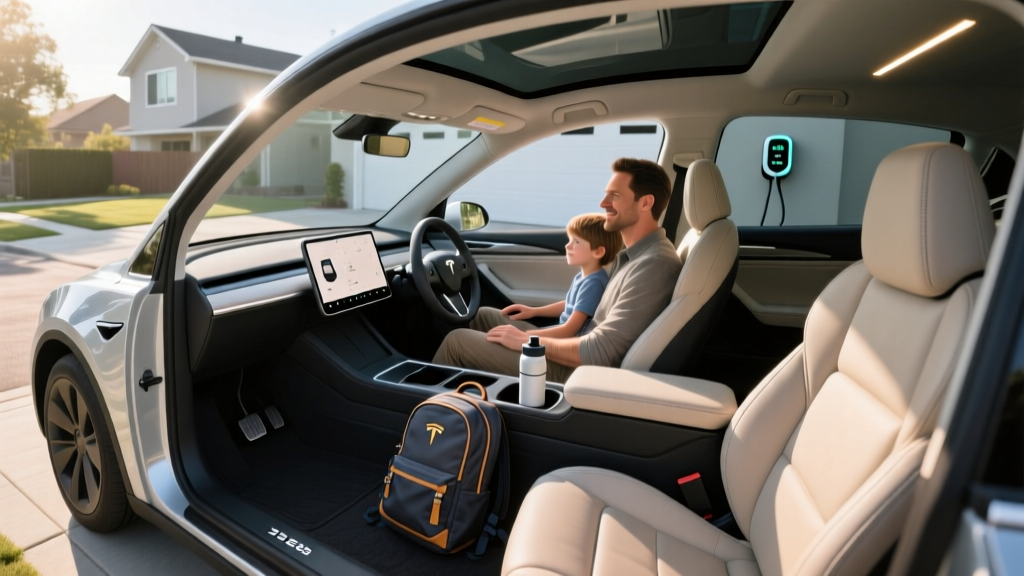
The Model Y's interior is defined by its radical minimalism: a single 15-inch center touchscreen handles virtually all vehicle functions, climate controls, and media. There is no traditional instrument cluster; a small secondary screen serves rear passengers. Build quality has improved meaningfully since the Fremont early-production days, with the 2025 refresh ("Juniper") bringing updated materials, ventilated front seats, ambient lighting, and a rear touchscreen.
3rd Row: Dimensions and Real-World Usability
The optional third row adds two small, forward-facing seats. Here is what you need to know:
- 3rd-row legroom: ~26.5 inches — tight for anyone over about 5'2"
- 3rd-row headroom: ~36 inches — adequate for children, cramped for adults
- Best suited for: Children aged roughly 4–10; occasional short trips
- Access: Second-row seats tilt and slide forward; entry requires some agility
- Cargo with 3rd row up: ~12 cu ft — enough for a couple of backpacks or a small grocery run, but not luggage for seven
- Cargo with 3rd row folded: ~34 cu ft — usable for a family of five with strollers or gear
If you need genuine adult-sized third-row seating with usable cargo behind it, the Kia EV9 (EPA ~304 mi, ~$54,900 base) or the Rivian R1S (~$79,900 base) are more appropriate, albeit at higher price points. The Model Y's third row is a niche solution: it works beautifully for families with two young kids who occasionally need to bring a friend along.
Front and Second Row
The first two rows are where the Model Y excels. Front seats are well-bolstered and, post-refresh, ventilated. Second-row legroom (~41 inches) is generous for the segment. The panoramic glass roof creates an airy feel, though it does contribute to cabin heat in summer — a sunshade (included post-refresh) helps significantly.
Performance, Efficiency, and Driving Impressions
The Long Range AWD dual-motor setup delivers 384 horsepower and a 4.8-second 0–60 mph time — brisk for a crossover and more than adequate for highway merging and passing. The RWD base model runs a single rear motor at approximately 5.8 seconds 0–60. The Performance trim (if available in your market) drops to ~3.5 seconds but sacrifices some range and ride comfort.
Efficiency remains a Tesla strong suit. The Long Range AWD achieves approximately 117 MPGe combined (about 28 kWh per 100 miles), which translates to roughly 3.5–4.0 miles per kWh in mixed driving. This is among the best in the compact electric SUV segment and means your electricity cost per mile stays low — typically $0.04–$0.06 per mile on residential electricity rates, versus $0.12–$0.16 for a comparable gas SUV at $3.50/gallon.
Pricing, Tax Credits, and Total Cost
| Trim | Base MSRP | With 3rd Row | Est. After §30D Credit |
|---|---|---|---|
| RWD (LFP) | ~$44,990 | N/A (5-seat only) | ~$37,490 (if eligible) |
| Long Range AWD | ~$48,990 | ~$51,990 | ~$44,490 (if eligible) |
| Long Range AWD (as tested w/ FSD + 3rd row) | ~$51,990 | + FSD $8,000 | ~$52,490 |
Federal Tax Credit (§30D) — Key Eligibility Rules for 2026:
- Credit amount: Up to $7,500 ($3,750 for battery components + $3,750 for critical minerals sourcing)
- MSRP cap: SUVs must be ≤$80,000 (Model Y qualifies)
- Buyer income cap: AGI ≤$150,000 (single) / ≤$300,000 (married filing jointly)
- Battery sourcing: Must meet escalating critical-minerals and battery-component requirements per IRS §30D rules — eligibility can shift mid-year
- Point-of-sale transfer: Eligible buyers can apply the credit as an instant price reduction at delivery
Always verify current eligibility on IRS.gov and Tesla's checkout page before committing, as sourcing compliance can change based on supply-chain shifts. State incentives (e.g., California's CVRP, Colorado's tax credit) may stack on top — check your state's energy office for current programs.
Warranty, Ownership Costs, and Longevity
Tesla's battery and drive unit warranty for the Long Range AWD covers 8 years or 120,000 miles (whichever comes first) with a minimum 70% capacity retention threshold. The RWD (LFP) variant carries 8 years / 100,000 miles. The basic vehicle limited warranty is 4 years / 50,000 miles.
Long-term battery degradation on Tesla's NMC packs has been well-documented by fleet data: most Model Y owners report approximately 8–12% degradation over the first 100,000 miles, with the curve flattening significantly thereafter. The LFP chemistry in the RWD variant shows even slower degradation and can be charged to 100% daily without concern — a practical advantage for high-mileage commuters.
Insurance costs for the Model Y tend to run 15–25% above segment average due to repair-cost data from collision claims. Get quotes before purchasing. Maintenance costs are minimal: no oil changes, minimal brake wear (thanks to regenerative braking), and cabin air filter replacement every 2–3 years.
Standout Tech and Notable Drawbacks
Pros
- Access to Tesla Supercharger network — the most reliable DC fast-charging ecosystem
- Class-leading efficiency (~117 MPGe combined)
- Over-the-air updates continuously add features
- Strong real-world range (~275 mi highway)
- Minimalist, tech-forward cabin with excellent infotainment
- Autopilot standard; FSD (Supervised) available — SAE Level 2
- Optional 3rd row adds flexibility at a modest price premium
Cons
- 3rd row is cramped — children only, minimal cargo behind it
- No Apple CarPlay or Android Auto
- Turn-signal stalks removed (steering-wheel buttons) — polarizing
- Insurance premiums above average
- FSD (Supervised) is $8,000 and still requires full driver attention (SAE Level 2)
- Minimalist interior not for everyone — no physical climate knobs
Who Should Buy the Tesla Model Y with 3rd Row?
- You have 1–2 young children and occasionally need to transport a 3rd or 4th child
- You want Supercharger network access for road trips
- You prioritize efficiency and low per-mile energy cost
- You charge at home most nights and need 250+ miles of real-world range
- You regularly carry 6–7 passengers or adults in the 3rd row
- You need substantial cargo space with all seats in use (look at EV9 or R1S)
- You prefer physical controls and traditional instrument clusters
- You want Apple CarPlay integration
Frequently Asked Questions
What is the real-world range of the Tesla Model Y Long Range AWD?
The EPA rates it at approximately 320 miles. In real-world highway driving at 70–75 mph, expect 260–285 miles. In cold weather (below freezing), plan for 220–250 miles. The 3rd-row option adds weight and typically reduces range by 3–5% when loaded.
How fast does the Model Y charge at home and on DC fast chargers?
On a 48-amp Level 2 home charger (Tesla Wall Connector), you'll add approximately 44 miles of range per hour — a full overnight charge covers most daily needs. On a V3 Supercharger, peak rate is ~250 kW, and a 10–80% session takes approximately 25–28 minutes. Charge speed tapers significantly above 80% SoC, so plan to unplug at 80% on road trips for optimal time efficiency.
How much does the Tesla Model Y cost after federal tax credits?
The Long Range AWD starts at approximately $48,990. With the 3rd-row option, it's about $51,990. If you meet all IRS §30D eligibility requirements (income caps, MSRP cap, battery sourcing), you may qualify for up to $7,500 — bringing the effective price to roughly $44,490. The credit can be applied as a point-of-sale reduction at delivery. Always verify current eligibility before purchase.
Is the Model Y worth buying vs. the Kia EV9, Hyundai Ioniq 5, or Ford Mustang Mach-E?
It depends on your priorities. The Model Y wins on efficiency, Supercharger access, and overall range. The Kia EV9 is the better choice if you need genuine 3-row adult seating. The Hyundai Ioniq 5 offers 800V ultra-fast charging and a more conventional interior. The Ford Mustang Mach-E provides a sportier driving feel but less range. For a 5-seat family crossover with occasional 3rd-row flexibility and best-in-class charging infrastructure, the Model Y remains the benchmark.
Does the Tesla Model Y qualify for the federal EV tax credit?
The Model Y is on the IRS-eligible list, but your personal eligibility depends on your adjusted gross income (≤$150K single / ≤$300K joint), the vehicle's MSRP (≤$80K for SUVs — the Model Y qualifies), and current battery-sourcing compliance. Eligibility can shift as supply chains change. Verify on IRS.gov and at Tesla checkout before committing.
Is Autopilot or FSD self-driving?
No. Both Autopilot and Full Self-Driving (Supervised) are SAE Level 2 driver-assistance systems. You must keep your hands on the wheel and eyes on the road at all times. The car can steer, accelerate, and brake within its lane, but it is not autonomous. Only Level 4 services like Waymo operate without a human driver — and those are limited to specific geofenced areas.