The 2026 Tesla Model Y at a Glance
The Tesla Model Y remains the best-selling electric vehicle in the United States for good reason: it blends usable range, fast charging, a growing Supercharger network, and practical crossover cargo space into a single package. But with the refreshed "Juniper" update now in full swing for the 2026 model year, buyers are asking a more financial question — how does the current Tesla Model Y interest rate environment affect the real cost of ownership?
With the Federal Reserve holding rates elevated and auto loan APRs for new EVs averaging between 5.5% and 8.9% depending on credit tier (according to Experian's latest auto finance data), the monthly payment on a ~$45,000 Model Y can swing by over $150/month between a strong-credit and sub-prime borrower. That makes understanding both the vehicle's specs and the financing math essential before signing.
This review covers everything you need: real-world range, charging speeds, battery chemistry, pricing after the federal tax credit, and a detailed breakdown of how interest rates affect your total cost over a 60- or 72-month loan.
| Spec | Long Range AWD | Performance AWD |
|---|---|---|
| EPA Range | 320 miles | 285 miles |
| Battery (usable) | ~78 kWh, NMC | ~78 kWh, NMC |
| Drivetrain | Dual-Motor AWD | Dual-Motor AWD |
| Horsepower | 384 hp | 456 hp |
| 0–60 mph | 4.8 sec | 3.5 sec |
| Max DC Fast Charge | 250 kW | 250 kW |
| 10–80% DC Charge | ~25 min | ~25 min |
| Level 2 Home Charge | 11.5 kW (~44 mi/hr) | 11.5 kW (~44 mi/hr) |
| Efficiency | 122 MPGe / 28 kWh/100mi | 111 MPGe / 30 kWh/100mi |
| Cargo (rear seats up) | 30.2 cu ft | 30.2 cu ft |
| Cargo (seats folded) | 72.1 cu ft | 72.1 cu ft |
| Base MSRP | $44,990 | $51,490 |
| Battery Warranty | 8 yr / 120,000 mi | 8 yr / 120,000 mi |
Real-World Range: What the EPA Sticker Doesn't Tell You
The 2026 Model Y Long Range carries an EPA-estimated 320 miles of range. The Performance trim drops to 285 miles due to its stickier tires, sportier tuning, and larger 21-inch wheels. But as any seasoned EV owner knows, the EPA number is a laboratory composite — real-world results depend heavily on speed, temperature, and terrain.
- City / moderate climate: 310–330 mi (regen braking recovers energy in stop-and-go)
- Highway (70–75 mph, 70°F): ~260–280 mi
- Highway in cold weather (30°F or below): ~210–240 mi (expect 20–30% range loss)
- Mixed driving, temperate: ~280–300 mi
Source: EPA / fueleconomy.gov
The Juniper refresh improved the Model Y's aerodynamic drag coefficient and added a standard heat pump across all trims, which helps preserve range in cold weather compared to pre-2024 models that relied on resistive heating. Still, if you live in the northern tier and commute on highways, plan around ~230 miles of usable winter range and charge accordingly.
Charging Speed: DC Fast, Level 2, and the Supercharger Advantage
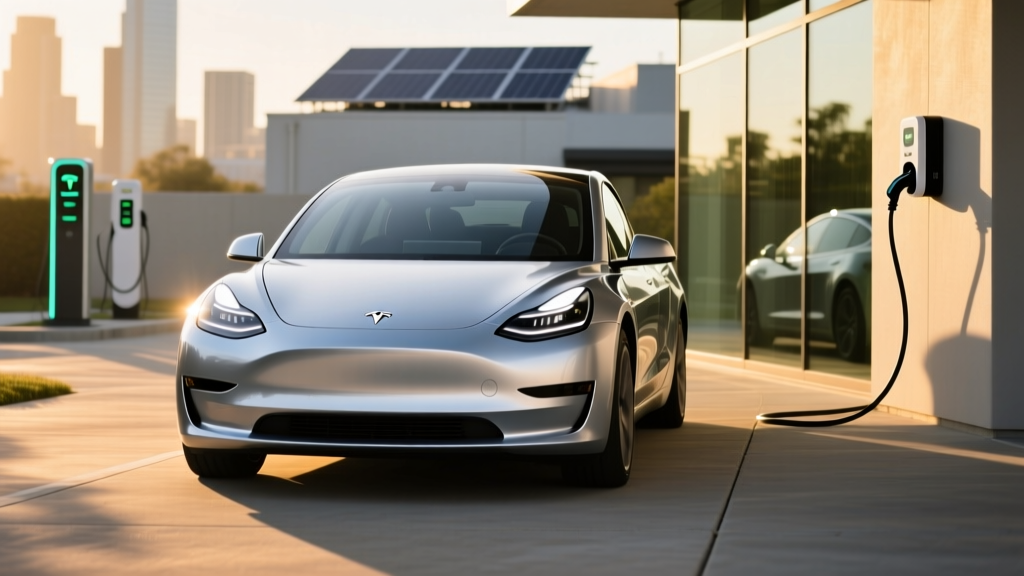
Charging speed is where the Model Y continues to outperform many rivals. The 2026 model supports up to 250 kW peak DC fast charging on Tesla's V3 and V4 Superchargers, and the NACS (North American Charging Standard) connector is now the industry default, with Ford, GM, Rivian, and others having adopted it.
| Charging Level | Power | Speed (approx.) | Use Case |
|---|---|---|---|
| Level 1 (120V outlet) | 1.4 kW | ~5 mi/hr | Emergency / overnight trickle |
| Level 2 (240V, 48A Wall Connector) | 11.5 kW | ~44 mi/hr | Home daily charging |
| DC Fast (Supercharger V3/V4) | 250 kW peak | 10–80% in ~25 min | Road trips |
| DC Fast (non-Tesla CCS w/ adapter) | Up to 150–250 kW | Varies by station | Third-party networks |
A critical nuance: the 250 kW figure is a peak, not a sustained rate. The Model Y's charge curve tapers meaningfully above ~60% State of Charge (SoC). In practice, you'll see 250 kW only in the 10–30% SoC window, dropping to ~150 kW by 50% and ~70 kW by 80%. This is why Tesla (and most EV makers) quote 10–80% times rather than 0–100%.
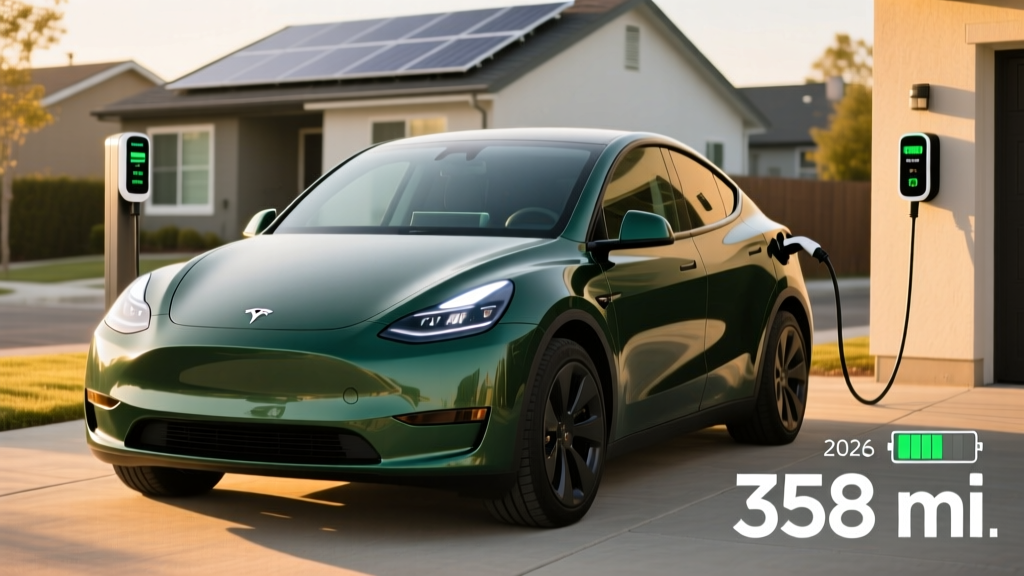
For home charging, Tesla's Gen 3 Wall Connector on a 60-amp circuit delivers the full 11.5 kW (48 amps continuous), adding roughly 44 miles of range per hour. A typical overnight session from 30% to 80% takes about 4.5 hours — more than sufficient for daily driving. Installation costs vary: expect $800–$2,000 for a standard install near the panel, or $2,500–$4,500+ if your home needs a 200-amp panel upgrade. Always get a quote from a licensed electrician before committing.
Performance and Drivetrain
The Long Range AWD pairs dual permanent-magnet motors producing a combined 384 horsepower, reaching 0–60 mph in 4.8 seconds. The Performance trim bumps output to 456 hp and drops the sprint to 3.5 seconds, aided by a track-tuned suspension, larger brakes, and 21-inch Überturbine wheels.
Both trims feature precise torque-vectoring AWD, a low center of gravity from the floor-mounted battery pack, and regenerative braking that enables effective one-pedal driving in most conditions. The steering is quick and direct, though some reviewers note it lacks the feedback of a Porsche Macan EV or BMW iX. Ride quality on the Juniper refresh is noticeably improved over pre-2025 models, with revised dampers and additional sound insulation reducing road noise.
Battery Chemistry, Degradation, and Warranty
The 2026 Model Y Long Range and Performance use a ~78 kWh usable NMC (nickel manganese cobalt) battery pack. Tesla has standardized on NMC for its Long Range and Performance vehicles, reserving LFP (lithium iron phosphate) chemistry for the Standard Range RWD model sold in select markets.
NMC offers higher energy density (more range per kilogram) but is more sensitive to sustained high SoC. Tesla recommends daily charging to 80% for NMC packs and reserving 100% charges for road trips. Long-term degradation data from fleet analytics firm Recurrent shows Tesla NMC packs retaining approximately 88–92% of original capacity after 100,000 miles — among the best in the industry.
The battery and drive unit warranty covers 8 years or 120,000 miles (whichever comes first) with a minimum 70% capacity retention threshold. This is competitive with Hyundai/Kia's 10-year/100,000-mile warranty, though Tesla's mileage cap is more generous for high-mileage drivers.
Pricing, Financing, and the Interest Rate Factor
Here's where the Tesla Model Y interest rate conversation becomes critical. The 2026 Model Y Long Range AWD starts at $44,990 (including destination), while the Performance begins at $51,490. Adding Full Self-Driving (Supervised) costs $8,000, and premium colors and 20-inch wheels add $1,000–$2,500.
| Scenario | Long Range AWD | Performance AWD |
|---|---|---|
| Base MSRP | $44,990 | $51,490 |
| Federal Tax Credit (§30D) | –$7,500* | –$7,500* |
| Effective Price (before state incentives) | $37,490 | $43,990 |
| Monthly (72 mo, 5.9% APR) | ~$620 | ~$727 |
| Monthly (72 mo, 7.9% APR) | ~$656 | ~$769 |
| Monthly (72 mo, 9.9% APR) | ~$693 | ~$812 |
*Federal tax credit eligibility depends on multiple factors. See the tax credit section below for details. Monthly payments estimated before taxes, fees, and down payment.
The spread between a 5.9% APR (excellent credit, manufacturer-subsidized rate) and 9.9% APR (fair credit, unsecured lender) is roughly $36–$42/month — or $2,600–$3,000 in total interest over 72 months. That's essentially the cost of two years of home electricity for charging. Tesla periodically offers promotional financing through partner lenders; check Tesla's configurator for current rates, which fluctuate monthly.
- MSRP cap: SUVs/vans/pickups must be ≤$80,000 (Model Y qualifies)
- Buyer income cap: AGI ≤$150,000 (single), ≤$225,000 (head of household), ≤$300,000 (joint)
- Battery sourcing: Critical minerals and battery components must meet phased-in domestic/free-trade thresholds (Tesla has largely complied for 2026)
- Point-of-sale transfer: You can apply the $7,500 as an immediate discount at purchase rather than waiting for tax filing
- Verification: Confirm eligibility at IRS.gov before purchasing — rules are subject to change
Interior, Tech, and Daily Livability
The Juniper interior is a meaningful step up from the pre-refresh Model Y. A ventilated front seat row, ambient lighting, rear-seat touchscreen, power-folding second row, and improved materials (soft-touch surfaces, acoustic glass) close the gap with luxury competitors. The 15.4-inch center touchscreen runs Tesla's proprietary OS, which remains the most responsive and feature-rich infotainment system in the EV market — navigation, media, climate, and vehicle settings all flow through it with minimal lag.
Cargo space is a Model Y strength: 30.2 cubic feet behind the second row and 72.1 cubic feet with seats folded. A front trunk (frunk) adds ~4.1 cubic feet for charging cables or a small bag. Rear legroom measures 41.6 inches — adequate for adults on longer trips, though the sloping roofline limits headroom for passengers over 6'2".
Driver assistance: The Model Y ships with Basic Autopilot (lane centering + adaptive cruise), which is an SAE Level 2 system — meaning the driver must remain fully attentive with hands on the wheel at all times. The optional Full Self-Driving (Supervised) package ($8,000) adds automated lane changes, traffic light/stop sign recognition, and city-street navigation, but it remains a Level 2 system requiring continuous supervision. Tesla's vision-only approach (no LiDAR or radar) continues to draw scrutiny; the NHTSA has opened multiple investigations into Autopilot/FSD behavior near emergency scenes.
Tesla's Full Self-Driving (Supervised) is classified as SAE Level 2 automation. The driver must remain engaged, monitor the road, and be prepared to take over instantly. Only Level 4 services like Waymo operate without a human driver — and those are limited to geo-fenced urban areas. Do not treat FSD as a substitute for attentive driving.
Pros, Cons, and Who Should Buy
- Class-leading Supercharger network access (19,000+ U.S. stalls)
- 320 mi EPA range (Long Range) with strong real-world efficiency
- 250 kW DC fast charging; 10–80% in ~25 minutes
- Spacious cargo area (72.1 cu ft max) with practical frunk
- Over-the-air updates continuously add features
- Strong resale value relative to most EV competitors
- Qualifies for full $7,500 federal tax credit (verify eligibility)
- No Apple CarPlay or Android Auto
- Turn-signal stalk removed (steering-wheel buttons — polarizing)
- FSD (Supervised) costs $8,000 and remains Level 2
- Rear headroom limited for tall passengers due to roofline
- Insurance premiums above segment average (~$1,800–$2,400/yr)
- Interest rate sensitivity: high APRs significantly increase total cost
- Choose the Model Y if: You want the most proven EV ecosystem (Superchargers + OTA updates), need 300+ miles of range, and prioritize cargo versatility for a family of 4–5.
- Look at the Hyundai Ioniq 5 if: You want 800V ultra-fast charging (10–80% in ~18 min), prefer physical controls, or value Apple CarPlay.
- Look at the Ford Mustang Mach-E if: You want a more engaging driving experience and don't mind slightly less range (EPA ~312 mi on Extended Range AWD).
- Consider a PHEV (e.g., Toyota RAV4 Prime) if: You lack reliable home charging and frequently drive in areas with sparse DC fast-charging infrastructure.
Frequently Asked Questions
What is the real-world range of the 2026 Tesla Model Y?
The EPA rates the Long Range AWD at 320 miles. In real-world mixed driving, expect 280–300 miles. Highway driving at 75 mph reduces that to ~260–280 miles, and cold weather (below 30°F) can drop range to 210–240 miles. The heat pump on the Juniper refresh helps mitigate winter losses compared to older Model Y vehicles.
How fast does the Model Y charge at home and on the road?
On a 250 kW Supercharger, the Model Y charges from 10–80% in approximately 25 minutes (with taper above 60%). At home on a 48-amp Level 2 Wall Connector (11.5 kW), it adds about 44 miles of range per hour, fully replenishing a depleted battery in roughly 7–8 hours.
Does the 2026 Model Y qualify for the $7,500 federal EV tax credit?
Yes, the Model Y currently qualifies for the full $7,500 under IRS §30D, provided you meet the income caps (≤$150K single / ≤$300K joint) and the vehicle's MSRP is under the $80,000 SUV cap. The credit can be transferred at point of sale as an immediate discount. Always verify current eligibility at IRS.gov before purchasing, as sourcing rules evolve annually.
How does the current interest rate affect my Model Y payment?
On a Long Range AWD at an effective price of $37,490 (after the tax credit), a 72-month loan at 5.9% APR yields ~$620/month. At 9.9% APR, the same loan costs ~$693/month — a $73/month or $5,256 total difference. Improving your credit score or taking advantage of Tesla's promotional financing can save thousands over the loan term.
Is the Model Y worth buying over competitors in 2026?
For most buyers, yes. The Supercharger network, strong efficiency (122 MPGe), 320-mile range, and $7,500 tax credit make it the default EV crossover choice. However, if 800V ultra-fast charging, Apple CarPlay, or a more traditional interior are priorities, the Hyundai Ioniq 5 and Kia EV6 are strong alternatives worth cross-shopping.
What is the battery warranty on the 2026 Model Y?
Tesla covers the battery and drive unit for 8 years or 120,000 miles (whichever comes first), guaranteeing a minimum of 70% capacity retention. Real-world fleet data suggests NMC packs in Tesla vehicles typically retain 88–92% capacity at 100,000 miles under normal use patterns.