The 2025 Tesla Model Y Color Lineup: What's New and What's Available
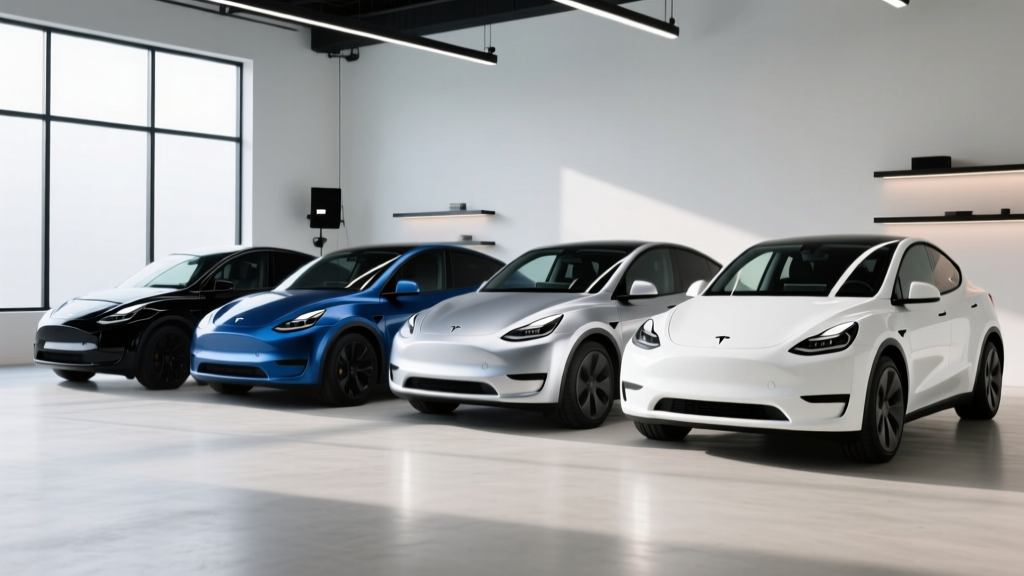
If you've been researching Tesla Model Y colors 2025, you've likely noticed the palette has shifted. Tesla periodically rotates its exterior paint options, and the 2025 model year (sold into early 2026) is no exception. The Model Y remains the best-selling EV in the United States, and while most buyers prioritize range and charging speed, your color choice affects more than aesthetics — it influences resale value, paint durability, and even thermal management in extreme climates.
As of the current order configuration, Tesla offers the following exterior colors for the 2025 Model Y:
- Pearl White Multi-Coat — No-cost option; the default and most popular choice
- Solid Black — $2,000 premium
- Deep Blue Metallic — $2,000 premium
- Ultra Red — $2,500 premium (replaced the previous Red Multi-Coat)
- Quicksilver — $2,500 premium (replaced Midnight Silver Metallic)
- Glacier Grey — $0 (introduced as a no-cost option in select markets; check configurator for availability)
Interior options remain streamlined: All Black (standard) and Black and White ($1,000 premium). Tesla discontinued the cream interior option for the Model Y in prior model years.
Color availability can shift without notice on Tesla's configurator. If you're ordering today, confirm your preferred shade is active before placing a deposit. Below, we break down the full ownership picture — range, charging, pricing, and tax credits — so you can evaluate the Model Y beyond the paint.
Range, Battery, and Efficiency: The Numbers That Matter
The 2025 Model Y is offered in three primary configurations in the U.S. market: Long Range AWD, Performance AWD, and (when available) a Standard Range RWD variant. Here's the spec breakdown:
| Spec | Long Range AWD | Performance AWD |
|---|---|---|
| EPA Range | 308 miles | 277 miles |
| Battery Capacity (usable) | ~75 kWh | ~75 kWh |
| Battery Chemistry | NMC (Nickel Manganese Cobalt) | NMC |
| Drivetrain | Dual-Motor AWD | Dual-Motor AWD |
| Horsepower | ~384 hp | ~456 hp |
| 0-60 mph | 4.8 seconds | 3.3 seconds |
| Efficiency | 122 MPGe / 28 kWh/100mi | 111 MPGe / 30 kWh/100mi |
| Top Speed | 135 mph | 155 mph |
The Model Y's NMC battery chemistry offers higher energy density than LFP (lithium iron phosphate), which is why Tesla reserves LFP for the Standard Range variants. NMC batteries benefit from keeping state of charge (SoC) between 20–80% for daily use, charging to 100% only when you need maximum range for a trip. Tesla's battery management system includes a buffer that protects against deep degradation, and real-world data from high-mileage owners shows most NMC packs retain 85–90% capacity after 100,000 miles.
Charging Speed: DC Fast Charging and Home Setup
Charging speed is one of the Model Y's strongest selling points, thanks to Tesla's Supercharger network and the vehicle's capable onboard architecture. Here's what to expect:
| Charging Level | Power / Rate | What You Get |
|---|---|---|
| Level 1 (120V household) | ~1.4 kW | ~3–4 miles per hour |
| Level 2 (240V home / public) | 11.5 kW (48A) | ~37–44 miles per hour |
| DC Fast Charge (V3 Supercharger) | Peak 250 kW | 10–80% in ~22 minutes |
| DC Fast Charge (V4 Supercharger) | Peak 250 kW (vehicle-limited) | 10–80% in ~22 minutes |
Charging curve reality: The Model Y peaks at 250 kW only at low state of charge (typically 5–15% SoC) and tapers significantly above 60%. A 10–80% session takes roughly 22 minutes at a V3 Supercharger, but an 80–100% top-off can add another 25–30 minutes. For road trips, plan to charge from 10% to 80% and skip the slow top-off unless you absolutely need the extra miles.
For home charging, a Tesla Wall Connector on a 60A circuit delivers the full 11.5 kW (48A), adding roughly 40 miles of range per hour — enough to fully replenish overnight. Installation costs typically range from $500 to $2,000 depending on your electrical panel's capacity and the distance from panel to charger location. If your home has a 200A panel with available capacity, expect the lower end of that range. Older homes with 100A service may require a panel upgrade ($1,500–$3,000+).
With the Model Y now shipping with the NACS (North American Charging Standard) port natively, you have full access to Tesla's Supercharger network without adapters. Tesla has also opened portions of its network to other EVs, but as a Tesla owner, you'll never deal with the CCS-to-NACS adapter hassle that non-Tesla drivers face.
Pricing, Trims, and Federal Tax Credit Eligibility
The 2025 Model Y's pricing has shifted multiple times over the past year — Tesla adjusts MSRPs frequently based on demand and production costs. Here's the current pricing landscape as of early 2026:
| Trim | Base MSRP | Federal Tax Credit (§30D) | Effective Price (if eligible) |
|---|---|---|---|
| Long Range AWD | ~$47,990 | Up to $7,500 | ~$40,490 |
| Performance AWD | ~$51,490 | Up to $7,500 | ~$43,990 |
Important tax credit caveats: The IRS §30D federal tax credit has specific eligibility requirements that change periodically:
- MSRP cap: SUVs (including the Model Y) must have an MSRP at or below $80,000 to qualify. All current Model Y trims fall under this cap.
- Buyer income cap: Modified adjusted gross income (MAGI) must not exceed $300,000 (married filing jointly), $225,000 (head of household), or $150,000 (individual).
- Battery sourcing requirements: The credit is split into two halves ($3,750 each) — one for critical minerals sourcing and one for battery component manufacturing. Eligibility for the full $7,500 depends on Tesla's current supply chain compliance, which shifts as sourcing rules tighten annually.
- Point-of-sale transfer: As of 2024+, you can transfer the credit to the dealer at purchase, reducing your out-of-pocket cost immediately rather than waiting for tax filing.
Always verify current credit eligibility on the IRS website or with a tax professional before purchasing. Battery sourcing requirements tighten each year, and a vehicle that qualifies in January may have different eligibility by mid-year.
Interior Space, Cargo, and Daily Practicality
The Model Y's crossover form factor is a major reason for its sales dominance. It bridges the gap between the Model 3 sedan and the larger Model X, offering family-friendly space without the luxury-SUV price tag.
- Cargo volume (rear seats up): ~30.2 cu ft
- Cargo volume (rear seats folded): ~72.1 cu ft
- Front trunk (frunk): ~4.1 cu ft
- Front headroom: 41.0 inches
- Rear headroom: 39.4 inches
- Rear legroom: 41.6 inches
- Optional third row: Available but extremely tight — best suited for small children only
The cargo area is wide and flat with the seats folded, making it practical for furniture runs, camping gear, or two large dogs. The frunk adds useful space for charging cables, groceries, or a small carry-on. Compared to the Ford Mustang Mach-E (29.7 cu ft behind rear seats) and Hyundai Ioniq 5 (27.2 cu ft), the Model Y edges ahead on total volume and benefits from its hatchback-style opening.
Tech, Driver Assistance, and Standout Features
Tesla's software-first approach continues to define the Model Y experience. Key technology highlights include:
- 15.4-inch center touchscreen controlling all vehicle functions, navigation, media, and climate
- Over-the-air (OTA) updates that add features and refine performance post-purchase
- Tesla Autopilot (standard): Adaptive cruise control, lane centering, automatic emergency braking, blind-spot monitoring
- Full Self-Driving (Supervised) ($8,000 option or $99/month): Adds automatic lane changes, Navigate on Autopilot, traffic light/stop sign recognition, and parking assist
- Sentry Mode: 360-degree camera recording when parked, with alerts for nearby threats
- Dog Mode / Camp Mode: Climate control presets for leaving pets in the car or sleeping overnight
- Heat pump: Standard on all trims — significantly improves cold-weather efficiency and range retention compared to resistive heating
The Model Y received a refresh (internally called "Juniper") that introduced a redesigned front and rear fascia, ambient interior lighting, ventilated front seats, a rear-seat touchscreen, and improved suspension tuning for a quieter, more compliant ride. If you're comparing a new 2025 order against a pre-refresh used Model Y, the differences in ride quality and cabin noise are substantial.
Warranty Coverage and Long-Term Ownership
Tesla's warranty structure is straightforward:
- Basic vehicle warranty: 4 years / 50,000 miles
- Battery & drive unit warranty: 8 years / 120,000 miles (Long Range & Performance)
- Battery capacity retention threshold: 70% minimum during the warranty period
The 8-year/120,000-mile battery warranty is competitive with the industry standard (most rivals offer 8 years/100,000 miles). Tesla's 70% retention threshold means the battery must retain at least 70% of its original capacity — if it degrades below that within the warranty window, Tesla will repair or replace it. Real-world degradation data from fleet sources and owner tracking suggests most Model Y NMC packs lose approximately 5–8% capacity in the first 50,000 miles, then degradation slows considerably. A battery replacement outside warranty currently costs between $12,000 and $16,000 depending on the pack and service center.
Insurance costs for the Model Y tend to run 15–25% higher than comparable gas-powered crossovers, reflecting repair costs for aluminum body panels and the battery pack's vulnerability in collisions. Get quotes before ordering — your zip code, driving history, and trim level all affect premiums significantly.
How the Model Y Compares to Key Competitors
The compact electric SUV segment is crowded. Here's how the Model Y Long Range AWD stacks up against three rivals:
| Attribute | Tesla Model Y LR | Ford Mustang Mach-E ER AWD | Hyundai Ioniq 5 Long Range AWD | Kia EV6 GT-Line AWD |
|---|---|---|---|---|
| EPA Range | 308 mi | 290 mi | 290 mi | 282 mi |
| Peak DC Charge | 250 kW | 150 kW | 233 kW | 239 kW |
| 10-80% DCFC Time | ~22 min | ~36 min | ~18 min | ~18 min |
| Cargo (rear seats up) | 30.2 cu ft | 29.7 cu ft | 27.2 cu ft | 24.4 cu ft |
| Base MSRP | ~$47,990 | ~$48,995 | ~$52,600 | ~$56,400 |
| Charging Network | Native NACS/Supercharger | NACS adapter needed | NACS adapter needed | NACS adapter needed |
The Model Y's advantages are clear: longest EPA range in the segment, native Supercharger access, and the most cargo space. The Ioniq 5 and EV6 charge faster on compatible DC hardware (their 800V architecture enables quicker 10–80% sessions), but rely on adapters for Supercharger access and offer less cargo room. The Mach-E provides a more traditional driving feel and Ford dealer service, but its slower DC charging and lower range are notable trade-offs.
Consider a competitor if: You prioritize faster DC charging on non-Tesla networks (Ioniq 5/EV6), prefer a traditional dealership service experience (Mach-E), or want a more distinctive interior design.
- Class-leading 308-mile EPA range (Long Range)
- Native Supercharger access — no adapters needed
- Best-in-segment cargo volume
- Heat pump standard for cold-weather efficiency
- Frequent OTA updates add features over time
- Strong resale value relative to EV segment
- Touchscreen-dependent controls (no physical buttons for climate/media)
- FSD (Supervised) is expensive and still requires full driver attention
- Insurance premiums run higher than gas alternatives
- Ride quality improved with Juniper refresh but still firm on Performance trim
- No Apple CarPlay / Android Auto — Tesla's native infotainment only
- Color options carry steep premiums ($2,000–$2,500)
Frequently Asked Questions
What is the real-world range of the 2025 Tesla Model Y?
The EPA rates the Long Range AWD at 308 miles and the Performance at 277 miles. In real-world highway driving at 70–75 mph, expect 250–275 miles (Long Range) and 225–250 miles (Performance). Cold weather below freezing can reduce range by 20–30%. City driving with regenerative braking often meets or exceeds EPA estimates.
How fast does the Model Y charge at home and on the road?
At home on a Level 2 Wall Connector (240V, 48A), the Model Y charges at 11.5 kW, adding roughly 40 miles of range per hour — a full charge takes about 8 hours. On a V3 Supercharger, it peaks at 250 kW and charges from 10–80% in approximately 22 minutes, though the charge rate tapers significantly above 60% SoC.
How much does the 2025 Model Y cost after federal tax credits?
The Long Range AWD starts at approximately $47,990. If you qualify for the full $7,500 §30D federal tax credit (subject to income caps, MSRP caps, and battery sourcing rules), the effective price drops to around $40,490. The Performance trim starts at ~$51,490, or ~$43,990 after the maximum credit. Always verify current eligibility at irs.gov.
Does the 2025 Model Y qualify for the federal EV tax credit?
The Model Y qualifies for up to $7,500 under IRS §30D, but eligibility depends on your income (MAGI ≤ $300K joint / $150K individual), the vehicle's MSRP (under $80K — all trims qualify), and current battery sourcing compliance. The credit can be transferred at point of sale to reduce your purchase price directly. Check the IRS website for the most current sourcing requirements, as these tighten annually.
Is the Model Y worth buying over the Ford Mach-E or Hyundai Ioniq 5?
The Model Y wins on range (308 mi vs. 290 mi), cargo space (30.2 vs. 29.7 / 27.2 cu ft), and native Supercharger access. The Ioniq 5 and EV6 charge faster on 800V-compatible DC stations (10–80% in ~18 min vs. ~22 min). If Supercharger access is your priority, the Model Y is the strongest pick. If you want faster non-Tesla DC charging and don't mind using an adapter, the Ioniq 5 is a compelling alternative.
What are the best Tesla Model Y colors for resale value?
Pearl White Multi-Coat and Solid Black historically hold the strongest resale value due to broad buyer appeal and high original order volume. Quicksilver and Ultra Red are more niche and may appeal to enthusiasts but don't consistently command a premium on the used market. White also has a practical advantage: it shows fewer swirl marks and minor scratches than darker colors.
Does the Model Y come with Autopilot or self-driving capability?
Every Model Y includes Tesla Autopilot (SAE Level 2), which provides adaptive cruise control, lane centering, and automatic emergency braking. Full Self-Driving (Supervised) is a $8,000 option that adds automatic lane changes and Navigate on Autopilot. Neither system is self-driving — you must remain fully engaged as the driver at all times.
The 2025 Model Y continues to set the benchmark for the electric compact SUV segment. Whether you choose Pearl White for its no-cost practicality or Ultra Red for its head-turning presence, the underlying vehicle delivers class-leading range, the most reliable public charging network, and cargo versatility that rivals traditional gas crossovers. Just be sure to factor in insurance costs, verify your tax credit eligibility, and understand the real-world range trade-offs before placing your order.