Why Tesla Insurance Costs More — And How to Pay Less
If you're researching insurance for a Tesla, you've likely already seen the sticker shock. Tesla vehicles — especially the Model Y, the best-selling EV in America — consistently carry higher-than-average insurance premiums. The reasons are structural: aluminum-intensive unibody construction, expensive integrated battery packs, proprietary sensor suites, and a limited repair network mean collision claims cost more to settle. According to industry data, the average Tesla Model Y insurance premium sits between $2,800 and $4,200 annually depending on driver profile, location, and coverage level — roughly 40-60% above the segment average for compact electric SUVs.
But premiums aren't fixed. Tesla's own insurance product (available in most states) uses real-time driving behavior via a Safety Score, and several mainstream carriers now offer EV-specific discounts. This review pairs a deep dive into Model Y insurance economics with a complete 2026 vehicle profile — range, charging, pricing, tax credit eligibility, and ownership reality — so you can evaluate the full cost picture before signing a policy or a purchase agreement.
2026 Tesla Model Y: Core Specs at a Glance
| Attribute | Long Range AWD | Performance |
|---|---|---|
| EPA Range | 320 miles | 293 miles |
| Battery (usable) | ~75 kWh, NMC | ~75 kWh, NMC |
| Drivetrain | Dual-Motor AWD | Dual-Motor AWD |
| Horsepower | 384 hp | 510 hp |
| 0-60 mph | 4.8 sec | 3.5 sec |
| Peak DC Fast Charge | 250 kW | 250 kW |
| 10-80% DCFC Time | ~25 min | ~25 min |
| Level 2 Home Charge | 11.5 kW (~44 mi/hr) | 11.5 kW (~44 mi/hr) |
| MPGe (combined) | 122 MPGe | 111 MPGe |
| Energy Consumption | 28 kWh/100 mi | 30 kWh/100 mi |
| Cargo (rear seats up) | 30.2 cu ft | 30.2 cu ft |
| Cargo (rear seats folded) | 72.1 cu ft | 72.1 cu ft |
| Base MSRP | $44,990 | $51,490 |
| Federal Tax Credit | Up to $7,500 | Up to $7,500 |
| Battery Warranty | 8 yr / 120,000 mi | 8 yr / 120,000 mi |
Source: EPA fueleconomy.gov and Tesla.com. Specs reflect the Juniper-refresh Model Y sold for the 2026 model year.
Real-World Range: What the EPA Number Doesn't Tell You
Real-World Highway (70-75 mph): ~265-280 miles
Real-World Mixed Commuting: ~290-310 miles
Cold Weather (below 30°F): ~220-250 miles (30-35% reduction from sticker is typical for NMC packs without aggressive preconditioning)
The Juniper-refresh Model Y Long Range carries a 75 kWh usable NMC (nickel-manganese-cobalt) battery. NMC chemistry offers high energy density — which is why Tesla fits a relatively compact pack while still achieving 320 EPA miles — but it is more temperature-sensitive than LFP (lithium iron phosphate). In real-world highway driving at sustained speeds above 70 mph, aerodynamic drag dominates energy consumption, and you should expect roughly 265-280 miles before needing to charge. Cold weather compounds this: the battery's internal resistance increases, cabin heating draws significant power (the Model Y uses a heat pump, which helps but doesn't eliminate the penalty), and regenerative braking is restricted until the pack warms up.
For daily commuting under 50 miles round-trip with home charging, these reductions are largely academic. For road trips, plan conservatively: I treat 250 miles as my practical interstate range in moderate weather and 210 miles in winter. Tesla's navigation will route you through Superchargers and precondition the battery automatically, which significantly improves actual charge speeds on arrival.
Charging Speed and Network Reality
| Charging Level | Power | Speed (approx.) | Use Case |
|---|---|---|---|
| Level 1 (120V outlet) | ~1.4 kW | ~5 mi/hr | Emergency / trickle |
| Level 2 (240V home) | 11.5 kW | ~44 mi/hr | Daily overnight |
| DC Fast Charge (V3 Supercharger) | Peak 250 kW | 10-80% in ~25 min | Road trips |
| DC Fast Charge (V4 Supercharger) | Peak 250 kW* | 10-80% in ~25 min | Road trips (newer stalls) |
*The Model Y's onboard architecture caps charge acceptance at approximately 250 kW. V4 Supercharger stalls may deliver higher amperage, but the vehicle cannot accept more than its peak rate.
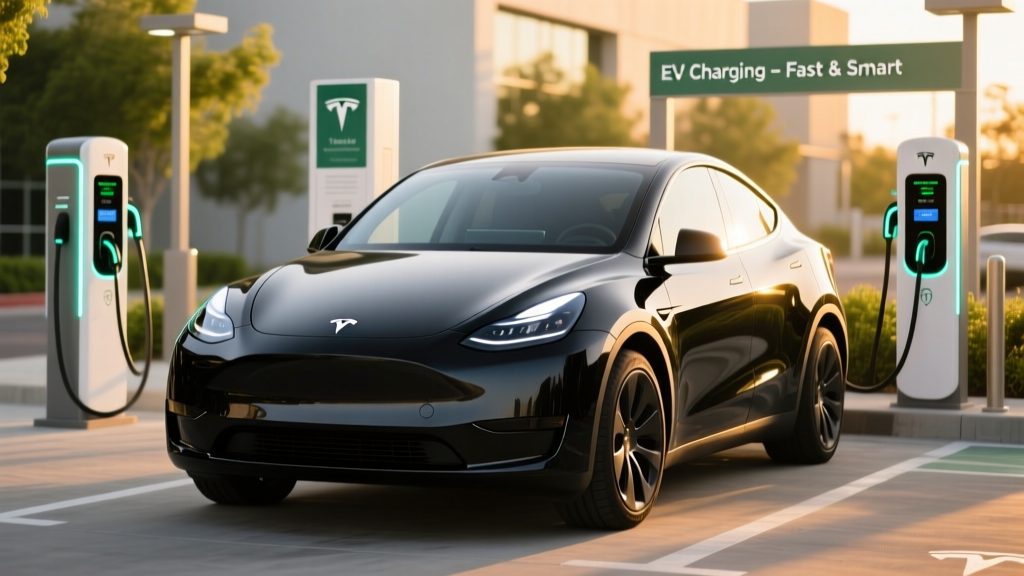
The Model Y uses the NACS (North American Charging Standard) connector natively — Tesla's proprietary design now adopted industry-wide. This means access to over 20,000 Supercharger stalls in North America plus, increasingly, third-party networks (Electrify America, EVgo) via NACS adapters. The charge curve peaks near 250 kW at low state-of-charge (around 5-15%) and tapers progressively: by 60% SoC you'll see roughly 150 kW, and above 80% the rate drops sharply to protect cell longevity. This is why the 10-80% metric matters far more than peak kW claims.
At home on a Level 2 Wall Connector (48-amp circuit, 60-amp breaker), you'll add approximately 44 miles of range per hour. A full overnight session from 20% to 90% takes about 6-7 hours — easily covering any daily driving need. Installation typically requires a 240V/60A dedicated circuit; budget $800-$2,000 for electrician labor depending on panel proximity and local permitting. If your home panel is at capacity (common in older 100A or 150A services), a panel upgrade can add $1,500-$3,000.
Insurance for a Tesla Model Y: What You'll Actually Pay
Insurance for a Tesla Model Y averages $235-$350 per month ($2,820-$4,200/year) for a 35-year-old driver with a clean record, full comprehensive/collision coverage, and $500 deductibles. Several factors drive this above-average cost:
- Repair cost concentration: Tesla's gigacast aluminum rear and front underbody sections are efficient to manufacture but expensive to replace after collision damage. Many body shops lack Tesla-certified equipment, funneling repairs to a smaller network with higher labor rates.
- Battery replacement exposure: While rare, a damaged high-voltage pack can total a vehicle that would otherwise be repairable. Insurers price this tail risk into premiums.
- Sensor and camera density: The Model Y's 8-camera Tesla Vision suite is integrated into body panels and glass. A windshield replacement that might cost $400 on a conventional SUV can exceed $1,200 when camera recalibration is required.
- Performance perception: Even the Long Range trim's 4.8-second 0-60 time places it in a higher-risk actuarial bracket than mainstream crossovers.
How to Reduce Your Tesla Insurance Premium
Tesla Insurance (Safety Score program): Available in 40+ states, Tesla's own product uses real-time driving data — hard braking, aggressive turning, forced Autopilot disengagements, forward collision warnings — to calculate a monthly Safety Score. Drivers scoring consistently above 90 can see premiums 20-40% below traditional carrier quotes. However, scores below 70 can result in higher rates than the conventional market.
EV-specific discounts: State Farm, Progressive, GEICO, and USAA all offer EV ownership discounts (typically 5-10%). Bundling home and auto, maintaining continuous coverage, and completing defensive driving courses stack with these.
Liability-only for older Model Y vehicles: If you own a 2020-2022 Model Y with high mileage and no loan/lease obligation, dropping collision coverage can cut premiums by 40-50%. The trade-off: you absorb all repair or replacement cost in an at-fault accident.
Higher deductibles: Moving from a $500 to a $1,000 or $2,000 deductible typically reduces collision premiums by 15-25%. Only do this if you can absorb the deductible out of pocket.
Pricing, Trim Levels, and Federal Tax Credit Eligibility
| Trim | Base MSRP | Est. Federal Credit | Effective Price |
|---|---|---|---|
| Long Range AWD | $44,990 | Up to $7,500* | ~$37,490* |
| Performance AWD | $51,490 | Up to $7,500* | ~$43,990* |
*Federal tax credit eligibility under IRS §30D depends on multiple requirements. As of 2026, the Model Y qualifies, but buyer eligibility is not universal.
§30D Tax Credit Requirements (2026)
- MSRP Cap: SUVs must have a manufacturer's suggested retail price at or below $80,000. Both Model Y trims qualify.
- Buyer Income Cap: Modified adjusted gross income (MAGI) must not exceed $150,000 (single), $225,000 (head of household), or $300,000 (married filing jointly).
- Battery Sourcing: A percentage of critical minerals and battery components must be sourced from the U.S. or free-trade-agreement partners. Tesla's Fremont and Austin battery supply chains have largely met these thresholds for 2026, but the exact credit amount ($3,750 or $7,500) depends on whether both the mineral and component requirements are satisfied for the specific VIN's production date.
- Point-of-Sale Transfer: Buyers can transfer the credit to the dealer at purchase, reducing the purchase price directly rather than waiting for a tax refund. This is available regardless of tax liability.
Always verify current eligibility on IRS.gov and confirm with your tax professional before relying on credit amounts in purchase decisions. Sourcing rules tighten annually, and mid-year supply chain changes can affect eligibility.
Interior, Technology, and Driver Assistance
The Juniper-refresh Model Y interior represents a meaningful step up from the pre-2025 cabin. Ventilated front seats, ambient lighting, a rear-seat touchscreen, and improved acoustic glass bring refinement closer to European luxury-compact standards — though the minimalist ethos remains. There is still no instrument cluster; all information flows through the 15.4-inch center touchscreen, including speed, navigation, and climate. This remains polarizing: some owners find it intuitive after a week, while others miss glancing down for speed confirmation.
Autopilot and FSD (Supervised): Tesla's basic Autopilot (traffic-aware cruise control and lane centering) is standard. Full Self-Driving (Supervised) remains an $8,000 option or $99/month subscription and includes automatic lane changes, traffic light/stop sign recognition, and autosteer on city streets.
Both Autopilot and FSD (Supervised) are SAE Level 2 driver-assistance systems. The driver must remain fully engaged — hands on the wheel, eyes on the road — at all times. These systems do not make the vehicle self-driving. Tesla's "Supervised" branding reflects this: the human is the supervisor and ultimate decision-maker.
Notable drawbacks: the Model Y still lacks Apple CarPlay and Android Auto — a dealbreaker for some buyers accustomed to phone-mirrored infotainment. The glass roof, while dramatic, admits substantial solar heat in summer; a shade is effectively mandatory in southern climates. And the absence of physical stalks for turn signals and gear selection (everything is on the steering wheel or screen) continues to generate complaints from new owners during the adaptation period.
Pros and Cons: The Honest Scorecard
Pros
- Best-in-class Supercharger network access — still the most reliable DC fast-charging ecosystem
- Class-leading efficiency (122 MPGe combined) translates to low per-mile energy cost
- Spacious cargo area (72.1 cu ft with seats folded) rivals midsize SUVs
- Over-the-air updates continuously add features post-purchase
- Strong resale value relative to most EV competitors
- Heat pump standard — critical for cold-climate range preservation
Cons
- Insurance premiums 40-60% above segment average
- No Apple CarPlay / Android Auto support
- Turn signals on steering wheel (not stalk) frustrate many drivers
- Ride quality firm on larger wheel options; road noise still present on coarse surfaces
- Repair network limited — collision claims can take weeks longer than mainstream brands
- FSD (Supervised) costs $8,000 and remains Level 2 — not autonomous
Who Should Buy the Model Y — And Who Shouldn't
Choose the Model Y if: You have home Level 2 charging, drive 200+ miles daily on road trips where Supercharger density matters, value cargo versatility, and want an EV with strong resale value and OTA feature updates.
Consider competitors if: You want CarPlay (Hyundai Ioniq 5, Kia EV6), need a smoother ride (BMW iX), want lower insurance costs (Ford Mustang Mach-E averages ~$2,200-$3,000/year), or require third-row seating (Kia EV9).
The Model Y excels as a daily commuter and road-trip vehicle for households that can charge at home. It's less ideal for buyers in states with Tesla Insurance unavailable and high third-party premiums, apartment dwellers without reliable charging access, or families needing more than five seats.
Frequently Asked Questions
What is the real-world range of the 2026 Tesla Model Y?
The EPA rates the Long Range AWD at 320 miles. In real-world highway driving at 70-75 mph, expect 265-280 miles. In cold weather below 30°F, plan for 220-250 miles. Mixed city/highway commuting in moderate temperatures typically yields 290-310 miles.
How fast does the Model Y charge on DC fast chargers and at home?
On a V3 or V4 Supercharger, the Model Y peaks at 250 kW and charges from 10-80% in approximately 25 minutes. At home on a Level 2 Wall Connector (11.5 kW), it adds roughly 44 miles of range per hour — enough for a full overnight charge.
How much does a Tesla Model Y cost after tax credits?
The Long Range AWD starts at $44,990 MSRP. If you qualify for the full $7,500 federal tax credit under §30D (income and sourcing requirements apply), the effective price drops to approximately $37,490. The Performance trim starts at $51,490, or roughly $43,990 after the credit.
Is the Tesla Model Y worth buying vs. competitors like the Ioniq 5 or Mach-E?
The Model Y wins on Supercharger access, cargo space, efficiency, and resale value. The Hyundai Ioniq 5 offers 800V ultra-fast charging (10-80% in ~18 min), Apple CarPlay, and a more comfortable ride. The Ford Mustang Mach-E typically carries lower insurance premiums. Your priority — charging network, ride comfort, or insurance cost — should drive the decision.
Does the Tesla Model Y qualify for the federal EV tax credit?
Yes, as of 2026, the Model Y qualifies under IRS §30D. However, buyer eligibility depends on income caps ($150K single / $300K joint), and the credit amount ($3,750 or $7,500) depends on battery critical-mineral and component sourcing for your specific VIN. Always verify on IRS.gov.
Why is insurance for a Tesla more expensive than other EVs?
Tesla's aluminum gigacast body structure, integrated battery pack, proprietary sensor suite, and limited certified repair network all increase collision claim costs. These costs are passed to consumers through higher premiums. Tesla Insurance's Safety Score program can reduce premiums for careful drivers by 20-40%.
What is the battery warranty on the Model Y?
Tesla covers the battery and drive unit for 8 years or 120,000 miles (whichever comes first) with a minimum 70% capacity retention guarantee. If the battery degrades below 70% State of Health within the warranty period, Tesla will repair or replace it at no cost.