What's Really Inside the Tesla Model Y for 2026?
The Tesla Model Y remains one of the best-selling electric vehicles in the United States, and the refreshed "Juniper" update that rolled out through 2025 and into 2026 brought meaningful changes to the cabin, suspension tuning, and efficiency. But marketing gloss aside, what does the Tesla Model Y inside actually deliver for daily drivers, families, and road-trippers? This review strips away the hype and focuses on the numbers that matter: EPA range versus real-world expectations, charging speeds across DC fast and Level 2 home setups, true cargo capacity, and whether the federal tax credit actually applies to your purchase.
We've spent time behind the wheel, at the charger, and inside the cabin to give you an honest, data-driven look at what you're getting — and what you're giving up — when you choose the Model Y over competitors like the Hyundai Ioniq 5, Ford Mustang Mach-E, or Chevrolet Equinox EV.
Full Specs at a Glance
| Spec | Long Range RWD | Long Range AWD | Performance AWD |
|---|---|---|---|
| EPA Range | 320 mi | 308 mi | 277 mi |
| Battery (usable) | ~75 kWh | ~75 kWh | ~75 kWh |
| Chemistry | NMC (2170 cells) | NMC (2170 cells) | NMC (2170 cells) |
| Drivetrain | Rear-Wheel Drive | Dual-Motor AWD | Dual-Motor AWD |
| Horsepower | 346 hp | 384 hp | 456 hp |
| 0–60 mph | 5.8 sec | 4.8 sec | 3.5 sec |
| MPGe (combined) | 123 MPGe | 117 MPGe | 111 MPGe |
| Efficiency | 27 kWh/100 mi | 29 kWh/100 mi | 30 kWh/100 mi |
| Max DC Fast Charge | 250 kW | 250 kW | 250 kW |
| 10–80% DCFC Time | ~27 min | ~27 min | ~27 min |
| Level 2 Home Charge | 11.5 kW (~44 mi/hr) | 11.5 kW (~44 mi/hr) | 11.5 kW (~44 mi/hr) |
| Cargo (rear seats up) | 30.2 cu ft | 30.2 cu ft | 30.2 cu ft |
| Cargo (rear seats down) | 72.1 cu ft | 72.1 cu ft | 72.1 cu ft |
| Rear Legroom | 41.6 in | 41.6 in | 41.6 in |
| Battery Warranty | 8 yr / 120,000 mi | 8 yr / 120,000 mi | 8 yr / 120,000 mi |
| Base MSRP | $44,990 | $47,990 | $51,990 |
Real-World Range: EPA Sticker vs. What You'll Actually Get
EPA Estimate: 308 miles
Real-World Highway (70–75 mph): ~260–280 miles
Real-World Mixed Commute: ~280–300 miles
Cold Weather (below 32°F, highway): ~210–240 miles
Source: fueleconomy.gov
The Long Range AWD's EPA rating of 308 miles is respectable for a dual-motor crossover, but real-world driving tells a more nuanced story. On a flat, 70-mph highway loop in moderate temperatures (65–75°F), expect to see roughly 260–280 miles before the battery hits zero. That's a 9–15% reduction from the sticker — typical for any EV at sustained highway speeds where aerodynamic drag dominates.
Cold weather amplifies the gap. In sub-freezing conditions, battery chemistry becomes less efficient and cabin heating draws significant power even with the Model Y's heat pump. Plan for 210–240 miles of usable range in winter highway driving. If your commute is mostly city and suburban at lower speeds, you'll land closer to the EPA number, because regenerative braking recovers energy that gas vehicles waste.
The RWD Long Range model's 320-mile EPA figure gives it a slight buffer, making it the efficiency pick for buyers in mild climates who don't need all-wheel drive.
Charging Speed: DC Fast, Level 2, and the Curve Reality
| Charging Level | Power / Rate | Miles Added per Hour | Notes |
|---|---|---|---|
| Level 1 (120V household) | ~1.4 kW | ~4–5 mi/hr | Emergency/trickle only |
| Level 2 (240V home, Wall Connector) | 11.5 kW | ~44 mi/hr | Full charge overnight (~7–8 hrs) |
| Level 2 (public, 48A) | ~11.5 kW | ~44 mi/hr | Same as home max |
| DC Fast (Tesla Supercharger V3/V4) | Peak 250 kW | ~1,000+ mi/hr (peak) | 10–80% in ~27 min |
| DC Fast (CCS adapter, Electrify America) | Up to 250 kW | Varies by station | CCS adapter included with newer models |
The Model Y's peak DC fast-charge rate of 250 kW on Tesla's V3 and V4 Superchargers is solid but no longer class-leading — the Hyundai Ioniq 5 peaks at 350 kW on compatible chargers, and the Porsche Macan EV pushes past 270 kW. However, peak rate only tells part of the story.
The critical metric is the charge curve. The Model Y sustains close to its peak rate from roughly 10% to 45% State of Charge, then progressively tapers. By 80% SoC, the rate drops to around 60–70 kW, and above 90% it slows to a trickle. A 10–80% session takes approximately 27 minutes at a V3 Supercharger — fast enough for a rest-stop break, but not the fastest in its segment.
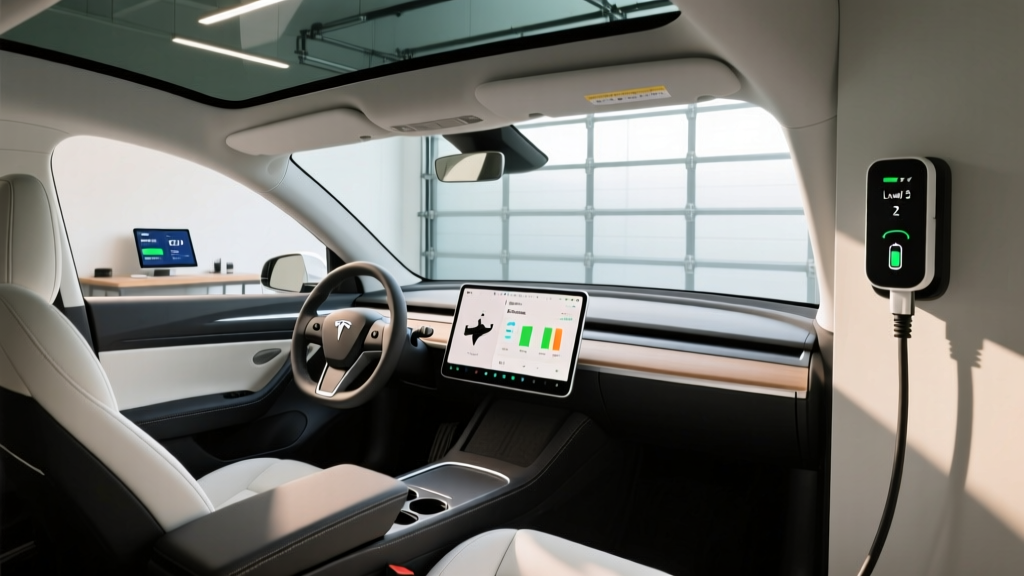
At home on a Tesla Wall Connector wired to a 60-amp circuit (48 amps continuous), the onboard charger pulls 11.5 kW, adding about 44 miles of range per hour. A full 0–100% charge takes roughly 7–8 hours. Most owners charge from 20–80% overnight, which takes about 4 hours — easily handled while you sleep.
Preconditioning matters. If you navigate to a Supercharger using the car's built-in navigation, the battery thermal management system begins warming the pack en route. This can shave 5–10 minutes off your charging session in cold weather. Skipping preconditioning — for example, by driving to a charger without using navigation — can significantly slow your charge rate.
Inside the Cabin: Space, Tech, and the Minimalist Bet
Step inside the 2026 Model Y and the Juniper refresh is immediately apparent. The dashboard is cleaner, ambient lighting runs along the door panels and footwells, and the ventilated front seats are a welcome upgrade over the pre-refresh model. The 15.4-inch center touchscreen remains the command hub for everything — climate, media, navigation, vehicle settings, and the optional rear-seat entertainment screen.
Space is where the Model Y shines for families. With 41.6 inches of rear legroom, adults sit comfortably on longer trips. The 30.2 cubic feet behind the second row swallows a full week of groceries or two large suitcases. Fold the 60/40 split rear seats and you get 72.1 cubic feet — competitive with midsize gas crossovers. The front trunk (frunk) adds another 4.1 cubic feet for charging cables or a small bag.
The all-glass roof creates an airy, open feel, though it does reduce headroom slightly compared to vehicles with conventional roofs. Tesla's cabin filtration system (the large HEPA filter with "Bioweapon Defense Mode") is genuinely effective at removing particulates and odors — a practical advantage in urban environments or wildfire-prone regions.
Drawbacks to acknowledge: The absence of physical buttons or stalks (turn signals are now on the steering wheel face, gear selection is via the touchscreen or overhead console) has a learning curve. Some drivers adapt quickly; others find it frustrating, particularly during low-speed maneuvers. The ride quality, while improved with the Juniper suspension retune, is still firmer than a Hyundai Ioniq 5 or Kia EV6 on rough pavement.
Performance and Efficiency Numbers
The dual-motor Long Range AWD delivers 384 horsepower and hits 60 mph in 4.8 seconds — quick enough to merge confidently onto any freeway and pass without hesitation. The Performance trim drops that to 3.5 seconds with 456 hp, putting it in sports-sedan territory despite its crossover body.
Efficiency is a Tesla strong suit. The Long Range AWD achieves 117 MPGe combined (29 kWh per 100 miles) per EPA data. That translates to roughly $0.04–$0.06 per mile when charging at home on an average U.S. electricity rate of $0.16/kWh — dramatically cheaper than a comparable gas crossover getting 25 mpg at $3.50/gallon ($0.14/mile).
The RWD Long Range is the efficiency king of the lineup at 123 MPGe combined and 27 kWh/100 mi, making it the smart pick for warm-climate commuters who rarely see snow.
Pricing, Trims, and the Federal Tax Credit Question
| Trim | Base MSRP | Est. Destination | §30D Credit Potential | Effective Price* |
|---|---|---|---|---|
| Long Range RWD | $44,990 | $1,390 | Up to $7,500 | ~$38,880 |
| Long Range AWD | $47,990 | $1,390 | Up to $7,500 | ~$41,880 |
| Performance AWD | $51,990 | $1,390 | Up to $7,500 | ~$45,880 |
*Effective price assumes full §30D credit eligibility. Your actual credit depends on income, battery sourcing, and point-of-sale transfer. Verify at irs.gov or with a tax professional.
The IRS §30D New Clean Vehicle Credit can reduce your effective purchase price by up to $7,500, but eligibility is not automatic. Key requirements include:
- MSRP cap: SUVs/vans/pickups must be priced at or below $80,000. All Model Y trims qualify.
- Buyer income cap: Modified AGI must not exceed $150,000 (single), $225,000 (head of household), or $300,000 (joint).
- Battery sourcing: A percentage of critical minerals and battery components must be sourced from the U.S. or free-trade-agreement countries. These thresholds increase annually. Tesla has historically met these requirements for U.S.-built Model Y vehicles, but always verify the specific VIN's eligibility at purchase.
- Point-of-sale transfer: As of 2024, you can transfer the credit to the dealer at purchase, reducing your out-of-pocket cost immediately rather than waiting for a tax refund.
The Model Y's pricing under the $80,000 SUV cap means all trims are credit-eligible on price. The variable is your income and the battery-sourcing compliance at the time of delivery.
Pros and Cons: An Honest Scorecard
- Strong efficiency — 123 MPGe (RWD) is best-in-class
- Extensive Supercharger network with reliable uptime
- Generous cargo space (72.1 cu ft max) and rear legroom
- Over-the-air updates continuously add features
- Excellent cabin air filtration (HEPA)
- Low cost per mile when home-charging
- Strong resale value relative to most EVs
- 250 kW peak charge rate trails Ioniq 5's 350 kW
- No physical turn-signal stalks or gear selector
- Firm ride on rough roads despite Juniper improvements
- Paint quality inconsistent — inspect at delivery
- All-glass roof increases cabin heat in summer
- Autopilot/FSD is Level 2 — not self-driving
- Premium features (FSD, acceleration boost) add cost
Driver Assistance: Autopilot and FSD Supervised
Tesla Autopilot and Full Self-Driving (Supervised) are driver-assistance systems, not autonomous driving. The driver must remain fully attentive, keep hands on the wheel, and be prepared to take over at any moment. SAE Level 4 (true driverless operation) is currently limited to geofenced robotaxi services like Waymo in select cities.
Every Model Y ships with Tesla's basic Autopilot, which includes Traffic-Aware Cruise Control and Autosteer (lane centering). It works well on divided highways and in stop-and-go traffic. The optional FSD (Supervised) package ($8,000 or $99/month) adds automatic lane changes, navigation-guided on/off-ramp handling, and traffic-light/stop-sign recognition.
In practice, FSD Supervised handles most highway scenarios competently but requires constant monitoring. City-street performance varies widely by location and complexity. It is not a substitute for an attentive driver, and treating it as one is dangerous.
Who Should Buy the Tesla Model Y?
Best for: Families and commuters who want a practical, efficient electric crossover with strong cargo capacity, access to the most reliable DC fast-charging network in North America, and the lowest cost-per-mile in its segment when home-charging. The Long Range RWD at ~$38,880 after the tax credit is the value pick.
Consider alternatives if: You prioritize the fastest possible DC charging (look at the Ioniq 5 or Ioniq 6 with 350 kW capability), you want a more traditional cabin with physical controls (Ford Mustang Mach-E, Kia EV6), or you need a plush, quiet ride over sporty handling (Genesis GV60).
Frequently Asked Questions
What is the real-world range of the Tesla Model Y?
The Long Range AWD delivers roughly 260–280 miles on the highway and 280–300 miles in mixed driving. In cold weather below freezing, expect 210–240 miles on the highway. The RWD variant adds about 10–15 miles in each scenario thanks to its higher EPA rating of 320 miles.
How fast does the Model Y charge at home and on the road?
At home on a 240V Wall Connector (11.5 kW), the Model Y gains about 44 miles of range per hour, fully charging overnight in 7–8 hours. On a Tesla V3/V4 Supercharger, it peaks at 250 kW and charges from 10–80% in approximately 27 minutes. Charging slows significantly above 80% due to the battery's charge curve taper.
How much does the Model Y cost after the federal tax credit?
The Long Range RWD starts at $44,990 plus $1,390 destination. If you qualify for the full $7,500 §30D credit (income and battery-sourcing requirements met), the effective price drops to approximately $38,880. The Long Range AWD comes to roughly $41,880 after credit. Always verify eligibility with your tax professional and at irs.gov before purchase.
Does the Tesla Model Y qualify for the federal EV tax credit?
All Model Y trims fall under the $80,000 SUV MSRP cap, making them price-eligible. You must also meet income limits ($150K single / $300K joint) and the vehicle's battery must meet critical-mineral and component sourcing thresholds. Tesla's U.S.-built Model Y has historically qualified, but confirm the specific VIN at the time of purchase. The credit can be transferred at the point of sale to reduce your upfront cost.
Is the Model Y worth buying over competitors in 2026?
The Model Y's advantages — Supercharger access, efficiency, cargo space, and OTA updates — make it the default choice for many EV buyers. However, if charging speed is your top priority, the Hyundai Ioniq 5 charges faster on compatible 350 kW stations. If you prefer physical controls and a softer ride, the Ford Mustang Mach-E or Kia EV6 are strong alternatives. The Model Y wins on total ecosystem convenience and efficiency, not on any single spec.
What is the battery warranty on the Tesla Model Y?
Tesla covers the Model Y's battery and drive unit for 8 years or 120,000 miles (whichever comes first) on Long Range and Performance trims, with a guaranteed minimum 70% capacity retention over that period. This is competitive with the industry standard, though some competitors offer 10-year/100,000-mile battery warranties.