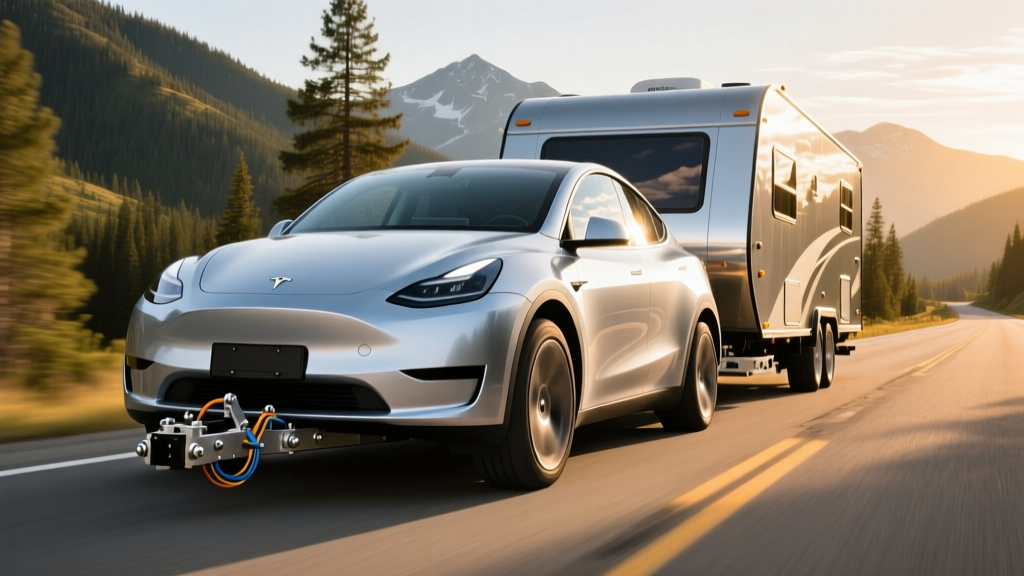
If you have searched for Tesla hitch install options, you are likely weighing whether a Tesla Model Y can genuinely serve double duty as a daily commuter and a light-duty tow vehicle. The short answer: yes, with caveats that most hitch-installation guides gloss over. Towing with any EV compresses range dramatically, and the Model Y is no exception. But for bike racks, cargo trailers, and light camping teardrops, a properly installed hitch on a Model Y is a practical, code-compliant solution — provided you understand the engineering and electrical realities before bolting anything to the subframe.
This guide covers which Model Y trims support towing, the real-world range hit you can expect, hitch hardware options, the wiring-harness complication unique to Teslas, and how the 2026 Model Y (refreshed "Juniper" platform) compares to the outgoing generation for tow duty.
Which Tesla Model Y Trims Support a Hitch?
Not every Model Y leaves the factory rated for towing. In the U.S. market, Tesla sells a factory tow hitch accessory exclusively for the Long Range AWD and (previously) Performance trims. The base Rear-Wheel-Drive (RWD) Model Y does not carry a factory tow rating and is not eligible for the OEM hitch package.
| Spec | Long Range AWD | Performance AWD |
|---|---|---|
| Max Tow Capacity | 3,500 lbs | 3,500 lbs |
| Hitch Receiver | 1.25" Class II (factory) | 1.25" Class II (factory) |
| Drivetrain | Dual-Motor AWD | Dual-Motor AWD |
| 0-60 mph | 4.8 sec | 3.5 sec |
| Horsepower | 384 hp | 456 hp |
| EPA Range (no towing) | 320 mi | 298 mi |
| Battery (usable) | 75 kWh, NMC | 75 kWh, NMC |
| Max DC Fast Charge | 250 kW | 250 kW |
| 10-80% DCFC Time | ~27 min | ~27 min |
| Level 2 Home Rate | 11.5 kW (~37 mi/hr) | 11.5 kW (~37 mi/hr) |
| Efficiency (combined) | 122 MPGe / 27 kWh/100mi | 115 MPGe / 29 kWh/100mi |
| Base MSRP (2026) | $48,990 | $53,990 |
| Federal Tax Credit (§30D) | Eligible up to $7,500* | Eligible up to $7,500* |
*§30D eligibility requires buyer AGI ≤ $150K single / $300K joint, vehicle MSRP ≤ $80K (SUV classification), and compliant battery-critical-mineral sourcing. Rules subject to change — verify at IRS.gov.
Tesla Hitch Install: OEM vs. Aftermarket Options
There are three primary paths to getting a hitch on your Model Y, each with distinct trade-offs for fitment, warranty, and electrical integration.
1. Tesla Factory Tow Hitch (OEM)
Available through Tesla's shop for Long Range and Performance trims, the OEM hitch includes a 1.25-inch receiver, a wiring harness with 4-pin trailer-light connector, and software integration that enables Trailer Mode in the vehicle settings. Trailer Mode disables automatic emergency braking false-triggering from the trailer, adjusts stability control algorithms, and enables the rear-camera view while in reverse with a trailer attached. Professional installation at a Tesla Service Center typically runs $1,200–$1,500 including parts and labor.
2. Aftermarket Hitches (Curt, Draw-Tite, EcoHitch)
Companies like Curt (model C13425), Draw-Tite, and EcoHitch offer 2-inch Class III receivers that bolt to the Model Y's rear subframe. These typically cost $200–$350 for hardware alone. The advantage: a 2-inch receiver accepts a far wider range of bike racks and ball mounts than the OEM 1.25-inch. The complication: wiring is not included, and tapping into the Model Y's lighting circuits requires a dedicated powered converter module (such as the Curt 56284 or Tekonsha 119250) to avoid triggering ground-fault errors in Tesla's CAN bus system.
3. The Wiring-Harness Problem
This is where most DIY Tesla hitch install guides fail their readers. The Model Y does not use a conventional 12V tail-light circuit you can splice into. Its lighting runs on a low-voltage CAN-controlled system. Connecting trailer lights directly can cause flickering, bulb-out warnings, or even ECU faults. You must use a powered isolation module that draws power directly from the 16V lithium auxiliary battery (in the 2026 Juniper refresh) or the 12V/16V system in older models, reading the tail-light signals optically or via CAN bus without drawing current through the lighting circuit. Budget an additional $80–$150 for the module and $200–$400 in labor if you are not running it yourself.
Real-World Range Impact When Towing
This is the metric that determines whether a Tesla hitch install is a practical solution or a frustration machine. Towing any trailer increases aerodynamic drag and rolling resistance, and EVs — which are far more affected by aero drag at highway speeds than by idling losses — see their range drop sharply.
- EPA Sticker (no trailer): 320 miles
- Real-world, no trailer (highway 70 mph, 65°F): ~270–285 miles
- With light trailer (~1,500 lbs, teardrop camper): ~170–200 miles
- With max-load trailer (~3,500 lbs, enclosed cargo): ~130–160 miles
- Cold weather + towing (30°F, max load): ~110–140 miles
Rule of thumb: expect a 40–55% range reduction when towing near max capacity at highway speeds. Cold weather compounds this by another 15–20% due to battery internal resistance and cabin heating draw.
These figures align with independent testing by EV reviewers and owner-reported data on Tesla forums. The physics are straightforward: a boxy 3,500-lb trailer roughly doubles the vehicle's effective frontal area, and energy consumption climbs from ~27 kWh/100mi to 55–75 kWh/100mi depending on trailer aerodynamics and speed.
Planning a Tow Trip: Charging-Desert Reality
With a max-load trailer, your practical range between charges drops to ~150 miles. Tesla's Supercharger network remains the best option, but you cannot unhook at most stalls — you will need to find pull-through Supercharger locations (increasingly common at newer V4 sites) or use a campground with destination charging. According to fueleconomy.gov, the Model Y's combined efficiency makes it one of the most efficient SUVs available, but that advantage evaporates behind a trailer.
Charging Speeds: What You Need to Know for Tow Trips
| Level | Power | Miles Added per Hour | Notes |
|---|---|---|---|
| Level 1 (120V) | 1.4 kW | ~4 mi/hr | Impractical for tow-trip recovery |
| Level 2 (240V, 48A) | 11.5 kW | ~37 mi/hr | Full charge in ~7 hrs; ideal overnight |
| DC Fast (V3 Supercharger) | Peak 250 kW | ~1,000 mi/hr (peak) | 10-80% in ~27 min; tapers above 60% |
| DC Fast (V4 Supercharger) | Peak 250 kW | ~1,000 mi/hr (peak) | Pull-through stalls available at select sites |
| CCS Adapter (EA, etc.) | Peak 150-350 kW | Varies by station | NACS-native on 2026 Model Y; CCS adapter optional |
The 2026 Model Y Juniper uses the NACS (North American Charging Standard) connector natively, meaning it plugs directly into Tesla Superchargers and the growing number of third-party NACS stations (Electrify America, EVgo, and others are adding NACS cables through 2026). For non-Tesla DC fast chargers still using CCS1, Tesla sells a CCS adapter (~$175).
Charging-curve reality: The 250 kW peak is sustained only between roughly 10–35% State of Charge. Above 60%, the curve tapers significantly — expect ~100 kW at 70% and ~50 kW at 85%. On a tow trip, plan your stops around 15–20% remaining SoC and charge to 80% to avoid the slow taper. A typical tow-trip stop adds ~100–120 miles of range in 25 minutes.
Pros and Cons of Towing with the Model Y
Pros
- 3,500-lb capacity covers bike racks, kayak trailers, small utility trailers, and teardrop campers
- OEM Trailer Mode provides integrated stability control and rear-camera trailer view
- Supercharger network (especially pull-through V4 stalls) is the most reliable tow-trip charging infrastructure
- Instant torque (384+ hp, dual-motor AWD) handles hill starts and merging with a trailer confidently
- Regenerative braking reduces brake wear on downhill grades while towing
- No fuel cost penalty at idle — unlike gas trucks, an EV in stop-and-go traffic with a trailer doesn't burn energy
Cons
- 40–55% range loss at max tow capacity — 320-mile EPA becomes ~150 real miles
- Cold weather + towing can push range below 120 miles between charges
- Aftermarket hitch wiring requires a powered isolation module to avoid CAN-bus faults
- 1.25" OEM receiver limits accessory compatibility vs. 2" aftermarket options
- No integrated trailer brake controller — electric-brake trailers require an aftermarket controller (e.g., Curt Echo or Tekonsha Prodigy RF)
- Tire wear accelerates under tow load; expect 20–30% faster rear-tire degradation
Pricing, Tax Credits, and Total Tow-Rig Cost
| Item | Cost |
|---|---|
| Model Y Long Range AWD (base MSRP) | $48,990 |
| OEM Tow Hitch + Installation (Tesla Service) | $1,200–$1,500 |
| Aftermarket Hitch + Wiring Module + Install (alt.) | $500–$900 |
| Federal §30D Tax Credit (if eligible) | –$7,500 |
| Effective Price (OEM hitch, with credit) | ~$42,690–$43,000 |
| Effective Price (aftermarket hitch, with credit) | ~$41,990–$42,400 |
The 2026 Model Y Long Range AWD qualifies for the full $7,500 §30D federal tax credit when purchased new, provided you meet the income caps ($150K single / $300K joint AGI) and Tesla's battery sourcing continues to satisfy critical-mineral and component requirements. As of early 2026, Tesla's U.S.-built Model Y batteries (sourced from the Nevada and Texas gigafactories with Panasonic and CATL-supplied cells) have maintained §30D eligibility, but this can shift with supply-chain changes. Always verify current eligibility at IRS.gov before purchasing. The credit can now be transferred to the dealer at point of sale, reducing your out-of-pocket cost at delivery.
Is It Worth It vs. Competitors?
Compared to a Ford F-150 Lightning (7,700-lb tow rating, ~230-mile range while towing) or Rivian R1S (7,700 lbs, ~160-mile towing range), the Model Y sacrifices raw tow capacity for lower cost, better daily-driver efficiency, and a superior charging network. If your towing needs stay under 3,500 lbs and your trips are under 150 miles between charging stops, the Model Y is the most economical electric tow rig available. If you need to pull a full-size travel trailer or boat over 4,000 lbs, look at the F-150 Lightning, R1S, or a diesel SUV.
Battery, Warranty, and Long-Term Tow Durability
The 2026 Model Y Long Range AWD uses a 75 kWh usable NMC (nickel manganese cobalt) battery pack. Tesla's battery warranty covers 8 years or 120,000 miles (whichever comes first) with a minimum 70% capacity retention threshold. Towing does not void the battery warranty, but sustained high-load driving does accelerate calendar degradation slightly — expect ~1–2% additional capacity loss over 5 years compared to non-towing use, based on fleet-data analysis from Recurrent Auto.
The dual-motor drivetrain carries an 8-year/120,000-mile warranty. Tesla does not publish a separate transmission or gearbox warranty because the drive units use single-speed reduction gears with no traditional transmission fluid to change. Under tow load, the rear motor sees the most thermal stress; Tesla's thermal management system (shared coolant loop for battery and drive units) keeps temperatures in check, but sustained mountain-pass towing in hot weather will trigger power-limiting to protect the drivetrain.
Cargo and Passenger Space
Without a trailer, the 2026 Model Y offers 30.2 cu ft of rear cargo space (behind the second row) and 72.1 cu ft with seats folded — competitive with compact SUVs like the Honda CR-V. Front trunk (frunk) storage adds 4.1 cu ft. Rear legroom measures 38.4 inches. These dimensions are unchanged by hitch installation, though a hitch-mounted cargo carrier or bike rack will block the rear hatch camera unless you install an auxiliary camera extension (available from aftermarket suppliers like Pearl RearVision).
Who Should (and Shouldn't) Install a Hitch on a Model Y
Install a Tesla hitch if:
- You tow a bike rack, kayak trailer, or small utility trailer (under 2,000 lbs) on weekend trips
- Your tow trips are under 150 miles one-way, or you have access to pull-through charging
- You want a single vehicle for daily commuting (122 MPGe, ~$0.05/mile at home) and light weekend towing
- You value Trailer Mode integration and Tesla's stability-control calibration
Look elsewhere if:
- You need to tow over 3,500 lbs (travel trailers, large boats, horse trailers)
- Your typical tow route exceeds 200 miles through areas with sparse Supercharger coverage
- You frequently tow in sub-freezing weather over long distances
- You need an integrated trailer brake controller for electric-brake trailers
Frequently Asked Questions
Can I install a hitch on a Tesla Model Y myself?
The mechanical bolt-on portion is feasible for a competent DIYer with torque wrenches and jack stands — the hitch bolts to the rear subframe using existing mounting points. The wiring harness, however, requires a powered CAN-bus-compatible isolation module and careful routing through the rear bumper fascia. If you are not experienced with automotive electrical systems, professional installation ($300–$600 labor) avoids the risk of triggering fault codes in the vehicle's lighting controller.
Does adding a hitch void my Tesla warranty?
The OEM Tesla hitch, installed by a Tesla Service Center, does not affect your vehicle warranty. Aftermarket hitches do not automatically void the warranty either (per the Magnuson-Moss Warranty Act), but if an aftermarket wiring harness causes electrical damage, Tesla may deny coverage for the affected circuits. Stick to the OEM hitch if warranty preservation is a priority.
What is the real-world range of the Model Y while towing?
Expect 170–200 miles with a light trailer (~1,500 lbs) and 130–160 miles at the 3,500-lb max load at 65–70 mph in moderate temperatures. Cold weather (below 35°F) reduces these figures by an additional 15–20%. The EPA-rated 320 miles (Long Range AWD, no trailer) is not achievable under tow load. Source: fueleconomy.gov.
Do I need a trailer brake controller for the Model Y?
The Model Y does not include a factory-integrated trailer brake controller. For trailers under 1,500 lbs with surge brakes or no brakes, none is needed. For trailers with electric brakes (most campers over 2,000 lbs), you will need an aftermarket wireless controller like the Curt Echo ($250–$300), which plugs into the 4-pin connector and communicates with a smartphone app — no wiring into the dash required.
Does the 2026 Model Y Juniper still support towing?
Yes. The 2026 refreshed Model Y (Juniper platform) retains the 3,500-lb tow rating for Long Range AWD and Performance trims. The factory hitch option is available at order or through Tesla Service post-delivery. The Juniper's updated thermal management system actually improves sustained-tow cooling compared to the pre-refresh model.
How fast does the Model Y charge on a road trip with a trailer?
At a V3 or V4 Supercharger, the Model Y peaks at 250 kW and charges from 10–80% in approximately 27 minutes. While towing, you will typically arrive at a charger with a lower State of Charge (due to higher consumption), which means you spend more time in the peak-charge portion of the curve. Plan for ~30-minute stops every 130–150 miles when towing at max load.
Is the Model Y the best EV for towing?
It is the most efficient EV for light towing (under 3,500 lbs) thanks to its low base consumption and Supercharger network access. For heavier towing, the Ford F-150 Lightning, Rivian R1S/R1T, or Chevrolet Silverado EV offer higher capacities (7,700–10,000 lbs) at the cost of higher purchase price and lower daily-driver efficiency. See NHTSA for tow-rating safety standards.
Final Assessment
A Tesla hitch install on the Model Y is a practical solution for light-duty towing — bike racks, small cargo trailers, and teardrop campers under 3,500 lbs. The OEM hitch with Trailer Mode integration is the cleanest path, though aftermarket 2-inch receivers offer broader accessory compatibility if you solve the wiring-harness isolation challenge. The real constraint is range: plan for 130–200 miles between charges depending on trailer weight and weather, and map your route around pull-through Superchargers. For the right use case, the Model Y is the cheapest, most efficient electric tow rig on the market. For heavier loads or longer tow routes, you will need a larger EV or a hybrid SUV.