Tesla Model Y Hardware Version: What Changed and Why It Matters
If you're shopping for a 2026 Tesla Model Y — or comparing used listings from prior model years — the phrase "Model Y hardware version" isn't just trivia. It dictates which cameras and computers run Autopilot and FSD (Supervised), how the thermal management system handles cold-weather range, which battery chemistry sits under your floor, and even which charging speeds you'll see at a Supercharger. Tesla has quietly iterated the Model Y through multiple hardware generations since its 2020 launch, culminating in the heavily refreshed "Juniper" variant that now defines the 2025–2026 lineup.
This guide breaks down exactly what each hardware version means for range, charging, performance, and ownership costs — with the EPA numbers and real-world caveats you need to make a spec-driven purchase decision.
Model Y Hardware Generations at a Glance
Tesla doesn't publish formal "hardware version" badges on the window sticker, but the enthusiast and service community tracks them by autopilot computer generation and major platform refreshes. Here's how they map:
| Generation | Autopilot HW | Model Years | Key Differentiators |
|---|---|---|---|
| Legacy (pre-refresh) | HW3 (AP3) | 2020–early 2023 | Original cameras, 148 mph top speed governance, CCS adapter required for non-Tesla DC charging |
| Mid-cycle update | HW4 (AI4) | Mid 2023–2024 | Higher-res cameras, new computer, integrated NACS + CCS, improved heat pump |
| Juniper refresh | HW4+ / AI5 (expected) | 2025–2026 | Redesigned exterior/interior, ventilated seats, ambient lighting, rear touchscreen, updated battery packs |
For 2026 buyers, the relevant comparison is between remaining HW4 Juniper inventory and the upcoming AI5-equipped variants Tesla has signaled for later production runs. If you're buying new today, you'll receive a Juniper Model Y with HW4.
2026 Model Y Range, Battery, and Efficiency
The 2026 Model Y Long Range AWD carries an EPA-estimated 320 miles of range (as published for the Juniper refresh), while the Performance trim drops to approximately 294 miles due to stickier tires and sportier tuning. The base Rear-Wheel Drive (if available in your market) targets around 300 miles on a smaller LFP pack.
EPA 320 mi (Long Range AWD) is measured on a mixed city/highway cycle at moderate temperatures. Expect roughly 270–290 miles on a sustained 75-mph highway run in fair weather. In sub-freezing conditions (below 32°F / 0°C), plan for a 20–30% reduction — roughly 220–255 miles — due to battery resistance and cabin heating load, even with the Juniper's improved heat pump. Preconditioning while plugged in recovers significant range in cold climates.
| Spec | Long Range AWD | Performance AWD |
|---|---|---|
| EPA Range | 320 mi | ~294 mi |
| Battery (usable) | ~75 kWh (NMC, 2170 cells) | ~75 kWh (NMC, 2170 cells) |
| Efficiency | 122 MPGe / 28 kWh/100mi | 118 MPGe / 29 kWh/100mi |
| Drivetrain | Dual-motor AWD | Dual-motor AWD |
| Horsepower | ~384 hp | ~456 hp |
| 0–60 mph | 4.8 sec | 3.5 sec |
| Max DC Charge Rate | 250 kW peak | 250 kW peak |
| 10–80% DC Time | ~25 min | ~25 min |
| Level 2 Home Rate | 11.5 kW (~44 mi/hr) | 11.5 kW (~44 mi/hr) |
| Base MSRP | $47,990 | $52,490 |
Charging Speed: What Each Hardware Version Actually Delivers
Charging speed is where hardware version differences become tangible on a road trip. The Juniper Model Y with HW4 retains a 250 kW peak DC fast-charge rate on V3 Superchargers, but Tesla has refined the charge curve to sustain higher power deeper into the session.
| Charging Level | Power (kW) | Miles Added per Hour | Notes |
|---|---|---|---|
| Level 1 (120V) | ~1.4 kW | ~5 mi/hr | Emergency/trickle only |
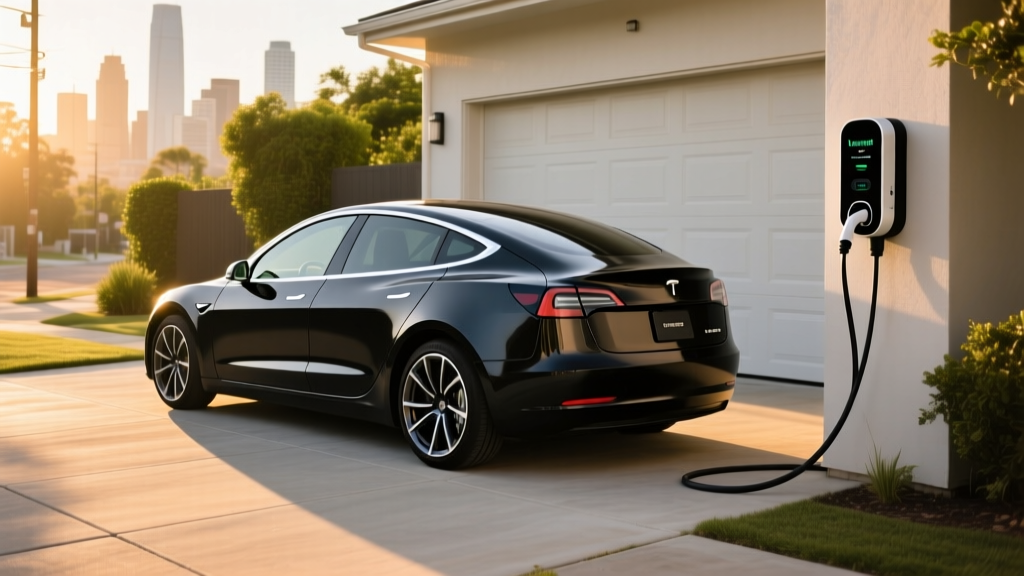
| Level 2 (240V, 48A) | 11.5 kW | ~44 mi/hr | Home Wall Connector; full overnight charge in ~7 hr |
| DC Fast (V3 Supercharger) | 250 kW peak | ~200 mi in 15 min | Peak rate at low SoC; tapers above 60% |
| DC Fast (V4 Supercharger) | Up to 250 kW | Similar to V3 | Newer stalls; CCS-native cable |
The critical insight: peak kW is not sustained kW. The Model Y will pull close to 250 kW only between roughly 10–30% state of charge. By 60% SoC, expect the rate to taper to ~120 kW, and above 80% it drops below 50 kW. This is why Tesla and the navigation system recommend charging to 80% on road trips — the time penalty from 80–100% often exceeds the time saved by skipping a stop.
Preconditioning is non-negotiable for fast charging. If you navigate to a Supercharger, the Model Y automatically warms the battery to optimize the charge curve. Arriving without preconditioning (e.g., at a non-Tesla CCS station without nav routing) can cut peak charge rates by 30–50% in cool weather.
Autopilot Hardware: HW3 vs HW4 vs AI5
The autopilot computer is the single most hardware-version-dependent system in the Model Y. Here's what separates them:
HW3 (AP3): Found in 2020–early 2023 Model Y vehicles. Eight cameras at 1.2 megapixels, dual-redundant computing chips. Capable of running FSD (Supervised), but Tesla has confirmed HW3 will receive a reduced feature set compared to HW4 as neural network models grow larger. If you're buying used with FSD transfer, verify the build date.
HW4 (AI4): Introduced mid-2023 and standard on all 2025–2026 Juniper Model Y vehicles. Higher-resolution cameras (up to 5 MP on front-facing), improved low-light performance, and a more powerful inference computer. Tesla has stated HW4 provides a "significantly longer" useful life for future FSD improvements. The Juniper also eliminates ultrasonic sensors entirely, relying on Tesla Vision (camera-only) for parking distance estimation.
AI5 (announced, expected late 2026+): Tesla has referenced a next-generation computer with roughly 5x the compute of HW4. Vehicles produced in later 2026 runs may begin receiving AI5, but this is not confirmed for all trims. If AI5 matters to you, check the vehicle's "Software" menu at delivery or ask your delivery advisor for the build computer part number.
Autopilot and FSD (Supervised) are SAE Level 2 driver-assistance systems. The driver must remain fully engaged, hands on or near the wheel, and eyes on the road at all times. These are not self-driving systems. Only Level 4 services like Waymo (in approved geo-fenced areas) operate without a human driver.
Pricing, Tax Credits, and Total Cost
The 2026 Model Y Long Range AWD starts at $47,990 before destination. The Performance trim is $52,490. Both fall under the IRS §30D federal tax credit MSRP cap of $80,000 for SUVs. However, eligibility is not automatic.
| Trim | Base MSRP | Federal Credit (max) | Effective Price | Key Caveats |
|---|---|---|---|---|
| Long Range AWD | $47,990 | Up to $7,500 | ~$40,490 | Income caps apply; battery sourcing rules |
| Performance AWD | $52,490 | Up to $7,500 | ~$44,990 | Income caps apply; battery sourcing rules |
- Income caps: Modified AGI ≤ $150,000 (single), $225,000 (head of household), $300,000 (joint)
- MSRP cap: ≤ $80,000 for SUVs (Model Y qualifies)
- Battery sourcing: Critical minerals and battery components must meet phased-in domestic/free-trade sourcing thresholds — check Tesla's website for current eligibility per trim, as this changes quarterly
- Point-of-sale transfer: You can transfer the credit to Tesla at purchase for an upfront price reduction, or claim it on your tax return
- VIN verification: Confirm the specific vehicle's credit status on fueleconomy.gov before signing
For ownership cost context, a Model Y Long Range driven 12,000 miles/year at the US average electricity rate of $0.17/kWh costs roughly $575/year in energy. A comparable gas SUV at 25 MPG combined and $3.40/gallon costs ~$1,630/year. Over five years, fuel savings alone offset ~$5,275 of the purchase price — before factoring in lower maintenance (no oil changes, reduced brake wear from regen).
Interior, Cargo, and Daily Practicality
The Juniper refresh overhauled the Model Y cabin with ventilated front seats, ambient lighting, a rear 8-inch touchscreen for passengers, power-folding second-row seats, and improved acoustic glass. Cargo space remains class-competitive at approximately 30.2 cubic feet behind the second row (76.2 cu ft with seats folded), plus a modest frunk for charging cables or a small bag.
Legroom is generous for the segment: 41.8 inches front, 37.7 inches rear. The panoramic glass roof creates an airy feel but does absorb some headroom — taller passengers (6'2"+) may notice the compromise. The 15.4-inch center touchscreen handles all vehicle controls; there is no traditional instrument cluster, and turn signals remain on the steering wheel (not stalk-mounted, as Tesla removed the stalk in the Juniper refresh).
Pros, Cons, and Who Should Buy
- Class-leading Supercharger network access (17,000+ stalls in North America)
- HW4 cameras and computer provide the longest FSD feature runway
- 250 kW DC charging with improved charge-curve sustain
- Juniper cabin upgrades close the interior-quality gap with rivals
- Over-the-air updates continuously add features post-purchase
- Strong resale value relative to most EV competitors
- No ultrasonic sensors — Tesla Vision parking assist is less precise than radar/USS
- Stalkless steering wheel (turn signals on wheel) frustrates some drivers
- FSD (Supervised) remains Level 2 and requires $8,000 or $99/month for uncertain long-term value
- Insurance premiums run 15–25% higher than comparable gas SUVs in most states
- Cold-weather range loss is meaningful without garage parking and preconditioning
- Choose the Model Y Long Range if: You commute 30–60 miles daily, road-trip 2–4 times per year, have Level 2 home charging, and want the broadest Supercharger coverage.
- Choose the Performance trim if: You prioritize acceleration (3.5s 0–60) and sport handling over ~25 miles of range and are willing to pay the $4,500 premium.
- Look at the Hyundai Ioniq 5 or Ford Mustang Mach-E instead if: You prefer physical controls, need 800V ultra-fast charging (Ioniq 5), or want a more traditional dealership service experience.
Battery and Powertrain Warranty
Tesla covers the Model Y battery and drive unit for 8 years or 120,000 miles (Long Range/Performance), whichever comes first, with a minimum 70% capacity retention threshold. The basic vehicle limited warranty is 4 years or 50,000 miles. These terms are competitive with the industry standard (Hyundai offers 10yr/100,000mi on the battery, which is more generous on duration).
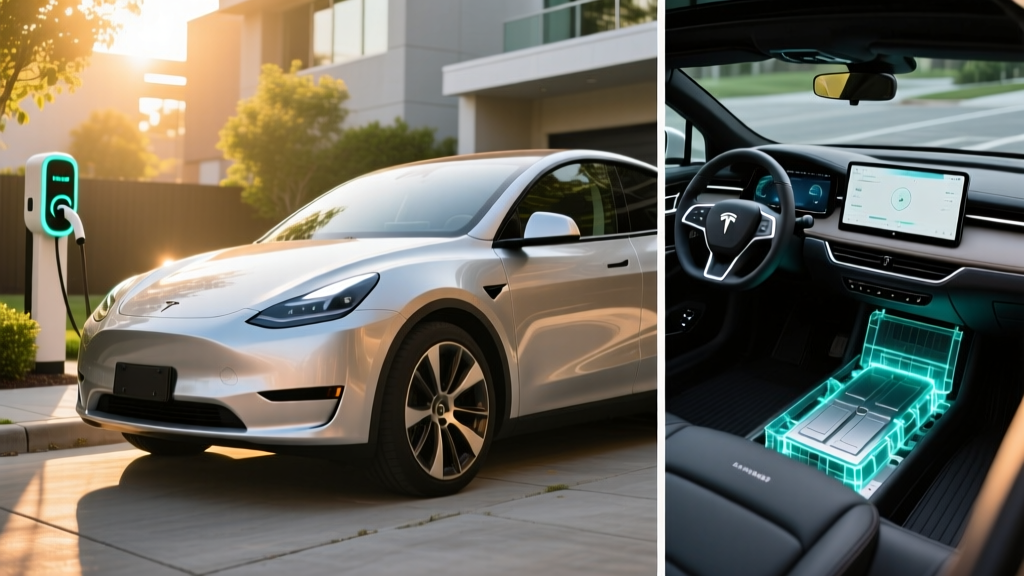
For battery chemistry: the Long Range and Performance trims use NMC (nickel manganese cobalt) 2170 cells, which offer higher energy density but are more sensitive to sustained 100% state of charge. Tesla recommends daily charging to 80–90% for NMC packs and 100% only for trips. The base RWD trim, where available, uses LFP (lithium iron phosphate) chemistry, which Tesla recommends charging to 100% regularly — a better fit for drivers without home Level 2 who rely on public charging.
Frequently Asked Questions
What is the real-world range of the 2026 Tesla Model Y?
The EPA rates the Long Range AWD at 320 miles. In real-world highway driving at 75 mph in moderate temperatures, expect 270–290 miles. In freezing weather, plan for 220–255 miles. Always precondition in cold weather to minimize losses.
How fast does the Model Y charge at home and on DC fast chargers?
On a Level 2 home charger (11.5 kW / 48A), the Model Y adds roughly 44 miles per hour — a full charge takes about 7 hours. On a V3 or V4 Supercharger, it peaks at 250 kW, adding up to 200 miles in 15 minutes (10–80% in approximately 25 minutes). Charging slows significantly above 80% SoC.
How much does the 2026 Model Y cost after tax credits?
The Long Range AWD starts at $47,990. If you qualify for the full $7,500 §30D federal credit (income caps, battery sourcing, and MSRP rules apply), the effective price drops to approximately $40,490. Verify your specific vehicle's eligibility on fueleconomy.gov and consult a tax professional.
Is the Model Y worth buying vs. the Ioniq 5 or Mach-E?
The Model Y wins on Supercharger network access, software ecosystem, and resale value. The Hyundai Ioniq 5 offers 800V architecture for faster peak charging (~18 min 10–80% on 350 kW chargers) and a more distinctive design. The Ford Mach-E provides a more traditional interior with physical controls. Test-drive all three — the "best" EV is the one whose charging logistics and ergonomics fit your daily routine.
What hardware version does the 2026 Model Y have?
All 2026 Juniper Model Y vehicles ship with HW4 (AI4) autopilot hardware, featuring higher-resolution cameras and an upgraded inference computer vs. the HW3 in 2020–early 2023 models. Tesla has announced AI5 for future production, but it is not confirmed for early-to-mid 2026 builds.
Does the 2026 Model Y qualify for the federal EV tax credit?
It can, but eligibility depends on your income (AGI caps apply), the vehicle's battery component and critical-mineral sourcing (which Tesla updates quarterly), and the MSRP cap ($80,000 for SUVs — the Model Y clears this). Always verify the specific VIN on fueleconomy.gov before purchase and review IRS §30D guidance.
Sources: EPA Fuel Economy (fueleconomy.gov), Tesla official specifications, IRS §30D Clean Vehicle Credit guidance. Pricing and tax credit rules reflect 2026 model year data and are subject to change. Consult a tax professional for personal eligibility.