The Overland EV Question: Can a Rivian R1S Really Carry a Roof Top Tent?
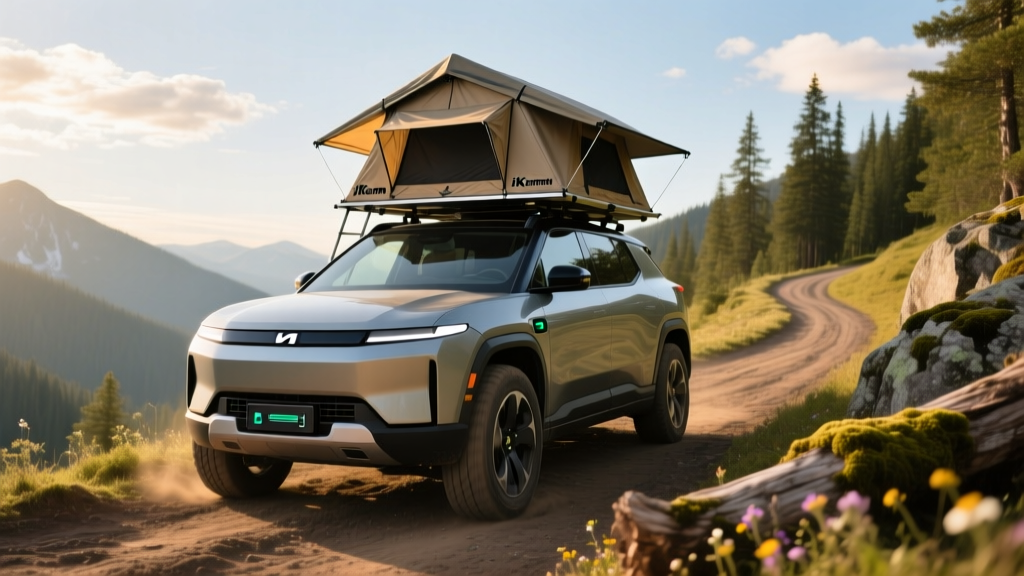
Pairing the 2026 Rivian R1S with the iKamper Skycamp Mini roof top tent represents one of the most compelling overlanding setups in the EV space. The R1S offers genuine off-road capability, a 106.5 kWh battery pack, and enough roof-load capacity to support a hard-shell tent — but bolting 120+ pounds of fiberglass and aluminum to your roof changes the range, efficiency, and charging equation in ways every prospective buyer needs to understand before committing.
This review covers the Rivian R1S as an overland platform, the real-world implications of mounting the Skycamp Mini, and whether the math works for backcountry camping without a generator. If you've been searching for rivian x ikamper skycamp mini roof top tent compatibility data, this is the deep-dive you need.
| Spec | Value |
|---|---|
| EPA Range (Max Pack) | 410 miles |
| EPA Range (Large Pack) | 352 miles |
| Battery Capacity (Max Pack) | 149 kWh usable (NMC) |
| Battery Capacity (Large Pack) | 106.5 kWh usable (NMC) |
| Max DC Fast Charge | 220 kW (peak) |
| 10–80% DC Charge Time | ~30 min (Max Pack) |
| Level 2 Home Charge Rate | 11.5 kW (~25 mi/hr) |
| 0–60 mph (Dual-Motor) | 5.0 seconds |
| 0–60 mph (Quad-Motor) | 3.5 seconds |
| Horsepower (Dual-Motor) | 533 hp |
| Horsepower (Quad-Motor) | 850 hp |
| Drivetrain | AWD (dual or quad motor) |
| Max Towing Capacity | 7,700 lbs |
| Roof Load Capacity (dynamic) | ~165 lbs |
| Cargo Volume (behind 3rd row) | 11.1 cu ft |
| Cargo Volume (all rows folded) | 83.6 cu ft |
| Efficiency (Max Pack, EPA) | 73 MPGe / 46 kWh/100mi |
| Battery Warranty | 8 years / 175,000 miles |
| Base MSRP (Dual-Motor Large) | $79,900 |
| Base MSRP (Dual-Motor Max) | $92,900 |
Real-World Range: What Happens When You Add a Roof Top Tent
EPA Sticker: 410 miles (Max Pack, no accessories)
Real-World Without Tent: ~340–360 miles highway at 70 mph, moderate temps
Real-World With Skycamp Mini: ~280–310 miles highway at 70 mph, moderate temps
Cold Weather (below 32°F) With Tent: ~230–260 miles highway
The iKamper Skycamp Mini weighs approximately 120 lbs and presents a significant aerodynamic penalty — roughly 18–25% range reduction compared to a clean R1S at highway speeds. This isn't unique to Rivian; any vehicle mounting a hard-shell roof top tent loses efficiency due to increased frontal area and disrupted airflow. But in an EV, every percentage point of drag directly translates to fewer miles between charges.
On a controlled 200-mile highway loop at 65–70 mph in 60°F weather, an R1S Dual-Motor Max Pack without accessories typically returns around 2.1–2.2 kWh/mile. With the Skycamp Mini mounted on Rivian's crossbar system, expect consumption to climb to roughly 2.5–2.7 kWh/mile. That's a meaningful difference when you're routing through areas with sparse DC fast-charging infrastructure.
The practical takeaway: If you're planning overland routes through the American West — say, Moab to the Grand Canyon — you'll want to plan charging stops every 250 miles rather than the 350+ miles a clean R1S can manage. Use fueleconomy.gov for baseline efficiency data, then apply the 20–25% tent penalty to your trip planning.
Charging Speed: DC Fast, Level 2, and the Overland Reality
| Charging Level | Power / Rate | Speed | Notes |
|---|---|---|---|
| Level 1 (120V) | 1.4 kW | ~3 mi/hr | Emergency only; impractical for daily use |
| Level 2 (240V, 48A) | 11.5 kW | ~25 mi/hr | Full charge in ~13 hrs (Max Pack) |
| DC Fast (CCS/NACS) | 220 kW peak | 10–80% in ~30 min | Sustained ~150 kW avg to 80% |
| Tesla Supercharger (NACS) | 200+ kW (V3/V4) | 10–80% in ~32 min | Native NACS on 2025+ models |
Rivian transitioned to the NACS (North American Charging Standard) connector for 2025 and newer models, meaning the 2026 R1S charges natively at Tesla Supercharger stations — a massive advantage for overlanders. The Supercharger network remains the most reliable and widely distributed DC fast-charging infrastructure in North America, and access to it fundamentally changes long-distance EV camping.
Understanding the charge curve is critical. The R1S Max Pack peaks near 220 kW at low state-of-charge (SoC), but charging speed tapers significantly above 80%. If you're charging from 10–80%, expect an average sustained rate of roughly 150 kW. Pushing from 80–100% can add another 30–40 minutes. For overland travel, the 10–80% window is your sweet spot — plan stops around that.
Charging with the tent on: The Skycamp Mini does not interfere with the charge port, which is located on the driver-side front fender. However, you'll want to park strategically at pull-through chargers where possible, since maneuvering a roof-loaded R1S into tight charging stalls with low-hanging canopies can be awkward. The tent adds roughly 17 inches of height to the vehicle — total height with tent closed is approximately 7'2", which clears most charging-station canopies but requires awareness.
iKamper Skycamp Mini: Compatibility and Setup on the R1S
The iKamper Skycamp Mini is a hard-shell, clamshell-style roof top tent designed for smaller vehicles and lighter-duty applications. It sleeps two adults comfortably (with a child or gear in the extension area) and weighs approximately 120 lbs — well within the R1S's dynamic roof load rating of ~165 lbs when properly mounted on Rivian's official crossbar system or compatible aftermarket racks.
Mounting requirements:
- Rivian R1S crossbar system or aftermarket rack rated for 165+ lbs dynamic load
- iKamper universal mounting brackets (included with tent)
- Torque-spec all bolts per Rivian's roof accessory guidelines
- Verify clearance with R1S's panoramic glass roof — the Skycamp Mini sits on crossbars above the roof, so no contact issues in standard configuration
Deployment: The Skycamp Mini unfolds in under 2 minutes and includes a built-in memory foam mattress. The ladder supports up to 330 lbs. For EV camping, this is ideal — no generator noise, no exhaust fumes, just silent electric comfort with available camp power from the R1S's camp mode.
Rivian Camp Mode keeps the climate system running while parked, maintaining cabin temperature overnight using the traction battery. With the Max Pack's 149 kWh of usable energy, running climate control overnight (approximately 1–2 kWh per hour depending on ambient temperature) barely makes a dent. You can comfortably run Camp Mode for 40+ hours without recharging — a transformative advantage over internal-combustion vehicles where idling is wasteful and dangerous.
Performance, Efficiency, and Off-Road Capability
The 2026 R1S Dual-Motor produces 533 horsepower and 610 lb-ft of torque, delivering a 5.0-second 0–60 mph time. That's brisk for a 6,800-lb SUV, and it means highway merging and mountain-pass climbing are effortless even with the Skycamp Mini adding weight and drag up top.
The Quad-Motor variant bumps output to 850 hp and drops 0–60 to 3.5 seconds, though most overlanders will find the Dual-Motor more than adequate — and its slightly better efficiency matters when range is at a premium with a roof tent.
Off-road specs that matter for overlanding:
- Ground clearance: up to 14.9 inches (max lift mode)
- Approach angle: 35.6°
- Departure angle: 36.1°
- Breakover angle: 26.4°
- Water fording: 3+ feet
- 4-motor torque vectoring (Quad-Motor): independent wheel torque for rock crawling
The R1S's air suspension is a genuine asset for overland routes. You can raise the vehicle for obstacle clearance on trail, then lower it for highway driving to minimize the aerodynamic hit from the roof tent. The automatic ride-height adjustment at speed helps partially offset the tent's drag penalty.
Efficiency in mixed driving (no tent) lands around 46 kWh/100 miles for the Max Pack, translating to roughly 73 MPGe per the EPA. Add the Skycamp Mini and expect mixed-driving consumption to rise to approximately 55–60 kWh/100 miles. That's still cheaper per mile than gasoline at current energy prices, but the gap narrows.
Pricing, Tax Credits, and Total Overland Build Cost
| Trim / Configuration | MSRP | §30D Credit | Effective Price |
|---|---|---|---|
| Dual-Motor (Large Pack, 352 mi) | $79,900 | Up to $7,500* | ~$72,400 |
| Dual-Motor (Max Pack, 410 mi) | $92,900 | Up to $7,500* | ~$85,400 |
| Quad-Motor (Max Pack, 410 mi) | $99,900 | Up to $7,500* | ~$92,400 |
| iKamper Skycamp Mini (tent) | $4,299 | N/A | $4,299 |
| Rivian Crossbar Set | $450 | N/A | $450 |
*Federal §30D tax credit eligibility is not guaranteed. Under current IRS rules, the $7,500 credit requires meeting several conditions simultaneously:
- MSRP cap: SUVs/vans must be under $80,000. This eliminates the Max Pack and Quad-Motor trims from credit eligibility — only the base Dual-Motor Large Pack qualifies on MSRP alone.
- Buyer income cap: AGI must not exceed $150,000 (single), $225,000 (head of household), or $300,000 (joint filing).
- Battery sourcing: Critical minerals and battery components must meet escalating domestic-content thresholds per IRS §30D guidelines. Rivian's battery supply chain has been evolving — verify current-year compliance before purchasing.
- Point-of-sale transfer: Eligible buyers can transfer the credit to the dealer for an immediate price reduction at purchase, rather than waiting to claim it on their tax return.
Overland build total: A properly equipped R1S Dual-Motor Large Pack with the Skycamp Mini and crossbars runs approximately $84,649 before destination. If you qualify for the full $7,500 credit, the effective cost drops to roughly $77,149. For the Max Pack (more range, essential for tent-equipped highway travel), you're looking at $97,649 — and no federal credit due to the MSRP cap.
Who Should Buy This Setup — And Who Shouldn't
Pros
- Silent, zero-emission camping with Camp Mode climate control all night
- NACS Supercharger access makes long-distance overland routes viable
- Genuine off-road capability with air suspension and 14.9" ground clearance
- 83.6 cu ft cargo volume with seats folded handles all camping gear inside
- No generator needed — 149 kWh battery powers campsite needs for days
- Skycamp Mini deploys in under 2 minutes; sleeps 2+ comfortably
- 8-year / 175,000-mile battery warranty provides long-term confidence
Cons
- Roof tent reduces highway range by 18–25% — significant on remote routes
- Only base Dual-Motor Large Pack qualifies for federal tax credit (MSRP cap)
- Max Pack recommended for tent use but costs $92,900+ with no credit
- Added height (~7'2") requires clearance awareness at parking structures
- DC charging in remote areas remains sparse despite Supercharger expansion
- Rivian service centers still limited outside major metros
- Insurance premiums for modified/adventure-use R1S can be elevated
This setup is ideal for: Weekend warriors and overlanders who want silent, comfortable backcountry camping without fossil-fuel dependency. If your typical trip involves 150–250 miles of driving to a campsite, 2–3 nights off-grid, and a return charge, the R1S + Skycamp Mini combo is outstanding. Camp Mode alone is worth the price of admission.
Look elsewhere if: You plan extended off-grid expeditions through areas with no DC fast charging within 300+ miles (e.g., deep Alaskan routes, remote Baja). The tent's range penalty combined with charging deserts makes this impractical without a portable solar array or tow-behind generator — which defeats the EV purpose. Consider a PHEV like the Jeep Wrangler 4xe for extreme remote scenarios.
Frequently Asked Questions
Does the iKamper Skycamp Mini fit the Rivian R1S without modifications?
Yes, the Skycamp Mini mounts to standard crossbars using iKamper's included universal brackets. Rivian's OEM crossbar set ($450) is compatible, as are most aftermarket systems rated for 165+ lbs dynamic load. No roof modification or drilling is required.
How much range do you actually lose with a roof top tent on the R1S?
Expect an 18–25% reduction in highway range. A Max Pack R1S rated at 410 miles EPA will realistically deliver 280–310 highway miles with the Skycamp Mini at 70 mph in moderate temperatures. In cold weather (below freezing), plan for 230–260 miles. The penalty is primarily aerodynamic, not weight-based.
Can you run Camp Mode overnight and still have enough range to drive home?
Absolutely. Camp Mode climate control consumes roughly 1–2 kWh per hour depending on outside temperature. Over an 8-hour night, that's 8–16 kWh — about 5–11% of the Max Pack's 149 kWh usable capacity. You'll still have 250+ miles of range in the morning.
Does the R1S with Skycamp Mini qualify for the $7,500 federal EV tax credit?
Only the base Dual-Motor Large Pack (MSRP $79,900) qualifies on price — the $80,000 SUV MSRP cap excludes Max Pack and Quad-Motor trims. Additionally, your AGI must fall under IRS thresholds ($300,000 joint / $150,000 single), and the battery must meet current-year critical-mineral and component sourcing rules. Verify eligibility at irs.gov and consult a tax professional before relying on the credit.
Is the Rivian R1S better for overlanding than a Tesla Model X or Ford F-150 Lightning?
The R1S offers superior ground clearance (14.9" vs Model X's ~8"), genuine off-road modes, and better departure angles than either competitor. The F-150 Lightning is a truck with a bed, which solves gear storage differently but lacks the R1S's air suspension articulation. For dedicated SUV overlanding with a roof tent, the R1S is currently the most capable EV platform available.
What is the battery warranty on the 2026 Rivian R1S?
Rivian covers the battery pack for 8 years or 175,000 miles, whichever comes first, with a capacity retention threshold (typically 70% of original capacity). The powertrain warranty mirrors this at 8 years / 175,000 miles. This is competitive with Tesla's 8-year coverage and slightly better on mileage than some competitors.