Most Tesla Model Y shoppers focus on range and 0-60 times, but one spec quietly governs how much gear, how many passengers, and what trailer you can legally haul: the Gross Vehicle Weight Rating (GVWR). For the 2025–2026 Tesla Model Y (the refreshed "Juniper" generation), understanding GVWR, curb weight, and payload capacity is essential for buyers who plan to tow, carry heavy cargo, or simply want to know how close they'll run to the vehicle's legal weight limits on a loaded road trip.
This review breaks down the Model Y's weight ratings alongside the real-world range, charging performance, pricing, and ownership economics you need before signing the purchase agreement.
Tesla Model Y GVWR, Curb Weight & Payload by Trim
GVWR is the maximum allowable total weight of the vehicle including passengers, cargo, and the vehicle itself. Exceeding it voids warranty coverage, stresses suspension components, and can invalidate insurance in an accident. Here is how the 2026 Model Y lineup stacks up:
| Spec | Long Range RWD | Long Range AWD | Performance AWD |
|---|---|---|---|
| Curb Weight (lbs) | ~4,330 | ~4,497 | ~4,497 |
| GVWR (lbs) | ~5,512 | ~5,512 | ~5,512 |
| Payload Capacity (lbs) | ~1,182 | ~1,015 | ~1,015 |
| Max Towing (lbs, w/ hitch) | 3,500 | 3,500 | 3,500 |
| Drivetrain | Rear-Wheel Drive | Dual-Motor AWD | Dual-Motor AWD |
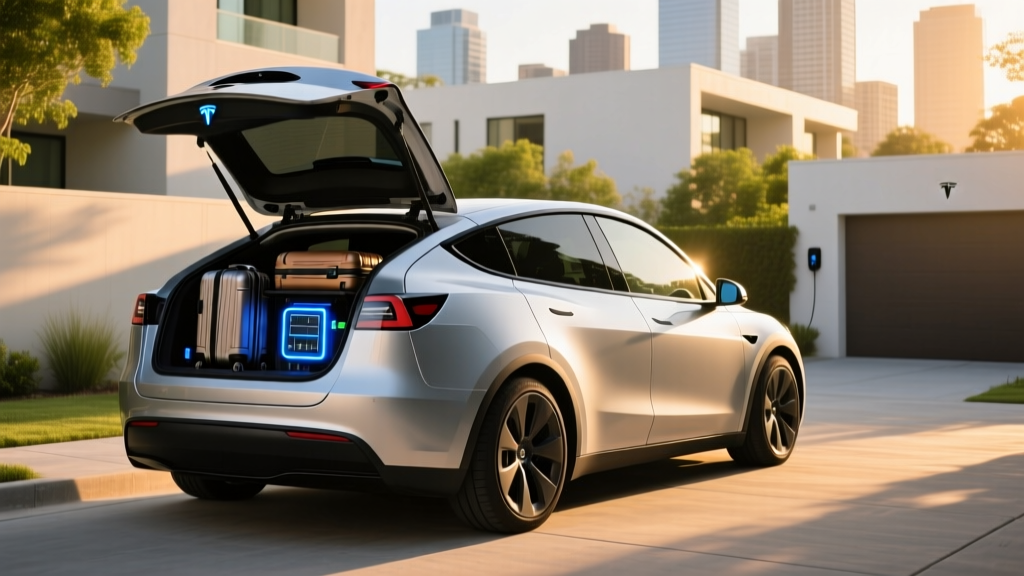
The roughly 1,000–1,180 lb payload figure is what matters most day-to-day. Five adults averaging 180 lb each consume 900 lb, leaving just 115–280 lb for luggage. If you regularly haul a full cabin plus rooftop cargo or a small utility trailer, you will approach the GVWR ceiling faster than in a midsize ICE SUV.
EPA Range vs. Real-World Range: What to Actually Expect
The Juniper-generation Model Y Long Range AWD carries an EPA-estimated 320 miles of range on its ~78.1 kWh usable battery pack (NMC chemistry). The RWD Long Range variant pushes slightly higher at 325 miles, while the Performance trim drops to roughly 295 miles due to stickier tires, larger wheels, and more aggressive power delivery.
| Trim | EPA Range | MPGe (Combined) | kWh/100 mi | Real-World Highway | Real-World Cold (30°F) |
|---|---|---|---|---|---|
| Long Range RWD | 325 mi | 122 MPGe | 27 | ~275 mi | ~230 mi |
| Long Range AWD | 320 mi | 119 MPGe | 28 | ~270 mi | ~225 mi |
| Performance AWD | 295 mi | 111 MPGe | 30 | ~250 mi | ~205 mi |
On a 70°F day at 65 mph, expect to see roughly 85–90% of the EPA sticker. In winter conditions with cabin heat running, plan for 70–75% of EPA range. The Model Y's heat pump helps mitigate cold-weather losses compared to older resistance-heated EVs, but physics still wins. Source: fueleconomy.gov.
Charging Speed: DC Fast, Level 2, and the Charge Curve
The Model Y's 400-volt architecture supports a peak DC fast-charge rate of 250 kW at V3/V4 Superchargers. In practice, the charge curve peaks early and tapers significantly above 60% State of Charge (SoC).
| Charging Method | Max Power | Speed / Time |
|---|---|---|
| DC Fast Charge (Supercharger V3/V4) | 250 kW peak | 10–80% in ~27 min; ~162 mi in 15 min |
| Level 2 Home (Tesla Wall Connector) | 11.5 kW (48A) | ~44 mi/hr of charging |
| Level 2 Home (32A mobile connector) | 7.7 kW | ~30 mi/hr of charging |
| Level 1 (120V standard outlet) | ~1.4 kW | ~4 mi/hr of charging |
Charge curve reality check: The 250 kW peak only sustains from roughly 5–30% SoC. From 30–60%, expect ~150–180 kW. Above 80%, the rate drops below 50 kW as the battery management system protects cell longevity. This means a 10–80% session takes about 27 minutes, but 10–95% takes closer to 50 minutes. Plan road-trip stops around the 80% mark to avoid wasting time at the tail end of the curve.
The Model Y now ships with the native NACS (North American Charging Standard) port, eliminating the need for adapters at Tesla Superchargers. CCS adapter use is supported for Electrify America and other non-Tesla DC networks.
Performance, Battery & Drivetrain Specs
| Spec | Long Range RWD | Long Range AWD | Performance AWD |
|---|---|---|---|
| 0–60 mph | 5.6 sec | 4.6 sec | 3.5 sec |
| Horsepower | ~346 hp | ~384 hp | ~456 hp |
| Torque (lb-ft) | ~339 | ~376 | ~450 |
| Battery (usable) | ~78.1 kWh (NMC) | ~78.1 kWh (NMC) | ~78.1 kWh (NMC) |
| Top Speed | 125 mph | 125 mph | 155 mph |
All 2026 Model Y trims use nickel-manganese-cobalt (NMC) lithium-ion cells. NMC offers higher energy density than LFP (lithium iron phosphate), which is why Tesla reserves LFP for the lower-priced Standard Range models in some markets. NMC packs benefit from charging to 80% daily and 100% only for long trips, whereas LFP packs tolerate regular 100% charges.
Pricing, Tax Credits & Total Cost
| Trim | Base MSRP | Est. As-Tested* | §30D Credit Eligible? | Effective Price |
|---|---|---|---|---|
| Long Range RWD | $44,990 | $46,490 | Yes (if qualified) | ~$37,490 |
| Long Range AWD | $47,990 | $49,990 | Yes (if qualified) | ~$40,490 |
| Performance AWD | $51,490 | $53,990 | Yes (if qualified) | ~$43,990 |
*As-tested includes destination fee and common options (FSD capability, paint upgrade).
IRS §30D Federal Tax Credit Rules (2026): The Model Y qualifies as an SUV under the IRS vehicle classification, meaning the $80,000 MSRP cap applies (all trims clear this). However, buyers must also meet:
- Income caps: Modified AGI ≤ $150,000 (single), ≤ $225,000 (head of household), ≤ $300,000 (married filing jointly)
- Battery sourcing: Increasing percentages of critical minerals and battery components must be sourced from the US or FTA partners — Tesla's supply chain has generally met these thresholds, but verify at purchase via the dealer/manufacturer compliance report
- Point-of-sale transfer: As of 2024+, you can transfer the credit to the dealer at purchase for an immediate price reduction rather than claiming it at tax time
Full eligibility details: IRS §30D Clean Vehicle Credits. Always consult a tax professional for your specific situation.
Cargo, Passenger Space & Practicality
The Model Y's hatchback design gives it a cargo advantage over traditional sedans but it faces stiff competition from the Hyundai Ioniq 5 and Ford Mustang Mach-E in interior volume.
| Measurement | Specification |
|---|---|
| Cargo (behind 2nd row) | 30.2 cu ft |
| Cargo (2nd row folded) | 72.1 cu ft |
| Front trunk (frunk) | 4.1 cu ft |
| Front legroom | 41.8 in |
| Rear legroom | 37.8 in |
| Seating capacity | 5 (optional 7-seat on Long Range) |
The optional third-row seat (available on Long Range trims) is best suited for small children — adults will find legroom and headroom severely compromised. For families needing genuine 7-passenger comfort, the Kia EV9 or Rivian RDS are more appropriate, though at significantly higher price points.
Technology, Driver Assistance & Drawbacks
The Juniper refresh brought a substantially updated interior: ventilated front seats, a rear touchscreen for passengers, ambient lighting, improved cabin noise isolation, and a redesigned center console. The 15.4-inch front touchscreen runs Tesla's latest software with native navigation, streaming, and over-the-air updates.
Autopilot & FSD (Supervised): Every Model Y ships with basic Autopilot (Traffic-Aware Cruise Control + Autosteer). Full Self-Driving (Supervised) remains a $8,000 add-on (or $99/month subscription). Critically, FSD is an SAE Level 2 system — the driver must remain fully engaged, hands on the wheel, and eyes on the road at all times. It is not autonomous driving.
Notable drawbacks:
- No Apple CarPlay or Android Auto — Tesla's proprietary infotainment only
- Minimalist interior lacks physical buttons for climate, mirrors, and glovebox (all screen-controlled)
- Ride quality on 20-inch wheels can be firm on rough pavement
- No heads-up display
- Insurance costs run 20–35% higher than comparable ICE crossovers in many states
Pros, Cons & Who Should Buy the Model Y
- Best-in-class Supercharger network access (17,000+ V3/V4 stalls in North America)
- Segment-leading efficiency (27–30 kWh/100 mi)
- Strong performance across all trims
- Continuous OTA software improvements
- Excellent safety ratings (NHTSA 5-Star, IIHS Top Safety Pick+)
- NACS native — no adapter needed at Superchargers
- GVWR/payload limits are tight for a full cabin plus cargo
- No CarPlay/Android Auto
- FSD costs $8,000 and remains Level 2 only
- Service center wait times remain long in some metro areas
- Build quality variability still reported by some owners
- Towing severely impacts range (40–50% loss)
- Commuters & tech-forward families: Supercharger access, strong range, and low running costs make it ideal for daily driving and road trips
- Choose Model Y over Mach-E/Ioniq 5 if: Supercharger reliability is your top priority and you value software integration
- Look elsewhere if: You regularly tow heavy loads (consider Rivian R1S), need 7 adult-passenger seating (Kia EV9), or require CarPlay (Hyundai Ioniq 5)
Warranty Coverage
| Coverage | Term |
|---|---|
| Basic Vehicle | 4 years / 50,000 miles |
| Battery & Drive Unit | 8 years / 120,000 miles (Long Range & Performance) |
| Battery Capacity Retention | Minimum 70% over warranty period |
The 8-year/120,000-mile battery warranty is competitive within the segment. Tesla guarantees the pack will retain at least 70% of its original capacity during the warranty window. Real-world degradation data from fleet operators suggests NMC packs typically lose 8–12% capacity over the first 100,000 miles, well within the warranty threshold.
Frequently Asked Questions
What is the Tesla Model Y GVWR?
The 2026 Tesla Model Y has a GVWR of approximately 5,512 lb across all trims. This is the maximum legal total weight including the vehicle, passengers, cargo, and tongue weight from any trailer.
What is the real-world range of the Model Y?
Expect roughly 270 miles on the highway in mild weather for the Long Range AWD (EPA 320 mi). In cold weather (below 35°F), plan for 225 miles. Loaded to near GVWR, subtract another 5–8%.
How fast does the Model Y charge?
Peak DC fast-charge rate is 250 kW at a V3/V4 Supercharger, achieving 10–80% in approximately 27 minutes. At home on a Tesla Wall Connector (11.5 kW / 48A), you'll add roughly 44 miles of range per hour of charging.
Does the Tesla Model Y qualify for the federal EV tax credit?
Yes, all 2026 Model Y trims fall under the $80,000 SUV MSRP cap for the §30D credit. However, buyer income limits ($150K single / $300K joint) and battery-sourcing requirements apply. Verify eligibility at IRS.gov before purchasing.
Is the Model Y worth buying vs. competitors?
The Model Y remains the benchmark for efficiency and charging infrastructure. The Hyundai Ioniq 5 offers faster 800V charging, CarPlay, and a more comfortable ride. The Ford Mustang Mach-E provides a more traditional interior layout. Choose the Model Y if Supercharger access and software integration are your top priorities.
Can I tow with the Model Y?
Yes, up to 3,500 lb with the factory tow hitch. However, towing near max capacity will reduce range by 40–50% at highway speeds. A 3,000 lb trailer on a Long Range AWD means planning Supercharger stops every ~150 miles.