Quick Verdict: The Model Y as a Gaming Platform
If you've searched for "gaming on Tesla" and landed here, you already know the Model Y's 15.4-inch center touchscreen isn't just for navigation. Tesla's infotainment OS supports a growing library of casual and mid-core games — from Stardew Valley and Cuphead to Cyberpunk 2077 (yes, really) — playable while parked. But an EV purchase shouldn't hinge on its arcade mode. This review covers the full 2026 Tesla Model Y Long Range AWD package: real-world range, charging speed, cabin space, pricing, and whether it still holds the midsize electric-SUV crown against the Hyundai Ioniq 5, Ford Mustang Mach-E, and Chevrolet Equinox EV.
EPA sticker: 310 miles (Long Range AWD, 19-inch wheels). Real-world highway driving at 70 mph typically yields 265–285 miles. In sub-30°F winter conditions with cabin heat, expect 220–250 miles before needing a charger. The heat pump helps, but cold chemistry is physics.
2026 Model Y Specs at a Glance
| Attribute | 2026 Model Y Long Range AWD |
|---|---|
| EPA Range | 310 miles |
| Battery (usable) | ~78 kWh, NMC chemistry |
| Drivetrain | Dual-motor AWD |
| Horsepower | 384 hp |
| 0–60 mph | 4.8 seconds |
| Peak DC Fast Charge | 250 kW (Supercharger V3/V4) |
| 10–80% DC Time | ~27 minutes |
| Level 2 Home Charge | 11.5 kW / ~37 mi/hr |
| MPGe (combined) | 111 MPGe |
| Efficiency | 30 kWh/100 mi |
| Cargo (rear seats up) | 30.2 cu ft |
| Cargo (rear seats folded) | 72.0 cu ft |
| Rear Legroom | 38.8 inches |
| Battery Warranty | 8 yr / 120,000 mi |
| Base MSRP | $44,990 (before incentives) |
Source: fueleconomy.gov and Tesla's official 2026 spec sheet.
Gaming on Tesla: Hardware, Library, and the Parked-Only Rule
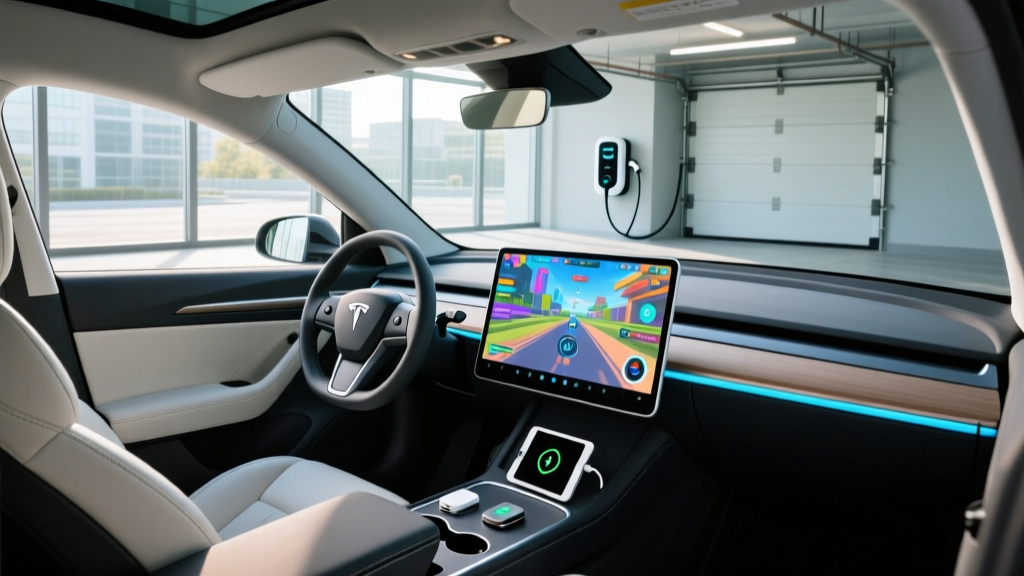
The Model Y's AMD Ryzen-based infotainment processor (introduced with the "Ryzen MCU") delivers console-grade responsiveness. The 15.4-inch 2K touchscreen handles touch inputs with minimal latency, and Tesla supports Bluetooth game controllers — including Xbox Wireless and PlayStation DualSense — for titles that benefit from physical inputs.
The game library spans several categories:
- Casual: Solitaire, Sudoku, 2048, Backgammon
- Indie / Mid-Core: Stardew Valley, Cuphead, Stardew Valley, Beach Buggy Racing 2
- AAA Ports: Cyberpunk 2077 (streamed/optimized for Tesla hardware)
- Multiplayer: Select titles support local split-screen or online play via the car's LTE/5G connection
The catch: Tesla enforces a hard Park-only lock. The vehicle must be in Park with the parking brake engaged; games are disabled the instant you shift to Drive. This is a deliberate safety measure and non-negotiable. Gaming on Tesla is a charging-session pastime, not a commute companion.
Where this actually matters: on a 27-minute DC fast-charge stop, you're not staring at a progress bar. You're two rounds into Cuphead before the car tells you it's at 80%. That's a genuine quality-of-life advantage over competitors whose screens offer little beyond a charging animation.
Charging Speed: Supercharger Network and Home Setup
The 2026 Model Y Long Range AWD peaks at 250 kW on Tesla Supercharger V3 and V4 stalls. The charge curve is front-loaded: you'll see 250 kW from roughly 10–30% State of Charge, then a taper to ~150 kW through 60%, and a further drop above 80%. The 10–80% sprint takes approximately 27 minutes under ideal thermal conditions.
| Charging Level | Power | Miles Added per Hour | Best Use Case |
|---|---|---|---|
| Level 1 (120V household) | ~1.4 kW | ~4 mi/hr | Emergency / trickle |
| Level 2 (240V Wall Connector) | 11.5 kW | ~37 mi/hr | Daily home charging |
| DC Fast (Supercharger V3/V4) | Up to 250 kW | ~1,000+ mi/hr (peak) | Road trips |
Home charging reality: The Tesla Wall Connector ($420 hardware) on a 60-amp circuit delivers the full 11.5 kW (48A continuous). Expect a licensed electrician to charge $800–$2,000 for a straightforward install near your panel. If your home has a 100-amp main panel, a $1,500–$3,000 panel upgrade to 200 amps may be required — factor this into your budget.
Preconditioning matters. Navigate to a Supercharger via the car's built-in routing, and the battery thermal management system will warm or cool the pack en route to optimize charge acceptance. Skip this (e.g., by driving to a charger without nav routing) and your first 5–10 minutes of charging may be significantly slower, especially in cold weather.
Real-World Range: What 310 EPA Miles Actually Means
The EPA's 310-mile estimate assumes a mix of city and highway driving at moderate temperatures. In practice, the Model Y Long Range AWD's efficiency varies considerably by scenario:
- City / suburban (40–55 mph, mild weather): 300–320 miles achievable. Regenerative braking recaptures energy in stop-and-go traffic.
- Highway (70–75 mph, 65°F): 265–285 miles. Aero drag dominates at speed; the Model Y's 0.23 Cd helps but can't eliminate physics.
- Winter highway (30°F, cabin heat on): 220–250 miles. The heat pump is more efficient than resistive heating, but cold batteries hold less usable energy and cabin demand is high.
- Towing (with optional tow package, 3,500-lb max): 160–200 miles depending on trailer weight and terrain.
At 30 kWh/100 miles combined, the Model Y is among the most efficient vehicles in its class. For context, the Hyundai Ioniq 5 AWD returns 110 MPGe combined — very close — while the Ford Mustang Mach-E Extended Range AWD sits at 101 MPGe. Efficiency translates directly to charging cost: at the US average residential electricity rate of ~$0.17/kWh, a full home charge costs roughly $13.26 for 310 miles, or about 4.3 cents per mile.
Pricing, Trims, and Federal Tax Credit Eligibility
The 2026 Model Y is offered in three trims:
- Long Range RWD: ~$42,990 — 320-mile EPA range (est.), single-motor
- Long Range AWD: $44,990 — 310-mile EPA range, dual-motor
- Performance AWD: ~$48,990 — 285-mile EPA range, 3.5-sec 0–60
| Trim | Base MSRP | Est. Federal Credit (§30D) | Effective Price (before state incentives) |
|---|---|---|---|
| Long Range RWD | $42,990 | Up to $7,500 | ~$35,490 |
| Long Range AWD | $44,990 | Up to $7,500 | ~$37,490 |
| Performance AWD | $48,990 | Up to $7,500 | ~$41,490 |
Critical tax-credit caveats: The IRS §30D Clean Vehicle Credit has several gates you must pass:
- MSRP cap: SUVs must be under $80,000. All Model Y trims clear this easily.
- Income cap: Modified AGI must not exceed $300,000 (joint), $225,000 (head of household), or $150,000 (single).
- Battery sourcing: Critical minerals and battery components must meet phased-in domestic/free-trade-area sourcing thresholds. Tesla has shifted significant supply-chain sourcing to North America, but eligibility can change — verify the current VIN-level status on fueleconomy.gov before purchasing.
- Point-of-sale transfer: As of 2024, you can transfer the credit to the dealer at purchase, reducing your out-of-pocket cost immediately rather than waiting for a tax refund. Confirm with your tax professional.
Interior, Tech, and Driver Assistance
The 2026 Model Y "Juniper" refresh brought meaningful cabin improvements: ventilated front seats, ambient lighting, a rear-seat touchscreen for climate and media control, power-folding second-row seats, and improved acoustic glass reducing highway noise by several decibels.
Infotainment highlights:
- 15.4-inch center touchscreen with AMD Ryzen processor
- Native Spotify, Netflix, YouTube, Twitch (parked), and web browser
- Bluetooth controller support for gaming library
- Dashcam and Sentry Mode recording (requires USB drive)
- Over-the-air updates adding features monthly
Driver assistance — Autopilot and FSD (Supervised):
Tesla Autopilot and Full Self-Driving (Supervised) are SAE Level 2 driver-assistance systems. You must keep your hands on the wheel and eyes on the road at all times. The car does not drive itself. FSD (Supervised) can navigate on-ramps, stop lights, and city streets, but requires continuous driver supervision. Only Level 4 services like Waymo operate without a human driver — and those are geofenced robotaxis, not consumer vehicles.
Autopilot (basic) is standard and includes adaptive cruise control and lane-centering. FSD (Supervised) remains an $8,000 add-on or $99/month subscription. Its value proposition depends heavily on your commute; it excels on well-marked highways but still requires intervention in construction zones, unmapped areas, and adverse weather.
Pros, Cons, and Competitor Comparison
- Class-leading Supercharger network reliability — 250 kW peak, 27-min 10–80%
- Best-in-class gaming and infotainment experience (parked)
- 310-mile EPA range with strong real-world efficiency (30 kWh/100 mi)
- Excellent cargo versatility (72 cu ft folded, available 7-seat option)
- OTA updates continuously improve the vehicle post-purchase
- Strong resale value relative to EV segment average
- No physical stalks — turn signals and wipers are steering-wheel buttons (Juniper)
- Rear-seat headroom is tight for 6'+ passengers due to sloping roofline
- FSD (Supervised) is expensive and still requires full driver attention
- Insurance premiums run 15–25% above segment average in many states
- No Apple CarPlay or Android Auto — Tesla's ecosystem is closed
- NACS connector is now standard, but CCS adapters needed for some public chargers
Choose the Hyundai Ioniq 5 if: You want 800V ultra-fast charging (10–80% in ~18 min), prefer physical controls, or need V2L (vehicle-to-load) to power devices from your car.
Choose the Ford Mustang Mach-E if: You prefer a more traditional driving feel, want Apple CarPlay/Android Auto, or find better local dealer pricing and service access.
Warranty and Long-Term Battery Outlook
Tesla covers the Model Y battery and drive unit for 8 years or 120,000 miles (whichever comes first), with a minimum 70% capacity retention threshold. The limited vehicle warranty is 4 years / 50,000 miles.
The Long Range AWD uses NMC (nickel manganese cobalt) chemistry, which offers higher energy density than LFP but is more sensitive to sustained high-state-of-charge storage. Best practice: set your daily charge limit to 80–90% and only charge to 100% before long road trips. Tesla's battery management system (BMS) and liquid thermal management have proven effective — fleet data from high-mileage Model 3/Y vehicles shows typical degradation of 8–12% at 100,000 miles, with most loss occurring in the first 20,000 miles before stabilizing.
Frequently Asked Questions
Can you play games on a Tesla while driving?
No. Tesla enforces a Park-only lock on all gaming features. The vehicle must be stationary with the parking brake engaged. Attempting to shift to Drive while a game is active immediately suspends the game. This is a safety-critical restriction and cannot be bypassed.
What controllers work for gaming on Tesla?
Tesla supports Bluetooth game controllers including Xbox Wireless Controllers (Series X/S and later), PlayStation DualSense, and several third-party Bluetooth controllers. USB controllers are also supported in some configurations. Check Tesla's support page for the current compatibility list, as it updates with OTA releases.
Does the 2026 Model Y qualify for the $7,500 federal tax credit?
The Model Y qualifies in principle — its MSRP is well under the $80,000 SUV cap, and Tesla has worked to meet critical-mineral and battery-component sourcing requirements. However, your personal eligibility depends on income limits ($300K joint / $150K single) and the current sourcing status of the specific VIN you purchase. Always verify on fueleconomy.gov and consult a tax professional before relying on the credit.
How much does it cost to charge a Model Y at home vs. Supercharging?
At the US average residential rate of ~$0.17/kWh, a full 78-kWh home charge costs about $13.26. Supercharger pricing varies by location and time of day but averages $0.25–$0.40/kWh, making a full Supercharger session $19.50–$31.20. Most owners do 80–90% of charging at home, where cost per mile drops to roughly 4 cents.
Is the Model Y good for road trips?
Yes, with planning. The Supercharger network remains the most reliable DC fast-charging ecosystem in the US, with stalls spaced every 150–200 miles along major corridors. At 250 kW peak and ~27 minutes per 10–80% stop, road-trip downtime is manageable. Use the built-in trip planner for automatic battery preconditioning. For rural routes with limited Supercharger coverage, a CCS adapter (sold by Tesla) expands your options to Electrify America and other networks.
What's the biggest drawback of the 2026 Model Y?
The removal of physical turn-signal stalks in the Juniper refresh is polarizing — turn signals are now buttons on the steering wheel rim, which many drivers find unintuitive during roundabouts or lane changes. Combined with the lack of Apple CarPlay/Android Auto and above-average insurance costs, these are the most common owner complaints.
Safety data: The 2026 Model Y earned a 5-Star Overall Safety Rating from NHTSA and a TOP SAFETY PICK+ designation from IIHS.