The Tesla Trunk in Front: Why the Frunk Matters for Real-World Cargo
Search for "tesla trunk in front" and you'll find a mix of curiosity and confusion. The front trunk — or frunk — is a hallmark of electric vehicle design. Without an engine block, EVs reclaim space under the hood that gas cars waste. But not all frunks are created equal, and Tesla's approach has evolved significantly across its lineup.
For the 2026 model year, the Tesla Model Y offers the most practical frunk in Tesla's current fleet. It's the vehicle most buyers are cross-shopping when they research Tesla's front-trunk utility. This review examines exactly how much space you get, how usable it is, and pairs that with a full breakdown of the Model Y's range, charging, pricing, and ownership profile so you can decide if it's the right EV for your cargo needs.
Frunk Dimensions and Cargo Capacity: What Fits Up Front
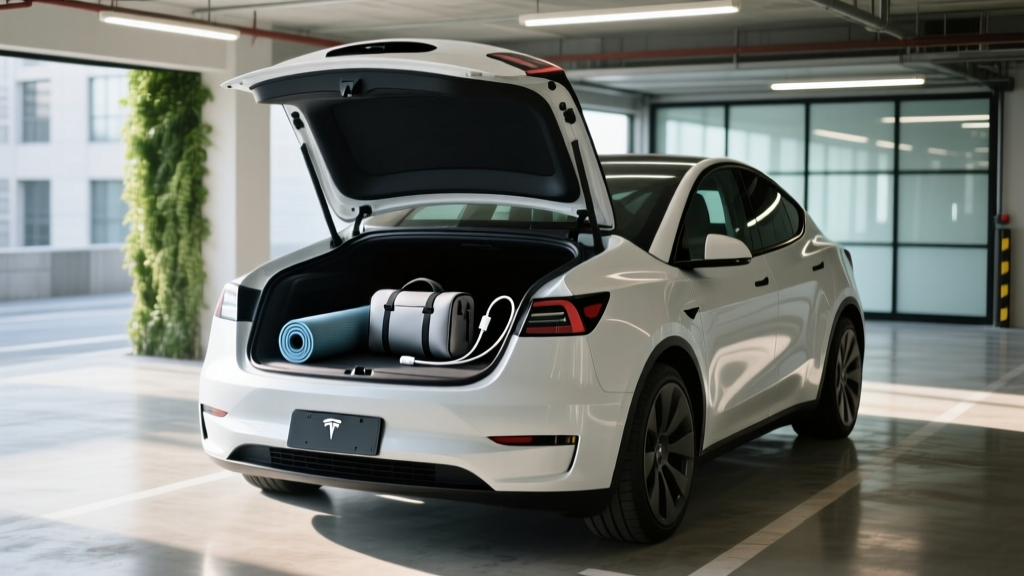
The 2026 Tesla Model Y's frunk provides approximately 4.1 cubic feet of storage space. That's enough for a medium carry-on suitcase, a laptop bag and groceries for two, or charging cables and emergency supplies you want separated from the main cabin.
By comparison, the Model 3's frunk offers roughly 3.1 cubic feet — noticeably tighter and more of a shallow basin than a true cargo compartment. The Model S frunk sits around 5.3 cubic feet, and the Model X offers about 6.7 cubic feet thanks to its larger platform.
| Model | Frunk Volume (cu ft) | Rear Cargo (cu ft) | Total Cargo (cu ft) |
|---|---|---|---|
| Model 3 | 3.1 | 23.0 | 26.1 |
| Model Y | 4.1 | 30.2 (76.2 seats folded) | 34.3 / 80.3 |
| Model S | 5.3 | 26.3 | 31.6 |
| Model X | 6.7 | 42.5 (88.4 seats folded) | 49.2 / 95.1 |
The Model Y's frunk is lined with a molded plastic tub that's easy to wipe clean — practical for muddy shoes, gym bags, or takeout that might leak. It lacks a 12V power outlet (unlike some competitors' frunks), and the opening mechanism is power-operated via the touchscreen or app. There's no physical release latch inside the frunk itself, which is worth knowing in case of an electrical failure — Tesla includes a manual release cable tucked behind the front bumper trim.
2026 Model Y: Range, Battery, and Real-World Efficiency
The frunk is only part of the ownership equation. The 2026 Tesla Model Y is available in three trims, each with distinct range and powertrain characteristics.
| Spec | Long Range RWD | Long Range AWD | Performance |
|---|---|---|---|
| EPA Range | 320 miles | 310 miles | 285 miles |
| Battery (usable) | ~75 kWh (NMC) | ~75 kWh (NMC) | ~75 kWh (NMC) |
| Drivetrain | Rear-Wheel Drive | Dual-Motor AWD | Dual-Motor AWD |
| Horsepower | 346 hp | 384 hp | 510 hp |
| 0-60 mph | 5.8 sec | 4.8 sec | 3.5 sec |
| MPGe (combined) | 122 MPGe | 117 MPGe | 111 MPGe |
| Efficiency | 28 kWh/100mi | 29 kWh/100mi | 30 kWh/100mi |
| Base MSRP | $44,990 | $47,990 | $52,490 |
Tesla uses NMC (nickel manganese cobalt) battery chemistry across the Model Y lineup. NMC offers higher energy density than LFP (lithium iron phosphate), which translates to more range in a lighter pack. The trade-off: NMC batteries prefer not to sit at 100% state of charge for extended periods. Tesla recommends daily charging to 80-90% and only charging to 100% before long trips. This is a meaningful ownership consideration versus LFP-equipped vehicles like the base Model 3 RWD, where daily 100% charging is encouraged.
Charging Speed: DC Fast Charging and Home Level 2
Charging speed is where Tesla's Supercharger network advantage becomes tangible. The 2026 Model Y supports a peak DC fast-charge rate of 250 kW on V3 Superchargers.
| Charging Level | Power / Rate | Speed (miles added per hour) | Notes |
|---|---|---|---|
| Level 1 (120V) | ~1.4 kW | ~3-5 mi/hr | Emergency/trickle only |
| Level 2 (240V, 48A) | 11.5 kW | ~37 mi/hr | Home Wall Connector; full charge ~8 hrs |
| Level 2 (240V, 32A) | 7.7 kW | ~25 mi/hr | Mobile Connector on 240V dryer outlet |
| DC Fast (V3 Supercharger) | Peak 250 kW | ~162 mi in 15 min | 10-80% in ~25 min; tapers above 80% |
| DC Fast (CCS station w/ adapter) | Up to ~150 kW | Varies by station | Requires Tesla CCS adapter (included) |
Understanding the charge curve: The 250 kW peak is not sustained across the entire session. The Model Y hits peak charge rate between roughly 10-30% state of charge, then progressively tapers. By 60% SoC, you're typically seeing 100-120 kW. By 80%, it drops to around 50-60 kW. This is why manufacturers quote 10-80% times rather than 0-100% — charging the final 20% can take nearly as long as the first 70%.
At home, Tesla's Wall Connector at 48 amps adds about 37 miles of range per hour. For most owners, plugging in overnight means starting every day with a full charge. Installation costs vary widely — expect $500-$2,000 depending on whether your electrical panel needs an upgrade to support a 60-amp circuit (which the 48A continuous draw requires).
Pricing, Trims, and Federal Tax Credit Eligibility
The 2026 Model Y starts at $44,990 for the Long Range RWD — a significant price reduction from the $52,990+ pricing we saw in 2023. Tesla has aggressively repositioned the Model Y to compete with the Hyundai Ioniq 5, Ford Mustang Mach-E, and Chevrolet Equinox EV.
| Trim | MSRP | Est. Federal Credit (§30D) | Effective Price |
|---|---|---|---|
| Long Range RWD | $44,990 | Up to $7,500* | ~$37,490 |
| Long Range AWD | $47,990 | Up to $7,500* | ~$40,490 |
| Performance | $52,490 | Up to $7,500* | ~$44,990 |
*Critical tax credit caveats: The IRS §30D federal tax credit has strict eligibility requirements that change frequently:
- MSRP cap: SUVs/vans/pickups must be under $80,000 — all Model Y trims qualify.
- Income cap: Modified AGI must not exceed $150,000 (single), $225,000 (head of household), or $300,000 (joint).
- Battery sourcing: Critical minerals and battery components must meet phased-in domestic sourcing thresholds. Tesla has largely restructured its supply chain to meet these requirements, but eligibility can shift with regulatory updates.
- Point-of-sale transfer: As of 2024, you can transfer the credit to the dealer at purchase, reducing your out-of-pocket cost immediately rather than waiting for tax season.
Consult a tax professional and verify current-year eligibility at fueleconomy.gov before assuming the full $7,500. Some buyers may qualify for only $3,750 (half credit) depending on the sourcing phase-out schedule.
Tech, Driver Assistance, and Interior Features
The 2026 Model Y continues with Tesla's minimalist interior: a single 15.4-inch touchscreen handles infotainment, climate, navigation, and vehicle settings. There are no physical buttons — not even for the glovebox or windshield wipers. This is polarizing; some owners love the clean aesthetic, others find it distracting.
Autopilot and FSD (Supervised):
Notable tech features:
- Over-the-air software updates that regularly add features
- Sentry Mode dashcam recording when parked
- Dog Mode and Camp Mode for climate control while stationary
- Phone-as-key with Bluetooth proximity unlock
- HEPA air filtration with Bioweapon Defense Mode
- NACS (North American Charging Standard) port — now the industry standard adopted by Ford, GM, Rivian, and others
Notable drawbacks:
- No Apple CarPlay or Android Auto — Tesla's proprietary system only
- Rear visibility is compromised by the sloping roofline; the backup camera is essential
- Panel gap quality, while improved, still varies between vehicles
- No physical instrument cluster — all driving info is on the center screen
- Insurance costs tend to run 15-25% higher than comparable non-Tesla EVs due to repair costs
Who Should Buy the 2026 Model Y — And Who Shouldn't
- You need crossover cargo space (30.2 cu ft rear + 4.1 cu ft frunk) with sedan-like efficiency
- Supercharger network access is a priority for road trips
- You want OTA updates and a tech-forward ownership experience
- You qualify for the §30D credit and can bring the effective price under $40K
- You have home Level 2 charging access
- You need Apple CarPlay/Android Auto integration
- You prefer physical controls and a traditional instrument cluster
- You want a true third-row seat (the Model Y's optional third row is extremely tight and best for small children only)
- You frequently tow — the 3,500-lb tow rating is modest for the segment
- You live in an area with limited Supercharger coverage and no home charging
Model Y vs. Key Competitors: Where the Frunk and Value Stack Up
| Spec | Tesla Model Y LR AWD | Hyundai Ioniq 5 Limited | Ford Mustang Mach-E ER AWD |
|---|---|---|---|
| EPA Range | 310 mi | 305 mi | 290 mi |
| Frunk | 4.1 cu ft | 0.85 cu ft | 4.7 cu ft |
| Peak DC Charge | 250 kW | 233 kW | 150 kW |
| 10-80% DC Time | ~25 min | ~18 min | ~36 min |
| 0-60 mph | 4.8 sec | 5.1 sec | 5.1 sec |
| Base MSRP | $47,990 | $52,600 | $48,995 |
| Charging Network | Supercharger (native) | NACS adapter needed | NACS adapter needed |
The Model Y's frunk is middle-of-the-pack in raw volume (the Mach-E's is slightly larger at 4.7 cu ft), but Tesla's integration is more refined — power-operated, well-sealed, and accessible via the app. The Ioniq 5's frunk is disappointingly small because Hyundai placed components there. Where Tesla wins decisively is charging infrastructure: native Supercharger access means no adapter needed and generally higher station reliability than third-party CCS networks.
Pros, Cons, and Final Verdict
- 4.1 cu ft frunk adds practical separated storage
- 310-mile EPA range (LR AWD) handles most road trips
- 250 kW peak DC charging; Supercharger network is best-in-class
- Class-leading efficiency (29 kWh/100mi for AWD)
- Aggressive pricing after §30D credit
- Strong OTA update track record
- No CarPlay/Android Auto
- Minimalist interior isn't for everyone
- FSD is expensive and still Level 2
- Insurance costs above segment average
- NMC battery requires 80% daily charge discipline
- Rear visibility limited by roofline design
Verdict: If you're researching the "tesla trunk in front" because you need smart cargo solutions in an electric crossover, the 2026 Model Y delivers. The 4.1-cubic-foot frunk won't replace a roof box for family road trips, but it solves everyday problems: keeping groceries from rolling around the rear cargo area, stowing charging cables out of sight, or giving your gym bag its own compartment. Combined with best-in-class charging infrastructure, competitive pricing after tax credits, and strong efficiency, the Model Y remains the default recommendation in the EV crossover segment — even as competitors close the gap on individual metrics.
Frequently Asked Questions
Does every Tesla have a trunk in front?
Yes, all current Tesla models (Model 3, Model Y, Model S, Model X) have a front trunk. The size varies significantly: the Model Y offers 4.1 cu ft, the Model S has 5.3 cu ft, the Model X has 6.7 cu ft, and the Model 3 has 3.1 cu ft. The Cybertruck does not have a traditional frunk due to its front-end design.
Can you open the Tesla frunk from outside the car?
Yes. You can open it via the Tesla mobile app, the key fob (double-press the front trunk button), or the touchscreen inside the vehicle. There is no external physical button on the frunk lid itself — this is a deliberate theft-deterrent design.
Is the Model Y frunk insulated or climate-controlled?
The frunk is not actively climate-controlled. It sits outside the cabin's HVAC envelope, so items stored there will be subject to ambient and under-hood temperatures. It's fine for groceries and bags, but don't store temperature-sensitive items like medications there in extreme heat or cold.
What's the total cargo space in the Model Y with seats folded?
With the rear seats folded flat, the Model Y offers approximately 76.2 cubic feet of rear cargo space, plus 4.1 cubic feet in the frunk, for a total of roughly 80.3 cubic feet. That's competitive with midsize gas SUVs and significantly more than most electric crossovers.
Does the Model Y qualify for the $7,500 federal tax credit in 2026?
It likely qualifies, but eligibility depends on your income (must be under $150K single / $300K joint), the vehicle's battery sourcing compliance (which Tesla has largely addressed), and current IRS rules. The credit can now be transferred at point of sale, reducing your purchase price immediately. Always verify at irs.gov and consult a tax professional before purchasing.
How does the Model Y's frunk compare to gas-powered SUVs?
Gas-powered SUVs don't have a frunk — the space under the hood is occupied by the engine. The Model Y's 4.1 cu ft frunk is essentially "bonus" storage that doesn't exist in vehicles like the Toyota RAV4 or Honda CR-V. That said, gas SUVs often have slightly more rear cargo space to compensate. The Model Y's total cargo (frunk + rear) is competitive with the segment.