Does Tesla Have a Front License Plate? The Quick Answer
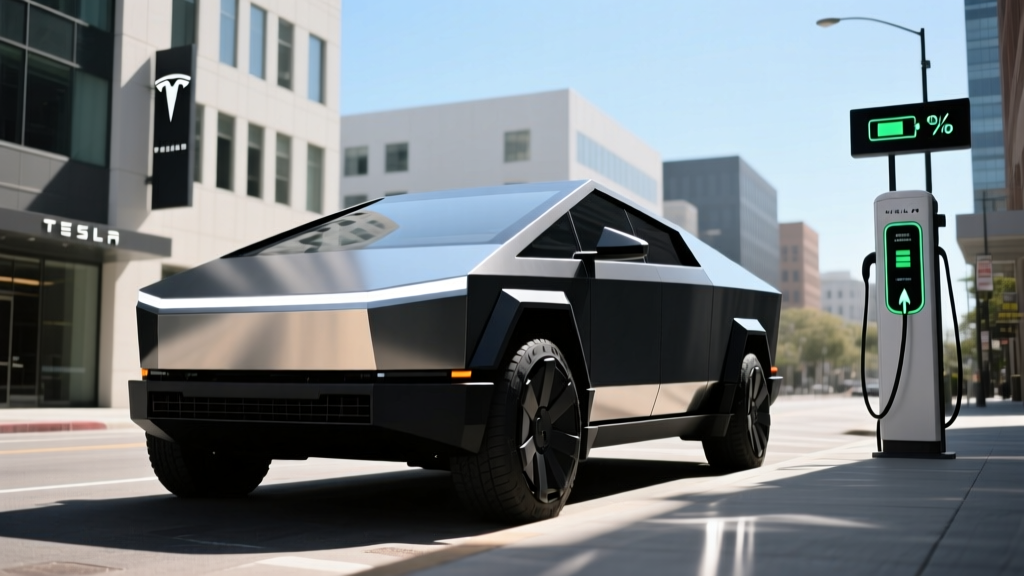
Every Tesla vehicle — including the 2026 Model Y, Model 3, Model S, Model X, and Cybertruck — ships without a front license plate bracket installed. Tesla includes the bracket in the trunk or glovebox at delivery, leaving it to the owner to mount it. In the 31 U.S. states that require a front plate, skipping this step can result in fines ranging from $25 to $200+ per ticket, making it one of the most common new-Tesla-owner surprises.
This guide pairs that practical ownership answer with a full technical review of the 2026 Tesla Model Y Long Range AWD — the highest-volume EV in America — covering range, charging speeds, battery chemistry, pricing after federal tax credits, and how it stacks up against the Hyundai Ioniq 5 and Ford Mustang Mach-E.
2026 Tesla Model Y: Core Specs at a Glance
| Spec | 2026 Model Y Long Range AWD |
|---|---|
| EPA Range | 320 miles |
| Battery (usable) | ~75 kWh, NMC (2170 cells) |
| Drivetrain | Dual-motor AWD |
| Horsepower | 384 hp (combined) |
| 0–60 mph | 4.8 seconds |
| Max DC Fast Charge | 250 kW peak |
| 10–80% DC Time | ~27 minutes |
| Level 2 Home Charge | 11.5 kW (~44 mi/hr) |
| MPGe (combined) | 111 MPGe |
| Efficiency | 30 kWh/100 mi |
| Cargo (rear seats up) | 30.2 cu ft |
| Cargo (rear seats folded) | 72.0 cu ft |
| Rear Legroom | 38.0 in |
| Frunk | 4.1 cu ft |
| Base MSRP | $46,630 (incl. destination) |
| Battery Warranty | 8 yr / 120,000 mi |
Source: fueleconomy.gov, Tesla spec sheets.
Real-World Range: What the EPA Sticker Doesn't Tell You
Tesla's efficiency advantage is real — 30 kWh/100 mi is among the best in the compact electric SUV segment — but physics still governs outcomes. The Model Y's heat pump (standard on all 2026 trims) mitigates cold-weather losses significantly compared to resistive heaters, typically limiting winter range drop to 15–25% rather than the 30–40% seen in older EVs. Preconditioning the battery via the Tesla app while plugged in is the single most impactful habit for preserving both range and charge speed in cold weather.
For a 300-mile road trip, most owners will need one 15–20 minute Supercharger stop if driving at highway speeds in moderate temperatures — a reality that aligns closely with Tesla's trip planner estimates when the battery is preconditioned.
Charging Speed: DC Fast, Level 2, and the Supercharger Advantage
| Charging Method | Power / Rate | Miles Added per Hour |
|---|---|---|
| Level 1 (120V household) | ~1.4 kW | ~4–5 mi/hr |
| Level 2 (240V, 48A Wall Connector) | 11.5 kW | ~44 mi/hr |
| DC Fast (Tesla Supercharger V3) | 250 kW peak | ~200 mi in 15 min |
| DC Fast (CCS adapter, 350 kW station) | ~250 kW peak | ~180 mi in 15 min |
The Model Y peaks at 250 kW on V3 Superchargers, but that peak is sustained only between roughly 10–30% state of charge. The charge curve tapers progressively: by 60% SoC, speed drops to ~120 kW, and above 80% it falls below 50 kW. This is standard for NMC chemistry and why Tesla's navigation routes you to arrive at chargers at low SoC — preconditioning the battery en route is automatic when a Supercharger is set as your destination.
Home charging with the Tesla Wall Connector at 48 amps adds roughly 44 miles per hour of charging — enough for most commuters to fully replenish overnight on a standard NEMA 14-50 outlet or hardwired 60A circuit. Installation typically costs $800–$2,000 depending on panel proximity and whether a 200A service upgrade is needed.
The Model Y uses the NACS (Tesla) connector natively. With the opening of Tesla's Supercharger network to non-Tesla EVs, the adapter ecosystem has matured, but Tesla owners still enjoy the most seamless plug-and-charge experience in the U.S. — no RFID cards, no app fumbling, just plug and walk away.
Pricing, Trims, and Federal Tax Credit Eligibility
| Trim | 2026 MSRP | Est. After §30D Credit |
|---|---|---|
| Long Range AWD | $46,630 | ~$39,130* |
| Performance | $52,130 | ~$44,630* |
*Assumes full $7,500 federal credit eligibility. Actual credit depends on buyer income, battery sourcing, and point-of-sale transfer rules.
The federal §30D EV tax credit offers up to $7,500, but eligibility is governed by three intersecting rules per IRS guidelines:
- MSRP cap: SUVs must be priced at or below $80,000 (all Model Y trims qualify).
- Income cap: Modified AGI must not exceed $150,000 (single), $225,000 (head of household), or $300,000 (joint).
- Battery sourcing: A percentage of critical minerals and battery components must be sourced from the U.S. or FTA partners — this threshold increases annually and has disqualified several competitors. Tesla's vertically integrated supply chain (including domestic cathode production) has kept the Model Y eligible for the full $7,500 through early 2026, but buyers should verify current eligibility at the point of sale, as rules tighten yearly.
Since 2024, the credit can be transferred to the dealer at point of sale, effectively reducing the purchase price by $7,500 on the spot — a meaningful cash-flow advantage over waiting for a tax refund.
Performance, Tech, and Interior Practicality
The dual-motor AWD Model Y delivers 384 hp and a 4.8-second 0–60 time — brisk enough to merge confidently at any speed and outpace most gas-powered compact SUVs off the line. The Performance trim drops that to 3.5 seconds with track-tuned suspension and larger brakes, though at a ~$5,500 premium and slight range reduction.
Standout tech features:
- 15.4-inch center touchscreen with integrated navigation, streaming, and gaming
- Over-the-air updates that add features post-purchase
- Autopilot (standard) — adaptive cruise + lane centering on highways
- Full Self-Driving (Supervised) — $8,000 option, still SAE Level 2 requiring active driver supervision
- Sentry Mode dashcam recording and remote climate via app
- Heat pump for efficient cabin heating in cold climates
Notable drawbacks:
- No physical buttons or stalks — turn signals are on the steering wheel (2025+ refresh), which draws polarized reviews
- Rear visibility is compromised by the sloping roofline; camera reliance is heavy
- Ride quality is firm, especially on 20-inch wheels — noticeable on rough pavement
- No Apple CarPlay or Android Auto — Tesla's ecosystem is closed
- Class-leading efficiency (30 kWh/100 mi)
- Best-in-class Supercharger network access
- Spacious cargo area (72 cu ft max)
- Strong OTA update cadence
- Full §30D credit eligibility (as of early 2026)
- No front plate bracket pre-installed
- Firm ride on larger wheels
- No CarPlay/Android Auto
- Steering-wheel turn signals (love/hate)
- FSD is Level 2, not autonomous — $8K is steep for supervised assist
Front License Plate: What Tesla Owners Need to Know
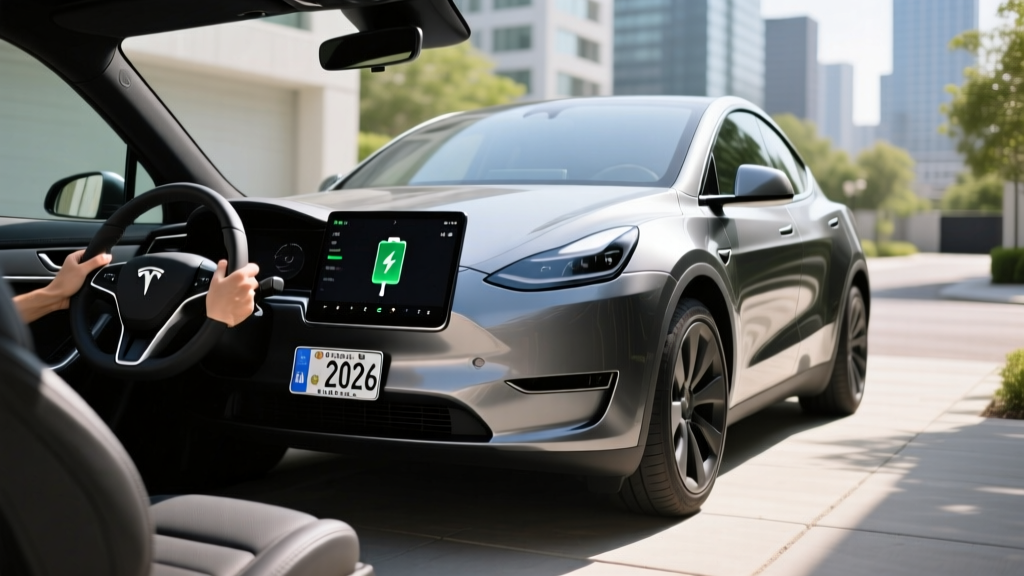
Tesla includes a front license plate mounting bracket in the vehicle at delivery — typically in the trunk or with your delivery paperwork. It is not installed at the factory. In the 31 states that require a front plate (including California, New York, Texas, Florida, Illinois, and Washington), you must install it yourself or have a body shop do it.
Installation options:
- OEM bracket + 3M tape or screws: Tesla's included bracket uses adhesive or self-tapping screws. Screw mounting requires drilling into the front bumper — a prospect that makes many new owners hesitant.
- No-drill adhesive mounts: Third-party solutions (e.g., Sto N Sho, EV Plate Mount) use industrial-strength adhesive pads rated for highway speeds, avoiding bumper penetration.
- Tow-hook mounts: Some aftermarket brackets attach to the front tow-hook receiver, keeping the bumper intact — but these can obstruct parking sensors and the front camera.
Risk of skipping it: In front-plate-required states, law enforcement can issue fix-it tickets or fines. Automated toll and HOV-lane cameras may also fail to read your plate, causing missed toll violations or HOV citations. The cost of a $15–$40 no-drill mount is trivial compared to repeated $100+ tickets.
Who Should Buy the 2026 Model Y?
Choose the Model Y if: You want the most proven EV ecosystem in the U.S., need 300+ miles of real-world range for road trips, value Supercharger reliability, and want a practical family SUV with strong cargo space. It's the default recommendation for first-time EV buyers who can charge at home.
Consider competitors if: You prefer physical controls and CarPlay (Hyundai Ioniq 5), want a softer ride (Ford Mustang Mach-E), or need 800V ultra-fast charging that outpaces Tesla's 250 kW peak (Ioniq 5 at 350 kW stations). The Ioniq 5 also starts ~$4,000 lower but may not qualify for the full §30D credit depending on sourcing.
For commuters covering 30–60 miles daily with home charging, any trim is more than sufficient. For families taking regular 200+ mile road trips, the Long Range AWD's 320-mile EPA rating and Supercharger network remain the lowest-friction option available in 2026. For towing (up to 3,500 lbs when equipped), expect range to drop 30–50% — plan charging stops accordingly.
Frequently Asked Questions
Does Tesla include a front license plate bracket?
Yes, Tesla includes the bracket in the trunk or with delivery documents, but it is not pre-installed. Owners in the 31 states requiring a front plate must mount it themselves to avoid fines.
What is the real-world range of the 2026 Model Y?
The EPA rates it at 320 miles. Real-world highway driving at 75 mph yields roughly 260–290 miles; cold-weather (sub-30°F) driving without preconditioning can drop to 220–250 miles. City driving with regen braking can meet or slightly exceed the EPA figure.
How fast does the Model Y charge at home and on the road?
On a Level 2 home charger (11.5 kW), it adds ~44 miles per hour — a full charge in about 7 hours. On a V3 Supercharger (250 kW peak), it charges 10–80% in approximately 27 minutes, adding up to 200 miles in 15 minutes under optimal conditions.
Does the 2026 Model Y qualify for the $7,500 federal tax credit?
As of early 2026, yes — the Model Y Long Range AWD and Performance trims fall under the $80,000 SUV MSRP cap. Buyer eligibility depends on income (≤$300K joint / $150K single) and battery-sourcing requirements that tighten annually. Verify current eligibility at point of sale per IRS §30D rules.
Is the Model Y worth buying over the Ioniq 5 or Mach-E?
The Model Y wins on charging-network reliability, efficiency, and cargo space. The Ioniq 5 offers 800V charging (faster at 350 kW stations), CarPlay, and a lower starting price. The Mach-E provides a softer ride and more traditional interior. For first-time EV buyers prioritizing infrastructure confidence, the Model Y remains the benchmark.
Is Tesla Autopilot or FSD self-driving?
No. Both Autopilot and Full Self-Driving (Supervised) are SAE Level 2 driver-assistance systems. The driver must remain fully engaged, hands on or near the wheel, and eyes on the road at all times. Tesla's camera-based system is capable but not autonomous — treat it as an advanced cruise-and-lane-centering aid, not a replacement for attention.