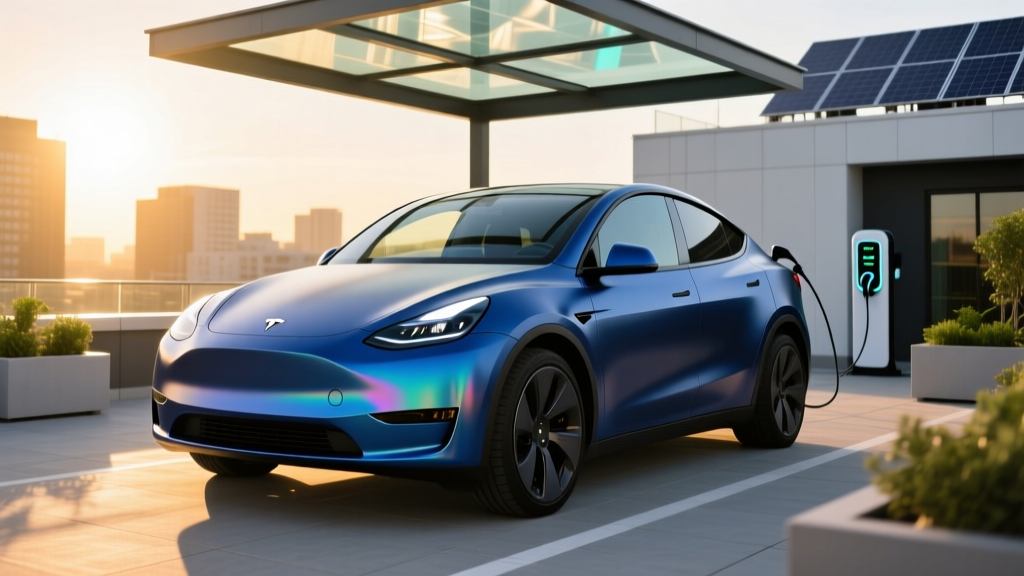
The Tesla Model Y remains the best-selling electric vehicle in the United States for good reason: it packages long range, fast charging, and a mature software ecosystem into a crossover footprint that fits most American driveways. But as the EV market has flooded with compelling alternatives from Hyundai, Ford, and Rivian, buyers need more than brand cachet to make a decision. This review dissects the features of Tesla's 2026 Model Y lineup with exact numbers — range, charging curves, interior dimensions, and tax-credit math — so you can weigh it against the competition on data, not hype.
For 2026, Tesla streamlined the Model Y into two primary trims: the Long Range AWD and the Performance AWD, following the discontinuation of the base RWD variant in late 2025. Both ride on the refreshed "Juniper" platform introduced in early 2025, which brought a revised interior, ventilated seats, ambient lighting, a rear touchscreen, and improved NVH (noise, vibration, harshness) isolation.
Range, Battery, and Real-World Efficiency
The 2026 Model Y Long Range AWD carries an EPA-estimated range of 320 miles from a 78.1 kWh usable NMC (nickel-manganese-cobalt) battery pack. The Performance trim drops slightly to 293 miles EPA due to stickier tires, sport tuning, and 21-inch wheels. Efficiency for the Long Range lands at 122 MPGe combined, translating to roughly 27 kWh per 100 miles — competitive but no longer class-leading against the Hyundai Ioniq 5's 114 MPGe (which achieves more miles from a smaller battery thanks to lighter weight).
The EPA's 320-mile figure assumes a mix of city and moderate-speed highway driving at mild temperatures. In our experience and consistent with independent testing:
- Highway (75 mph sustained): Expect 265–285 miles before needing a charge.
- Cold weather (below 30°F): Range drops 15–25%, yielding roughly 240–270 miles.
- City/regen-heavy driving: You can approach or slightly exceed the EPA number.
The Model Y's heat pump (standard since 2021) mitigates cold-weather cabin-heating losses better than many competitors, but battery chemistry still suffers in deep cold. Preconditioning the battery before fast charging is essential — the car does this automatically when a Supercharger is set as your navigation destination.
| Spec | Long Range AWD | Performance AWD |
|---|---|---|
| EPA Range | 320 miles | 293 miles |
| Battery (usable) | 78.1 kWh, NMC | 78.1 kWh, NMC |
| Efficiency | 122 MPGe / 27 kWh/100mi | 111 MPGe / 30 kWh/100mi |
| 0–60 mph | 4.8 seconds | 3.5 seconds |
| Horsepower | 384 hp | 456 hp |
| Drivetrain | Dual-motor AWD | Dual-motor AWD |
| Top Speed | 125 mph | 155 mph |
| Max DC Fast Charge | 250 kW | 250 kW |
| 10–80% DC Time | ~25 minutes | ~25 minutes |
| Level 2 Home Charge | 11.5 kW (~37 mi/hr) | 11.5 kW (~37 mi/hr) |
| Base MSRP | $44,990 | $48,990 |
Charging Speed: Supercharger Network and Home Setup
Tesla's charging advantage has always been twofold: the proprietary Supercharger network's reliability and the vehicle's ability to accept high charge rates consistently. The 2026 Model Y peaks at 250 kW on V3 Superchargers and can sustain roughly 150–175 kW through the bulk of the 10–80% window, completing that charge in approximately 25 minutes. Above 80%, the charge curve tapers sharply — a 10–100% session takes closer to 45 minutes, which is typical for NMC chemistry.
| Charging Level | Power | Miles Added per Hour | Typical Use Case |
|---|---|---|---|
| Level 1 (120V household) | ~1.4 kW | ~5 mi/hr | Emergency/overnight trickle |
| Level 2 (240V, Wall Connector) | 11.5 kW | ~37 mi/hr | Daily home charging |
| Level 2 (public, 48A) | ~9.6 kW | ~31 mi/hr | Workplace/destination |
| DC Fast (V3 Supercharger) | 250 kW peak | ~180 mi in 15 min | Road trips |
| DC Fast (CCS adapter, non-Tesla) | Up to 150–175 kW | Varies by station | Non-Tesla networks |
With the North American Charging Standard (NACS) now adopted by Ford, GM, Rivian, Hyundai, and others, Tesla's Supercharger network has become the de facto national fast-charging backbone. Model Y owners now share stalls with these vehicles, though Tesla has expanded stall counts to compensate. For home charging, the Tesla Wall Connector on a 60-amp circuit delivers the full 11.5 kW — enough to replenish a full day's driving in roughly two hours. Budget $500–$1,500 for a professional Level 2 installation depending on your panel capacity and run distance; a 200-amp panel upgrade can add $1,500–$3,000 if needed.
Performance and Driving Dynamics
The Long Range's dual-motor setup produces 384 horsepower and delivers a 4.8-second 0–60 mph time — genuinely quick for a family crossover. The Performance trim bumps output to 456 hp with a 3.5-second sprint, aided by a lowered sport suspension, larger brakes, and 21-inch Überturbine wheels. Both trims feature a low center of gravity from the floor-mounted battery pack, resulting in minimal body roll and confident cornering for the segment.
Ride quality on the 2026 Juniper refresh is noticeably improved over pre-2025 models. Tesla retuned the damping and added acoustic glass, reducing cabin noise at highway speeds. However, the Performance trim's 21-inch wheels and stiffer sidewalls still transmit sharper impacts — buyers prioritizing comfort should stick with the Long Range's 19- or 20-inch options.
Interior Space, Cargo, and Practicality
The Model Y's crossover form factor delivers 76.2 cubic feet of total cargo space with the second row folded — one of the most generous figures in the compact electric SUV class. Behind the second row, you get 30.2 cu ft, and the front trunk (frunk) adds another 4.1 cu ft for charging cables or a soft bag.
Passenger space is adequate but not segment-leading:
- Front headroom: 41.0 inches
- Front legroom: 41.8 inches
- Rear headroom: 39.4 inches
- Rear legroom: 40.5 inches
The 2025 Juniper update added ventilated front seats, a power-folding second row, ambient lighting, and a rear 8-inch touchscreen for climate and entertainment control — addressing longstanding complaints about rear-seat amenity. A third-row option (previously available for very small children) has been discontinued for 2026, simplifying the lineup.
Tech, Autopilot, and Software Features
Tesla's software remains a core differentiator. The 15.4-inch center touchscreen handles navigation, media, climate, vehicle settings, and even gaming (while parked). Over-the-air updates continuously add features — recent additions include adaptive headlights, improved dashcam recording, and enhanced trip planning with real-time stall availability.
Standard Basic Autopilot includes Traffic-Aware Cruise Control and Autosteer (lane centering), which together constitute an SAE Level 2 driver-assistance system. This means the driver must remain attentive with hands on or near the wheel at all times. Tesla's steering-wheel torque monitoring enforces engagement.
Tesla's optional Full Self-Driving (Supervised) software, currently priced at $8,000 or $99/month, adds automatic lane changes, traffic light/stop sign recognition, and city-street navigation. Despite the name, FSD remains an SAE Level 2 system — the driver is legally and practically responsible for all driving decisions. It does not replace an attentive human. For context, only Level 4 systems like Waymo's robotaxi service operate without a human driver in defined zones. Never treat FSD as autonomous.
Other standout tech features include:
- Sentry Mode: Cameras record surroundings when parked, with motion-triggered alerts.
- Dog Mode: Maintains cabin climate for pets with a display message for passersby.
- Vehicle-to-Load (V2L): The 2026 Model Y supports limited external power output via a Tesla adapter, useful for camping or emergency backup.
- Tesla app: Remote preconditioning, location tracking, service scheduling, and keyless entry.
Pricing, Tax Credits, and Ownership Cost
The 2026 Model Y Long Range AWD starts at $44,990 (including destination). The Performance trim begins at $48,990. Common add-ons — Ultra Red paint ($2,000), 20-inch wheels ($1,500), and FSD ($8,000) — can push an as-tested Long Range to $52,000–$56,000.
Federal tax credit eligibility under IRS §30D requires careful navigation:
- MSRP cap: SUVs/vans/pickups must have an MSRP at or below $80,000 — both Model Y trims qualify.
- Buyer income cap: Modified AGI must not exceed $150,000 (single), $225,000 (head of household), or $300,000 (joint filers).
- Battery sourcing: A percentage of critical minerals and battery components must be sourced from the U.S. or free-trade-agreement countries. Tesla has progressively shifted supply chains, but eligibility can change mid-year. Verify current status on fueleconomy.gov.
- Point-of-sale transfer: Eligible buyers can transfer the credit to the dealer at purchase, reducing the out-of-pocket price immediately.
| Trim | Base MSRP | Est. After $7,500 Credit* | Notes |
|---|---|---|---|
| Long Range AWD | $44,990 | ~$37,490 | Requires buyer/sourcing eligibility |
| Performance AWD | $48,990 | ~$41,490 | Requires buyer/sourcing eligibility |
*Credit eligibility is not guaranteed. Confirm current battery-sourcing compliance and your income qualification via IRS.gov or a tax professional before purchase.
On the ownership-cost side, Tesla's insurance arm offers competitive rates in many states, though third-party premiums can run 15–30% higher than equivalent gas crossovers due to repair costs. Maintenance is minimal — no oil changes, minimal brake wear thanks to regenerative braking — and electricity cost averages $0.13–$0.16/kWh nationally, translating to roughly $3.50–$4.30 per 100 miles versus $12–$15 for a 25-MPG gas crossover.
Warranty Coverage
Tesla provides:
- Basic Vehicle Warranty: 4 years / 50,000 miles
- Battery & Drive Unit Warranty: 8 years / 120,000 miles (Long Range & Performance), with a guaranteed minimum 70% capacity retention over the warranty period.
The 120,000-mile battery warranty is generous and reflects confidence in the NMC pack's longevity. Real-world data from Tesla's fleet suggests average degradation of roughly 10–12% at 100,000 miles, though individual results vary with charging habits. Avoid routinely charging to 100% (Tesla recommends 80% daily for NMC) and minimize DC fast-charging frequency to preserve long-term State of Health.
- Supercharger network access — most reliable DC fast-charging infrastructure in the U.S.
- 320-mile EPA range covers most commutes and road-trip legs comfortably
- 250 kW peak charging with strong sustained curve
- Class-leading cargo volume (76.2 cu ft)
- Mature OTA software with continuous feature updates
- Strong safety ratings (IIHS Top Safety Pick+)
- Touchscreen-only controls — no physical buttons for climate or volume
- FSD remains Level 2 despite its $8,000 price and "self-driving" name
- Performance trim ride quality is firm on rough roads
- Insurance premiums above segment average
- No third-row option for 2026
- Increasing competition from Ioniq 5, EV6, and Equinox EV on price
Who the Model Y Suits Best
Choose the Model Y Long Range if: You want a proven, spacious electric crossover with the most reliable fast-charging network, you commute 30–80 miles daily, and you road-trip several times a year. The 320-mile range and 25-minute 10–80% charge make it a genuine one-car household.
Choose the Model Y Performance if: You want sports-sedan acceleration in a practical package and accept a firmer ride and 27 fewer miles of range for the privilege.
Look elsewhere if: You want physical controls, a more affordable entry point (Chevrolet Equinox EV starts under $35K), or maximum rear-seat comfort for tall adults on long trips (the Hyundai Ioniq 5 and Kia EV6 offer more rear legroom).
Frequently Asked Questions
What is the real-world range of the 2026 Tesla Model Y?
The EPA rates the Long Range AWD at 320 miles. Real-world highway driving at 75 mph yields roughly 265–285 miles. In cold weather (below 30°F), expect 240–270 miles. City driving with regenerative braking can match or slightly exceed the EPA number.
How fast does the Model Y charge at home and on the road?
On a Tesla Wall Connector (Level 2, 11.5 kW), the Model Y adds approximately 37 miles of range per hour — a full overnight charge easily covers daily needs. On a V3 Supercharger, it peaks at 250 kW and charges from 10–80% in about 25 minutes, though charging slows significantly above 80%.
How much does the 2026 Model Y cost after the federal tax credit?
If you qualify for the full $7,500 §30D credit (income and battery-sourcing requirements met), the Long Range drops from $44,990 to approximately $37,490, and the Performance from $48,990 to approximately $41,490. The credit can be applied at the point of sale. Always verify current eligibility on IRS.gov before committing.
Does the Tesla Model Y qualify for the federal EV tax credit?
Both trims fall under the $80,000 MSRP cap for SUVs. Eligibility depends on your modified adjusted gross income (below $150K single / $300K joint), and the battery must meet critical-mineral and component sourcing thresholds that can change throughout the year. Check fueleconomy.gov for the most current status.
Is the Model Y worth buying vs. competitors in 2026?
The Model Y's Supercharger access, proven efficiency, and strong resale value remain compelling. However, the Hyundai Ioniq 5, Kia EV6, and Ford Mustang Mach-E now match or exceed it in areas like interior design, physical controls, and rear-seat space — often at lower prices. If charging-network reliability is your top priority, Tesla still leads. If you want the most interior refinement per dollar, test-drive the Korean alternatives.
What are the biggest pros and cons of owning a Model Y?
Pros: Supercharger network, 320-mile range, fast 250 kW charging, massive cargo space, continuous software updates, and strong safety ratings. Cons: touchscreen-only interface, FSD's misleading name vs. its Level 2 reality, firm ride on the Performance trim, higher insurance costs, and increasing price competition.